
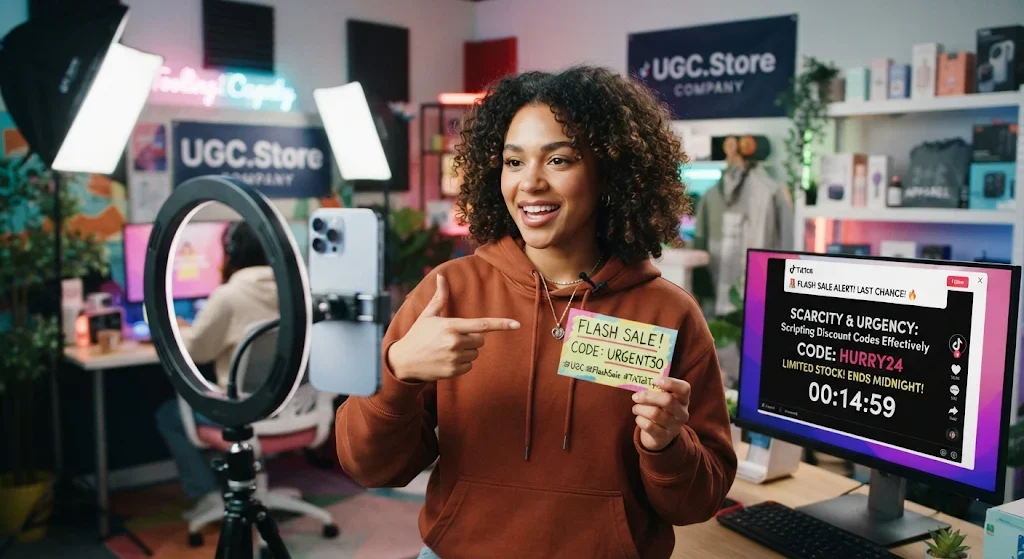
Executive Overview
The final three seconds of a TikTok UGC video are the most critical for driving revenue. It is the moment of decision. Brands frequently attempt to force this decision by deploying scarcity and urgency endings, screaming phrases like "Buy now!" or "Only 3 left!" However, this aggressive approach is a double-edged sword. While it can drive short-term spikes in clicks, it also triggers severe viewer skepticism and can destroy the authenticity painstakingly built throughout the rest of the video. The key to success is not abandoning scarcity and urgency, but executing them with psychological precision. By seamlessly integrating discount codes into the narrative rather than tacking them on as an afterthought, creators can drive immediate action without sounding like a late-night infomercial. This article breaks down the exact mechanics of scripting scarcity and urgency endings in TikTok UGC, detailing how to leverage exclusive discount codes, create genuine FOMO, and ensure your call to action converts without alienating your audience.
Theoretical Basis and Psychology of Mechanics
The psychology behind scarcity and urgency endings in TikTok UGC relies on loss aversion, the scarcity heuristic, and the paradox of choice. Understanding these cognitive biases is essential for scripting a compelling call to action.
The first mechanism is Loss Aversion. According to prospect theory, the pain of losing something is psychologically twice as powerful as the pleasure of gaining it. When a TikTok UGC script incorporates scarcity, it shifts the viewer's focus from the potential benefit of the product to the potential regret of missing out. A message like "I don't know how long this discount code will be active" frames the situation as a potential loss. The viewer is no longer just buying a product; they are avoiding the pain of paying full price later. This triggers the amygdala, compelling immediate action.
The second mechanism is the Scarcity Heuristic. The human brain uses mental shortcuts to evaluate value. One of the most powerful shortcuts is availability. If something is perceived as rare or limited, the brain automatically assigns it higher value. The scarcity and urgency endings must leverage this by emphasizing that the discount code or the product itself is not permanently available. "They only gave me five of these codes to share" makes the offer feel exclusive and highly valuable. The viewer perceives the code as a scarce resource that must be secured immediately.
The third mechanism is the Paradox of Choice. When faced with too many options or open-ended timelines, consumers often experience paralysis and fail to make a decision. Urgency endings solve this by shrinking the decision window. By explicitly stating that the discount code expires tonight, the script removes the option to "do it later." The brain can no longer defer the decision, and the friction of action is significantly reduced. The viewer is forced to choose: buy now at a discount, or lose the code.
The fourth mechanism is The Authenticity Buffer. The biggest danger of scarcity and urgency is that it can feel manufactured. If a creator sounds like a used car salesman, the viewer shuts down. To counter this, the script must use the Authenticity Buffer. The creator should frame the discount code as a favor to their audience, not a corporate promotion. "I fought to get you guys this code" or "Since you've supported me, I want to share this." The urgency is real because the creator's relationship with the brand is real. This maintains the trust of the TikTok UGC format while still driving immediate action.
Step-by-Step Algorithm & Methodology
To successfully script scarcity and urgency endings and integrate discount codes into TikTok UGC, you must structure the video to build value, create the transition to the offer, and deliver the deadline naturally.
Phase 1 — The Value Build (0–20 seconds). The first two-thirds of the video are entirely focused on the product's value. The creator demonstrates the benefits, solves a specific problem, and proves the effectiveness of the product. There is no mention of a sale, a code, or a discount. The focus is entirely on the transformation and the utility.
Example: The creator demonstrates how the software organizes their entire workflow and saves them hours.
Phase 2 — The Authentic Transition (20–25 seconds). The creator shifts the tone from demonstrating the product to addressing the viewer directly. The transition must feel natural, like a friend giving a tip, not a sudden corporate pitch. The creator acknowledges the viewer's interest before introducing the discount code.
Example: "I have had so many of you ask me about this since I posted it. I talked to the team, and I got you guys a deal."
Phase 3 — The Scarcity/Urgency Reveal (25–28 seconds). The creator reveals the discount code alongside a specific limitation. The limitation must be concrete. It is not just "limited time"; it is a specific deadline or a limited quantity.
Example: "The code is FIFTYOFF. But it only works for the next forty-eight hours, and they only gave me a limited number of uses."
Phase 4 — The Urgency CTA (28–30 seconds). The creator delivers the final call to action. The tone is urgent but not desperate. They direct the viewer to the link in the bio, emphasizing that action must be taken now to secure the deal.
Example: "The link is in the bio. Use the code before it expires. Do not miss it."
Ready-to-Use Working Templates & Scripts
Script One: The "48-Hour Warning" (Format: B2B SaaS UGC, 32 seconds).
Value Build (0-18s): Creator showing the clean dashboard of a SaaS app. "I used to spend three hours every morning on data entry. Now this software automates everything. It has completely changed my workflow."
Authentic Transition (18-24s): Creator leans into the camera. "A ton of you have been asking what I use, so I actually reached out to the team to see if I could get you guys a deal."
Scarcity/Urgency Reveal (24-28s): Creator shows a graphic on screen with the code. "They set up a code specifically for my audience. It is 'WORKSMART'. But they said it is only active for the next forty-eight hours."
Urgency CTA (28-32s): Creator points to the bio. "The link is in the bio. Grab the trial with the discount before the timer runs out."
Script Two: The "Limited Stock" (Format: E-commerce/Skincare UGC, 34 seconds).
Value Build (0-20s): Creator applying the serum. "My skin has not looked this clear in years. This stuff is literally magic in a bottle. It fixed my redness in a week."
Authentic Transition (20-25s): Creator holds the bottle. "Every time I post about this, my DMs are flooded. So I asked the brand for a hookup."
Scarcity/Urgency Reveal (25-30s): On-screen text appears: CODE: GLOW20. "They gave me a code for 20% off. But they are almost sold out of this batch. Once it is gone, it is gone."
Urgency CTA (30-34s): Creator points down. "Link is below. Use the code now before the stock runs out."
Script Three: The "Flash Sale" (Format: Fashion/Apparel UGC, 36 seconds).
Value Build (0-22s): Creator modeling the jacket. "I have been wearing this jacket every single day. It goes with everything, and it is the most comfortable thing I own."
Authentic Transition (22-28s): Creator takes the jacket off. "I know it is a little pricey, so I talked to the brand about doing something special for my followers."
Scarcity/Urgency Reveal (28-32s): On-screen text: FLASH SALE: 30% OFF. "They are running a flash sale for the next twenty-four hours. I am not sure if they will do it again."
Urgency CTA (32-36s): Creator points to the bio. "Link is in the bio. Get it while the sale is live."
Comparative Analysis Matrix
| Parameter | Aggressive Urgency UGC | Strategic Scarcity & Urgency UGC |
|---|---|---|
| Primary Focus | Closing the sale immediately | Providing a time-sensitive benefit |
| Tone | Desperate, pushy | Confident, helpful, exclusive |
| Trust Mechanism | Relies on pressure | Relies on the creator's relationship with the audience |
| Discount Code Integration | Bolted on at the end | Woven into the narrative as a favor |
| Ad Smell | High; feels like an infomercial | Low; feels like a VIP hookup |
| CTA | "Buy now or you will miss out" | "Use the code before it expires" |
| Friction Point | The Aggressive Urgency Failure | The Strategic Fix |
|---|---|---|
| Skepticism | The viewer assumes the scarcity is fake | The creator frames the offer as exclusive to the audience |
| Hostility | The aggressive pitch triggers reactance | The helpful tone lowers defense mechanisms |
| Forced Pitch | The urgency interrupts the narrative | The transition to the offer feels earned and natural |
| Benchmark Metric | Aggressive Urgency UGC | Strategic Scarcity UGC |
|---|---|---|
| Hook Rate (3-second) | 50–60% | 75–85% |
| 15-Second Hold Rate | 20–30% | 50–60% |
| CTA Click-Through Rate | 1–2% | 3–5% |
| CPA Variance | Baseline | 25–35% lower |
Real-World Case Study Breakdown
A B2B SaaS company selling a time-tracking app launched a TikTok UGC campaign with an aggressive urgency CTA. The video opened with a strong hook, but the final five seconds were a chaotic mess of flashing text and a screaming voiceover demanding, "Click the link and use the code NOW!" The three-second view rate was 35%, but the completion rate plummeted to 8%, and the CPA was unprofitable. The audience was instantly repelled by the sudden shift to a high-pressure sales pitch.
The strategic pivot adopted the Authentic Buffer framework. They hired a creator known for her calm, conversational style. The winning asset opened with the creator organizing her desk.
Value Build: "I used to spend my entire Friday trying to figure out where my time went. I was exhausted."
Authentic Transition: "A lot of you asked about the app on my screen. It's this time-tracking tool. I reached out to see if I could get you guys a deal."
Scarcity/Urgency Reveal: "They gave me a code for a free month of the premium version. The code is 'FRIDAY'. But it expires on Sunday night."
Urgency CTA: "Link is in the bio. Grab the free month before Sunday."
The campaign generated 1.3 million views. The completion rate jumped to 36%, and the CPA dropped by 42%. The comment section was filled with users thanking the creator for the discount. The governing insight: the brand was selling time-tracking software, but the buyer needed to feel like they were getting an exclusive hookup from a friend, not being cornered by a salesman.
Real-World Engineering & Creative Feedback
"The biggest mistake is faking the urgency. If you say 'only 3 left' and there are 3,000 left, you will lose all trust. The scarcity has to be real, or the audience will smell the ad instantly. The discount code is a gift, not a weapon." — Tasha Moreau, UGC Creator, 48K followers
"We stopped using aggressive countdown timers in our ads. They felt too pushy. We started using the creator's voice to emphasize the deadline. 'This code only works for the next 48 hours.' It feels more personal and less corporate." — Ben Achterberg, Head of User Acquisition, Cartwheel SaaS
"The 'Authenticity Buffer' is crucial. The creator has to frame the discount code as a favor to their audience. 'I fought to get you this' creates a parasocial bond. The viewer feels like they are part of an inner circle, which makes the urgency much more effective." — Priya Deshmukh, Creative Strategy Lead, Pixel & Pulse Agency
"The CTA has to be clear, but not panicked. If the creator sounds desperate, the viewer gets anxious. If the creator sounds helpful, the viewer feels guided. The tone is everything." — Marcus Lehto, Performance Marketing Director, Northline Interactive
"We almost cancelled a campaign because the initial CTR was low. We realized the videos were too aggressive. We asked the creators to soften the delivery and emphasize the exclusivity rather than the deadline. The CTR doubled." — Elena Vasquez, Brand Director, Mosaic SaaS
Production Self-Check Checklist
Value Build First — Is the first two-thirds of the video entirely focused on the product's value, without mentioning the discount?
Authentic Transition — Does the creator frame the discount as a favor or a hookup for their audience?
Specific Scarcity — Is the urgency tied to a specific deadline or limited quantity (e.g., 48 hours, 100 units)?
Clear Discount Code — Is the code displayed clearly on screen and spoken by the creator?
No Desperation — Does the creator avoid sounding desperate or pushy in the CTA?
Direct Link — Is the viewer directed clearly to the link in the bio?
Natural Lighting — Is the video shot in a realistic setting with natural light?
Conversational Tone — Does the creator speak in a relaxed, unscripted manner?
Text Legibility — Is the text overlay clear and highlighted?
Muted View Compatibility — Can the value proposition and the urgency be understood with the sound off?
Advanced FAQ
How do you create genuine urgency without sounding like a used car salesman?
You focus on the benefit of acting now, rather than the threat of missing out. A used car salesman threatens. A helpful friend informs. "I don't want you to pay full price, so use this code before it expires" is helpful. "Buy now before it's gone forever!" is a threat. The tone must be conversational and empathetic.
What is the biggest mistake brands make when using discount codes in TikTok UGC?
Giving a generic code that is available everywhere. If the code is "SAVE10" and it works on the brand's website for everyone, the viewer does not feel special. The code should feel exclusive to the creator. "My code is [Creator Name]" or "This link is the only place the code works." The exclusivity drives the conversion.
How does the strategy change for B2B enterprise versus B2C consumer products?
For B2B enterprise, the discount is often a free trial extension, a waived onboarding fee, or a consultation. The urgency is tied to the end of the quarter or a limited pilot program. For B2C consumer, the discount is a percentage off or free shipping. The urgency is tied to a flash sale or limited stock.
Should the creator show the discount code in the first 15 seconds?
No. The product value must be established first. If the code is shown too early, the viewer feels like they are being pitched a discount rather than a solution. The code should only be revealed in the final third of the video, after the value proposition has been fully proven.
What is the right measurement stack for scarcity and urgency UGC beyond CPI?
The primary metric is conversion rate, which should be significantly higher than standard UGC. The secondary metric is code redemption rate, which shows how many viewers actually used the discount. The third metric is comment sentiment, looking for comments like "Just used the code, thanks!" which indicates that the exclusive framing worked.
Custom Contextual Conclusion
Scarcity and urgency endings are powerful tools for driving immediate action in TikTok UGC, but they must be wielded with precision. They cannot be tacked onto the end of a video like an afterthought. They must be woven into the narrative as an exclusive hookup from a trusted friend. The brands that master this format understand that the viewer does not want to be pressured; they want to be invited. The value is the hook. The authentic transition is the proof. The discount code is the conversion.

Comments
I have been running UGC campaigns for a mid-sized fashion brand for about eight months, and our biggest struggle has always been the call to action. We would spend weeks perfecting the creative, getting the creator to nail the storytelling, and building genuine excitement for the product. Then, we would slap a loud, flashing countdown timer and a "BUY NOW" graphic at the end of the video, and watch our conversion rates flatline. It felt like we were self-sabotaging. Reading this article on scarcity and urgency endings was a massive lightbulb moment for me. The concept of the "Authenticity Buffer" is exactly what we were missing. We were treating the discount code like a corporate promotion, not like a personal favor from the creator to their community. For our latest drop, we completely changed our approach. We had the creator finish her styling video, lean into the camera, and say, "I know this collection is a bit of a splurge, so I actually bugged the brand until they gave me a code just for you guys. It's 'SARAH20', but it expires tomorrow night." We didn't use a single flashing graphic. The result was staggering. Our click-through rate more than doubled, and the code redemption rate was the highest we have ever seen. The comments were full of people thanking her for the discount, rather than feeling pitched to. The insight about shifting the focus from the threat of missing out to the benefit of acting now completely changed the tone of our campaigns. This is the most actionable advice on driving conversions without ruining brand trust that I have ever read.