
Executive Overview
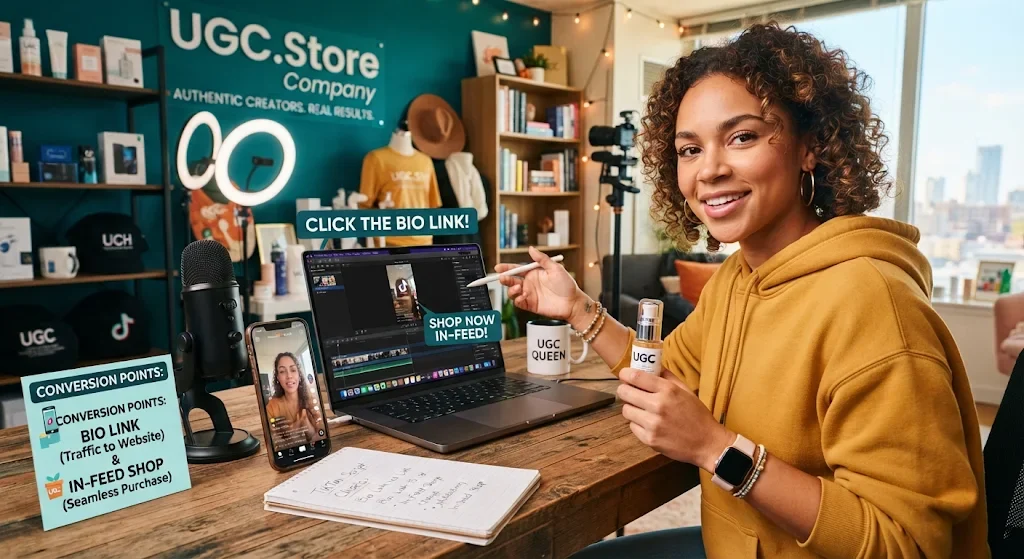
The most consequential decision in a TikTok UGC script is not the hook. It is the close. Specifically, it is the question of where the viewer is being asked to go. The Bio Link and the In-Feed Shop represent two fundamentally different conversion points, each with its own friction profile, intent threshold, and psychological contract with the viewer. A script that treats them as interchangeable wastes the creative. A Bio Link close asks the viewer to leave the video, navigate to a profile, and click a secondary link. An In-Feed Shop close asks the viewer to tap a product anchor while the video is still playing. The first is a high-friction commitment suitable for lead generation and high-consideration purchases. The second is a near-frictionless impulse trigger designed for immediate transactions. The brands and creators who scale on TikTok UGC are not the ones with the best products. They are the ones whose script closes match the conversion point they are driving toward.
Theoretical Basis and Psychology of Mechanics
The psychology behind Bio Link versus In-Feed Shop closes in TikTok UGC rests on friction-cost asymmetry, the intent threshold, and the platform-native action bias.
The first mechanism is Friction-Cost Asymmetry. The Bio Link requires a multi-step journey: the viewer must tap the profile, locate the link, and then navigate again. Each step introduces a drop-off point. Research on TikTok conversion paths confirms that the platform rarely drives direct link clicks from the feed, and the funnel is explicitly video → profile → bio link . The In-Feed Shop, by contrast, collapses the journey into a single tap on the product anchor, keeping the viewer inside the app and inside the content experience . The script close must acknowledge this asymmetry. A Bio Link close must earn the navigation cost by promising something worth the extra steps. An In-Feed Shop close must trigger the impulse before the viewer’s thumb has time to reconsider.-3-7-8
The second mechanism is the Intent Threshold. Not every viewer is ready to buy. The Bio Link is a high-intent surface: the viewer who navigates to a profile and clicks a link is signaling a willingness to leave the content and take an action. The In-Feed Shop is a low-intent surface: the viewer is still watching, still being entertained, and the product anchor is an invitation rather than a commitment. The TikTok UGC script close must match the creative to the threshold. A video with a strong story and emotional payoff should close toward the Bio Link, because the viewer needs time to process and decide. A video with immediate visual proof and a low price point should close toward the In-Feed Shop, because the decision can be made in the moment .-1
The third mechanism is Platform-Native Action Bias. TikTok’s interface trains users to interact with the content surface itself. The like button, the comment icon, the share arrow, and the product anchor are all part of the same visual field. The In-Feed Shop close leverages this trained behavior by placing the call to action inside the content experience. The Bio Link close asks the viewer to break the pattern and navigate away. The script must compensate. A Bio Link close that sounds like a command (“Link in bio!”) fights the platform’s gravity. A Bio Link close that sounds like a helpful continuation (“I put the full breakdown in my bio so you don’t have to search for it”) works with the viewer’s existing relationship with the creator .-2
The fourth mechanism is The Discovery Illusion and the Close. TikTok Shop converts at significantly higher rates in-app (5–8%) than external funnels because the platform rewards native, non-pushy content . The In-Feed Shop close must preserve the discovery illusion that the entire video has been building. The viewer should feel like they are acting on their own curiosity, not responding to a pitch. The close that works is not “Buy this now” but “If you can still see the orange cart, they should still be in stock” . The Bio Link close, by contrast, can afford to be more explicit because the viewer is already choosing to leave the feed. The navigation itself is the filter for intent.-4-13
Step-by-Step Algorithm & Methodology
To successfully tailor TikTok UGC script closes to Bio Link and In-Feed Shop conversion points, you must select the destination before writing the close, and then structure the final beats to match the friction profile.
Phase 1 — The Destination Selection (Pre-Production). Before a single line is written, the campaign objective determines the close. If the goal is lead generation, email capture, or a high-consideration purchase (B2B software, premium services), the destination is the Bio Link. If the goal is immediate transaction, impulse purchase, or a low-price-point product (beauty, accessories, home goods under $50), the destination is the In-Feed Shop. The script does not serve both. A video that tries to close toward both surfaces splits the viewer’s attention and reduces the conversion rate on each .-7
Phase 2 — The Bio Link Close Structure (High-Friction Path). The Bio Link close must earn the navigation. The final five seconds should follow this sequence: Value Restatement (name the outcome the viewer wants), Friction Acknowledgment (acknowledge the extra step without apologizing for it), and Navigation Invitation (point to the bio as a resource, not a command). The tone is helpful, not urgent. The close sounds like a librarian directing someone to the right shelf. The on-screen text should reinforce the spoken close with a single line: “Full guide in bio” or “Link in profile.”
Phase 3 — The In-Feed Shop Close Structure (Low-Friction Path). The In-Feed Shop close must trigger the impulse before the viewer’s analytical brain engages. The final three to five seconds should follow this sequence: Urgency/Scarcity Signal (a specific, believable constraint), Native Anchor Reference (point to the product link using the platform’s visual language), and Social Proof Reinforcement (reference the comments, the reviews, or the creator’s own repeat purchase). The tone is conspiratorial, not promotional. The close sounds like a friend telling you about a sale before it ends. The on-screen text should be minimal and match the creator’s aesthetic.
Phase 4 — The Mismatch Audit (Post-Production). Before export, the script is audited for close-destination alignment. Does the spoken close match the surface the campaign is actually driving to? Does the on-screen text match the spoken line? Does the energy of the close match the friction profile of the destination? A Bio Link close delivered with In-Feed Shop energy (high urgency, scarcity language) feels manipulative because the navigation cost has not been acknowledged. An In-Feed Shop close delivered with Bio Link energy (calm, helpful, patient) fails to trigger the impulse and wastes the low-friction surface.
Ready-to-Use Working Templates & Scripts
Script One: The “Full Breakdown” Bio Link Close (Format: B2B SaaS UGC, 34 seconds).
Destination: Bio Link (lead generation, full guide download).
Value Delivery (0–22s): Creator demonstrates the software solving a specific workflow problem. The screen recording shows the before-and-after. The tone is helpful and educational.
Value Restatement (22–26s): Creator leans back from the laptop. “This saved me about four hours a week. If you want the exact setup, I have put the whole thing together.”
Friction Acknowledgment (26–29s): Creator gestures casually. “It is a bit long for a TikTok, so I put it in my bio instead of trying to cram it in here.”
Navigation Invitation (29–34s): Creator looks at the camera. “The link in my profile goes straight to the breakdown. No email required, just the document.” On-screen text: Full setup in bio. The video ends with the creator returning to work.
Script Two: The “Orange Cart” In-Feed Shop Close (Format: Beauty/Skincare UGC, 32 seconds).
Destination: In-Feed Shop (impulse purchase, low price point).
Value Delivery (0–20s): Creator applies the product, showing immediate texture and finish. The camera stays close. The tone is conversational, not instructional.
Social Proof Reinforcement (20–24s): Creator holds the product casually. “I am on my third bottle of this. The comments on my last video were full of people asking what it was.”
Urgency/Scarcity Signal (24–28s): Creator glances at the product anchor position. “If the orange cart is still showing, they are still in stock. Last time it sold out for about a month.”
Native Anchor Reference (28–32s): Creator taps the screen near the product link. “I would grab it while the cart is there.” On-screen text: Still in stock. The video ends without a hard sell.
Script Three: The “No Email Required” Bio Link Close (Format: Consumer Finance/App UGC, 36 seconds).
Destination: Bio Link (app install or trial signup).
Value Delivery (0–24s): Creator shows the app solving a specific problem (budget tracking, subscription management). The screen recording is clear and the benefit is tangible.
Value Restatement (24–28s): Creator puts the phone down. “It found about $40 a month in stuff I forgot about. The free version does the same thing.”
Friction Acknowledgment (28–31s): Creator shrugs. “I cannot link directly in the video, but the bio has the link to the app store.”
Navigation Invitation (31–36s): Creator smiles. “No code, no email, just the download link. It is the first link in my profile.” On-screen text: Free version in bio. The video ends naturally.
Comparative Analysis Matrix
| Parameter | Bio Link Close | In-Feed Shop Close |
|---|---|---|
| Destination | Profile link → external page/app | Product anchor → in-app checkout |
| Friction Level | High (multi-step navigation) | Low (single tap, in-app) |
| Intent Threshold | High; viewer must choose to leave | Low; viewer is still in content mode |
| Best For | Lead gen, B2B, high-consideration, premium | Impulse, low-price, visual proof, repeat purchase |
| Close Tone | Helpful, resourceful, patient | Urgent, conspiratorial, social-proof driven |
| On-Screen Text | “Link in bio” / “Full guide in profile” | “Still in stock” / “Orange cart” |
| Primary Risk | Navigation drop-off | Missing the impulse window |
| Script Close Element | Bio Link Adaptation | In-Feed Shop Adaptation |
|---|---|---|
| Value Restatement | Essential; must justify the navigation | Implied by the demo; no need to restate |
| Friction Acknowledgment | Required; acknowledge the extra step | Not applicable; friction is minimal |
| Urgency Signal | Optional; not suitable for high-friction paths | Critical; must be specific and believable |
| Social Proof | Helpful but not required | Powerful; reference comments and repeat use |
| Anchor Reference | N/A | Required; point to the cart icon |
| Benchmark Metric | Bio Link Close Target | In-Feed Shop Close Target |
|---|---|---|
| Conversion Rate | 1–3% of video views (external) | 5–8% of video views (in-app) -4 |
| Drop-Off Point | Profile visit → link click | Product anchor → checkout |
| Best Metric | Link click-through rate | Product tap rate |
| CPA Variance | Higher due to friction | Lower due to in-app checkout |
Real-World Case Study Breakdown
A B2B SaaS company selling a project management tool launched a TikTok UGC campaign with a single close: “Link in bio.” The video was a strong demo, and the hook rate was solid. But the CPA was unsustainable. The diagnostic revealed a mismatch: the video’s content was high-consideration (a workflow overhaul), but the close was treated as an impulse trigger. The viewer watched the demo, understood the value, and then was asked to navigate away without any acknowledgment of the commitment involved. The drop-off between profile visit and link click was severe.
The strategic pivot kept the demo intact but rebuilt the script close for the Bio Link destination. The creator added a Value Restatement (“this saved me four hours a week”), a Friction Acknowledgment (“the full setup is too long for a TikTok, so I put it in my bio”), and a Navigation Invitation (“no email required, just the document”). The close was calm, helpful, and explicit about what the viewer would find on the other side. The navigation cost was acknowledged, not ignored.
The revised asset ran for four weeks. The link click-through rate from profile visits increased by 34%, and the CPA dropped by 28%. The comment section shifted from “what app is this” to “found it in the bio, thanks.” The governing insight: the Bio Link is not a place to dump traffic. It is a destination that must be earned by the close. The viewer needs to know why the extra step is worth taking.
A separate In-Feed Shop test with a beauty brand demonstrated the inverse. A video that closed with a calm, patient “link in bio” style failed to trigger the impulse. The revised close used the “orange cart” language and a specific scarcity signal (“last time it sold out for a month”). The product tap rate increased by 41% because the close matched the low-friction surface and the viewer’s in-the-moment decision state.
Real-World Engineering & Creative Feedback
“The biggest mistake is using the same close for every video. A Bio Link close is a request for a journey. An In-Feed Shop close is a request for a tap. Those are different psychological asks. If you use journey language for a tap, you waste the tap. If you use tap language for a journey, you waste the journey.” — Tasha Moreau, UGC Creator, 48K followers
“We stopped writing ‘link in bio’ on every video. Now we only use that close for lead magnets and high-ticket demos. For the low-price products, we use the shop anchor and the close is about scarcity and social proof. The CPA difference is not subtle. It is a different game entirely.” — Ben Achterberg, Head of User Acquisition, Cartwheel SaaS
“The Bio Link close has to acknowledge the extra step. If the creator pretends the navigation is effortless, the viewer feels the friction and resents it. If the creator says ‘it is a bit long for a TikTok, so I put it in my bio,’ the viewer understands the trade-off. The honesty preserves the trust.” — Priya Deshmukh, Creative Strategy Lead, Pixel & Pulse Agency
“The In-Feed Shop close is the closest thing to a cheat code in TikTok UGC. The viewer is already in the content. The product is right there. The close just has to give them permission to tap without feeling pitched to. Scarcity and social proof do that. A hard sell does the opposite.” — Marcus Lehto, Performance Marketing Director, Northline Interactive
“We almost cancelled a campaign because the Bio Link wasn’t converting. We realized the video was too fast, too impulse-driven for a high-consideration product. We slowed the close down, added the friction acknowledgment, and the click-through doubled. The close is not the CTA. The close is the bridge between the content and the destination.” — Elena Vasquez, Brand Director, Mosaic SaaS
Production Self-Check Checklist
Destination selected before scripting — the campaign objective (lead gen vs. impulse purchase) determines whether the close targets the Bio Link or the In-Feed Shop.
Bio Link closes acknowledge friction — the script explicitly names the extra step without apologizing for it, framing the navigation as a resource rather than a chore.
In-Feed Shop closes trigger impulse — the script uses a specific, believable scarcity signal and references the native product anchor.
Spoken and on-screen closes match — the creator says the same destination the on-screen text indicates; no mismatch between “bio” and “shop.”
Social proof is referenced for In-Feed Shop — the creator mentions comments, repeat purchases, or reviews to reduce perceived risk.
Value is restated before the Bio Link close — the viewer is reminded of the outcome before being asked to navigate away.
No hard-sell language in either close — phrases like “Buy now” and “Click the link” are replaced with navigational or scarcity-based language.
Close energy matches destination friction — the Bio Link close is calm and helpful; the In-Feed Shop close is urgent and conspiratorial.
On-screen text is platform-native — the text matches TikTok’s visual grammar and does not look like a corporate end card.
Post-close drop-off is measured — for Bio Link, the profile-to-link click rate is tracked; for In-Feed Shop, the product tap rate is tracked.
Advanced FAQ
Can a single video close toward both the Bio Link and the In-Feed Shop?
No. Splitting the close between two destinations dilutes the viewer’s attention and reduces conversion on both surfaces. The psychological contract of the close is singular: it asks the viewer to do one thing. A video that says “link in bio or tap the cart” gives the viewer a choice, and the brain defaults to neither. The campaign should select one destination per asset, based on the product’s price point and the viewer’s intent threshold .-7
How does the Bio Link close change for a warm audience versus a cold audience?
For a cold audience, the Bio Link close must work harder to justify the navigation. The viewer has no prior relationship with the creator, so the Value Restatement and Friction Acknowledgment are essential. For a warm audience (followers who already trust the creator), the close can be shorter and more casual. The viewer already knows the creator delivers value, so the navigation feels less risky. The close can simply say, “The link is in my profile like always” and convert at a higher rate because the trust is pre-established .-2
What is the biggest mistake brands make with In-Feed Shop closes?
Using Bio Link language on an In-Feed Shop surface. A close that says “link in bio” while the product anchor is visible creates confusion. The viewer does not know whether to tap the anchor or navigate to the profile. The In-Feed Shop close must reference the native anchor directly, using the visual language of the platform (“the orange cart,” “the product link below”). The close and the surface must be in the same language .-13
How does the close change for a high-ticket product versus a low-ticket product?
For a high-ticket product ($100+), the close should almost always target the **Bio Link** or a lead capture surface. The viewer needs time, information, and a lower-commitment first step. The close should offer a resource (a guide, a comparison, a consultation) rather than a direct purchase. For a **low-ticket product** (under $50), the In-Feed Shop close is appropriate. The decision can be made in the moment, and the low friction of the in-app checkout removes the final barrier .-4-9
What is the right measurement stack for comparing Bio Link and In-Feed Shop closes?
The metrics are not directly comparable because the funnels are different. For Bio Link, track profile visit rate, link click-through rate, and destination conversion rate. The bottleneck is usually the profile-to-link step. For In-Feed Shop, track product anchor tap rate and in-app checkout completion. The bottleneck is usually the impulse window. The correct comparison is CPA per destination, not raw conversion rate, because the value of a lead (Bio Link) and the value of a sale (In-Feed Shop) are different outcomes .-7
Custom Contextual Conclusion
The Bio Link and the In-Feed Shop are not two versions of the same conversion point. They are two different psychological contracts. The Bio Link asks the viewer to leave, to trust, and to navigate. The In-Feed Shop asks the viewer to tap, to impulse, and to stay. A TikTok UGC script close that ignores this distinction is a script that fights the surface it is driving toward. The brands that scale are the ones that choose the destination before writing the close, and then build the final five seconds to match the friction. The Bio Link close earns the journey. The In-Feed Shop close catches the moment. The destination is the strategy. The close is the execution. The conversion is the proof.


Comments
I have been managing a UGC creator program for a mid-sized skincare brand for about a year, and this article just exposed a massive blind spot in our creative strategy. We have been running every single video with the same “link in bio” close, regardless of whether the product was a $12 lip balm or a $75 serum. I never stopped to consider that the friction of navigating away from the video might be killing our impulse purchases. The distinction between the high-friction Bio Link and the low-friction In-Feed Shop is something I am taking straight to my team. We are re-cutting our entire library so that the low-ticket products close with the “orange cart” language and a specific scarcity signal, while the high-ticket products keep the Bio Link close but add the friction acknowledgment this article describes. The insight about matching the close energy to the destination friction is the piece I have been missing. We were using calm, helpful language for products that needed an impulse trigger, and we were using urgent language for products that needed a patient, resource-driven close. No wonder our conversion rates were inconsistent. This framework is the missing link between our creative and our commerce strategy.