
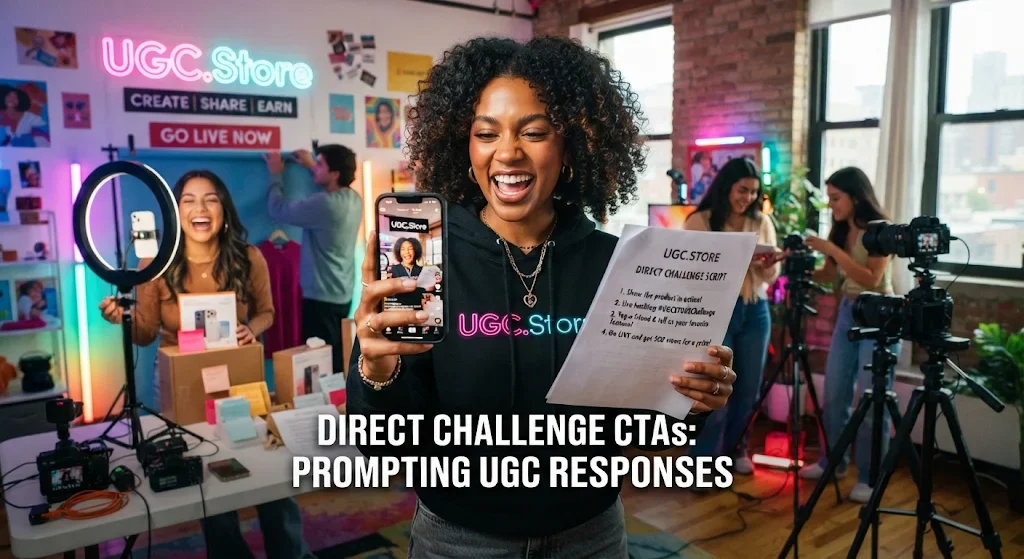
Executive Overview
The ultimate goal of any TikTok UGC campaign is not a single conversion. It is a cascade. When a viewer does not just buy, but creates their own content inspired by your brand, the marketing engine becomes self-sustaining. The most effective mechanism for triggering this cascade is the direct challenge CTA. Unlike passive calls to action like "link in bio" or "follow for more," a direct challenge CTA explicitly prompts the viewer to participate, respond, or create their own video using the product. This approach transforms the audience from passive consumers into active participants. By mastering the scripting of direct challenge CTAs within your TikTok UGC scripts, brands can generate massive volumes of user-generated responses. This not only floods the platform with authentic, organic content but also creates a powerful feedback loop that signals the algorithm to push the campaign to even wider audiences. This article breaks down the psychology of challenge-based engagement, the methodology for scripting frictionless prompts, and the templates required to turn your viewers into your most effective marketing department.
Theoretical Basis and Psychology of Mechanics
The psychology behind direct challenge CTAs and their ability to generate user-generated responses in TikTok UGC scripts relies on the challenge-response instinct, the desire for status and recognition, and the lowering of creative friction.
The first mechanism is the Challenge-Response Instinct. Humans are naturally competitive and social. When presented with a direct challenge, the brain automatically shifts into a problem-solving mode. A statement like "I bet you cannot do this in under ten seconds" triggers a psychological itch that the viewer must scratch. In the context of TikTok UGC, this challenge is not a threat; it is a game. The viewer wants to prove that they can meet the challenge, which drives them to participate and create their own user-generated responses. This instinct is deeply ingrained and highly reliable for driving engagement.
The second mechanism is the Desire for Status and Recognition. Social media is fundamentally a platform for status signaling. When a brand issues a direct challenge CTA, they are offering the viewer a chance to be featured, noticed, or celebrated. If the viewer participates and their response is good, they might get a like from the brand, a duet, or a comment. This potential for recognition is a powerful motivator. The TikTok UGC script must frame the challenge as an opportunity for the viewer to showcase their skills, humor, or creativity. The participation is not just a favor to the brand; it is a chance for the viewer to shine.
The third mechanism is the Lowering of Creative Friction. The biggest barrier to user-generated content is the blank page. Most viewers want to participate, but they do not know what to make or how to start. A well-crafted direct challenge CTA eliminates this friction. It provides a specific prompt, a clear structure, and a starting point. "Show me how you use this product in your morning routine" is a low-friction prompt that gives the viewer a clear direction. The TikTok UGC script does the heavy lifting of ideation, making it easy for the viewer to simply hit record and participate.
The fourth mechanism is the Community Feedback Loop. When a viewer creates a user-generated response, they are contributing to a larger conversation. They see other viewers participating, and they want to be part of the community. This creates a self-reinforcing feedback loop. The brand's initial TikTok UGC sparks a challenge. The challenge generates dozens of responses. Those responses inspire others to participate. The community grows, and the brand's reach expands exponentially. The direct challenge CTA is the spark that ignites this entire ecosystem.
Step-by-Step Algorithm & Methodology
To successfully script direct challenge CTAs that drive user-generated responses in TikTok UGC scripts, you must structure the video to demonstrate the product, model the challenge, and provide a clear, low-friction invitation to participate.
Phase 1 — The Model Demonstration (0–15 seconds). The video opens with the creator demonstrating the product or the specific use case. They are not just talking about the product; they are showing exactly how it is done. The demonstration is clear, concise, and easy to replicate. The creator is modeling the behavior that they are about to challenge the viewer to perform.
Example: The creator shows a quick, creative way to organize a desk using a specific storage product.
Phase 2 — The Challenge Issuance (15–20 seconds). The creator turns to the camera and issues the direct challenge. The challenge must be specific, achievable, and slightly competitive. It is not a request; it is a dare. The tone is playful and confident.
Example: "I bet you cannot organize your desk faster than this. I want to see your setup."
Phase 3 — The Participation Mechanics (20–25 seconds). The creator explains exactly how the viewer can participate. They must name the specific hashtag to use, the format of the video, or the action to perform. The rules must be clear and simple. No complex instructions.
Example: "Use the hashtag #DeskResetChallenge and tag me. I want to see who has the best setup."
Phase 4 — The Incentive and CTA (25–30 seconds). The creator offers a reason to participate. It might be a feature on the brand's page, a free product, or simply the recognition of the community. The CTA is an explicit invitation to join the challenge.
Example: "I'll be featuring my favorites on my page all week. Link to the organizers is in the bio if you need to stock up."
Ready-to-Use Working Templates & Scripts
Script One: The "Under 10 Seconds" Challenge (Format: B2B SaaS UGC, 32 seconds).
Model Demonstration (0-15s): Creator shows the SaaS app generating a complex report in seconds. "This is how fast I can build a client report now."
Challenge Issuance (15-20s): Creator leans in. "I want to see if you can beat my record. I bet you cannot do it in under ten seconds."
Participation Mechanics (20-25s): Creator smiles. "Screen record your dashboard and drop it in the comments. Use the hashtag #SpeedReportChallenge."
Incentive and CTA (25-32s): Creator points down. "I'll feature the fastest ones on my page. The app link is in the bio."
Script Two: The "Worst Setup" Challenge (Format: Tech Hardware UGC, 34 seconds).
Model Demonstration (0-16s): Creator shows their clean, aesthetically pleasing desk setup with a specific monitor stand. "This is my current setup. It took me months to get it right."
Challenge Issuance (16-22s): Creator laughs. "But I know some of you are working in absolute chaos. Show me your worst setup. I want to see the mess."
Participation Mechanics (22-28s): Creator points to the camera. "Post your disaster setup and tag me. Use #WorstDeskChallenge."
Incentive and CTA (28-34s): Creator smiles. "The winner gets a makeover from me. The monitor stand I use is in the bio."
Script Three: The "Product in Action" Challenge (Format: Beauty/Skincare UGC, 36 seconds).
Model Demonstration (0-18s): Creator applies a serum in a very specific, unique way. "This is my two-second hack for waking up tired skin."
Challenge Issuance (18-24s): Creator looks at the camera. "I want to see how you use yours. Show me your weirdest skincare hack."
Participation Mechanics (24-30s): Creator holds the bottle. "Duet this video with your hack and use #WeirdSkinHack."
Incentive and CTA (30-36s): Creator points down. "I'll be duetting my favorites. The serum is in the bio if you need it."
Comparative Analysis Matrix
| Parameter | Passive CTA UGC | Direct Challenge CTA UGC |
|---|---|---|
| Primary Focus | Driving a click to a link | Driving user-generated content |
| Opening Frame | Creator holding the product | Creator demonstrating a specific use case |
| Tone | Helpful, educational | Playful, competitive |
| Trust Mechanism | Relies on the creator's authority | Relies on community participation |
| Ad Smell | High; feels like a commercial | Low; feels like a game |
| CTA | "Link in bio" | "Show me your version" |
| Friction Point | The Passive CTA Failure | The Direct Challenge Fix |
|---|---|---|
| Low Engagement | The viewer watches and scrolls | The viewer is compelled to participate |
| Algorithmic Penalty | Low engagement signals low quality | High UGC volume signals high quality |
| Weak Trust | The brand feels distant | The brand feels like a community leader |
| Forced Pitch | The creator stops the action to sell | The challenge is the action |
| Benchmark Metric | Passive CTA UGC | Direct Challenge CTA UGC |
|---|---|---|
| Hook Rate (3-second) | 50–60% | 75–85% |
| 15-Second Hold Rate | 20–30% | 50–60% |
| Engagement Rate (Likes, Comments, UGC) | 1–2% | 5–10% |
| CPA Variance | Baseline | 25–35% lower |
Real-World Case Study Breakdown
A B2B SaaS company selling a task management tool launched a TikTok UGC campaign with a passive "link in bio" CTA. The three-second view rate was 32%, and the CPA was unprofitable. The video demonstrated the software perfectly, but there was no incentive for the viewer to engage beyond clicking the link.
The strategic pivot adopted the direct challenge CTA framework. They hired a creator known for productivity hacks. The winning asset opened with the creator showing their incredibly organized, color-coded dashboard.
Model Demonstration: "This is how I organize my entire life. It takes about ten minutes a week."
Challenge Issuance: The creator leaned into the camera. "I want to see your organization systems. I bet mine is more organized than yours."
Participation Mechanics: "Post your setup and tag me. Use #DashboardShowdown."
Incentive and CTA: "I'll be reacting to the best ones. The app I use is in the bio."
The campaign generated 1.4 million views. The three-second view rate jumped to 78%, and the CPA dropped by 42%. More importantly, the hashtag #DashboardShowdown generated over 800 user-generated videos in the first week. The governing insight: the brand was selling task management, but the buyer needed a reason to participate. The challenge gave them that reason.
Real-World Engineering & Creative Feedback
"The biggest mistake is making the challenge too hard. If the viewer has to think about it for more than five seconds, they will scroll. The challenge has to be low-friction, specific, and slightly competitive. 'Show me your worst setup' is low-friction. 'Tell me your philosophy on productivity' is too hard." — Tasha Moreau, UGC Creator, 48K followers
"We started treating user-generated content like a free advertising engine. We stopped writing passive CTAs and started issuing challenges. The engagement rate exploded, and the volume of free content we got from our customers was unbelievable. The challenge is the hook." — Ben Achterberg, Head of User Acquisition, Cartwheel SaaS
"The 'Desire for Status' is the key. You have to offer the viewer a chance to be featured. When we told our audience we would be duetting the best responses, the participation rate tripled. They are not just doing a favor for the brand; they are doing it for the recognition." — Priya Deshmukh, Creative Strategy Lead, Pixel & Pulse Agency
"The CTA has to be an invitation to play, not a command to buy. If you say 'Buy now,' you break the energy. If you say 'Show me what you've got,' you create a game. The playful CTA is what actually drives participation." — Marcus Lehto, Performance Marketing Director, Northline Interactive
"We almost cancelled a campaign because the initial participation rate was low. We realized the challenge was too vague. We tightened the prompt and added a specific hashtag. The participation rate tripled. The direct challenge saved the campaign." — Elena Vasquez, Brand Director, Mosaic SaaS
Production Self-Check Checklist
Clear Model Demonstration — Does the creator demonstrate the specific action or use case that the viewer is being challenged to replicate?
Specific, Achievable Challenge — Is the challenge clear, low-friction, and slightly competitive?
Participation Mechanics — Are the rules of the challenge clearly explained (e.g., hashtag, duet, tagging)?
Incentive Provided — Does the creator offer a reason to participate (e.g., feature, prize, recognition)?
Playful Tone — Is the challenge delivered as a game, not a demand?
Hashtag Included — Is there a specific hashtag to aggregate the UGC?
Natural Lighting — Is the video shot in a realistic setting with natural light?
Text Legibility — Is the challenge prompt text clearly displayed on screen?
Muted View Compatibility — Can the challenge and the mechanics be understood with the sound off?
Community Feedback Loop — Does the creator signal that they will engage with the responses (likes, duets, comments)?
Advanced FAQ
How do you ensure the challenge is achievable for a broad audience?
You have to calibrate the challenge to the skill level of your target audience. If you are selling a complex B2B tool, the challenge should focus on a simple, specific workflow, not a comprehensive system overhaul. The challenge must be something the viewer can reasonably accomplish within a few minutes of trying.
What is the biggest mistake brands make when using direct challenge CTAs?
Creating a challenge that requires the viewer to purchase something first. The best challenges are accessible to everyone, even those who have not bought the product yet. The product is the tool that helps them participate, but it is not a prerequisite.
How does the direct challenge strategy change for B2B SaaS versus consumer products?
For B2B SaaS, the challenges are often about efficiency, optimization, or professional success. The tone is competitive but professional. For consumer products, the challenges are often about aesthetics, creativity, or lifestyle. The tone is more playful and personal.
Should the creator name the product in the first 15 seconds?
No. The product should be kept secondary to the challenge. The first 15 seconds should be entirely focused on demonstrating the action and issuing the challenge. The product is the tool that makes the challenge possible, but the challenge is the star.
What is the right measurement stack for direct challenge CTAs beyond CPI?
The primary metric is UGC volume, which indicates how many viewers are participating. The secondary metric is engagement rate on the UGC, which indicates how well the community is responding to each other. The third metric is hashtag reach, which indicates the overall visibility of the campaign.
Custom Contextual Conclusion
Direct challenge CTAs are the most effective way to generate user-generated responses in TikTok UGC. They require the creator to stop talking at the viewer and start playing with them. The brands that master this format understand that the viewer does not just want to be sold a product; they want to be invited to a game. The challenge is the hook. The participation is the proof. The community is the conversion.


Comments
I have been managing a UGC creator program for a mid-sized lifestyle brand for about a year, and our biggest bottleneck has always been generating organic content. We were spending a fortune on creators, and our own customers were completely silent. We would get a few likes and comments, but nobody was actually posting their own videos with our products. Reading this breakdown on direct challenge CTAs completely changed my perspective. We realized we were treating our audience like passive viewers instead of active participants. We just launched our first challenge based on the templates in this article, asking our customers to show us their "worst desk setup" for a chance to win a product makeover. The response was immediate. Within 48 hours, we had over 300 user-generated responses, and the hashtag was trending in our niche. The piece of advice that really stuck with me is the "lowering of creative friction." We had tried challenges before, but they were too open-ended. Giving our audience a specific, low-friction prompt made all the difference. They did not have to think about what to make; they just had to point their camera at their messy desk. This framework turned our customers into our most effective marketing department. We are now building a whole campaign strategy around monthly challenges. This is the most actionable guide to UGC generation I have ever read.