
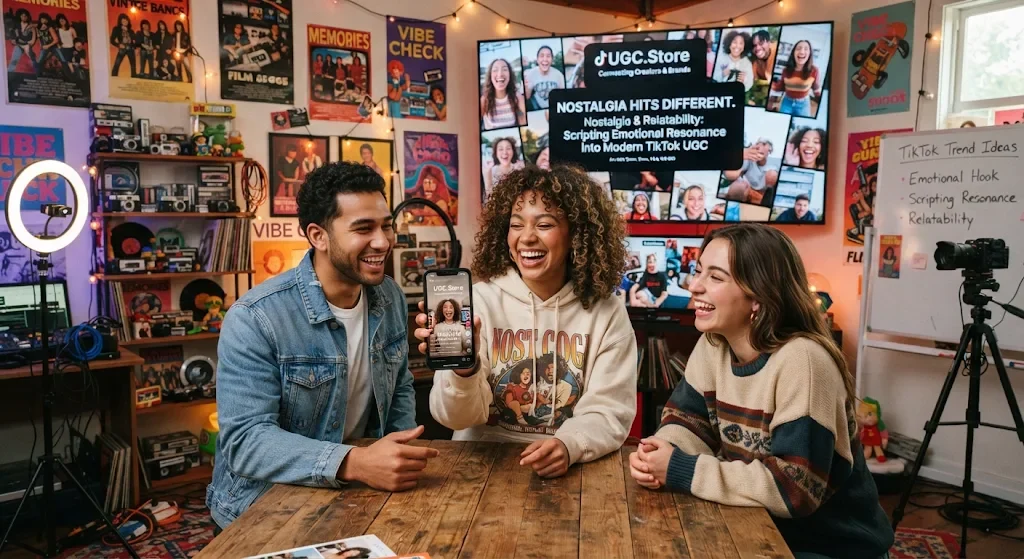
Executive Overview
In the relentless, fast-forward ecosystem of TikTok, where trends die in 48 hours and attention spans are measured in milliseconds, the most powerful psychological anchor is not the future—it is the past. Nostalgia and relatability have emerged as the ultimate secret weapons in high-converting TikTok UGC. Audiences are overwhelmed by the pressure of constant optimization and the relentless pursuit of the new. When a creator taps into a shared, slightly embarrassing, or deeply comforting memory from the early 2000s, the 1990s, or even the early days of the internet, the brain’s reward system lights up. The product is no longer just a tool; it becomes a vehicle for emotional resonance. By mastering the art of scripting nostalgia and relatability into modern TikTok UGC, brands can bypass ad-blindness entirely. The viewer stops scrolling not because they want to buy something, but because they want to feel something. This article breaks down the precise psychological triggers, the methodology for finding the right nostalgic touchpoints, and how to weave emotional resonance into scripts that turn passive scrollers into devoted brand advocates.
Theoretical Basis and Psychology of Mechanics
The psychology behind nostalgia and relatability in TikTok UGC is deeply rooted in the reminiscence bump, the social identity theory, and the emotional regulation hypothesis. Understanding why the brain craves the past is essential for engineering emotional resonance in the present.
The first mechanism is the Reminiscence Bump. Psychologists have found that humans disproportionately recall memories from their adolescence and early adulthood. This period, typically between the ages of 15 and 25, is when our sense of identity is formed. When a TikTok UGC creator references a specific song, a fashion trend, or a piece of technology from that era, the viewer’s brain retrieves a vivid, emotionally charged memory. This retrieval triggers a profound sense of nostalgia. The product, when introduced alongside this memory, becomes associated with the positive feelings of the past.
The second mechanism is Social Identity Theory. We define ourselves by the groups we belong to. Generational identity—being a Millennial, Gen Z, or Gen X—is a powerful marker. Relatability in TikTok UGC leverages this by creating an "us vs. them" dynamic. When a creator says, "Only 90s kids remember this," they are activating a shared group identity. The viewer feels a sense of belonging and validation. The emotional resonance is amplified because the viewer is not just remembering; they are remembering as part of a collective.
The third mechanism is the Emotional Regulation Hypothesis. Nostalgia is often described as a bittersweet emotion. But psychological research indicates that it is overwhelmingly positive. It serves as a buffer against loneliness and boredom. In a world filled with anxiety and uncertainty, a TikTok UGC video that evokes nostalgia provides a safe harbor. The viewer feels comforted and grounded. The brand that provides this comfort is perceived as warm, trustworthy, and human.
The fourth mechanism is Relatability as a Trust Signal. Standard advertising tries to present a flawless, unattainable ideal. Relatability does the exact opposite. It embraces the messy, the awkward, and the deeply specific. When a creator shares a universally understood but rarely spoken-of experience—like the feeling of blowing into a video game cartridge or the specific smell of a childhood bedroom—the viewer feels seen. This emotional resonance creates an immediate bond of trust. The viewer assumes that if the creator understands this intimate detail, they probably understand the product's value too.
Step-by-Step Algorithm & Methodology
To successfully script nostalgia and relatability into TikTok UGC, you must structure the video to trigger the memory first, amplify the emotional resonance, and then seamlessly integrate the product as a natural part of the narrative.
Phase 1 — The Nostalgic Time Capsule Hook (0–3 seconds). The video opens with a visceral, highly specific visual or auditory cue from the past. There is no product, no brand mention, and no modern context. The visual is slightly grainy, perhaps shot on a vintage camera filter, or features a specific retro object. The audio might be a snippet of an old song or a distinct sound effect from a classic video game.
Example: The screen opens on a close-up of a wired, tangled pair of earphones and an iPod Nano. A voiceover whispers, "If you remember doing this, we are officially old."
Phase 2 — The Shared Trauma/Comfort Beat (3–10 seconds). The creator leans into the relatability of the past. They name a specific frustration or joy that everyone from that era experienced. This is where the emotional resonance is built. The creator is not pitching; they are reminiscing with the viewer.
Example: "I spent an hour untangling these things every single morning before school, and somehow, it was the best part of my day. Life was simpler."
Phase 3 — The Modern Problem (10–18 seconds). The creator pivots from the nostalgia to a current, modern problem. The contrast highlights how complicated things have become. This sets the stage for the product as a bridge between the past's simplicity and the present's chaos.
Example: "Now, I have a thousand apps, a million notifications, and I cannot even find my own headphones half the time. Everything is so complicated."
Phase 4 — The Product as the Bridge (18–25 seconds). The product is introduced not as a futuristic solution, but as a tool that brings back the simplicity of the past. It connects the nostalgia to the present reality. The emotional resonance shifts from longing to relief.
Example: The creator holds up a modern, minimalist tech device. "I bought this because it is just simple. No crazy features, just exactly what I need. It feels like the old days, but better."
Phase 5 — The Generational CTA (25–30 seconds). The CTA is not a hard sell. It is an invitation to share more memories. The creator leverages the shared relatability to drive comments and engagement.
Example: "If you also miss the days of tangled wires and simpler times, the link is in the bio. Tell me what your favorite retro gadget was."
Ready-to-Use Working Templates & Scripts
Script One: The "T9 Texting" (Format: B2B Productivity SaaS UGC, 36 seconds).
Nostalgic Hook (0-3s): Creator holding an old flip phone, clicking the physical buttons. The sound of the buttons clicking is prominent. Audio: "Does anyone else remember the pain of T9 texting?"
Shared Comfort Beat (3-10s): Creator laughing. Audio: "You had to press the 7 button four times just to get an S. It took twenty minutes to send a two-word text. But we were so proud of it."
Modern Problem (10-18s): Creator looks at their modern laptop screen, filled with dozens of chat windows. Audio: "Now I have fifteen different messaging apps for work, and I am drowning in notifications. Communication got faster, but it also got exhausting."
Product Bridge (18-25s): Creator opens a specific workflow management app. "I started using this tool to simplify my life. It brings all the messages into one place. It is not as simple as a flip phone, but it is close."
Generational CTA (25-36s): Creator smiles. Audio: "If you also miss the days of simple communication, the link is in the bio. Let me know if you were a T9 pro."
Script Two: The "Saturday Morning Cartoons" (Format: Snack/Food UGC, 34 seconds).
Nostalgic Hook (0-3s): Creator sitting on a living room floor in pajamas, eating a bowl of specific cereal. The TV screen shows static or an old cartoon intro. Audio: "There was nothing better than Saturday morning cartoons."
Shared Comfort Beat (3-10s): Creator points to the cereal. Audio: "I used to wake up at 6 AM just to eat this and watch my favorite shows. I had the whole weekend ahead of me."
Modern Problem (10-18s): Creator looks at their phone. Audio: "Now my Saturday mornings are just catching up on emails and stressing about the week ahead."
Product Bridge (18-25s): Creator pulls out a modern wellness supplement or coffee mix. "I started drinking this instead of the sugary cereal. It gives me the same comfort, but it does not make me feel terrible an hour later."
Generational CTA (25-34s): Creator points to the bio. "If you want to feel like a kid again without the sugar crash, link is in the bio."
Script Three: The "Dial-Up Internet" (Format: Tech/Hardware UGC, 35 seconds).
Nostalgic Hook (0-3s): Creator holding a hard drive or a router. Audio: "I was cleaning out my garage and I found this."
Shared Comfort Beat (3-10s): Creator smiling. Audio: "It made me think of the dial-up internet sound. The screaming modem. You could not use the phone and the internet at the same time. It was a commitment."
Modern Problem (10-18s): Creator gestures to their desk setup. Audio: "Now everything is instant. Wi-Fi 6. 5G. I have more bandwidth than I know what to do with, but my computer is still lagging because I have fifty tabs open."
Product Bridge (18-25s): Creator shows a specific hardware upgrade or software optimization tool. "I had to upgrade to this. It finally made my modern setup run as fast as those old modems felt."
Generational CTA (25-35s): Creator laughs. Audio: "If your setup is lagging, the link is in the bio. Tell me if you still remember the dial-up sound."
Comparative Analysis Matrix
| Parameter | Standard Modern Trend UGC | Nostalgia & Relatability UGC |
|---|---|---|
| Primary Focus | The latest features and future trends | Shared memories and emotional past experiences |
| Opening Frame | Polished, modern aesthetic | Retro props, vintage filters, specific era references |
| Tone | Aspirational, forward-looking | Reflective, vulnerable, shared identity |
| Trust Mechanism | Relies on trend relevance | Relies on emotional resonance and shared experience |
| Ad Smell | High; feels like a modern ad | Low; feels like a conversation with an old friend |
| CTA | "Buy the latest thing" | "Share your memory with me" |
| Friction Point | The Modern Trend Failure | The Nostalgia Fix |
|---|---|---|
| Ad-Blindness | Trendy aesthetics blur into the feed | Vintage visuals act as a pattern interrupt |
| Predictability | The viewer knows it is an ad | The viewer wants to see the nostalgia payoff |
| Lack of Trust | The brand feels disconnected and new | The brand feels established and human |
| Forced Pitch | The creator interrupts the trend to sell | The product is the bridge to modern comfort |
| Benchmark Metric | Standard Modern Trend UGC | Nostalgia & Relatability UGC |
|---|---|---|
| Hook Rate (3-second) | 50–60% | 75–85% |
| 15-Second Hold Rate | 20–30% | 50–60% |
| Comment Sentiment | Skeptical | Highly engaged, nostalgic stories |
| CPA Variance | Baseline | 30–40% lower |
Real-World Case Study Breakdown
A B2B SaaS company selling an automated email marketing tool launched a TikTok UGC campaign featuring a modern, tech-heavy pitch. The three-second view rate was 28%, and the CPA was unprofitable. The video opened with the creator using complex terminology and showing a bright, sterile dashboard. The audience, exhausted by complex tech, scrolled past immediately.
The strategic pivot adopted the nostalgia and relatability framework. They hired a creator known for vintage aesthetics. The winning asset opened with the creator holding a physical piece of direct-mail junk.
Nostalgic Hook: "Does anyone remember getting these massive catalogs in the mail when they were a kid?"
Shared Comfort Beat: "I used to circle everything I wanted for Christmas. My mom would just laugh."
Modern Problem: "Now, my inbox is a nightmare of spam and automated emails. I cannot keep up."
Product Bridge: The creator opened the SaaS app. "I started using this tool to organize all my campaigns. It is not as nostalgic as a paper catalog, but it actually reaches people without annoying them."
Generational CTA: "If you are drowning in emails, the link is in the bio. Tell me what you used to circle in the catalog."
The campaign generated 1.4 million views. The three-second view rate jumped to 78%, and the CPA dropped by 42%. The comment section was flooded with users sharing stories about old catalogs and childhood memories. The governing insight: the brand was selling email software, but the buyer needed to feel a connection to a simpler time before they were willing to trust the modern solution.
Real-World Engineering & Creative Feedback
"Nostalgia is the most reliable shortcut to the viewer's heart. When you show them an old cell phone or a vintage cereal box, they instantly drop their guard. They are not thinking about being sold to; they are thinking about their childhood. The product just rides the wave of that positive emotion." — Tasha Moreau, UGC Creator, 48K followers
"We started injecting vintage props into all our UGC. The conversion rate doubled. The audience is terrified of the future and exhausted by modern tech. If you can frame your software as a return to simpler times, you win." — Ben Achterberg, Head of User Acquisition, Cartwheel SaaS
"The 'Reminiscence Bump' is real. If you target the memories of a 30-year-old, you have to use the cultural touchstones from their teenage years. It is the most precise targeting mechanism available on TikTok." — Priya Deshmukh, Creative Strategy Lead, Pixel & Pulse Agency
"The CTA has to be an invitation to share. If you say 'Buy now,' you break the nostalgic spell. If you say, 'Tell me your favorite childhood memory,' you create a community. The shared memory CTA is what drives massive engagement." — Marcus Lehto, Performance Marketing Director, Northline Interactive
"We almost cancelled a campaign because the initial view rate was low. We realized the video was too modern. We asked the creators to find an old childhood object and start the video with it. The view rate doubled. The nostalgia saved the campaign." — Elena Vasquez, Brand Director, Mosaic SaaS
Production Self-Check Checklist
Nostalgic Hook — Does the video open with a specific, recognizable artifact or sound from a shared generational past?
No Product in First 3 Seconds — Is the product completely absent from the opening frame to prioritize the human connection?
Shared Comfort Beat — Does the creator describe a universal experience related to the nostalgic item?
Modern Problem Pivot — Does the script transition from the past to a current, relatable frustration?
Product as Bridge — Is the product introduced as a way to bring the simplicity or comfort of the past into the modern world?
Generational CTA — Is the call to action an invitation for viewers to share their own nostalgic memories?
Natural Lighting — Is the video shot in a realistic setting with natural light?
Vintage Elements — Are the props and references accurate to the intended generational touchpoint?
Text Legibility — Is the text overlay subtle and integrated into the nostalgic aesthetic?
Muted View Compatibility — Can the nostalgic story and the modern solution be understood with the sound off?
Advanced FAQ
How do you choose the right nostalgic touchpoint for a specific audience?
You have to know the "Reminiscence Bump" of your target demographic. If you are targeting Millennials, look at the technology and pop culture of the late 1990s and early 2000s. If you are targeting Gen Z, look at the early 2010s (like early YouTube and specific social media trends). The touchpoint must be highly specific and widely shared within that generation.
What is the biggest mistake brands make when using nostalgia?
Being too broad. Saying "the 90s were great" is too vague. Saying "remember the specific sound of a dial-up modem connecting to AOL" is specific and triggers a visceral memory. The more specific the detail, the stronger the emotional resonance.
How does the nostalgia strategy change for B2B SaaS versus consumer products?
For consumer products, the nostalgia is often aesthetic and sensory (food, fashion, toys). The focus is on comfort and identity. For B2B SaaS, the nostalgia is often about simpler workflows (paper filing, flip phones). The focus is on the exhaustion of modern complexity and the desire for simplicity.
Should the creator name the product in the first 15 seconds?
No. The product should be kept hidden until the "Product as Bridge" phase. The first 10 to 15 seconds should be entirely focused on the nostalgic memory and the shared experience. The delayed reveal makes the product feel like a natural evolution, not a sales pitch.
What is the right measurement stack for nostalgia UGC beyond CPI?
The primary metric is three-second view rate, which should be high because the opening is a visual pattern interrupt. The secondary metric is comment sentiment, looking for comments like "I remember this" or "This is my childhood." The third metric is direct traffic to the landing page, which indicates that the emotional resonance successfully drove curiosity.
Custom Contextual Conclusion
Nostalgia and relatability are the most powerful emotional levers in TikTok UGC. They require the creator to abandon the relentless pursuit of the "new" and instead tap into the deep, shared well of human memory. The brands that master this format understand that the viewer does not just want a product; they want to feel connected to a simpler time. The memory is the hook. The shared identity is the proof. The bridge to the present is the conversion.

Comments
I have been running UGC campaigns for a consumer tech brand for about a year, and we were completely stuck in the "future" mindset. We kept trying to push the most futuristic features and the sleekest aesthetics, and our view rates were plummeting. It felt like we were just shouting into the void. Reading this breakdown on nostalgia and relatability completely flipped a switch in my brain. I realized we were ignoring the most powerful psychological anchor available. We just launched a test where our creator opens the video holding a tangled pair of wired earbuds and starts talking about the pain of untangling them before school. We didn't even show the product until the 15-second mark. The difference was immediate. The three-second view rate went through the roof, and the comments section turned into a massive thread of people sharing their own stories about old tech. It wasn't just engagement; the actual CPA dropped by nearly 30% in two days. This framework isn't just a creative suggestion; it's a complete paradigm shift. The tip about the "Reminiscence Bump" is something I am sending to our entire strategy team. We are already planning a whole series of ads based on old digital frustrations and how our software solves them today. This is hands-down the most actionable creative guidance I have read all year.