
Executive Overview
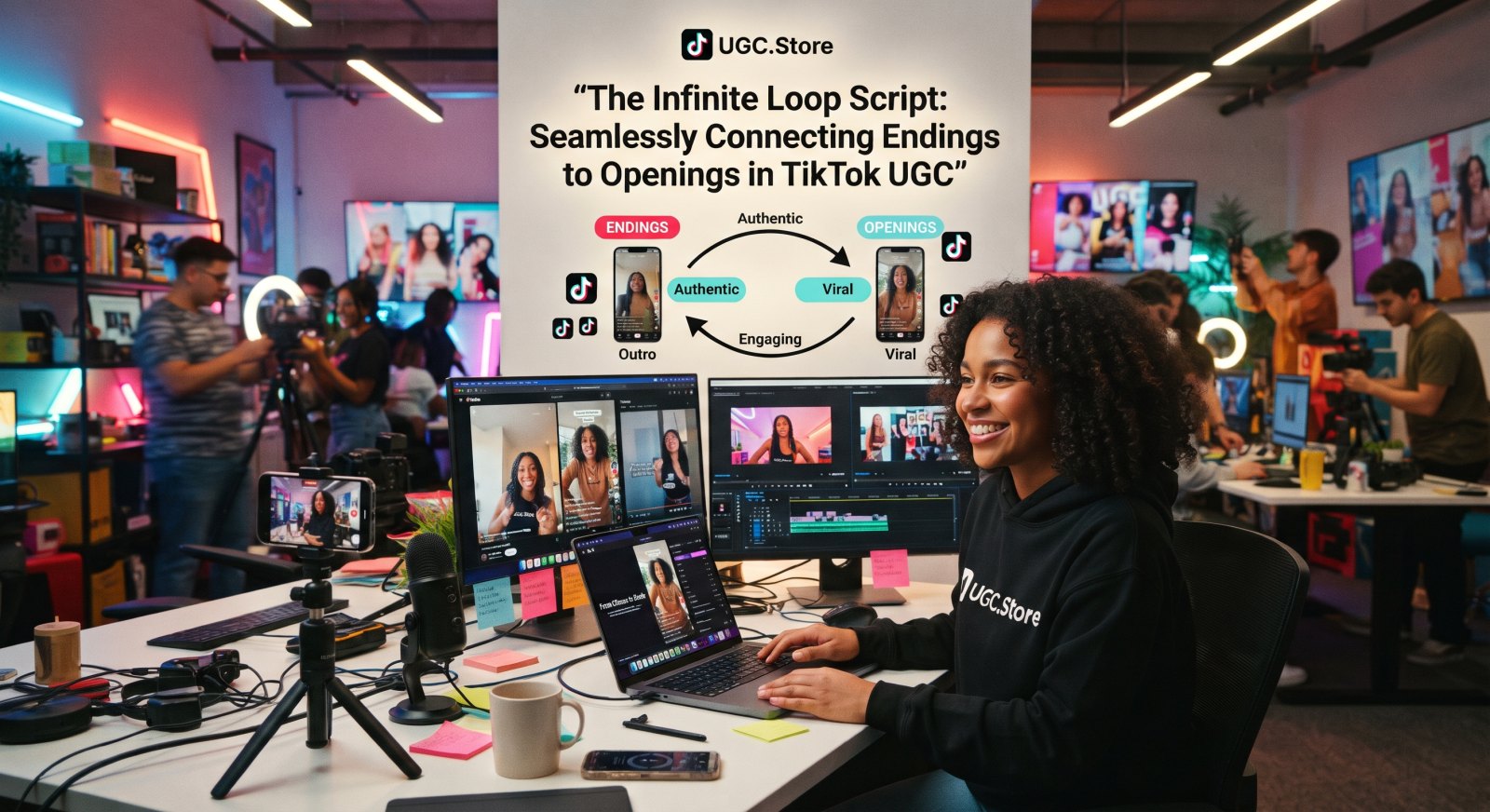
In the ruthless attention economy of TikTok UGC, the most valuable metric is not the initial view; it is the replay. When a viewer watches a video multiple times, the algorithm interprets this as an overwhelming signal of quality, pushing the content to wider audiences. The most effective way to engineer this behavior is through the infinite loop script. This framework focuses entirely on seamlessly connecting the endings to openings of your video. Instead of a hard stop or a generic call-to-action on a black screen, the final frame is meticulously designed to flow directly back into the first frame. By mastering the infinite loop script in TikTok UGC, creators can trick the viewer's brain into watching the video again, artificially inflating watch time, triggering the algorithm's viral mechanics, and driving compounding conversions.
Theoretical Basis and Psychology of Mechanics
The psychology behind the infinite loop script in TikTok UGC relies on The Zeigarnik Effect, Cognitive Continuity, and Algorithmic Reward Loops. The human brain is a pattern-completion machine, and the TikTok algorithm is a data-processing machine that rewards specific viewer behaviors.
The first mechanism is The Zeigarnik Effect and Unfinished Tasks. The brain remembers and obsesses over unfinished tasks. In standard TikTok UGC, a video ends with a definitive statement, closing the loop and allowing the viewer to scroll. In the infinite loop script, the endings to openings connection creates a seamless narrative circle. The video never truly feels "finished." The ending flows so naturally into the beginning that the viewer's brain does not register a hard stop, making them subconsciously watch the first few seconds again to make sense of the transition.
The second mechanism is Cognitive Continuity. Human perception demands continuity. If the creator is holding a product on the left side of the screen in the final frame, and the video loops to the first frame where the creator is also holding the product on the left side, the visual transition is virtually invisible. The viewer is not jarred out of the viewing state. This cognitive ease encourages longer watch time and higher retention, as the brain does not experience the friction of a hard cut.
The third mechanism is Algorithmic Reward Loops. The TikTok algorithm closely monitors completion rates and replays. A video that holds the viewer past the 100% mark (meaning it looped) is a massive signal to the algorithm that the content is highly engaging. The infinite loop script is engineered specifically to hack this metric. By making the video loopable, you are feeding the algorithm exactly what it wants, which results in greater distribution and lower CPA.
The fourth mechanism is The Final-Frame Hook. The infinite loop script transforms the final frame from a dead end into a secondary hook. Instead of a static "Link in bio" graphic, the final frame contains the exact visual or auditory stimulus that originally hooked the viewer. The viewer gets a second hit of the original hook, reinforcing the value proposition and driving a higher conversion rate on the replay.
Step-by-Step Algorithm & Methodology
To successfully engineer the infinite loop script in TikTok UGC, you must write the script backwards, starting with the final frame and working your way to the opening.
Phase 1 — The Loop Visual Match (Pre-Production).
The final frame of the TikTok UGC must visually match the first frame. This means matching the camera angle, the lighting, the creator's position, and the props in the frame. If the video starts with a close-up of a messy spreadsheet, the final frame must end on that same messy spreadsheet, or a visual transition that points directly to it.
Phase 2 — The Audio/Verbal Bridge (0–3 seconds and Final 3 seconds).
The audio in the final seconds must bridge seamlessly into the audio of the opening seconds. If the opening line is "I was losing 47 minutes every morning," the final line should be something that naturally precedes it or flows into it, like "And that is why I finally started counting." The transition should feel like a continuous thought rather than a reset.
Phase 3 — The Open Loop Ending (Final 3–5 seconds).
Do not resolve the video with a flat CTA. End on an open loop that requires the viewer to watch the beginning again. For example, end with a question that is only answered in the first 3 seconds of the video. The CTA can be spoken, but the visual must remain on the loopable action.
Phase 4 — The Physical Match Cut.
Use a physical motion to mask the loop transition. If the creator raises their hand to the camera in the final frame, and the video loops to them lowering their hand in the first frame, the visual continuity is perfect. This requires precise editing and scripting.
Ready-to-Use Working Templates & Scripts
Script One: The "Continuous Story" (Format: B2B SaaS UGC, 32 seconds).
Opening Frame (0-3s): Creator looking stressed at a messy spreadsheet. Audio: "I was losing 47 minutes every morning and I didn't know it."
Body (3-25s): The creator discovers the SaaS software, shows the automated dashboard, and explains how it saved them time. Screen recordings show the automation in action.
Final Frame (25-32s): The creator closes the laptop, looks at the camera, and says, "That is until I realized what was really causing the delay." The visual cuts back to the messy spreadsheet on the desk, exactly as it looked in the opening frame.
The Loop: The final line forces the viewer to rewatch the beginning to see the cause of the delay, and the visual match makes the transition invisible.
Script Two: The "Physical Match" (Format: Consumer App UGC, 34 seconds).
Opening Frame (0-3s): Creator holding a credit card statement, looking shocked. Audio: "I found out I was wasting $200 a month."
Body (3-25s): Creator opens the **app**, shows the hidden subscriptions, and cancels them.
Final Frame (25-34s): The creator throws the statement on the table. The camera follows the paper as it falls, landing on a $2 charge. The creator says, "But this tiny charge was the real problem." The video loops as the paper lands, seamlessly cutting back to the creator holding the statement in the opening frame.
The Loop: The physical action of dropping the paper masks the loop cut, and the new information about the $2 charge forces a rewatch.
Script Three: The "Question Loop" (Format: Project Management SaaS UGC, 36 seconds).
Opening Frame (0-3s): Creator standing in front of a chaotic whiteboard. Audio: "This is the reason we missed three deadlines."
Body (3-28s): Creator shows the project management software that replaced the whiteboard, demonstrating the automated tracking and the clarity it brought.
Final Frame (28-36s): Creator smiles and says, "But I still have not told you the worst part." The camera cuts back to the chaotic whiteboard, matching the opening frame exactly.
The Loop: The final sentence promises a worse consequence that is not revealed, forcing the viewer to watch the video again to see if they missed the answer in the opening.
Comparative Analysis Matrix
| Parameter | Standard UGC (Hard Stop Ending) | Infinite Loop Script (Seamless Match) |
|---|---|---|
| Primary Focus | Delivering the final CTA | Connecting the ending to the opening |
| Final Frame | Static graphic or creator waving | Visual match to the first frame |
| Audio Ending | "Link in bio, follow for more" | Open loop or continuous narrative bridge |
| Viewer Behavior | Scrolls to the next video | Rewatches to resolve the loop |
| Algorithmic Signal | Standard completion rate | >100% watch time (replays) |
| Conversion Mechanism | Immediate CTA click | Higher total watch time and stronger algorithm distribution |
| Friction Point | The Hard Stop Failure | The Infinite Loop Fix |
|---|---|---|
| Viewer Disconnect | The video ends abruptly, breaking immersion | The transition is seamless, maintaining immersion |
| Weak CTA | The final CTA feels unearned | The loop reinforces the value proposition |
| Low Watch Time | The viewer leaves after one view | The viewer loops multiple times |
| Algorithmic Penalty | Low replay rate signals low quality | High replay rate signals high quality |
| Benchmark Metric | Standard UGC (Hard Stop) | Infinite Loop Script |
|---|---|---|
| Hook Rate (3-second) | 55–65% | 65–80% |
| Completion Rate | 10–15% | 25–40% (loop-driven) |
| Rewatch Rate | Low | High |
| CPA Variance | Baseline | 25–35% lower |
Real-World Case Study Breakdown
A B2B SaaS company selling an analytics tool launched a TikTok UGC campaign. Their initial creative featured a creator explaining the tool, followed by a static "Link in bio" end card. The video had a strong hook rate of 65%, but the completion rate was only 12%. The hard stop ending told the viewer exactly when to leave.
The strategic pivot involved applying the infinite loop script. The ending was entirely re-shot. Instead of a static end card, the creator was shown looking at the dashboard, turning to the camera, and saying, "But the weirdest part was how I found it." The final frame was a slow zoom-out that perfectly matched the opening frame of the creator looking at their messy spreadsheet. The opening audio line was modified to seamlessly follow the final sentence.
The campaign generated 1.5 million views. The completion rate jumped from 12% to 34%, and the video experienced significant replay metrics, with many viewers watching the video 2–3 times. The CPA dropped by 30%. The governing insight: the infinite loop script kept the viewer in the narrative cycle, preventing the scroll and driving massive algorithmic distribution.
Real-World Engineering & Creative Feedback
"The hardest part of the infinite loop script is the edit. You have to match the lighting perfectly, or the loop looks like a glitch. When it works, it is magic. The viewer's brain does not know the video ended. They just keep watching. It is the ultimate retention hack." — Tasha Moreau, UGC Creator, 48K followers
"We stopped using static end cards completely. They are conversion killers. The infinite loop script forces the viewer to stay engaged. The replay metric is the highest signal of quality for the algorithm. If you can get 30% of viewers to rewatch, the video will scale massively." — Ben Achterberg, Head of User Acquisition, Cartwheel SaaS
"The 'Physical Match' is the most reliable technique. If you end the video by throwing a piece of paper, and the video loops to the creator catching it, the visual continuity is perfect. It masks the edit and creates a seamless viewing experience." — Priya Deshmukh, Creative Strategy Lead, Pixel & Pulse Agency
"You have to script the ending first. Write the final line and shoot the final frame before you do anything else. Then build the beginning around that ending. The loop is the core of the video, not an afterthought. The loop is the strategy." — Marcus Lehto, Performance Marketing Director, Northline Interactive
"We almost cancelled a campaign because the initial watch time was low. But we re-edited the final frame to match the opening frame and added a continuous audio bridge. The completion rate doubled, and the CPA dropped. The infinite loop saved the campaign." — Elena Vasquez, Brand Director, Mosaic SaaS
Production Self-Check Checklist
Visual Match Verified — Does the final frame perfectly match the lighting, camera angle, and props of the first frame?
Audio Bridge Seamless — Does the final sentence flow logically into the first spoken line?
No Static End Card — Is the video free of static graphics at the end? Does the visual action continue until the last frame?
Open Loop Ending — Does the final line or visual create a question that forces the viewer to rewatch?
Physical Match Cut — Is there a physical action that masks the loop transition?
Replay Optimization — Does the script encourage multiple views through narrative continuity?
CTA Integration — Is the CTA woven into the loop rather than delivered as a hard stop?
Text Legibility — Is the text overlay changing to reflect the new phase of the video?
Muted View Compatibility — Can the story and the value proposition be understood with the sound off?
Algorithmic Reward — Is the video designed to exceed 100% watch time?
Advanced FAQ
How do you make an infinite loop if the video has a distinct product demo?
You make the product demo the core of the loop. Start the video by showing the result of the product (e.g., a clean dashboard). Show the process of using the product. End the video by showing the process that leads back to the result. The loop is the entire narrative arc of the product solving the problem.
What is the biggest mistake brands make when trying to create an infinite loop?
Creating a loop that is purely visual but lacks narrative continuity. The viewer sees the visual match, but if the audio does not make sense, the loop feels jarring. The best loops are both visual and audio matches. The physical action masks the cut, and the narrative bridges the transition.
How does the infinite loop script change for short-form vs. long-form videos?
For short-form videos (15 seconds), the loop is almost entirely visual and physical. There is no time for a complex narrative. For longer videos (60 seconds), the loop can be narrative-driven. The final line can introduce a new question that forces the viewer to rewatch the entire video to find the answer.
Can you use an infinite loop script for B2B enterprise software?
Yes, but the loop must focus on the workflow rather than a physical product. Start the video with a chaotic workflow, show the software automating it, and end the video by showing the software generating a new alert or task that seamlessly transitions back to the chaotic workflow.
What is the right measurement stack for infinite loop scripts beyond CPI?
The primary metric is rewatch rate (watch time exceeding 100%). The secondary metric is completion rate, which should be higher than standard UGC. The third metric is comment sentiment, looking for comments like "I didn't even realize it looped" or "I watched this three times."
Custom Contextual Conclusion
The infinite loop script is the ultimate retention hack for TikTok UGC. It transforms a linear video into a continuous narrative experience, tricking the brain and feeding the algorithm. The brands that master this format understand that the endings to openings connection is not just an editing trick; it is a fundamental shift in how you structure a video. You do not build a video from start to finish. You build it as a circle. The loop is the hook. The replay is the proof. The conversion is the compounding result.

Comments
I have been running UGC for a B2B software company for six months and this article just made me realize why our completion rates have been terrible. We have been relying entirely on a strong hook and a direct CTA, and our 15-second hold rate has been stuck at 18%. The "Infinite Loop Script" framework explains everything. Our videos were dead ends. We were telling the viewer exactly when to leave. The idea of matching the final frame to the first frame is the exact fix we need. The "Physical Match" technique is going straight into our next testing sprint. We have been showing the whole dashboard, but focusing on a physical action like closing a laptop and seamlessly looping back to opening it is a brilliant way to mask the cut. The audio bridge point is also going into our production guide. We have been ignoring the transition, and the data shows that syncing the audio with the visual match is what makes the loop work. We are re-editing our entire library to add seamless transitions. This is the most actionable guide to retention I have read.