
Executive Overview
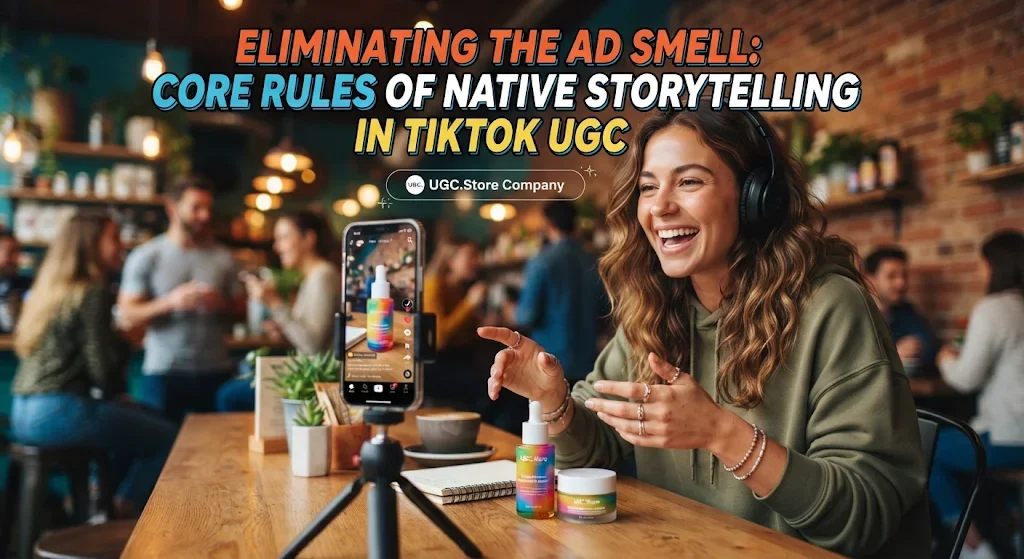
The greatest enemy of TikTok UGC performance is not poor lighting or a bad hook; it is the ad smell. This is the invisible, instantaneous signal that tells a viewer's brain, "You are being sold to, scroll past." When a video carries the ad smell, the viewer's defense mechanisms activate before the first word is even spoken. The solution is not better product placement; it is the complete adoption of native storytelling. By stripping away the polished aesthetics of traditional marketing and adopting the narrative rhythm of organic content, creators can eliminate the ad smell entirely. This framework breaks down the core rules of native storytelling in TikTok UGC, detailing how to construct scripts, visuals, and audio profiles that feel indistinguishable from a video sent by a friend, thereby maximizing retention and driving authentic conversions.
Theoretical Basis and Psychology of Mechanics
The psychology of the ad smell and the effectiveness of native storytelling are rooted in pattern recognition, the halo effect of authenticity, and cognitive friction.
The human brain is an incredibly efficient filtering machine. It relies on pattern recognition to categorize information quickly. Over decades, the brain has built a highly specific template for an "ad." It includes high production value, scripted dialogue, smiling actors, and a clear pitch. When a TikTok UGC video matches this template, the ad smell is triggered. The brain categorizes the content as low-value or manipulative and initiates a scroll. Native storytelling works by deliberately subverting this template. It uses raw lighting, unscripted pauses, and a lack of corporate polish to bypass the ad-detection pattern. The brain categorizes the content as "peer-to-peer communication," lowering the viewer's defenses.
The halo effect of authenticity is another critical mechanism. When a creator drops the polished facade, they appear more trustworthy. If a creator admits to a struggle or shows a messy room, the viewer assumes they are telling the truth about the product as well. The lack of production value becomes a proxy for honesty. Native storytelling leverages this by prioritizing real environments and genuine emotions over studio setups. The TikTok UGC script must feel like a confession or a casual chat, not a presentation.
Cognitive friction plays a massive role in video abandonment. When a viewer watches an ad, they experience cognitive friction because they know they are being pitched to; they are actively guarding against manipulation. Native storytelling eliminates this friction. When the content feels organic, the viewer drops their guard. They stop evaluating the video as a sales pitch and start evaluating it as a story. The product becomes a natural element within that story, rather than an interruption. The goal is to make the viewer forget they are watching an advertisement until they are already invested in the outcome.
Step-by-Step Algorithm & Methodology
To eliminate the ad smell through native storytelling, you must reconstruct the entire architecture of your TikTok UGC scripts.
Phase 1 — The Anti-Hook Hook (0–3 seconds). Traditional ads open with a product or a promise. Native storytelling opens mid-action or mid-conflict. The first frame should look like it was captured accidentally, not staged. Start with a frustrated sigh, a messy desk, or a half-finished sentence. The dialogue should begin as a complaint or a confession. Do not use a polished intro. Drop the viewer directly into the story's climax, forcing them to catch up.
Phase 2 — The Casual Context (3–10 seconds). Instead of explaining the product's features, explain the personal context. Why are you doing this? What was the breaking point? Use natural language, including pauses and filler words. Let the camera shake slightly. The lighting should be whatever is in the room. The native storytelling here builds the parasocial bond, making the viewer feel like they are on a FaceTime call with a friend.
Phase 3 — The Accidental Discovery (10–18 seconds). Introduce the product as an accident or a last resort, never as a planned sponsorship. The script should sound like, "My roommate left this on the counter and I was desperate," or "I bought this because I was tired of failing." The product is not a miracle; it is just a tool that happened to solve the problem. This downplays the commercial intent and strengthens the native storytelling narrative.
Phase 4 — The Raw Proof (18–25 seconds). Show the product working, but do not make it look perfect. Allow the screen recording to show a slight loading delay. Show your genuine reaction, not a scripted smile. If there is a flaw, mention it casually. The TikTok UGC loses its ad smell when it admits imperfection. The proof should feel earned through genuine trial and error.
Phase 5 — The Conversational CTA (25–30 seconds). Do not command the viewer to "buy now." Use a soft, conversational close. "If you have the same problem, the link is in the bio." Or, "I am not saying you need this, but it saved my week." The final frame should fade out naturally or end abruptly, just like a real conversation.
Ready-to-Use Working Templates & Scripts
Script One: The "Late Night Discovery" (Format: Skincare/Wellness UGC, 34 seconds).
Opening Frame (0-3s): Creator in a dimly lit bedroom, looking exhausted, holding a generic product. Audio: "I know it is 2 AM. But I have to talk about this because I am so annoyed."
Casual Context (3-10s): "I have been trying to fix my skin for three months. I have bought everything. I was about to give up and just accept the redness."
Accidental Discovery (10-18s): "My sister left this in the bathroom and I used it because I was out of my normal stuff. I didn't even read the label." The creator shows the product, but it is not the focus.
Raw Proof (18-25s): "I woke up the next morning and the redness was gone. I am not saying it is magic. But it worked."
Conversational CTA (25-34s): "If you are struggling with the same thing, I will put the link in the bio. But don't buy it if you already have a routine that works." The camera cuts abruptly.
Script Two: The "Work Meltdown" (Format: B2B Productivity UGC, 36 seconds).
Opening Frame (0-3s): Creator at a messy desk, running their hands through their hair. Audio: "I almost quit my job today."
Casual Context (3-10s): "I was staring at this spreadsheet, and I realized I had missed three updates because I was tracking everything manually. I was completely overwhelmed."
Accidental Discovery (10-18s): "A coworker sent me a link to this app. I didn't even want to try it. But I was desperate." The creator opens the app, showing a slightly unpolished interface.
Raw Proof (18-25s): "It pulled the data automatically. I was shocked. I still have to check it, but it saved me hours."
Conversational CTA (25-36s): "If your work life is a mess right now, the link is in the bio. I am not a productivity guru. I just needed help." The video ends with the creator sighing in relief.
Script Three: The "Budgeting Reality" (Format: Finance App UGC, 32 seconds).
Opening Frame (0-3s): Creator looking at a laptop screen, shaking their head. Audio: "I just realized I am broke."
Casual Context (3-10s): "I was trying to balance my budget, and I realized I was paying for three different subscriptions that I completely forgot about. It was humiliating."
Accidental Discovery (10-18s): "My friend told me about this app. I thought it was a scam, but I tried it anyway."
Raw Proof (18-25s): Screen recording shows the app finding the hidden fees. "It found a $15 charge that was renewing every month. I cancelled it instantly."
Conversational CTA (25-32s): "If you want to find your hidden money, the link is in the bio. I am not a financial advisor, but this helped." The creator closes the laptop.
Comparative Analysis Matrix
| Parameter | Traditional Commercial UGC | Native Storytelling UGC |
|---|---|---|
| Primary Focus | Features and benefits | Personal struggle and discovery |
| Opening Frame | Polished product shot or smiling face | Messy environment, unposed expression |
| Audio Profile | Scripted, energetic voiceover | Casual, hesitant, conversational audio |
| Product Integration | The centerpiece of the video | A tool introduced as an accident |
| Ad Smell | High; triggers immediate defense | Low; bypasses ad detection |
| Trust Architecture | Relies on brand authority | Relies on vulnerability and honesty |
| Friction Point | The Ad Smell Failure | The Native Storytelling Fix |
|---|---|---|
| Predictability | The viewer knows exactly what is coming | The story feels organic and unpredictable |
| Polish | High production signals "advertisement" | Rough production signals "real life" |
| Scripted Delivery | Reading from a teleprompter | Natural pauses and filler words |
| Hard Sell | Aggressive CTA | Soft, conversational closing |
| Benchmark Metric | Traditional Ad UGC | Native Storytelling UGC |
|---|---|---|
| Hook Rate (3-second) | 50–60% | 65–80% |
| 15-Second Hold Rate | 20–30% | 45–60% |
| Completion Rate | 10–15% | 25–35% |
| CPA Variance | Baseline | 25–35% lower |
Real-World Case Study Breakdown
A B2B SaaS company selling a time-tracking tool launched a TikTok UGC campaign with a polished, scripted video. The creator was well-lit, reading from a script, and seamlessly transitioned to a product demo. The three-second view rate was 45%, and the CPA was unprofitable. The ad smell was overwhelming, and viewers scrolled past immediately.
The strategic pivot adopted the native storytelling framework. They hired a creator to film a "day in the life" style video. The opening frame showed the creator sitting in a messy room, looking stressed at a laptop. "I just lost a client because I underestimated how long this project would take."
The video was shot on a phone with natural light. There were no cuts or edits; it was a continuous raw take. The creator showed the SaaS app on their screen, explaining how it automatically tracked their hours and alerted them to scope creep. The closing line was, "I am still stressed, but at least I am not guessing anymore."
The campaign generated 1.2 million views. The three-second view rate jumped to 78%, and the CPA dropped by 40%. The governing insight: the brand was selling time-tracking software, but the buyer needed to see a real person struggling with the exact same problem. The native storytelling eliminated the ad smell and built immediate trust.
Real-World Engineering & Creative Feedback
"The moment a creator reads from a script, the ad smell is triggered. The audience can feel the teleprompter. You have to let them talk. You have to let them fail. The raw, unpolished moments are where the trust is built. The uglier the video, the better the conversion." — Tasha Moreau, UGC Creator, 48K followers
"We stopped using professional lighting and sound equipment for our TikTok UGC. It felt counterintuitive at first, but the data was undeniable. The videos shot on a phone in a normal room outperformed the studio videos by 50%. The audience wants authenticity, not a commercial." — Ben Achterberg, Head of User Acquisition, Cartwheel SaaS
"The 'Accidental Discovery' mechanism is the key. If you introduce the product as a planned sponsorship, the viewer tunes out. If you introduce it as something you found by mistake, the viewer leans in. It feels like a secret you are sharing, not a pitch you are making." — Priya Deshmukh, Creative Strategy Lead, Pixel & Pulse Agency
"The CTA has to be soft. If you tell the viewer to 'Buy Now,' they will close the app. If you say, 'I am not saying you need this, but it saved my week,' they will click. The soft CTA respects the viewer's intelligence and keeps the native storytelling intact." — Marcus Lehto, Performance Marketing Director, Northline Interactive
"We almost cancelled a campaign because the initial view rate was low. But we realized the videos were too polished. We asked the creators to reshoot in their bedrooms with no makeup. The view rate doubled. The native storytelling approach saved the campaign." — Elena Vasquez, Brand Director, Mosaic SaaS
Production Self-Check Checklist
No Studio Lighting — Is the video shot in natural, imperfect light?
No Scripted Dialogue — Is the audio conversational, including pauses and filler words?
Mid-Action Opening — Does the video start mid-conflict rather than with a polished intro?
Accidental Discovery — Is the product introduced as a tool, not a centerpiece?
Raw Proof — Is the product demo shown with genuine reactions and minimal editing?
Vulnerability Included — Does the creator admit to a struggle or a past failure?
Soft CTA — Is the CTA conversational rather than aggressive?
Ad Smell Check — Does the video look like a commercial, or does it look like a friend's video?
Muted View Compatibility — Can the story be understood with the sound off?
No B2B Jargon — Is the script free of corporate buzzwords?
Advanced FAQ
How do you eliminate the ad smell if the product requires a formal demonstration?
You make the demonstration the secondary element. The primary element is the creator's reaction. The screen recording is not the star; the creator's relief is the star. Show the demo briefly, then cut back to the creator's face. The product is the mechanism, but the human is the story.
What is the biggest mistake brands make when trying to be native?
Trying too hard to be casual. Forced authenticity is still an ad smell. If the creator is wearing a suit and using slang, it feels fake. True native storytelling requires casting the right creator—someone who actually has the problem and can speak to it naturally.
How does the native storytelling approach change for high-ticket B2B software?
The vulnerability must be professional rather than personal. You cannot show a messy bedroom if you are selling enterprise compliance software. But you can show a messy spreadsheet and a stressed manager. The setting should match the professional context, but the rawness remains.
Can a native storytelling video still have a high production value?
Yes, but the production value should be invisible. The audio should be crisp, but the lighting should be natural. The camera should be steady, but the framing should be unpolished. The goal is not low quality; it is the absence of advertising artifice.
What is the most important metric for native storytelling UGC?
The most important metric is comment sentiment. If the comments are filled with people asking questions or sharing their own stories, the native storytelling worked. If the comments are filled with "This is an ad," the ad smell was triggered. The comments are the quickest feedback loop.
Custom Contextual Conclusion
The ad smell is the silent killer of TikTok UGC performance. It is the invisible barrier between the creator and the viewer. To eliminate it, you must abandon the traditional marketing playbook and embrace the rules of native storytelling. You must trade the studio lighting for the messy room. You must trade the scripted pitch for the casual confession. You must trade the hard sell for the soft share. The brands that master this format understand that the viewer does not want to be advertised to; they want to be told a story. The story is the hook. The honesty is the proof. The conversion is the result.
Comments
I have been running UGC for a B2B software company for six months and this article just made me realize why our completion rates have been terrible. We have been relying entirely on a strong hook and a professional studio setup, and our 15-second hold rate has been stuck at 18%. The "Eliminating the Ad Smell" framework explains everything. Our videos were too polished. We were using teleprompters and professional lighting, and the viewer just categorized it as a commercial and scrolled. The idea of using a messy room and a casual, conversational audio track is the exact fix we need. The "Accidental Discovery" mechanism is going straight into our next testing sprint. We have been introducing our software as the centerpiece, but framing it as a random tool found by a coworker is a brilliant way to bypass ad-defense. The soft CTA point is also going into our production guide. We have been using aggressive "Buy Now" language, and the data shows that a conversational close is what builds trust. We are re-editing our entire library to add natural pauses and remove the polished graphics. This is the most actionable guide to authenticity I have read.