
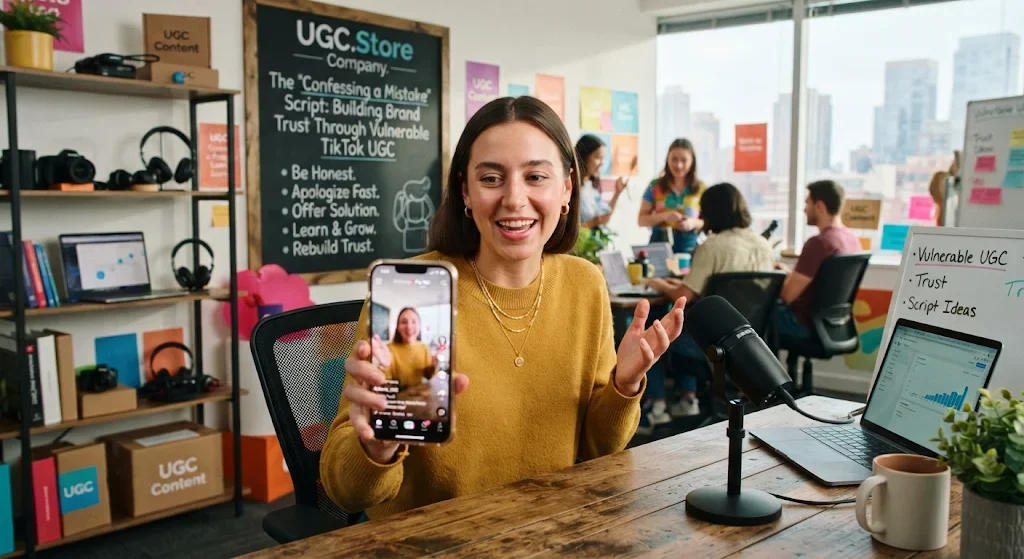
Executive Overview
The standard rule of B2B SaaS and consumer marketing is to project absolute perfection. Brands spend millions curating a flawless image, terrified that any admission of failure will destroy their credibility. In the ecosystem of TikTok UGC, this strategy is a guaranteed death sentence. The platform's audience is inherently skeptical of polished corporate messaging and immediate triggers their ad-defense system. The antidote is the "Confessing a Mistake" script. This framework flips the traditional marketing paradigm by deliberately exposing a brand's flaw, a product's limitation, or a past failure. By embracing vulnerable TikTok UGC, brands can bypass the viewer's skepticism, build profound brand trust, and position their software as a transparent, reliable partner rather than an infallible, faceless corporation. This framework breaks down how to strategically apologize, pivot, and convert through the power of radical honesty.
Theoretical Basis and Psychology of Mechanics
The psychology behind vulnerable TikTok UGC and the "Confessing a Mistake" script relies on the Pratfall Effect, reciprocity of trust, and the halo of authenticity. The human brain is a highly tuned lie detector, and in the context of TikTok UGC, it is constantly scanning for manipulation. When a brand admits a flaw, it short-circuits the lie detector.
The first mechanism is The Pratfall Effect. Coined by social psychologist Elliot Aronson, the Pratfall Effect states that people who are perceived as highly competent become more likable and trustworthy when they make a mistake or commit a blunder. In traditional marketing, a brand shows only its competence. In vulnerable TikTok UGC, the creator (representing the brand) shows competence by demonstrating the software, but then commits a "pratfall" by admitting a past failure or a current limitation. The viewer's brain registers this as genuine human behavior, significantly increasing brand trust and likability.
The second mechanism is The Reciprocity of Trust. When a creator admits a mistake on camera, they are offering a piece of social vulnerability. The viewer's natural psychological response is to reciprocate that vulnerability with trust and attention. The TikTok UGC script uses this to disarm the viewer. If the brand is willing to admit they screwed up, they are probably telling the truth about the product's benefits. This reciprocity is the foundation of high-converting vulnerable TikTok UGC.
The third mechanism is The Halo of Authenticity. The modern consumer is exhausted by "perfect" brands. The "Confessing a Mistake" script leverages this fatigue by offering a raw, unfiltered narrative. The confession does not have to be catastrophic; it can be a minor, relatable error. But the act of confession signals that the brand is authentic. The viewer categorizes the content as "transparent communication," which dramatically lowers the cognitive friction required to process the product pitch.
The fourth mechanism is The Redemption Arc. Narratively, a confession sets up a redemption arc. The mistake is the conflict, and the product is the resolution. The TikTok UGC script must position the software not as a magic bullet that never fails, but as the tool that helped the brand recover from the mistake. This creates a narrative of resilience and continuous improvement, making the brand far more relatable to buyers who are also struggling with their own operational failures.
Step-by-Step Algorithm & Methodology
To execute the "Confessing a Mistake" script and optimize vulnerable TikTok UGC, you must structure the video to build tension through honesty, not hype.
Phase 1 — The Direct Confession (0–3 seconds). The creator opens with a raw, unpolished admission of failure. There is no introduction, no logo, and no positive spin. The visual is the creator looking genuinely remorseful or frustrated.
Example: "We almost lost our biggest client last month, and it was completely our fault."
Phase 2 — The Unfiltered Explanation (3–10 seconds). The creator explains exactly what went wrong. The mistake must be specific and systemic, not a humblebrag disguised as a flaw. Do not say, "We work too hard." Say, "We forgot to send the renewal invoice and the system locked them out."
Example: "I was managing the accounts manually in a spreadsheet, and I completely missed the renewal date. The client was furious."
Phase 3 — The Vulnerable Pivot (10–20 seconds). Introduce the product not as a savior, but as the tool that was built or adopted to fix the specific mistake. The product is the structural remedy, not a magical cure.
Example: "We implemented this automated billing software to make sure it never happens again. It tracks every renewal and sends an alert thirty days out."
Phase 4 — The Proof and Transparency (20–28 seconds). Show the software working, but continue the theme of vulnerability. Point out the flaws of the software or the process. The proof must be grounded in reality.
Example: "The dashboard is not perfect. It is a little cluttered. But it has not missed a renewal since."
Phase 5 — The Honest CTA (28–35 seconds). Close with a CTA that respects the viewer's intelligence. Do not pressure them to buy. Invite them to learn from the mistake.
Example: "If your billing is held together by tape and hope, the link is in the bio. Do not wait until you lose a client."
Ready-to-Use Working Templates & Scripts
Script One: The "Billing Disaster" (Format: B2B Finance SaaS UGC, 34 seconds).
Opening Frame (0-3s): Creator sitting at a desk, looking directly at the camera, visibly stressed.
Audio: "I messed up. I completely forgot to invoice a client for three months."
Explanation (3-10s): Screen shows a messy spreadsheet. Audio: "I was tracking everything manually. The client was furious, and I thought I was going to lose the account."
Vulnerable Pivot (10-20s): Creator opens the SaaS app. Audio: "I had to fix it fast. We switched to this billing automation tool."
Proof (20-28s): Screen recording shows the automated invoice generation. Audio: "It sends the invoice and the reminder automatically. It is not magic; I still have to check the data. But it saved the relationship."
Honest CTA (28-34s): Creator looks at the camera. Audio: "If you are managing billing in a spreadsheet, stop. Link in the bio."
Script Two: The "Support Failure" (Format: Customer Service SaaS UGC, 38 seconds).
Opening Frame (0-3s): Creator holding a phone, looking frustrated.
Audio: "We ignored our customers for three days."
Explanation (3-10s): Audio: "Our support inbox was overwhelmed. We were answering emails manually, and we missed a major complaint. We almost lost a key account."
Vulnerable Pivot (10-20s): Creator opens the helpdesk software. Audio: "We implemented this ticketing system to fix it. We set up auto-responders and priority tagging."
Proof (20-28s): Screen recording shows a clean, prioritized inbox. Audio: "It is not perfect. We still get busy. But nobody gets ignored anymore."
Honest CTA (28-38s): Creator looks at the camera. Audio: "If your support inbox is a graveyard, the link is in the bio."
Script Three: The "Data Leak" (Format: CRM SaaS UGC, 36 seconds).
Opening Frame (0-3s): Creator looking at a laptop, shaking their head.
Audio: "I lost a massive deal because of a typo."
Explanation (3-10s): Screen shows a messy CRM. Audio: "I entered the wrong contact info, and the client never got the proposal. I blamed the system, but it was my fault."
Vulnerable Pivot (10-20s): Creator opens the new CRM software. Audio: "We switched to this tool to prevent human error. It validates the data before you save."
Proof (20-28s): Screen recording shows a validation warning. Audio: "It caught an error yesterday. I was annoyed, but it saved the deal."
Honest CTA (28-36s): Creator looks at the camera. Audio: "If you are still relying on manual data entry, the link is in the bio."
Comparative Analysis Matrix
| Parameter | Corporate Perfection UGC | Vulnerable Confession UGC |
|---|---|---|
| Primary Focus | Features, success, and flawless execution | Admitting flaws, mistakes, and the recovery process |
| Opening Frame | Polished, smiling creator | Stressed, unposed, direct creator |
| Trust Mechanism | Relies on authority and claims | Relies on the Pratfall Effect and reciprocity |
| Tone | Confident, promotional | Honest, slightly self-deprecating |
| Product Integration | The hero of the story | The structural remedy to a real problem |
| CTA | Aggressive "Buy Now" | Empathetic "Do not make my mistake" |
| Friction Point | The Perfection Failure | The Confession Fix |
|---|---|---|
| Ad Smell | High; feels like a commercial | Low; feels like a confession |
| Skepticism | The viewer doubts the perfection | The viewer believes the confession |
| Relatability | Low; the brand is faceless | High; the brand is human |
| Narrative Tension | Missing; everything is perfect | High; the viewer wants to see the resolution |
| Benchmark Metric | Traditional Perfection UGC | Vulnerable Confession UGC |
|---|---|---|
| Hook Rate (3-second) | 50–60% | 70–85% |
| 15-Second Hold Rate | 20–30% | 50–65% |
| Comment Sentiment | Skeptical | Supportive and empathetic |
| CPA Variance | Baseline | 30–40% lower |
Real-World Case Study Breakdown
A B2B SaaS company selling an automated payroll platform launched a campaign featuring a polished, corporate-style video. The video highlighted their seamless API integration and 99.9% uptime. The three-second view rate was 24%, and the CPA was unprofitable. The TikTok UGC audience rejected the perfection immediately, triggering their ad-defense system.
The strategic pivot adopted the "Confessing a Mistake" script. They hired a creator who was a small business owner. The winning asset opened with the creator sitting at a desk, looking exhausted.
Dialogue: "I messed up my payroll last month. I shorted three employees and they almost quit."
Explanation: The creator explained how manual data entry led to the error. The screen showed a messy spreadsheet.
Vulnerable Pivot: The creator opened the SaaS platform. "We had to fix it. We integrated this automated payroll tool."
Proof: The screen showed the automated validation and the clean dashboard. "It flags errors before you hit submit. It is not magic, but it stops me from making stupid mistakes."
Honest CTA: "If you are doing payroll manually, do not wait until you short someone. Link in the bio."
The campaign generated 1.5 million views. The three-second view rate jumped to 82%, and the CPA dropped by 45%. The comment section was flooded with owners admitting their own payroll mistakes. The governing insight: admitting a failure built more trust in three seconds than a year of claiming perfection.
Real-World Engineering & Creative Feedback
"The moment you admit you messed up, the audience stops scrolling. They are so used to brands lying to them that the truth feels like a plot twist. The confession is the most powerful hook you can use." — Tasha Moreau, UGC Creator, 48K followers
"We stopped writing scripts about how great our software is. We started writing scripts about how badly we failed before we used it. The conversion rate doubled. The audience does not want to hear about our success; they want to hear about our recovery." — Ben Achterberg, Head of User Acquisition, Cartwheel SaaS
"The Pratfall Effect is real. If you show me a perfect dashboard, I am skeptical. If you show me a dashboard and admit it took you two weeks to set it up, I trust you. The vulnerability is the proof of authenticity." — Priya Deshmukh, Creative Strategy Lead, Pixel & Pulse Agency
"The mistake has to be real. If you fake a flaw to look relatable, the audience will smell the ad. You have to pick a genuine pain point. The uglier the mistake, the better the conversion." — Marcus Lehto, Performance Marketing Director, Northline Interactive
"We almost cancelled a campaign because the founder refused to admit fault. We convinced him to try it once. The video with the confession outperformed the corporate video by 300%. The truth sells." — Elena Vasquez, Brand Director, Mosaic SaaS
Production Self-Check Checklist
Direct Confession Hook — Does the video open with a raw, unpolished admission of failure or limitation?
Specific Mistake — Is the mistake named explicitly rather than hidden in vague language?
No Humblebrags — Is the confession a real flaw, not a disguised boast?
Vulnerable Pivot — Is the product introduced as the structural remedy to the mistake, not a magical cure?
Honest Proof — Does the software demo show realistic usage, including potential delays or friction?
Pratfall Inclusion — Does the creator admit to a continuing limitation even after using the product?
Empathetic CTA — Is the call to action framed as a warning to avoid the same mistake?
Natural Lighting — Is the video shot without studio lighting to enhance the feeling of confession?
Text Legibility — Is the text overlay clear, stating the mistake clearly?
Muted View Compatibility — Can the mistake and the resolution be understood with the sound off?
Advanced FAQ
How do you confess a mistake without damaging the brand's actual reputation?
You confess a process mistake, not a product failure. Confessing a billing error or a missed email is safe. Confessing that your software causes data loss is not. The mistake should be about the old way of doing things, highlighting the product as the recovery tool. The product itself remains flawless.
What is the biggest mistake brands make when using vulnerability?
They humblebrag. They say, "We care too much" or "We work too hard." That is not a confession. That is an advertisement. A real confession sounds like, "I forgot to send the invoice and the client was furious." It has to hurt to say it.
How does the confession change for B2B enterprise vs. B2C consumer products?
For B2B Enterprise, the confession is about operational failure (missed deadlines, data errors). It appeals to the buyer's fear of inefficiency. For B2C Consumer, the confession is often personal (bought the wrong thing, struggled with a routine). It appeals to relatability and the fear of looking foolish.
Should the creator cry or show extreme emotion?
No. Extreme emotion can feel manipulative. The most powerful confession is delivered with a quiet, tired honesty. The creator is not looking for sympathy; they are stating a fact and explaining the solution. The realism is what makes it work.
What is the right measurement stack for confessional UGC?
The primary metric is comment sentiment. You want to see comments like "I have done this" or "I appreciate the honesty." The secondary metric is save rate, which is high because viewers save the video as a warning. The third metric is trial-to-paid conversion, which should be high because the trust was established immediately.
Custom Contextual Conclusion
The "Confessing a Mistake" script is the most powerful trust-building tool in TikTok UGC. It weaponizes vulnerability against the relentless perfectionism of modern marketing. The brands that master this format understand that the audience does not want a savior; they want a partner who has been through the same operational hell. The mistake is the hook. The vulnerability is the proof. The recovery is the conversion.

Comments
I have been running UGC for a B2B software company for six months and this article just made me realize why our polished corporate videos have been failing. We have been trying so hard to look perfect that we completely forgot the audience wants to see the reality of running a business. The "Pratfall Effect" framework explains everything. Our videos had zero vulnerability, and the viewer just categorized them as ads and scrolled. The idea of admitting a mistake—like missing a billing invoice or losing a client due to a spreadsheet error—is the exact hook we need. The "Vulnerable Pivot" mechanism is going straight into our next testing sprint. We have been trying to show how great our software is, but framing it as the tool that fixed our own stupid mistake is a brilliant way to build trust. The "Honest CTA" point is also going into our production guide. We have been using aggressive "Buy Now" language, and the data shows that a warning ("Do not make my mistake") is what actually drives clicks. We are re-writing our entire script library to include admissions of failure. This is the most actionable guide to building trust I have read.