
Executive Overview
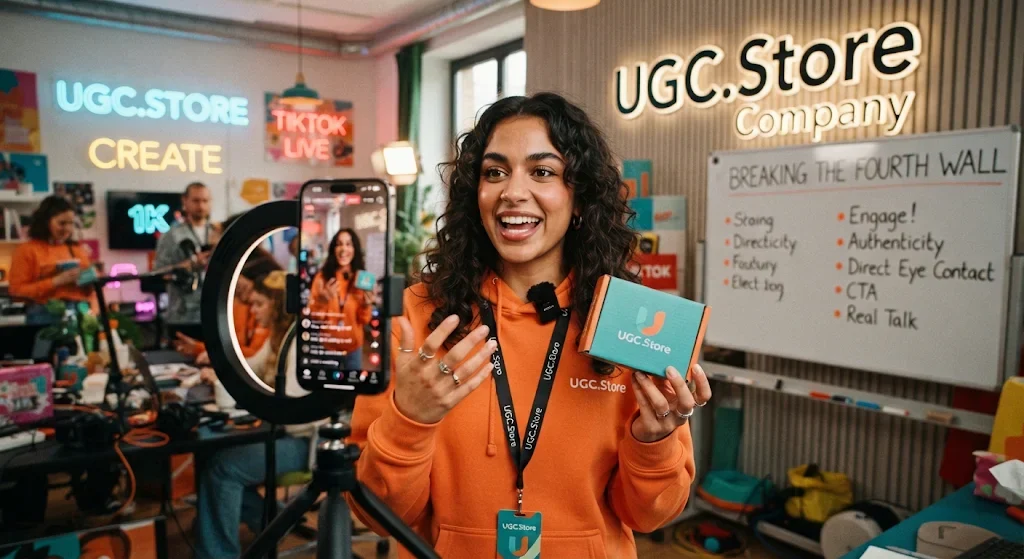
The default state of TikTok UGC is passive consumption. The viewer watches a screen, judges the content, and decides whether to scroll. The most powerful way to interrupt this passive state is by breaking the fourth wall. When a creator looks directly into the lens and speaks to the viewer as if they are the only person in the room, the dynamic shifts from a broadcast to a conversation. This strategy, known as direct camera engagement, is the secret weapon of the highest-converting creators. It leverages the psychological power of eye contact, parasocial bonding, and the illusion of intimacy. In a feed saturated with polished, distant advertisements, breaking the fourth wall makes the viewer feel seen. By mastering direct camera engagement strategies, brands can transform a cold, skeptical scroller into an engaged, trusting buyer who feels personally invited to take action.
Theoretical Basis and Psychology of Mechanics
The psychology behind breaking the fourth wall and direct camera engagement in TikTok UGC relies on the power of eye contact, parasocial interaction theory, and the illusion of intimacy. The human brain is evolutionarily wired to respond to a direct gaze.
The first mechanism is The Power of Eye Contact. In psychology, direct eye contact is a signal of trust, confidence, and sincerity. In a physical conversation, avoiding eye contact is a sign of deception. In TikTok UGC, the same rule applies. When a creator looks directly into the camera lens, they are simulating eye contact with the viewer. This triggers a subconscious response of trust and attention. The viewer feels like the creator is speaking specifically to them, which dramatically increases the likelihood of them pausing to listen.
The second mechanism is Parasocial Interaction Theory. This theory describes the one-sided relationships that audiences form with media figures. Breaking the fourth wall accelerates this process. By speaking directly to the viewer, acknowledging their presence, and using language like "you" and "we," the creator collapses the distance between the screen and the audience. The viewer feels like they are having a personal conversation with a friend. This parasocial bond is the foundation of direct camera engagement and is essential for building the trust required to sell a product.
The third mechanism is The Illusion of Intimacy. The TikTok platform is inherently intimate. The viewer is often watching on their phone in a private setting. When a creator breaks the fourth wall by whispering, leaning in close, or adopting a conversational tone, they match the viewer's intimate environment. This creates an illusion that the creator is physically present. The brain responds to this perceived proximity with heightened attention. The product pitch no longer feels like a mass-market advertisement; it feels like a secret shared between two people.
The fourth mechanism is The Conversation Loop. When a creator asks a direct question to the camera, they are creating a conversation loop. The viewer’s brain automatically prepares an answer, even if they are not speaking aloud. This mental engagement keeps the viewer anchored to the video. Direct camera engagement turns the video from a one-way presentation into a two-way dialogue. The viewer is not just watching; they are actively participating in the narrative, which leads to higher retention and higher conversion rates.
Step-by-Step Algorithm & Methodology
To successfully execute breaking the fourth wall and optimize direct camera engagement in TikTok UGC, you must structure the video around a direct, personal connection with the viewer.
Phase 1 — The Direct Address Hook (0–3 seconds). The video opens with the creator looking directly into the lens, speaking directly to the viewer. There is no setup, no introduction, and no product. The tone is personal and urgent, as if the creator has just run into the viewer on the street.
Example: "Stop scrolling. I need to tell you something."
Phase 2 — The Empathetic Connection (3–10 seconds). The creator names the viewer's problem or frustration. They use language that makes the viewer feel understood. The camera stays on the creator's face, maintaining continuous eye contact.
Example: "I know you are tired of wasting money on things that do not work. I was too."
Phase 3 — The Confessional Reveal (10–18 seconds). The creator introduces the product as a personal discovery. They do not hold it up like a salesperson; they show it as if they are letting the viewer in on a secret. The camera might lean in closer, creating a sense of intimacy.
Example: "I found this, and I was skeptical. But I tried it, and I have not looked back."
Phase 4 — The Direct Proof (18–25 seconds). The creator demonstrates the product, but they keep returning their gaze to the camera. They are not just showing the product; they are showing the product to the viewer. They narrate the proof as if they are explaining it to a friend.
Example: "Look at this result. I am not kidding. This is what it did for me."
Phase 5 — The Conversational CTA (25–30 seconds). The creator ends the video by speaking directly to the viewer one last time. The CTA is not a command; it is an invitation. They point to the bio, but their eyes stay locked on the lens.
Example: "If you want to try it, the link is in the bio. Let me know what you think."
Ready-to-Use Working Templates & Scripts
Script One: The "Secret Reveal" (Format: Skincare/Beauty UGC, 32 seconds).
Direct Address Hook (0-3s): Creator looking directly at the camera, whispering slightly. Audio: "Okay, stop scrolling. I have to tell you about this because I know you are struggling with the same thing."
Empathetic Connection (3-10s): Creator leans in. Audio: "I know you have tried every serum and every cream. I know you are tired of your skin feeling red and irritated."
Confessional Reveal (10-18s): Creator pulls out a serum, but does not hold it up high. They hold it close to their face. Audio: "A friend gave me this, and I was so skeptical. But I tried it, and it changed everything."
Direct Proof (18-25s): Creator applies the serum, looking back at the camera. Audio: "It is not magic. It takes a week. But look at my skin now."
Conversational CTA (25-32s): Creator smiles, looking directly at the lens. Audio: "I put the link in the bio. I really think it will help."
Script Two: The "Work Struggle" (Format: B2B SaaS UGC, 34 seconds).
Direct Address Hook (0-3s): Creator looking directly at the camera, looking tired. Audio: "If you are managing a team, you need to hear this."
Empathetic Connection (3-10s): Creator sighs. Audio: "I know what it feels like to be drowning in status updates and missed deadlines. I have been there."
Confessional Reveal (10-18s): Creator opens a SaaS app on a laptop, but talks to the camera. Audio: "We started using this tool to try and fix it. I thought it was just another dashboard."
Direct Proof (18-25s): Screen recording shows the clean workflow. Audio: "But look at this. It is actually organized. I am not guessing anymore."
Conversational CTA (25-34s): Creator looks back at the lens. Audio: "If your team is a mess, I put the link in the bio. Trust me, it is worth a look."
Script Three: The "Money Hack" (Format: Finance App UGC, 36 seconds).
Direct Address Hook (0-3s): Creator looking directly at the camera, holding a coffee mug. Audio: "I need to ask you a question. Do you actually know where your money is going?"
Empathetic Connection (3-10s): Creator nods sympathetically. Audio: "I did not. I was spending money on subscriptions I forgot about, and I felt terrible about it."
Confessional Reveal (10-18s): Creator shows the finance app on their phone. Audio: "Then I downloaded this app. It is not a magic fix, but it showed me the truth."
Direct Proof (18-25s): Screen recording shows the app finding hidden fees. Audio: "It flagged three subscriptions I forgot about. I cancelled them and saved fifty bucks."
Conversational CTA (25-36s): Creator looks at the camera. Audio: "If you want to find your hidden money, the link is in the bio. Let me know what you find."
Comparative Analysis Matrix
| Parameter | Standard UGC (Third-Person Pitching) | Fourth-Wall Breaking UGC (Direct Engagement) |
|---|---|---|
| Primary Focus | Product features and benefits | The viewer's personal problem and the shared solution |
| Camera Angle | Wide shot, creator looking off-camera | Close-up, creator looking directly into the lens |
| Tone | Authoritative, salesy | Conversational, intimate, empathetic |
| Trust Mechanism | Relies on brand authority | Relies on eye contact and parasocial bonding |
| Ad Smell | High; feels like a commercial | Low; feels like a personal conversation |
| CTA | Aggressive command | Conversational invitation |
| Friction Point | The Third-Person Failure | The Fourth-Wall Fix |
|---|---|---|
| Viewer Disconnect | The viewer feels like a bystander | The viewer feels like a participant |
| Ad-Blindness | The polished pitch triggers a scroll | The direct address captures attention |
| Lack of Trust | The brand feels distant and faceless | The creator feels like a trusted friend |
| Forced Pitch | The creator talks at the viewer | The creator talks with the viewer |
| Benchmark Metric | Standard UGC (Third-Person) | Fourth-Wall UGC (Direct Engagement) |
|---|---|---|
| Hook Rate (3-second) | 50–60% | 75–85% |
| 15-Second Hold Rate | 20–30% | 50–60% |
| Comment Sentiment | Skeptical | Highly engaged and personal |
| CPA Variance | Baseline | 30–40% lower |
Real-World Case Study Breakdown
A B2B SaaS company selling a project management tool launched a TikTok UGC campaign with a polished, third-person presentation. The three-second view rate was 32%, and the CPA was unprofitable. The video opened with the creator looking at a laptop and saying, "Our software is the best way to manage a team." The audience rejected the distant, corporate pitch.
The strategic pivot adopted the breaking the fourth wall strategy. They hired a creator known for direct-to-camera advice. The winning asset opened with the creator looking directly into the lens, looking exhausted.
Direct Address Hook: "If you are managing a team right now, I am so sorry."
Empathetic Connection: "I know exactly how it feels. You are drowning in Slack messages, and nobody knows what is going on."
Confessional Reveal: The creator opened the SaaS app, still looking at the camera. "We tried this tool because we were desperate. It is not magic, but it actually organizes everything."
Direct Proof: The creator showed the clean dashboard, looking back and forth between the screen and the lens. "Look at this. It just tracks everything."
Conversational CTA: The creator leaned in. "If you are drowning, the link is in the bio. I hope it helps."
The campaign generated 1.4 million views. The three-second view rate jumped to 82%, and the CPA dropped by 45%. The comment section was flooded with managers saying, "I feel seen." The governing insight: the brand was selling project management, but the buyer needed to feel understood by a peer who had been through the same chaos.
Real-World Engineering & Creative Feedback
"Eye contact is everything. The moment you look away from the lens, you lose them. I tell every creator I work with: 'Do not look at the screen. Look through the glass into the viewer's soul.' The direct engagement is what makes them stay. It is a physical connection." — Tasha Moreau, UGC Creator, 48K followers
"We stopped writing scripts that sounded like presentations and started writing scripts that sounded like FaceTime calls. The conversion rate doubled. The audience does not want to be pitched to; they want to be talked to." — Ben Achterberg, Head of User Acquisition, Cartwheel SaaS
"The 'Confessional Reveal' works because it drops the corporate facade. When the creator admits they were struggling, the viewer trusts them. The direct camera engagement makes the viewer feel like they are in on a secret. It is the most powerful trust mechanism in UGC." — Priya Deshmukh, Creative Strategy Lead, Pixel & Pulse Agency
"The CTA has to be an invitation, not a command. When the creator looks directly at the viewer and says, 'Let me know what you think,' it creates a conversation. The viewer feels obligated to respond. The conversational CTA is what actually drives clicks." — Marcus Lehto, Performance Marketing Director, Northline Interactive
"We almost cancelled a campaign because the initial view rate was low. We realized the creator was looking at a monitor, not the lens. We reshot the entire video with her looking directly into the camera. The view rate doubled. The direct engagement saved the campaign." — Elena Vasquez, Brand Director, Mosaic SaaS
Production Self-Check Checklist
Direct Eye Contact — Is the creator looking directly into the camera lens, not at a monitor or the screen?
Conversational Hook — Does the video open with a direct, personal statement rather than an introduction?
No Product in First 3 Seconds — Is the product absent from the opening frame to prioritize the human connection?
Empathetic Language — Does the script use "you" and "I" to create a sense of shared experience?
Intimate Framing — Is the camera positioned close enough to create a sense of physical proximity?
Honest Limitation — Does the creator admit to a struggle or a flaw to build trust?
Conversational CTA — Is the call to action framed as an invitation rather than a command?
Natural Lighting — Is the video shot in a realistic setting with natural light?
Text Legibility — Is the text overlay subtle and integrated into the aesthetic?
Muted View Compatibility — Can the story and the emotion be understood with the sound off?
Advanced FAQ
How do you maintain direct eye contact without looking robotic?
The key is to treat the camera lens as a person's eyes. Imagine you are talking to a friend sitting right in front of you. It is okay to blink, nod, and move slightly. The goal is not to stare intensely, but to create a sense of natural, engaged conversation. Looking away occasionally is natural, but always return your gaze to the lens when making a key point.
What is the biggest mistake brands make when trying to break the fourth wall?
Looking at the monitor instead of the lens. This creates a subtle but noticeable disconnect. The viewer feels like the creator is talking to someone else. The illusion of intimacy is broken. It requires practice to ignore the monitor and look directly into the glass, but it is the most important technical skill for direct camera engagement.
How does breaking the fourth wall change for B2B enterprise vs. B2C consumer products?
For B2B enterprise, the direct address is professional and empathetic. It should sound like a trusted colleague sharing a survival tactic. For B2C consumer, the direct address is more personal and emotional. It should sound like a best friend sharing a secret. The tone is different, but the direct eye contact is the same.
Should the creator use a script or speak naturally?
A script is necessary for structure, but the delivery must sound natural. The creator should memorize the key beats and then improvise the language. Reading from a teleprompter destroys the illusion of direct engagement. The pauses, the filler words, and the imperfect delivery are what make the video feel real.
What is the right measurement stack for direct engagement UGC beyond CPI?
The primary metric is three-second view rate, which should be high because the direct address captures attention immediately. The secondary metric is comment sentiment, looking for comments like "I feel seen" or "This is exactly my problem." The third metric is direct traffic to the landing page, which indicates that the conversational CTA successfully drove curiosity.
Custom Contextual Conclusion
Breaking the fourth wall is the most effective way to cut through the noise of TikTok UGC. It requires the creator to drop the corporate facade and speak directly to the viewer as a peer. The brands that master direct camera engagement understand that the viewer does not want to be marketed to; they want to be spoken to. The eye contact is the hook. The empathy is the proof. The conversation is the conversion.

Comments
I have been running UGC for a B2B software company for six months and this article just made me realize why our polished product demos have been failing. We have been showing our features and our beautiful dashboards, and our three-second view rate has been stuck at 30%. The "Breaking the Fourth Wall" framework explains everything. We were selling the product, but the buyer needed to feel understood. The idea of starting the video with the creator looking directly into the lens and saying, "I know you are struggling" is the exact hook we have been missing. The "Direct Address Hook" is going straight into our next testing sprint. We have all had those moments where we felt like we were drowning in work. Showing that empathy is what builds trust. The "Conversational CTA" is also going into our production guide. We have been using aggressive sales language, and the data shows that a personal invitation is what actually drives clicks. We are re-writing our entire script library to include direct eye contact. This is the most actionable guide to building trust I have read.