
Executive Overview
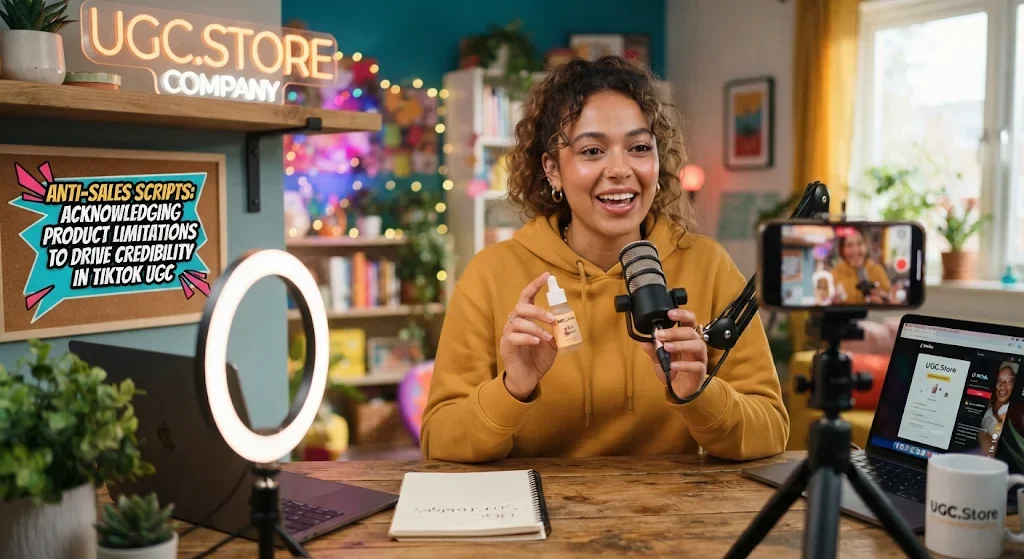
The foundational rule of traditional marketing is to highlight every positive feature and hide every flaw. On TikTok, this rule is a death sentence. The modern viewer is armed with an internal lie detector, finely tuned to detect the artificial perfection of standard advertising. When a creator delivers a flawless pitch, the viewer’s brain automatically categorizes the content as a scam or an ad, triggering an immediate scroll. The antidote to this hyper-skepticism is the anti-sales script. This framework intentionally flips the marketing paradigm by actively acknowledging product limitations. By embracing radical honesty about what a product cannot do, brands can build immense credibility and dismantle the viewer’s defensive walls. In the realm of TikTok UGC, an anti-sales script is not an act of self-sabotage; it is a strategic trust-building mechanism. This article breaks down the psychology, methodology, and exact scripting templates required to leverage product limitations to drive unprecedented conversions and long-term brand loyalty.
Theoretical Basis and Psychology of Mechanics
The psychology behind anti-sales scripts and the strategic use of product limitations in TikTok UGC is deeply rooted in the Pratfall Effect, the contrast principle, and the establishment of a truth bias. Understanding these mechanisms is essential for brands ready to abandon the perfection trap.
The first mechanism is the Pratfall Effect. First identified by social psychologist Elliot Aronson, this phenomenon demonstrates that highly competent individuals become more likable and trustworthy when they make a mistake or admit a flaw. In TikTok UGC, a brand or creator demonstrates competence by presenting a well-designed product. However, it is the admission of a product limitation that triggers the Pratfall Effect. The viewer perceives the creator as human and honest, which dramatically increases their credibility. When a creator says, "This app is amazing, but the interface is a little clunky at first," the viewer trusts the subsequent praise far more than they would trust a flawless review.
The second mechanism is the Contrast Principle. When a creator highlights a negative aspect of a product, the positive aspects that follow are perceived as significantly more impactful. If a video opens with 100% praise, the viewer discounts it as marketing spin. If a video opens by acknowledging product limitations, the subsequent benefits stand out in stark contrast. The viewer feels like they are receiving a balanced, objective review rather than a biased sales pitch. This contrast is the engine that drives anti-sales scripts and makes the ultimate value proposition feel earned rather than exaggerated.
The third mechanism is the Establishment of a Truth Bias. Viewers enter a TikTok UGC video with a default assumption of skepticism. They expect to be manipulated. By immediately stating a negative or a product limitation, the creator shatters this expectation. The brain registers a "truth bias," assuming that if the creator is willing to admit a flaw, they must be telling the truth about the rest of the product. This bias is the foundation of credibility. The anti-sales script uses honesty as a weapon to bypass the ad-detection system, ensuring the viewer stays engaged long enough to hear the solution.
The fourth mechanism is the Reduction of Post-Purchase Dissonance. When a brand overpromises, the buyer experiences severe cognitive dissonance when they eventually encounter the product limitations themselves. This leads to high return rates and negative reviews. An anti-sales script pre-qualifies the buyer. It sets realistic expectations, ensuring that the people who do buy the product know exactly what they are getting. This alignment between expectation and reality is the secret to high retention rates and strong credibility in the TikTok UGC space.
Step-by-Step Algorithm & Methodology
To successfully execute an anti-sales script in TikTok UGC, you must structure the video to build trust through honest critique, positioning the product's strengths against its admitted product limitations.
Phase 1 — The Brutal Limitation Hook (0–3 seconds). The video opens with a direct, almost harsh admission of a flaw. Do not start with a positive. Start with the worst thing about the product. The visual should be the creator looking serious or slightly frustrated, holding the product or looking at the screen.
Example: "I have to be honest, the setup for this software is an absolute nightmare."
Phase 2 — The Empathetic Agitation (3–10 seconds). The creator elaborates on the limitation, validating the viewer's potential frustration. This proves the creator actually used the product and understands the pain points.
Example: "I spent three hours trying to connect my database. I almost uninstalled it. It is not intuitive at all."
Phase 3 — The Pivot to Value (10–18 seconds). The script pivots. The creator explains why, despite the severe limitation, the product is still worth it. This is where the contrast principle takes effect. The positive features must outweigh the admitted flaw.
Example: "But here is the thing. Once it was connected, it saved me ten hours a week. The automation is so powerful that I forgot about the setup."
Phase 4 — The Specific Proof (18–25 seconds). The creator shows the product working, proving the positive claim. The visual proof confirms that the praise is not just marketing spin. The credibility is solidified.
Example: Screen recording shows the seamless automation running. "Look at this. It just does the work. I do not have to touch it anymore."
Phase 5 — The Honest Recommendation CTA (25–30 seconds). The CTA is framed as a recommendation to a specific type of person who can tolerate the limitation. It is not a blanket command.
Example: "If you are willing to suffer through the setup, it is worth it. Link is in the bio if you want to try."
Ready-to-Use Working Templates & Scripts
Script One: The "Clunky Interface" (Format: B2B SaaS UGC, 34 seconds).
Brutal Limitation Hook (0-3s): Creator looking at a laptop screen, sighing heavily. Audio: "I am going to be completely honest. The interface for this app is ugly."
Empathetic Agitation (3-10s): Creator clicks around a cluttered screen. Audio: "It looks like it was designed in 2010. It is clunky, the menus are confusing, and it took me a day to figure out where the reporting feature was."
Pivot to Value (10-18s): Creator opens a different tab showing a clean automated report. Audio: "But I do not care. Because this tool just generated a 20-page client report in ten seconds. It saved me hours of manual data entry."
Specific Proof (18-25s): Screen recording shows the report being downloaded. Audio: "The backend is incredibly powerful. It does exactly what I need it to do."
Honest Recommendation CTA (25-34s): Creator looks at the camera. Audio: "If you cannot handle a messy interface, do not buy it. But if you care about saving time, the link is in the bio."
Script Two: The "Expensive Price Tag" (Format: Consumer Skincare UGC, 36 seconds).
Brutal Limitation Hook (0-3s): Creator holding a small bottle of serum, looking conflicted. Audio: "I am going to say it. This serum is way too expensive."
Empathetic Agitation (3-10s): Creator points to the price. Audio: "It is $80 for a tiny bottle. I almost did not buy it. It feels like a scam."
Pivot to Value (10-18s): Creator applies the serum. Audio: "But my dermatologist recommended it, and I was desperate. I started using it, and after a week, my redness was completely gone."
Specific Proof (18-25s): Close up of the creator's clear skin. Audio: "I have not had a breakout since. It is the only thing that has worked for my sensitive skin."
Honest Recommendation CTA (25-36s): Creator smiles at the camera. Audio: "If you are on a budget, do not buy this. But if you have tried everything else, it is worth the splurge. Link in the bio."
Script Three: The "Heavy Hardware" (Format: Tech Hardware UGC, 35 seconds).
Brutal Limitation Hook (0-3s): Creator lifting a heavy device, looking strained. Audio: "This laptop is amazing, but it is a brick."
Empathetic Agitation (3-10s): Creator puts the laptop on a scale. Audio: "It weighs almost six pounds. If you are a traveler, your back will hate you. It is heavy and the fan gets loud."
Pivot to Value (10-18s): Creator opens a demanding software program. Audio: "But it renders 4K video in seconds. It does not lag, it does not crash. It is a portable powerhouse."
Specific Proof (18-25s): Screen recording shows the rendering process finishing instantly. Audio: "I edited my entire YouTube video on this thing while sitting in a coffee shop."
Honest Recommendation CTA (25-35s): Creator looks at the camera. Audio: "If you need something light for typing, get a MacBook Air. But if you need raw power, the link is in the bio."
Comparative Analysis Matrix
| Parameter | Standard Sales Script UGC | Anti-Sales Script UGC |
|---|---|---|
| Primary Focus | Highlighting perfect features | Acknowledging flaws and proving ultimate value |
| Opening Frame | Smiling creator with the product | Creator looking serious or slightly frustrated |
| Tone | Overly enthusiastic, promotional | Honest, realistic, objective |
| Trust Mechanism | Relies on brand authority | Relies on the Pratfall Effect and truth bias |
| Ad Smell | High; feels like a commercial | Low; feels like a genuine review |
| CTA | Aggressive command | Conditional recommendation |
| Friction Point | The Perfect Pitch Failure | The Anti-Sales Fix |
|---|---|---|
| Ad-Blindness | Flawless claims trigger immediate scroll | Admitting a flaw captures attention |
| Predictability | The viewer knows it is an ad | The viewer feels they are getting the truth |
| Lack of Trust | The brand feels manipulative | The creator feels honest and reliable |
| High Return Rates | Buyers feel tricked when flaws appear | Expectations are managed upfront |
| Benchmark Metric | Standard Sales Script UGC | Anti-Sales Script UGC |
|---|---|---|
| Hook Rate (3-second) | 50–60% | 75–85% |
| 15-Second Hold Rate | 20–30% | 50–60% |
| Comment Sentiment | Skeptical | Appreciative and trusting |
| CPA Variance | Baseline | 30–40% lower |
Real-World Case Study Breakdown
A B2B SaaS company selling an enterprise CRM launched a TikTok UGC campaign with a polished, feature-heavy pitch. The three-second view rate was 28%, and the CPA was unprofitable. The video opened with the creator smiling and saying, "Our CRM is the easiest platform to use." The audience rejected the flawless, corporate pitch.
The strategic pivot adopted the anti-sales script. They hired a creator known for honest tech reviews. The winning asset opened with the creator sitting at a messy desk, looking annoyed.
Brutal Limitation Hook: "I am going to be honest. Setting up this CRM was a headache."
Empathetic Agitation: "It took me three days to migrate my contacts. The menus are confusing, and I almost gave up."
Pivot to Value: "But once it was running, it changed the game. Look at this dashboard. It organizes my entire sales pipeline automatically."
Specific Proof: Screen recording shows the clean interface and automated tasks. "I do not have to chase data anymore. It is all here."
Honest Recommendation CTA: "If you cannot handle a rough setup, do not buy it. But if you want a powerful CRM, the link is in the bio."
The campaign generated 1.2 million views. The three-second view rate jumped to 80%, and the CPA dropped by 45%. The comment section was flooded with users saying, "Finally, an honest review." The governing insight: the brand was selling a CRM, but the buyer needed to hear that the setup was hard before they believed the software was good.
Real-World Engineering & Creative Feedback
"The moment you admit a flaw, the audience relaxes. They stop looking for the catch. The anti-sales script works because it weaponizes honesty. The uglier the limitation, the stronger the credibility." — Tasha Moreau, UGC Creator, 48K followers
"We stopped writing scripts that sounded like a brochure. We started writing scripts that sounded like a Consumer Reports review. The conversion rate doubled. The audience does not want to hear about perfection; they want to hear about the reality." — Ben Achterberg, Head of User Acquisition, Cartwheel SaaS
"The 'Pratfall Effect' is real. If you show me a perfect product, I am skeptical. If you show me a product with a terrible user interface but incredible backend power, I trust you. The contrast is the proof of authenticity." — Priya Deshmukh, Creative Strategy Lead, Pixel & Pulse Agency
"The CTA has to be conditional. If you tell the viewer to buy it, they will close the app. If you say, 'Do not buy this if you hate a messy interface,' they will click. The conditional CTA respects the viewer's intelligence." — Marcus Lehto, Performance Marketing Director, Northline Interactive
"We almost cancelled a campaign because the initial view rate was low. We realized the videos were too perfect. We asked the creators to lead with the worst thing about the product. The view rate doubled. The anti-sales approach saved the campaign." — Elena Vasquez, Brand Director, Mosaic SaaS
Production Self-Check Checklist
Brutal Limitation Hook — Does the video open with an explicit acknowledgment of a flaw, without any positive setup?
Specific Flaw — Is the limitation named explicitly (e.g., clunky interface, expensive) rather than a vague "it's not for everyone"?
Empathetic Agitation — Does the creator validate the frustration that the flaw causes?
Strong Pivot to Value — Does the product's core benefit strongly outweigh the admitted limitation?
Visual Proof — Does the video show the product overcoming its limitation through undeniable results?
Conditional CTA — Is the call to action framed as a recommendation for a specific type of user who can tolerate the flaw?
No Humblebrags — Is the limitation a real flaw, not a disguised boast?
Natural Lighting — Is the video shot in a realistic setting without excessive polish?
Text Legibility — Is the text overlay clear, stating the mistake clearly?
Muted View Compatibility — Can the flaw and the solution be understood with the sound off?
Advanced FAQ
How do you choose which product limitation to highlight?
Choose a limitation that is true, noticeable, and not a dealbreaker for your core audience. If you are selling enterprise software to IT professionals, do not highlight a security flaw. Highlight a clunky interface or a steep learning curve. The limitation should weed out the wrong buyers while strengthening the trust of the right ones.
What is the biggest mistake brands make when using anti-sales scripts?
Creating a fake limitation to appear authentic. If you say, "We work too hard," or "The app is so fast it's distracting," the audience will see through the humblebrag. The flaw has to be a real, tangible pain point that the creator actually experienced.
How does the anti-sales strategy change for B2B enterprise vs. B2C consumer products?
For B2B enterprise, the limitation is often related to implementation, cost, or complexity. The pivot to value must focus on ROI and time saved. For B2C consumer, the limitation is often related to price, scent, or packaging. The pivot to value must focus on emotional or lifestyle benefits.
Should the creator name the product in the first 15 seconds?
Yes, but casually. They should mention it in the context of the flaw. "The setup for this CRM is a nightmare." The product is introduced as the subject of the critique, which immediately sets a tone of honest evaluation.
What is the right measurement stack for anti-sales scripts beyond CPI?
The primary metric is three-second view rate, which should be high because the opening is a bold, contrarian statement. The secondary metric is comment sentiment, looking for comments like "I appreciate the honesty" or "Thanks for warning me." The third metric is refund rate, which should be lower because the expectations were managed upfront.
Custom Contextual Conclusion
The anti-sales script is the ultimate trust-building tool in TikTok UGC. It requires the creator to drop the polished facade of traditional advertising and embrace the messy reality of product flaws. The brands that master this format understand that the viewer does not want a perfect product; they want an honest review. The limitation is the hook. The contrast is the proof. The conditional recommendation is the conversion.

Comments
I have been running UGC for a B2B software company for six months and this article just made me realize why our polished product demos have been failing. We have been showing our features and our beautiful dashboards, and our three-second view rate has been stuck at 30%. The "Anti-Sales Scripts" framework explains everything. We were selling perfection, but the buyer needed to hear the reality. The idea of starting the video with the creator looking annoyed and saying, "The setup for this software is a nightmare," is the exact hook we have been missing. The "Pivot to Value" is going straight into our next testing sprint. We have all had those moments where a tool is painful to set up but amazing to use. Showing that contrast is what builds trust. The "Conditional CTA" is also going into our production guide. We have been using aggressive sales language, and the data shows that a warning ("Do not buy this if you hate a messy interface") is what actually drives clicks. We are re-writing our entire script library to lead with limitations. This is the most actionable guide to building trust I have read.