
5 UGC Video Formats Every New Creator Should Master First
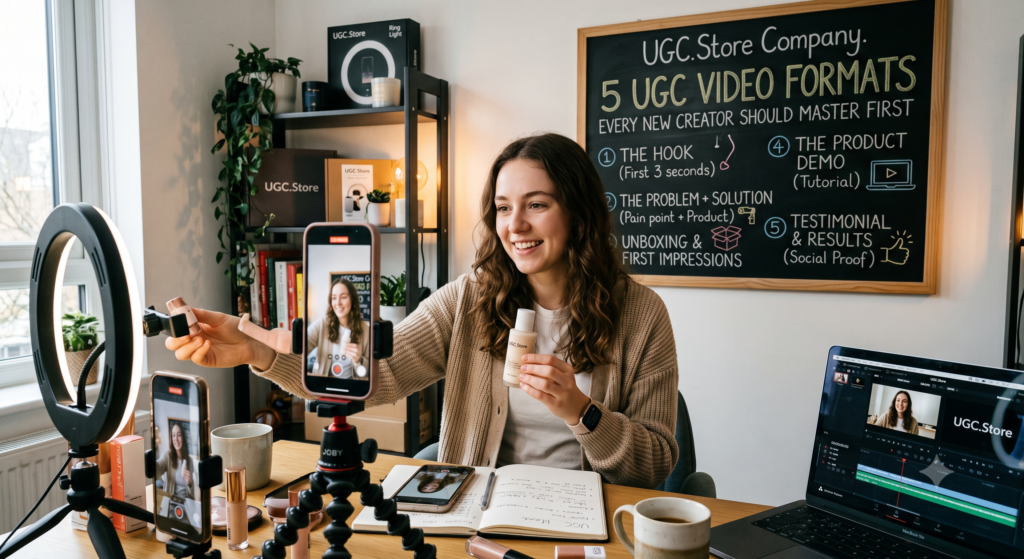
When brands browse UGC creator portfolios, they are not looking for Oscar-worthy cinematography. They are not impressed by slow-motion drone shots, color-graded footage, or cinematic transitions that took three hours to render. What they are looking for is something far simpler and far more valuable: proof that you can create content that sells. And the way you prove that is by demonstrating mastery over the five core UGC video formats that drive the vast majority of conversions across TikTok, Instagram Reels, YouTube Shorts, and paid social advertising in 2026.
Every piece of UGC content that has ever convinced a viewer to click “Add to Cart,” download an app, or sign up for a newsletter falls into one of these five categories. The unboxing that builds anticipation before the product is even revealed. The testimonial that feels like advice from a trusted friend. The tutorial that removes the fear of a complicated purchase. The problem-solution video that makes the viewer feel understood before they even know what is being sold. And the lifestyle integration that slips a product into a relatable daily routine so seamlessly that the viewer forgets they are watching marketing at all.
If you are a new UGC creator, your entire early career should revolve around these five formats. Not because they are the only types of content that exist, but because they are the only types that brands consistently pay for, test at scale, and request again and again. A portfolio that contains strong examples of all five is a portfolio that tells any brand, in any niche, “I can handle whatever campaign you throw at me.” A portfolio that is missing even one of them is a portfolio with a hole that brands will notice, question, and potentially pass over in favor of a more complete creator.
This guide breaks down each format in exhaustive detail. We will cover exactly how to film them, why they convert, what brands look for in each one, and how to adapt them to your specific niche. By the end, you will know not just what to film, but how to film it in a way that makes brands stop scrolling and start booking.
“When I started, I tried to invent my own ‘unique’ content style. I spent weeks filming artsy product montages with music and text overlays. Zero brands cared. Then I filmed a simple 30-second testimonial looking directly into my phone camera, and a skincare brand paid me $200 for it. That was the moment I realized UGC is not about creativity for creativity’s sake. It is about formats that convert, filmed authentically.”
— Priya K., UGC Creator (Beauty & Wellness), $7K/month
Format 1: The Unboxing — Building Anticipation and Trust
The unboxing video is the gateway drug of UGC content. It is the format that requires the least scripting, the least on-camera experience, and the least creative risk — yet it delivers some of the highest engagement rates of any UGC format when done correctly. At its core, an unboxing video is simply a recording of a creator opening a product package for the first time and sharing their genuine reactions. But the simplicity is deceptive. The best unboxing videos are carefully structured narratives that guide the viewer through a journey of curiosity, discovery, and desire.
The psychology behind the unboxing format is rooted in anticipation. Human brains are wired to experience pleasure not just from receiving a reward, but from the expectation of receiving it. When a viewer watches a creator slowly peel back packaging, reveal layers of tissue paper, and finally unveil a product, their brain mirrors the creator’s excitement. This mirroring creates an emotional investment in the product before the creator has even shared a single opinion about it. By the time the creator says, “Wow, this feels really premium,” the viewer has already decided that the product is worth considering.

For new UGC creators, the unboxing is the perfect starting format because it requires minimal performance energy. You do not need to be charismatic, funny, or highly animated. You simply need to be genuinely curious and verbally present. Talk through what you are seeing. Comment on the packaging quality. Mention the weight and texture of the product. Read any included cards or inserts aloud. These details might seem trivial, but they are exactly what separates a converting unboxing video from a boring one. A viewer who hears, “They included a handwritten thank-you card,” or “The box has this magnetic closure that feels really satisfying,” begins to form an emotional attachment to the brand’s attention to detail.
The structure of a high-converting unboxing UGC video follows a simple three-act formula. Act one is the hook, which should happen in the first three seconds. Hold the sealed package up to the camera and say something specific: “I have been waiting three weeks for this serum to arrive, and it finally came today.” That specificity creates intrigue. Act two is the unboxing itself, filmed in real time without cuts. Let the viewer experience the reveal alongside you. Do not rush. The slower you go, the more anticipation builds. Act three is the first impression, where you share your initial thoughts on the product’s look, feel, and smell. End with a soft call to action: “I am going to test this for a week and report back, but first impressions are really strong.”
Brands love unboxing UGC videos because they perform exceptionally well as organic content and as the opening segment of longer ad creatives. A strong unboxing hook can increase video completion rates by 20–30% because viewers feel compelled to see what is inside the package. For your portfolio, film at least two unboxing videos in your chosen niche — one for a physical product with impressive packaging, and one for a simpler product where your commentary carries the entertainment value.
Format 2: The Testimonial — The Conversion Workhorse
If the unboxing is the entry point, the testimonial is the heavy lifter. No UGC format has generated more direct revenue for brands than the simple, direct-to-camera testimonial. It is the format that requires the most authenticity, the most on-camera comfort, and the most persuasive speaking skills — which is exactly why brands pay premium rates for creators who can deliver testimonials that feel genuine rather than scripted.
The testimonial format is deceptively simple. The creator looks directly into the camera and shares their experience with a product. But within that simplicity lies an ocean of nuance. A bad testimonial feels like a late-night infomercial. The creator is too enthusiastic, too polished, too obviously reading from a script. The viewer’s skepticism alarm goes off immediately, and they scroll away. A great testimonial feels like a conversation over coffee. The creator is slightly imperfect. They pause to think. They use casual language. They share a specific, relatable result rather than generic praise.

The key to a converting testimonial is what psychologists call “parasocial authenticity” — the feeling that the creator is speaking directly to the viewer as a peer, not performing for an audience. This is why the most effective UGC testimonials are filmed in natural environments rather than studios. A creator sitting on their bed, in their kitchen, or at their desk feels more trustworthy than a creator in front of a ring light with a branded backdrop. The messiness of real life is what makes UGC work.
Structurally, the testimonial should follow a problem-agitation-solution framework, but delivered conversationally. Start by identifying a relatable struggle: “I have tried probably fifteen different moisturizers, and every single one either broke me out or felt like grease on my face.” That is the problem. Then agitate it slightly: “I was honestly ready to give up and just accept that my skin would always be dry and irritated.” Finally, introduce the product as the solution, but do it with restraint: “Then I tried this one, and after about a week, I noticed my skin was actually staying hydrated through the entire day. Not just for an hour after I put it on. The whole day.”
Notice what is missing from that example. There is no “This is the best product ever!” There is no “You need to buy this right now!” There is no exaggerated enthusiasm. The persuasion comes from specificity and restraint. The creator shares a concrete timeframe — one week. A concrete result — all-day hydration. And a concrete comparison — not just for an hour. Those specifics are what make the viewer believe the testimonial is real.
For your portfolio, film at least two testimonial videos. One should be a straightforward “why I love this product” testimonial. The other should be a transformation testimonial where you show a before-and-after result, even if the transformation is subtle. Brands in every niche — from SaaS to skincare to supplements — rely on testimonials as the backbone of their UGC ad strategy. If you can deliver this format convincingly, you will never run out of work.
Format 3: The Tutorial — Removing Purchase Anxiety
The tutorial is the UGC format that answers the question every hesitant buyer asks: “But will I actually know how to use this?” Whether the product is a complex tech gadget, a multi-step skincare routine, or a project management software, purchase anxiety is one of the biggest barriers to conversion. The tutorial format exists to demolish that barrier by showing, step by step, that the product is easy to use and worth the learning curve.
What makes tutorial UGC different from traditional how-to content is the perspective. A brand-produced tutorial is polished, comprehensive, and often boring. It shows every feature in excruciating detail because the marketing team wants to justify the product’s price tag. A UGC tutorial is selective, personal, and focused on the outcome. The creator does not show every feature. They show the three steps that actually matter to a new user. They do not use technical jargon. They use the language of someone who figured it out yesterday and is excited to share the shortcut.

The most effective tutorial UGC videos begin with a promise rather than an introduction. Instead of “Today I am going to show you how to use this air fryer,” the hook should be “I am going to show you how to make crispy restaurant-quality fries in under 15 minutes with zero oil.” That promise tells the viewer exactly what they will gain by watching. It answers the implicit question, “Why should I keep watching this instead of scrolling?”
The body of the tutorial should be ruthlessly streamlined. Identify the three to five steps that get the user from zero to result. Film each step in a single, uncut take whenever possible. Jump cuts are fine for removing dead air, but excessive editing undermines the authenticity that makes UGC effective. Speak directly to the viewer using second-person language: “You just press this button,” not “I press this button.” That small linguistic shift makes the viewer imagine themselves performing the action.
End the tutorial with a result shot and a soft validation. Show the finished meal, the organized closet, the glowing skin, or the completed project. Then say something like, “That took me literally five minutes, and I am not exactly a tech person.” That self-deprecating validation reassures the viewer that if this creator can do it, so can they.
Brands use tutorial UGC heavily in retargeting campaigns. When a viewer has visited a product page but has not purchased, showing them a 30-second tutorial that removes their fear of complexity is often the final nudge they need. For your portfolio, include at least one tutorial video that demonstrates a clear before-and-after process in under 60 seconds.
Format 4: Problem/Solution — The Empathy Engine
The problem/solution format is the most psychologically sophisticated of the five core UGC formats. It does not begin with the product. It begins with pain. And not just any pain — a specific, visceral, relatable pain that the target customer experiences regularly. The creator spends the first half of the video making the viewer feel understood. Only then do they introduce the product as the unexpected solution.
This format works because it flips the traditional advertising script. Most ads say, “Here is our product, and here is why it is great.” The problem/solution UGC video says, “Here is a problem you have, and oh by the way, this product fixes it.” The viewer does not feel sold to. They feel seen. And when people feel seen, they trust the person who sees them.
The hook is everything in this format. You have three seconds to make the viewer nod and think, “That is literally me.” Some of the highest-converting problem/solution hooks in UGC history are brutally simple: “I have not slept through the night in six months.”“My back hurts every time I sit at my desk.”“I have wasted hundreds of dollars on skincare that did nothing.” These hooks work because they are specific enough to feel personal and broad enough to apply to thousands of people.

After the hook, the video should spend 10–15 seconds agitating the problem. Describe the failed solutions you have already tried. The expensive products that disappointed you. The habits you attempted and abandoned. The frustration of feeling like nothing works. This agitation builds emotional investment. The viewer is no longer passively watching. They are actively hoping you will offer them a way out.
The product introduction should feel like an afterthought, even though it is the entire point of the video. “Then a friend randomly sent me this link, and I figured I had nothing left to lose.” That casual framing — a friend sent it, you had nothing to lose — removes the sales pressure. The viewer does not feel like they are being pitched. They feel like they are overhearing a recommendation.
The solution portion should focus on one specific result rather than a list of features. Do not say, “This has vitamin C, hyaluronic acid, and niacinamide.” Say, “After two weeks, my skin stopped flaking entirely.” One concrete result beats ten feature bullets every time.
Brands in high-consideration categories — supplements, software, mattresses, fitness equipment — rely heavily on problem/solution UGC because these are purchases where customers need emotional justification before they will spend money. For your portfolio, film one problem/solution video that follows this exact emotional arc: hook, agitation, casual introduction, specific result.
Format 5: Lifestyle Integration — The Invisible Sell
The lifestyle integration format is the most subtle and, in many ways, the most difficult to master. Unlike the testimonial, which is explicitly about the product, or the tutorial, which is explicitly about how to use it, the lifestyle integration format embeds the product into a broader narrative about the creator’s daily life. The product is not the star of the show. It is a supporting character. And that is precisely why it works.
Human beings are social learners. We do not just buy products because we are told they are good. We buy them because we see people we relate to using them in contexts we aspire to. When a creator films a “get ready with me” video and casually applies a serum while talking about their morning routine, the viewer absorbs the product’s value without conscious resistance. There is no sales pitch to reject because there is no sales pitch at all. There is just a person living their life, and the product happens to be part of it.

The key to effective lifestyle integration UGC is natural placement. The product should appear at a moment where it genuinely fits the narrative. If the video is about a productive morning routine, the creator might make coffee, stretch, check their planner, and then apply a face cream while mentioning that this five-minute ritual helps them feel put-together before work. The product is not the topic. The topic is productivity. The product is simply one element of the creator’s productive morning.
This format requires the most on-camera comfort because the creator is not following a tight script. They are vamping, storytelling, and maintaining viewer engagement while subtly showcasing a product. The best lifestyle integration creators have a conversational energy that makes viewers feel like they are FaceTiming a friend. They pause naturally. They laugh at themselves. They show small imperfections — a messy bed in the background, a coffee spill, a hair out of place. These imperfections are what make the content feel authentic rather than staged.
For brands, lifestyle integration UGC is invaluable because it performs exceptionally well as organic content. Viewers share these videos not because they want to promote a product, but because they relate to the narrative. A “day in my life” video featuring a productivity app gets shared in group chats with messages like, “This is literally my morning.” That organic sharing is worth more than any paid ad placement because it comes with built-in social proof.
For your portfolio, include one lifestyle integration video that shows a product naturally embedded in a relatable daily activity. The activity itself — morning routine, gym session, work-from-home setup, evening wind-down — should be something you actually do. Authenticity cannot be faked in this format, and viewers can detect performative lifestyle content instantly.
How Brands Use These 5 Formats Across Platforms
Understanding the formats is only half the battle. Understanding where and how brands deploy them is what separates portfolio builders from income earners. Each UGC format has natural homes on specific platforms and campaign types, and smart creators tailor their delivery accordingly.

TikTok favors the problem/solution and lifestyle integration formats because the algorithm rewards high completion rates and emotional engagement. A viewer who feels understood in the first three seconds is far more likely to watch to the end, and TikTok promotes videos with strong completion metrics.
Instagram Reels performs best with testimonials and unboxings because the platform’s shopping infrastructure allows viewers to click directly from the video to the product page. A testimonial that builds trust, followed by an instant purchase path, is a conversion machine.
YouTube Shorts is the natural home for tutorials because viewers on YouTube are already in a learning mindset. A 45-second tutorial that promises a specific skill or result fits perfectly into the Shorts ecosystem.
Facebook Ads rely heavily on testimonials and problem/solution videos because Facebook’s older demographic responds to direct persuasion and emotional storytelling more than trend-based content.
Amazon Product Detail Pages use unboxings and tutorials almost exclusively because shoppers on Amazon are in evaluation mode. They want to see what is in the box and how the product works before they commit to buying.
When you build your UGC.Store portfolio, organize your videos by format and note which platform each one is optimized for. This shows brands that you understand the strategic deployment of UGC content, not just the creation of it.
Building Your Format Mastery Portfolio
Your first five portfolio videos should be one of each format. Not two testimonials and three unboxings because those feel easiest. One of each. This demonstrates range, adaptability, and professional awareness.
As you gain experience, you can begin combining formats. A video that opens with an unboxing, transitions into a first-impression testimonial, and ends with a 10-second tutorial is a triple-threat piece of UGC content that brands will pay premium rates for. But do not attempt combinations until you have mastered the individual formats. Trying to hybridize before you understand the fundamentals produces messy, unfocused content that confuses viewers and fails to convert.
Create your creator profile on UGC.Store and upload one example of each of these five formats to maximize your discoverability across all campaign types.
Learn more about how we connect versatile creators with brands who need complete UGC strategies on our About Us page.
The Common Thread: Authenticity as a Skill
All five formats share one non-negotiable requirement: authenticity. Not the accidental authenticity of someone who happens to be charismatic on camera, but the deliberate authenticity of a creator who has learned to perform naturalness. This is the skill that separates hobbyists from professionals.
Authenticity in UGC does not mean turning the camera on and hoping for the best. It means scripting your hook so it feels spontaneous. It means rehearsing your testimonial until the pauses feel natural rather than nervous. It means planning your lifestyle integration so the product placement feels accidental rather than forced. The best UGC creators are not naturally authentic. They are authentically rehearsed.
Master these five formats. Practice them until they feel second nature. Film them, review them, and film them again. When you can deliver any one of them within an hour of receiving a brief, you are no longer a beginner. You are a professional UGC creator with a skill set that brands will pay for again and again.
