
How to Build a UGC Portfolio That Converts — Even With Zero Followers
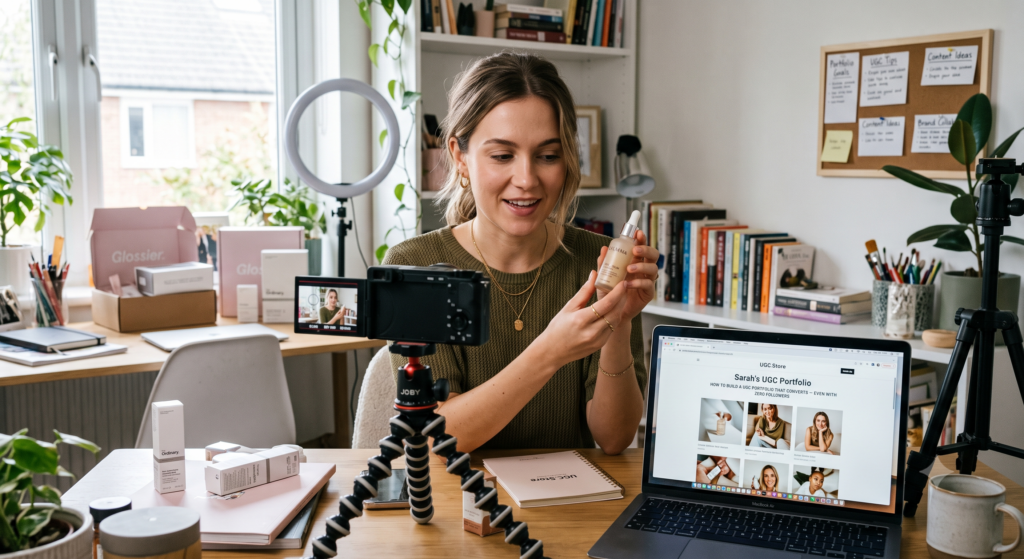
You have zero followers. Zero brand deals. Zero professional camera gear. And yet, you are about to build something that will make brands pay you real money for your UGC content. Not because you are famous. Not because you have a massive audience. But because you know how to create UGC videos that sell.
A UGC portfolio is not a vanity project. It is a sales tool. It is the single most important asset you will own as a UGC creator — more important than your editing skills, more important than your niche, and more important than any connection you might have in the industry. Brands do not hire creators based on personality alone. They hire based on proof. And your portfolio is that proof.
This guide will show you exactly how to build a UGC portfolio that converts casual browsers into paying clients — even if you are starting from absolute zero.
“My portfolio had exactly four videos when I landed my first $300 UGC gig. The brand didn’t ask about my follower count. They watched my mock unboxing video for 15 seconds and said, ‘This is exactly what we need.’ Your portfolio is your only resume in this business.”
— Lena K., UGC Creator (Home & Lifestyle), $6K/month
Why Your UGC Portfolio Matters More Than Your Follower Count
Here is the truth that changes everything: UGC creators are not influencers. Brands do not pay you for access to your audience. They pay you for the content itself. A UGC video that a brand can run as a paid ad, post on their product page, or embed in an email campaign has value completely independent of who created it or how many followers that creator has.
This is why a UGC portfolio with ten strong mock videos will outperform an Instagram account with 50,000 followers and zero relevant content. The brand is not buying your reach. They are buying your ability to create authentic, conversion-driven UGC content.

Your portfolio answers three questions for every brand that visits it:
- Can this creator film? — Is the lighting decent? Is the audio clear? Is the framing intentional?
- Does this creator understand my niche? — Have they filmed content for similar products? Do they speak the language of my target customer?
- Will this content convert? — Does the hook grab attention? Is the pacing right? Does it feel authentic rather than salesy?
If your UGC portfolio answers yes to all three, you will get hired. It really is that simple.
The Portfolio Paradox: How to Show Work Without Having Work
Every beginner faces the same chicken-and-egg problem. Brands want to see your portfolio before they hire you. But you need products to create portfolio pieces. And you need portfolio pieces to get hired. So how do you break the loop?
The answer is mock UGC videos.
A mock video is a UGC-style video you create using products you already own. You are not publishing it as an ad. You are not claiming the brand hired you. You are simply demonstrating your creative skills using real products in a real environment. Every successful UGC creator started this way. It is industry standard, and brands expect it.

Here is what you need to film your first mock UGC videos:
- A smartphone from the last three years
- Natural light from a window
- Products you already have at home
- 30 minutes of focused time per video
That is it. No ring light. No DSLR. No fancy editing suite. The best UGC content looks homemade because it is supposed to look homemade. Your job is not to make a commercial. Your job is to make content that feels like a real person sharing a real opinion.
The 5 Core UGC Formats Every Portfolio Needs

A strong UGC portfolio demonstrates range. Brands want to know you can handle different types of content for different campaign goals. Your starter portfolio should include at least one example of each of these five core UGC formats:
1. The Unboxing
Film yourself opening a product package for the first time. Share your genuine first impressions. Talk about packaging, initial thoughts, and what excites you. This format works because it mirrors the real customer experience. It builds trust before the viewer even sees the product in action.
2. The Tutorial
Show how to use the product step by step. This works especially well for tech, beauty, kitchen gadgets, and SaaS products. The key is clarity. Speak slowly. Show each step visually. A confused viewer will not buy.
3. The Testimonial
Look directly into the camera and explain why you love the product. Share a specific result or transformation. “I have been using this serum for three weeks and my skin has never looked better.” Testimonials are the most versatile UGC format because they work across every platform and ad type.
4. Problem / Solution
Start with a relatable pain point. “I used to waste 20 minutes every morning trying to find my keys.” Then introduce the product as the solution. This format is pure conversion psychology. It makes the viewer feel understood before they even know what you are selling.
5. Lifestyle Integration
Film a “day in my life” or “get ready with me” where the product appears naturally in the background. The viewer sees the product as part of your routine, not as the star of the show. This is the most subtle UGC format, and it works because it feels the least like an ad.
Each video should be 15 to 60 seconds long. Film vertically for TikTok and Reels. Include captions — 80% of social video is watched without sound. And front-load your hook. The first three seconds determine whether a viewer stays or scrolls.
What Makes a UGC Portfolio Actually Convert
Not all portfolios are created equal. Some look pretty but never generate inquiries. Others look basic but land gigs consistently. The difference is not production value. It is strategic design.

Here is what separates converting portfolios from forgettable ones:
The Hook Is Everything
Brands will watch your video for three seconds before deciding whether to keep watching or move on. If your first three seconds are boring, it does not matter how good the rest of the video is. Start with energy, curiosity, or a bold statement. “I spent $200 on this gadget and I have thoughts.” That is a hook.
Niche Focus Beats Variety
A portfolio with ten beauty videos converts better than a portfolio with two beauty videos, two tech videos, two fitness videos, and four random clips. Specialization signals expertise. When a skincare brand sees ten skincare videos, they think, “This person understands my customer.” When they see a mix, they think, “This person is still figuring it out.”
Captions Are Non-Negotiable
Always include burned-in captions or subtitle files. Brands know that most video is consumed without sound. A UGC video without captions is a UGC video that will underperform. Show brands you understand this by captioning every portfolio piece.
Social Proof Builds Trust
Even without paid gigs, you can include social proof. Add view counts from your public TikTok posts. Include comments from friends who loved your mock video. Mention any relevant background — “Former marketing manager with 5 years in e-commerce.” Anything that makes you look credible helps.
Clear Call to Action
Your portfolio page should make it stupidly easy to contact you. A visible email address. A link to your calendar. A contact form. If a brand has to hunt for your contact info, you have already lost them.
The 7-Day UGC Portfolio Sprint
You do not need a month to build a portfolio. You need one focused week. Here is the exact day-by-day breakdown:

Day 1: Audit Your Space. Walk around your home and gather 5–10 products you already own that fit your chosen niche. Skincare bottles, kitchen gadgets, tech accessories, fitness gear — anything works. Check that each product is clean and presentable.
Day 2: Film Three Videos. Block out three hours. Film your unboxing, tutorial, and testimonial videos back to back while your lighting setup is still in place. Do not overthink. Film, review once, and move on.
Day 3: Film Two More Videos. Film your problem/solution and lifestyle integration videos. Vary your location slightly — film one at your desk, one in your kitchen, one in your bathroom. This shows range.
Day 4: Edit Everything. Use CapCut or your preferred editor. Add captions. Trim dead air. Front-load your hooks. Export each video in vertical 9:16 format at 1080p.
Day 5: Build Your Portfolio Page. Upload your videos to UGC.Store and organize them by format. Add a professional headshot. Write a 2–3 sentence bio that includes your niche and what you offer.
Day 6: Write Your Bio and Add Contact Info. Your bio should answer three questions: Who are you? What do you create? How can brands work with you? Add your email, your UGC.Store profile link, and any relevant links.
Day 7: Share and Pitch. Post one or two of your best videos publicly on TikTok or Instagram with niche hashtags. Then send your first five cold pitches to brands in your niche. Include a direct link to your UGC.Store portfolio.
“I built my entire portfolio in a single weekend. Saturday morning I gathered products. Saturday afternoon I filmed six videos. Sunday I edited and built my page. By Monday I was pitching. By Wednesday I had my first response. Speed beats perfection every time.”
— David R., UGC Creator (Tech & Gadgets), 14 months in the industry
Before and After: What Optimization Actually Looks Like
Most beginner portfolios share the same mistakes. They are unfocused, poorly organized, and make brands work too hard to understand what the creator offers. Here is what happens when you apply strategic optimization:

Before optimization, a typical beginner portfolio gets 12% of viewers to click a video, 8% of those clicks to send an inquiry, and 5% of inquiries to convert into paid work. The overall conversion rate from portfolio visit to paid gig is roughly 0.05%.
After optimization — niche focus, strong hooks, captions, clear CTAs, and professional organization — those numbers jump dramatically. View-to-click rises to 28%. Click-to-inquiry hits 22%. Inquiry-to-paid-gig reaches 18%. The overall conversion rate climbs to over 1%.
That might not sound like much, but it is a 20x improvement. If 100 brands visit your portfolio per month, that is the difference between zero gigs and one or two consistent monthly clients.
Where to Host Your UGC Portfolio
You have three main options for hosting your UGC portfolio, and the right choice depends on your goals.
Option 1: UGC.Store Profile (Recommended)
UGC.Store offers built-in portfolio tools designed specifically for UGC creators. You can upload videos, organize by niche and format, and present your work in a layout brands already understand. The platform is built for conversion — brands browse UGC.Store specifically to find and hire creators, so your portfolio is sitting exactly where your customers are looking.
Additional benefits include escrow payment protection, pre-vetted brand campaigns, and direct messaging with potential clients. Create your creator profile on UGC.Store to get started.

Option 2: Notion Page
A simple, free option. Create a clean Notion page with embedded videos, your bio, and contact info. It is flexible and easy to update, but it lacks the built-in audience and professional credibility of a dedicated UGC platform.
Option 3: Personal Website
If you have web design skills or want full control over your branding, a personal website gives you the most flexibility. The downside is that brands need to leave their workflow to visit your site, and you miss out on the discovery benefits of being part of a UGC marketplace.
For most beginners, the best approach is to build your primary portfolio on UGC.Store and optionally mirror your best work on a simple Notion page or personal site for cold outreach.
Learn more about how UGC.Store connects creators with brands worldwide on our About Us page.
The UGC Portfolio Mistakes That Cost You Gigs
Avoid these common errors that silently kill portfolio performance:
Mistake 1: No niche focus. A portfolio that tries to appeal to everyone appeals to no one. Pick one niche and own it.
Mistake 2: Weak or missing hooks. If your video does not grab attention in the first three seconds, brands will assume it will not grab their customers’ attention either.
Mistake 3: No captions. Always include captions. Always. This is not optional in 2026.
Mistake 4: Hiding contact information. If a brand has to click more than once to find your email, you have already lost them.
Mistake 5: Outdated or irrelevant work. Remove old videos that no longer represent your current skill level or niche focus. A portfolio with three great videos beats a portfolio with ten mediocre ones.
Mistake 6: No clear CTA. Tell brands exactly what to do next. “Ready to work together? Email me at [address] or book a call here.”
Mistake 7: Perfectionism paralysis. Your portfolio will never be perfect. Launch with five good videos and improve over time. A live portfolio beats a perfect portfolio that never sees the light of day.
Turning Your Portfolio Into a Client Magnet
Building the portfolio is only half the battle. The other half is getting brands to see it.
Start by optimizing your UGC.Store profile for search. Use niche-specific keywords in your bio. Tag your videos with relevant categories. Complete every field in your profile — incomplete profiles rank lower in platform search results.

Next, leverage social proof. Post your best mock videos publicly on TikTok and Instagram. Even without a large following, a well-performing public video can catch a brand’s attention. Include a link to your UGC.Store portfolio in your bio.
Finally, master the cold pitch. Identify brands in your niche that are already running UGC ads. Send a short, personalized message referencing a specific product and linking to a relevant portfolio video. Keep it under 100 words. Brands are busy. Respect their time.
Your UGC Portfolio Is Your Foundation
Everything in your UGC career flows from your portfolio. Your rates, your client quality, your repeat business, and your reputation all start here. A strong portfolio does not just get you hired once. It gets you hired again and again by brands who trust your work.
You do not need followers. You do not need expensive gear. You do not need years of experience. You need five solid videos, a clean presentation, and the discipline to put yourself out there.
Register as a creator on UGC.Store today and start building the portfolio that will launch your UGC career. Your first client is closer than you think.
UGC portfolio UGC creator UGC content UGC marketing UGC strategy freelance UGC digital marketing 2026
