
Executive Overview
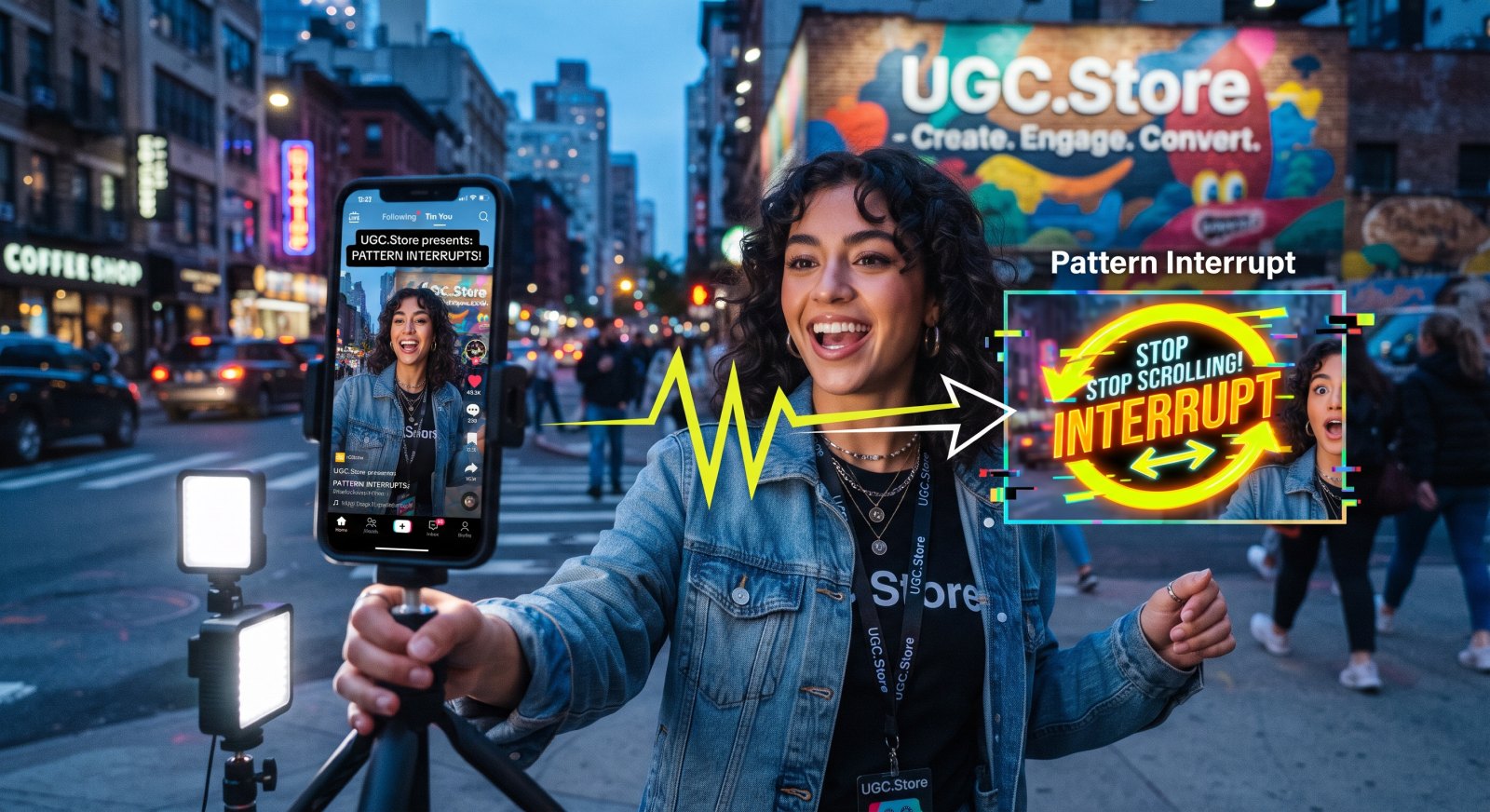
The modern TikTok viewer has the attention span of a distracted squirrel. The platform’s algorithm trains users to swipe the moment their brains predict what is coming next. In TikTok UGC, a static talking head or a predictable screen recording will inevitably lead to a sharp drop-off in viewer retention after the initial hook. The antidote is the pattern interrupt. By utilizing strategic cutaways, creators can deliberately break the visual and auditory rhythm of the video to reset the viewer’s attention span. A pattern interrupt is not just a fancy edit; it is a psychological reset button. It forces the brain to stop predicting and start processing again. The brands that master strategic cutaways do not just keep viewers watching longer; they condition the viewer’s brain to stay engaged through the entire conversion funnel.
Theoretical Basis and Psychology of Mechanics
The psychology of pattern interrupts and strategic cutaways is rooted in habituation, the orienting response, and visual working memory. The human brain is highly efficient; when it recognizes a pattern, it stops actively paying attention and shifts to autopilot.
The first mechanism is Defeating Habituation. When a TikTok UGC video starts with a creator talking to the camera, the viewer’s brain quickly habituates to the visual pattern. The novelty wears off in about five seconds. If the creator continues to talk without a visual change, the brain predicts the next ten seconds and suggests a scroll. A pattern interrupt—such as a sudden zoom, a dramatic lighting change, or a sudden cutaway to a different location—breaks the habituation. The brain is forced to re-evaluate the scene, resetting the viewer's attention span.
The second mechanism is The Orienting Response. This is an involuntary reflex that occurs when a new or unexpected stimulus is presented. A strategic cutaway—like a sudden close-up of a product, a sound effect, or a physical prop being thrown into the frame—triggers the orienting response. The viewer’s attention is involuntarily captured by the change. This is why high-retention TikTok UGC often features rapid cuts, overlays, or physical interactions. They are deliberately triggering the orienting response to keep the viewer anchored.
The third mechanism is Cognitive Reset. The human working memory can only hold a few pieces of information at once. During a dense B2B SaaS or consumer product demo, the viewer can easily become overwhelmed and scroll away. A pattern interrupt clears the working memory. By cutting to a different visual (e.g., a meme, a different angle, or a visual sound effect), the creator resets the viewer’s attention span, allowing them to absorb the next piece of information with a fresh mental slate.
The fourth mechanism is Visual Syncing. A strategic cutaway does not just reset attention; it can also emphasize the most important points. When the creator says a crucial metric or reveals the product, a sudden pattern interrupt (like a hard cut to a screen recording or a graphic overlay) visually underscores the audio. The viewer is forced to associate the visual interrupt with the key information, increasing the likelihood of retention and conversion.
Step-by-Step Algorithm & Methodology
To successfully deploy pattern interrupts and strategic cutaways in TikTok UGC, you must plan the interruptions as deliberately as you plan the script.
Phase 1 — The Baseline Hook (0–3 seconds). Start with a strong, visually interesting hook. Do not rely on a text overlay alone. Use motion, a prop, or a sudden physical action. This establishes the initial attention span before the first interrupt.
Example: Creator drops a heavy box on a desk.
Phase 2 — The First Interrupt (3–8 seconds). Introduce the problem or the premise. Right as the viewer settles into the audio, execute the first pattern interrupt. This can be a hard cut to a different camera angle, a sudden zoom, or a cutaway to the "old way" of doing things.
Example: Cut from the creator's face to a chaotic screenshot of a messy spreadsheet.
Phase 3 — The Mid-Point Reset (8–15 seconds). This is the 15-second drop-off prevention zone. The viewer has understood the problem. Now, execute a second pattern interrupt to introduce the solution. Use a strategic cutaway—like a close-up of a button being clicked or a physical object being moved—to visually transition to the software.
Example: Cutaway to a macro shot of a cursor clicking a "Fix" button, followed by a wide shot of the clean dashboard.
Phase 4 — The Proof Interrupt (15–25 seconds). Deliver the visual proof of the software. To keep the viewer from getting bored during the screen recording, introduce a pattern interrupt within the UI. Zoom in on the specific feature, use a highlight box, or cut back and forth between the creator's reaction and the screen.
Example: Screen recording of the software, followed by a quick cutaway to the creator nodding in approval.
Phase 5 — The Final Pattern Break (25–30 seconds). The video needs to end with a punch. Use a final strategic cutaway or a change in tone to deliver the CTA. Do not let the video fade out.
Example: Creator looks directly at the camera, smiles, and points to the link in the bio.
Ready-to-Use Working Templates & Scripts
Script One: The "Static to Dynamic" SaaS (Format: B2B Software UGC, 32 seconds).
Hook (0-3s): Creator sitting at a desk, frustrated, holding a printed report. Audio: "This report took me three hours to build."
First Interrupt (3-8s): Hard cut to a chaotic screen recording of an Excel spreadsheet. Audio: "I was copying and pasting data from five different platforms. It was a nightmare."
Mid-Point Reset (8-15s): Sudden cutaway to a macro shot of a mouse clicking a prominent button on a clean, dark-mode SaaS interface. Audio: "Then we found this tool. It did the work for us."
Proof Interrupt (15-25s): Screen recording of the software instantly populating a chart. Cut back to the creator looking relieved. Audio: "It pulled the data automatically. No more spreadsheets."
Final Break (25-32s): Creator closes the laptop, looks at the camera. Audio: "The link is in the bio. Save your three hours."
Script Two: The "Prop Drop" (Format: Consumer Product/App UGC, 34 seconds).
Hook (0-3s): Creator standing in a messy room, drops a large cardboard box on the floor. Audio: "I bought five different organizers and none of them worked."
First Interrupt (3-8s): Hard cut to a close-up of the creator's face, then a cutaway to a different messy corner of the room. Audio: "I was drowning in clutter. I was ready to throw it all away."
Mid-Point Reset (8-15s): The creator picks up their phone, and the camera cuts to a screen recording of the app they use. Audio: "Then I downloaded this app. It changed how I look at my space."
Proof Interrupt (15-25s): Rapid cuts between the app interface showing a checklist and the creator physically moving items into a designated bin. Audio: "I just followed the steps. It took twenty minutes."
Final Break (25-34s): Creator standing in the now-clean room, pointing at the screen. Audio: "Link in the bio. Get your space back."
Script Three: The "Perspective Shift" (Format: HR/Workplace UGC, 36 seconds).
Hook (0-3s): Creator sitting at a desk, looking directly at the camera. Audio: "I would reject this resume in three seconds."
First Interrupt (3-8s): Sudden cutaway to a close-up of a printed resume with a red marker circling a phrase. Audio: "It says 'hard-working team player'. That is AI filler."
Mid-Point Reset (8-15s): Hard cut to a different angle of the creator, holding up a different printed resume. Audio: "But look at this one. This is what gets an interview."
Proof Interrupt (15-25s): Cut to a screen recording of the hiring platform highlighting the correct metrics. Cut back to the creator. Audio: "Our software scans for this specific data. It saves us hours."
Final Break (25-36s): Creator looks directly at the camera. Audio: "Link in the bio to see how your resume scores."
Comparative Analysis Matrix
| Parameter | Standard UGC (No Interrupts) | UGC with Pattern Interrupts |
|---|---|---|
| Primary Focus | Continuous talking head or static screen | Dynamic visual changes and cutaways |
| Attention Mechanism | Relies on the initial hook only | Uses continuous micro-hooks to reset attention |
| Retention Driver | The desire to hear the rest of the story | The need to process the new visual stimuli |
| Editing Rhythm | Slow, predictable | Fast, unpredictable, rhythmic |
| Drop-Off Risk | High at the 10-15 second mark | Low; viewers are constantly re-engaged |
| Visual Proof | Static screen recording | Dynamic screen recording with zooms and highlights |
| Friction Point | The Retention Failure | The Pattern Interrupt Fix |
|---|---|---|
| Predictability | The viewer knows exactly what is coming | The sudden change breaks the pattern |
| Cognitive Overload | The viewer gets tired of processing dense info | The cutaway resets working memory |
| Visual Fatigue | The same camera angle for 30 seconds | Hard cuts, zooms, and prop interactions |
| Boredom | Lack of stimulation | The orienting response is triggered repeatedly |
| Benchmark Metric | Standard UGC | Pattern Interrupt UGC Target |
|---|---|---|
| Hook Rate (3-second) | 55–65% | 65–80% |
| 15-Second Hold Rate | 20–30% | 45–60% |
| Completion Rate | 10–15% | 25–35% |
| CPA Variance | Baseline | 25–35% lower |
Real-World Case Study Breakdown
A B2B SaaS company selling a project management tool launched a TikTok UGC campaign. Their initial creative was a single, continuous shot of the creator talking into the camera, followed by a static screen recording of the software. The hook rate was 60%, but the 15-second hold rate was a miserable 18%. The video was too static, and the viewer's attention span collapsed.
The strategic pivot involved a complete re-edit using pattern interrupts and strategic cutaways. The winning asset started with the creator holding a printed Gantt chart, looking frustrated.
Hook (0-3s): "This Gantt chart is the reason I missed my last deadline."
First Interrupt (3-8s): Hard cut to a screen recording of the creator scrolling through a chaotic Asana board, with an audio sound effect of a record scratch. "I was managing five projects with sticky notes and guesswork."
Mid-Point Reset (8-15s): Cutaway to the creator clicking a button on the new software, followed by a sudden zoom-in on the clean timeline. "Then we switched to this."
Proof Interrupt (15-25s): Rapid cuts between the software automatically updating a task and the creator's relieved expression. "It just updates itself. No more asking for status updates."
Final Break (25-30s): The creator drops the printed Gantt chart in the trash. "Link in the bio. Save your deadlines."
The campaign generated 1.2 million views. The 15-second hold rate jumped to 54%, and the CPA dropped by 38%. The governing insight: the video survived the drop-off because the constant visual changes kept the viewer's brain actively processing, rather than predicting the next move.
Real-World Engineering & Creative Feedback
"The brain is a prediction machine. If you do not interrupt the pattern, it will predict the end of your video and scroll. I plan my cutaways before I even film. Every 3 to 5 seconds, something must visually change. A zoom, a new angle, a prop. The change is the hook." — Tasha Moreau, UGC Creator, 48K followers
"We stopped using static screen recordings. They are a death sentence for retention. Now, we use motion graphics, zooms, and rapid cuts to show the software. The visual proof is faster, and the viewers stay longer. The retention metrics prove it." — Ben Achterberg, Head of User Acquisition, Cartwheel SaaS
"The 'Orienting Response' is real. When you cut to a different scene, the viewer's brain is forced to pay attention again. It is a physical reflex. You are not just editing a video; you are manipulating the viewer's nervous system. Use it strategically." — Priya Deshmukh, Creative Strategy Lead, Pixel & Pulse Agency
"The biggest mistake brands make is putting all the energy into the first three seconds and then letting the video flatline. The hook is just the entry ticket. The pattern interrupts are what keep the viewer in the seat. You need to maintain the energy throughout." — Marcus Lehto, Performance Marketing Director, Northline Interactive
"We almost cancelled a campaign because the hook rate was great but the CTR was terrible. We realized the video peaked too early. We added a cutaway at second 12, and the CTR doubled. The cutaway kept them watching." — Elena Vasquez, Brand Director, Mosaic SaaS
Production Self-Check Checklist
No Static Frames — Is there a visual change (zoom, cut, prop) every 3-5 seconds?
First Interrupt (3-5s) — Does the video break the initial pattern early to prevent habituation?
Mid-Point Reset (8-15s) — Is there a strategic cutaway to introduce the solution or shift the narrative?
Visual Pacing Shift — Does the editing rhythm change to reset the viewer's attention span?
Hard Cuts over Soft Fades — Are transitions sharp and deliberate, avoiding slow fade-outs that lose attention?
Audio Interrupts — Are there sound effects (whooshes, clicks, record scratches) that sync with the visual interrupts?
Prop Integration — Does the creator physically interact with objects (resumes, boxes, laptops) to create dynamic cutaways?
Screen Recording Dynamics — Are screen recordings zoomed in, highlighted, or interspersed with the creator's face?
Text Legibility — Does the text overlay change to reflect the new visual phase?
Muted View Compatibility — Can the story and the value proposition be understood with the sound completely off?
Advanced FAQ
How many pattern interrupts should a 30-second video have?
A 30-second video should have at least 3 to 4 distinct pattern interrupts. The first at 3-5 seconds to break the initial hook, the second at 10-15 seconds to prevent the mid-video drop-off, and the third at 20-25 seconds to drive the final CTA. This keeps the video moving at a pace that matches the TikTok viewer's attention span.
What is the difference between a pattern interrupt and a simple jump cut?
A jump cut removes dead air or stumbles in the dialogue. A pattern interrupt is a deliberate visual or auditory change designed to reset the viewer's brain. A jump cut keeps the same scene; a pattern interrupt changes the scene, the angle, the speed, or the prop to force the viewer to re-evaluate what they are watching.
Can a pattern interrupt be purely auditory?
Yes. Sudden silence, a loud sound effect (like a cash register or a whoosh), or a change in the music tempo can act as an auditory pattern interrupt. However, in TikTok UGC, visual interrupts are generally more effective because the viewer might be watching with the sound off. The best interrupts are both visual and auditory.
How do you prevent pattern interrupts from feeling chaotic or confusing?
The interrupts must serve the narrative. Do not just cut randomly; cut to a different angle that emphasizes the problem, or cut to a prop that introduces the solution. The audio must bridge the visuals smoothly. The viewer should feel the change in energy, not confusion about what they are looking at.
What is the most effective type of cutaway for B2B SaaS UGC?
The most effective is the "Macro to Micro" cutaway. Start with a wide shot of the creator looking frustrated at a spreadsheet. Then, use a hard cutaway to a macro, close-up shot of a cursor clicking a single button on the new software. The visual contrast between the messy wide shot and the precise close-up is a powerful pattern interrupt that immediately communicates the solution.
Custom Contextual Conclusion
The TikTok UGC landscape is a war for attention, and the viewer’s brain is armed with a scroll button. You cannot win this war with a static talking head or a predictable screen recording. You win with pattern interrupts. You win with strategic cutaways that break the visual rhythm and force the brain to pay attention. The brands that master this format understand that the hook is just the entry point. The attention span is maintained by the constant, deliberate disruption of the visual and auditory pattern. The interrupt is the reset. The retention is the proof. The conversion is the result.