
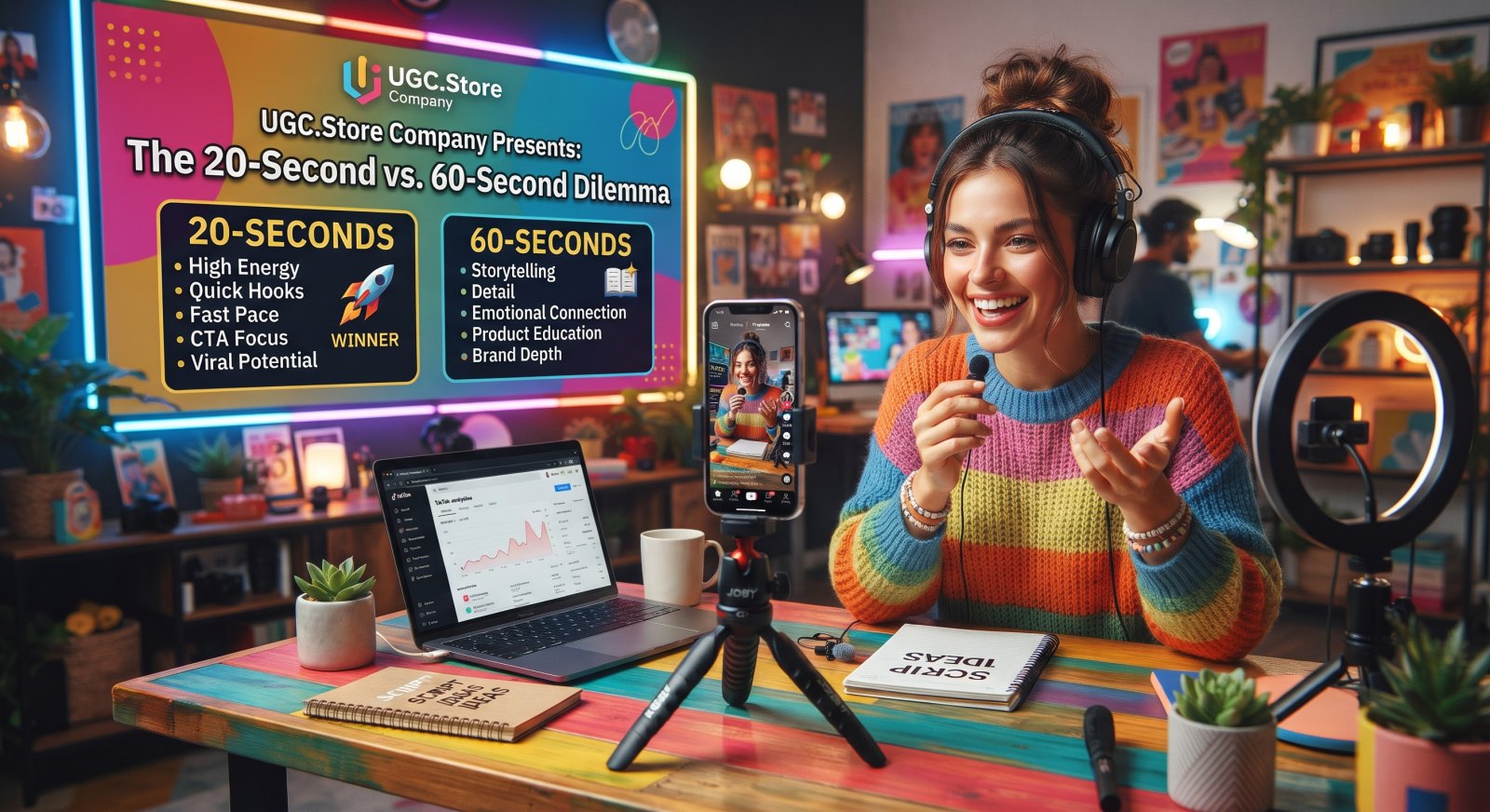
Executive Overview
Every UGC creator and performance marketer eventually faces the ultimate question: Is it better to make a rapid-fire 20-second ad that forces immediate action, or a 60-second story that builds deep trust? The debate over script length in TikTok UGC is usually framed as a binary choice, but the data reveals a more complex reality. The TikTok algorithm rewards watch time, but the human brain rewards immediate gratification. A 20-second video often boasts a higher completion rate, but a 60-second video allows for the deep narrative required to sell complex products. The optimal script length is not a universal constant; it is a variable determined by your funnel stage, your product’s cognitive load, and the viewer’s intent. This framework breaks down the exact scenarios where 20 seconds wins, where 60 seconds dominates, and how to engineer your TikTok UGC to maximize CPA and retention at both extremes.
Theoretical Basis and Psychology of Mechanics
The psychology behind script length in TikTok UGC relies on Cognitive Load Theory, the Peak-End Rule, and Algorithmic Watch Time. The viewer is constantly balancing the perceived value of the information against the time required to consume it.
The first mechanism is Cognitive Load Theory. A 20-second video is a sprint. It is perfect for low-ticket, impulse purchases or simple, single-feature software. The viewer can process the hook, the proof, and the CTA in one breath. A 60-second video is a marathon. It is required for high-ticket B2B SaaS, complex financial products, or emotional transformations. If you force a complex product into 20 seconds, the viewer feels confused and scrolls. If you stretch a simple product to 60 seconds, the viewer feels bored.
The second mechanism is The Peak-End Rule. The brain judges an experience based on its emotional peak and its end. A 20-second video peaks immediately and ends quickly. The completion rate is high because the effort is low. A 60-second video requires maintaining a flat, engaging curve until the final payoff. The script length must be justified by the strength of the ending. If the payoff is not worth the 60-second wait, the viewer will punish the creator with a mid-video swipe.
The third mechanism is Algorithmic Watch Time. The TikTok algorithm does not just measure raw watch time; it measures watch time relative to video length. A 20-second video watched to the end (100% retention) signals strong engagement, but it only keeps the viewer on the platform for 20 seconds. A 60-second video watched to 50% retention keeps the viewer on the platform for 30 seconds, often resulting in a higher algorithmic distribution. The ideal script length must balance absolute retention with platform dwell time.
The fourth mechanism is The Commitment Escalation. TikTok UGC works as a micro-commitment device. A 20-second video asks for a small commitment: "Watch this quick tip." A 60-second video asks for a larger commitment: "Hear my whole story." For high-ticket items, the 60-second video acts as a filter, weeding out casual scrollers and attracting highly qualified, intent-driven buyers.
Step-by-Step Algorithm & Methodology
To determine the ideal script length for your TikTok UGC, you must map the video's structure to the funnel stage and product complexity.
Phase 1 — The 20-Second Sprint (For Low Complexity / High Intent).
The structure is relentless. There is no room for fluff.
0–3 seconds: The specific pain or visual interrupt.
3–10 seconds: The immediate visual proof of the product solving the problem.
10–15 seconds: The honest friction note.
15–20 seconds: The aggressive CTA.
Phase 2 — The 60-Second Narrative (For High Complexity / Skeptical Buyers).
The structure requires layered pacing and narrative tension.
0–3 seconds: The high-stakes hook or shocking claim.
3–15 seconds: Deep agitation of the systemic problem. Establishing the emotional cost.
15–35 seconds: The product introduction as the mechanism for change. Detailed visual proof, screen recordings, and real-time workflow.
35–50 seconds: The transformation. The before-and-after, the emotional payoff, the "Chaos to Clarity."
50–60 seconds: The CTA and the community prompt.
Phase 3 — The 40-Second Hybrid (The Sweet Spot for B2B SaaS).
Most B2B SaaS products fall in the middle. You need enough time to show the workflow, but not so much time that the viewer gets bored.
0–3s: The pain point.
3–10s: The manual agony.
10–25s: The software demo (The "Zero-Setup" magic).
25–35s: The human payoff.
35–40s: The CTA.
Ready-to-Use Working Templates & Scripts
Script One: The 20-Second "Quick Fix" (Format: Consumer App / Utility SaaS).
Hook (0-3s): "I was losing $50 a month on subscriptions I forgot about."
Proof (3-10s): Screen recording of the app scanning a bank account and instantly flagging three dead subscriptions. "This app found three I didn't know about. I cancelled them in one tap."
Friction (10-15s): "You have to connect your bank, which is annoying, but it took two minutes."
CTA (15-20s): "Link in the bio. Check your subscriptions before you get charged again."
Script Two: The 60-Second "B2B Enterprise Story" (Format: Complex SaaS / HR Platform).
Hook (0-3s): "I almost lost my biggest client because of a spreadsheet error."
Agitation (3-15s): Creator looking stressed, holding a printed spreadsheet. "We were tracking 50 enterprise deals manually. A rep left, the data was corrupted, and we had no idea which contracts were renewing. I spent three days in panic mode trying to reconstruct the pipeline."
Product Introduction (15-35s): Screen recording of the SaaS CRM. "We implemented this platform. It syncs every email, every call, and every contract automatically. Look at this dashboard. It tells me exactly what is closing this week."
Transformation (35-50s): Creator looks relieved, sitting at a clean desk. "We didn't lose the client. We saved the pipeline. I got my weekend back. It is not magic; it just prevents human error."
CTA (50-60s): "If your enterprise pipeline is held together by tape, the link is in the bio. Book a demo. Save your weekends."
Script Three: The 40-Second "B2B SaaS Hybrid" (Format: Workflow Automation).
Hook (0-3s): "My team was spending 10 hours a week just copying data."
Agitation (3-10s): Fast-forward screen recording of the creator manually pasting data between two windows. "It was soul-crushing data entry. We were paying smart people to do robot work."
Product Intro (10-25s): Screen recording of the automation software. "Then we used this tool. It connects the two systems and pushes the data automatically. One click."
Payoff (25-35s): Creator looking at a clean dashboard. "We cut the data entry to zero. The team actually does their real jobs now."
CTA (35-40s): "Link in the bio. Automate one workflow today."
Comparative Analysis Matrix
| Parameter | 20-Second Script | 60-Second Script |
|---|---|---|
| Primary Focus | Immediate value and quick conversions | Deep narrative and trust building |
| Best For | Low-ticket, B2C, simple utilities | High-ticket, B2B SaaS, complex hardware |
| Cognitive Load | Low; fast processing | High; requires sustained attention |
| Completion Rate | Very High (easy to finish) | Lower (requires strong mid-video hooks) |
| Algorithmic Dwell Time | Low (keeps viewer on platform for 20s) | High (keeps viewer on platform for up to 60s) |
| Trust Architecture | Dependent on the speed of the proof | Dependent on the authenticity of the story |
| Friction Point | The Script Length Failure | The Fix |
|---|---|---|
| Boredom | A 60-second video that repeats the hook | Cut the script to 40 seconds or add pattern interrupts |
| Confusion | A 20-second video explaining a complex enterprise tool | Extend to 60 seconds to show the full workflow |
| High Drop-Off | A 60-second video with a weak middle | Insert a micro-loop at the 15-second mark |
| Low Trust | A 20-second video claiming a 300% ROI | Extend the video to show the visual proof and the friction note |
| Benchmark Metric | 20-Second Target | 60-Second Target |
|---|---|---|
| Hook Rate (3-second) | 65–80% | 65–80% |
| Completion Rate | 40–60% | 15–25% |
| 15-Second Hold Rate | N/A (Video ends) | 40–50% |
| Cost Per Acquisition (CPA) | Low (for simple products) | Low (for high-ticket products) |
Real-World Case Study Breakdown
A B2B SaaS company selling a specialized compliance tool for healthcare providers launched a TikTok campaign. They initially tested a 20-second script. The hook rate was 70%, and the completion rate was high, but the CPA was terrible. The 20-second video did not provide enough time to explain the complex regulatory environment, and the viewers who did click were unqualified.
The strategic pivot involved testing a 60-second script using the multi-touch narrative structure. The new video opened with a specific regulatory fine that a clinic had recently faced. It spent 20 seconds explaining the systemic risk, 20 seconds showing the software automating the audit, and 10 seconds on the transformation.
The 60-second video had a lower completion rate (22%), but the 15-second hold rate was strong (48%), and the viewers who watched to the end were highly qualified. The CPA dropped by 45% compared to the 20-second version. The governing insight: for complex B2B SaaS, the script length must be long enough to build the necessary trust. The 60-second format filtered out the casual viewers and attracted the decision-makers.
Real-World Engineering & Creative Feedback
"You cannot sell a $50,000 software license in 20 seconds. It is impossible. The buyer needs to see the problem, the proof, and the risk-reversal. That requires a 60-second narrative. Short videos are for cheap thrills and cheap products. Long videos are for enterprise trust." — Tasha Moreau, UGC Creator, 48K followers
"We used to think shorter was always better because of completion rates. We were wrong. We were optimizing for the wrong metric. Once we started measuring qualified leads instead of views, the 60-second videos won every time. They cost more to produce, but the ROI is undeniable." — Ben Achterberg, Head of User Acquisition, Cartwheel SaaS
"The 40-second hybrid is the sweet spot for most software tools. It is long enough to show the visual proof, but short enough to keep the retention high. If a video is over 45 seconds, you better have a damn good story, or the viewer is gone at the 15-second mark." — Priya Deshmukh, Creative Strategy Lead, Pixel & Pulse Agency
"The algorithm does not care about the length of the video. It cares about the watch time. A 60-second video watched for 30 seconds is better for the algorithm than a 20-second video watched for 10 seconds. Stop obsessing over the length and start obsessing over the pacing." — Marcus Lehto, Performance Marketing Director, Northline Interactive
"We almost cancelled a campaign because the 60-second video had a 15% completion rate. But when we looked at the backend, the 15% who watched the whole thing converted at a massive rate. The 60 seconds was a filter. It weeded out the tire-kickers and found the buyers." — Elena Vasquez, Brand Director, Mosaic SaaS
Production Self-Check Checklist
Funnel Stage Alignment — Is the script length matched to the buyer's journey? (20s for awareness, 60s for decision).
Product Complexity Match — Is the script long enough to explain the value without overloading the viewer?
Zero Fluff — Has every unnecessary word and pause been cut? A 60-second video must feel as dense as a 20-second video.
Micro-Loop Inclusion — For videos over 30 seconds, is there a new complication introduced at the 15-second mark?
Pattern Interrupts — Are there visual or auditory changes every 3-5 seconds to reset attention?
The Payoff is Earned — Does the final 10 seconds justify the time invested by the viewer?
Text Legibility — Is the hook text bold, under 7 words, and placed in the upper-middle third?
Muted View Compatibility — Can the core message be understood with the sound off?
CTA Clarity — Is the call to action appropriate for the funnel stage? (Follow vs. Download vs. Book a demo).
Algorithmic Optimization — Is the video longer than 30 seconds if the goal is maximum dwell time?
Advanced FAQ
Is it better to cut a 60-second script down to 30 seconds?
Only if the 30-second version retains the core emotional payoff and visual proof. Often, cutting a video in half destroys the narrative arc and makes the proof feel rushed. It is better to write a native 30-second script than to butcher a 60-second one. Test both to see which converts better.
How do you maintain retention in a 60-second B2B SaaS video?
By using staged proof and pattern interrupts. You cannot rely on a single hook for 60 seconds. You must introduce a new problem, a new feature, or a visual cutaway every 10-15 seconds. The viewer must feel that the video is constantly delivering new value, not just padding the runtime.
What is the ideal script length for a TikTok UGC testimonial?
Between 30 and 45 seconds. A testimonial needs enough time to establish the "before" state (the pain), the "during" state (the implementation), and the "after" state (the result). Anything shorter feels superficial; anything longer feels like an infomercial.
How does the script length affect the Cost Per Acquisition (CPA)?
It depends on the product. For a $10 app, a 20-second video is more efficient because the CPA is low and the impulse buy is high. For a $5,000 software, a 60-second video is more efficient because the CPA is high and the impulse buy is zero. The length must match the price.
Should you use different lengths for organic vs. paid Spark Ads?
Yes. Organic videos can be slightly longer because the audience is already familiar with the creator. Spark Ads, which target cold audiences, often need to be shorter and punchier to grab attention immediately. However, for B2B SaaS, even Spark Ads can be 60 seconds if the hook is strong enough.
Custom Contextual Conclusion
The debate over script length in TikTok UGC is a false dichotomy. There is no universal ideal. A 20-second video is a scalpel: fast, precise, and perfect for simple pain points. A 60-second video is a sledgehammer: heavy, narrative-driven, and necessary for complex enterprise software. The brands that win understand that the script length must be dictated by the buyer’s cognitive load and the funnel stage. You do not use a scalpel to chop down a tree, and you do not use a sledgehammer for surgery. The length is the strategy. The pacing is the proof. The conversion is the reward.