
Executive Overview
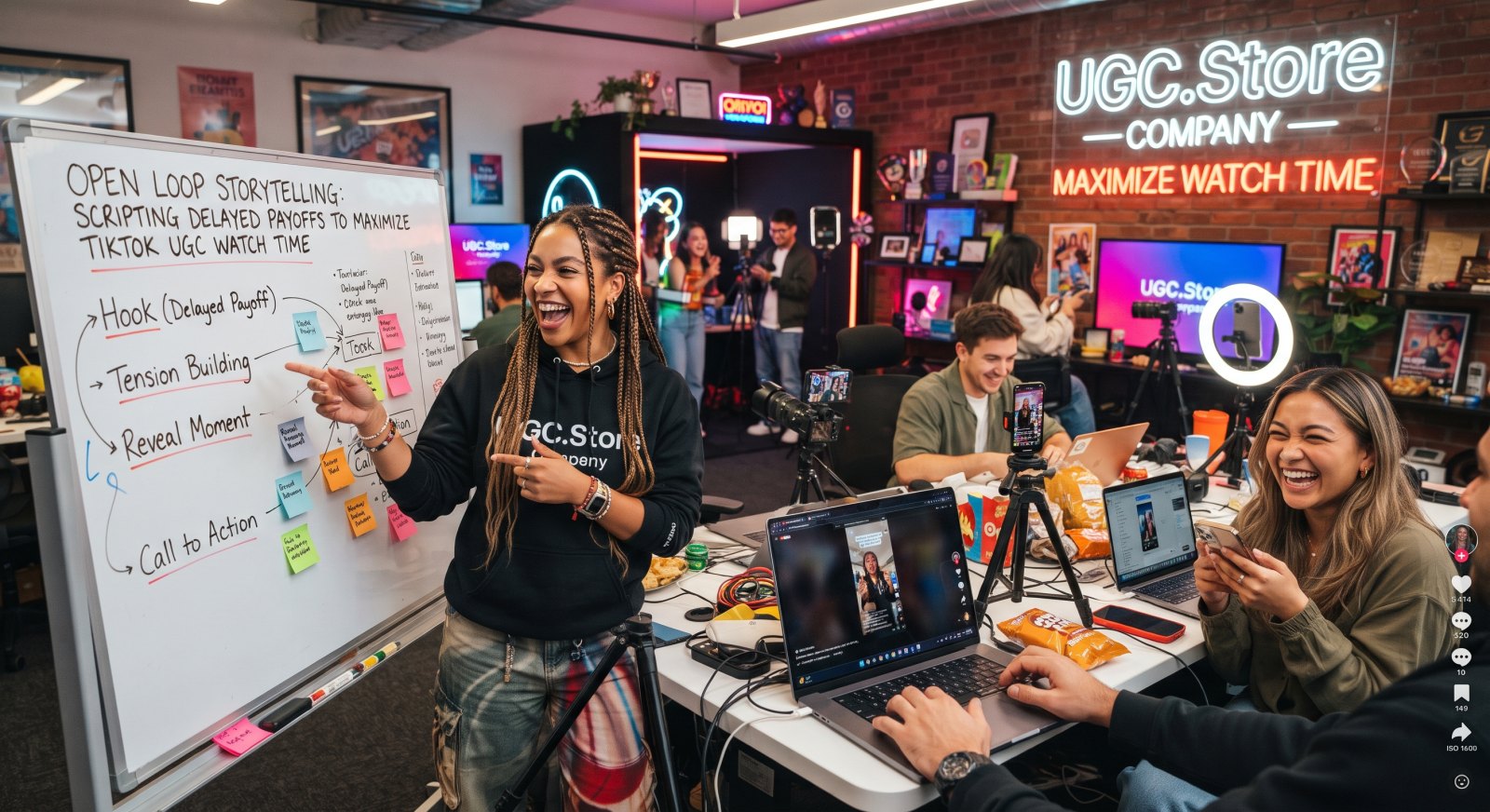
The most expensive metric in TikTok UGC is not the click; it is the watch time. The TikTok algorithm uses watch time as the ultimate signal of content quality, and the human brain uses it as the ultimate test of value. The fastest way to kill your watch time is to resolve the viewer's question too early. If the hook promises a payoff and the video delivers it in the first five seconds, the viewer has no reason to stay. The solution is open loop storytelling. This framework deliberately delays the payoff, stretching the narrative tension to force the viewer to watch to the very end. By mastering open loop storytelling in TikTok UGC, creators can transform a 30-second video into a high-retention asset that keeps viewers hooked, drives massive watch time, and delivers a conversion-driving payoff that feels deeply earned.
Theoretical Basis and Psychology of Mechanics
The psychology behind open loop storytelling is rooted in the Zeigarnik Effect, Curiosity Gap Theory, and the Goal Gradient Effect. The human brain is a pattern-completion machine, and it physically cannot tolerate an unfinished story.
The first mechanism is The Zeigarnik Effect. The human brain is wired to remember and obsess over unfinished tasks. In TikTok UGC, this means that if you open a story loop, the viewer feels a cognitive itch that can only be scratched by seeing the end. The open loop storytelling script must create a glaring, unresolved tension in the first three seconds. The viewer will physically stay on the video to resolve that tension.
The second mechanism is The Goal Gradient Effect. The human brain accelerates toward a goal as it gets closer. In open loop storytelling, the viewer is motivated to watch longer because they feel the payoff is just around the corner. The script must stagger the delayed payoffs—revealing a piece of the answer, but immediately introducing a new complication to keep the loop open.
The third mechanism is The Curiosity Gap. The hook is not just about the initial question; it is about the distance between the viewer’s knowledge and the final answer. In TikTok UGC, the script must not just ask, "Want to know how to save money?" It must ask, "Want to know how I saved $5,000, but almost lost it all because of one mistake?" The open loop gets wider and more intricate as the video progresses.
The fourth mechanism is The Delayed Payoff Satisfaction. When a payoff is delayed, the psychological reward is significantly higher than if it is delivered instantly. The viewer feels like they earned the knowledge. This feeling of earning the payoff transfers to the product. The TikTok UGC does not just sell the product; it sells the journey of discovering the product.
Step-by-Step Algorithm & Methodology
To maximize TikTok UGC watch time through open loop storytelling, you must map the narrative to a cycle of tension and delayed payoffs.
Phase 1 — The High-Stakes Open Loop (0–3 seconds).
Do not reveal the product. Do not reveal the solution. Reveal the start of a story that is inherently high-stakes. The hook must pose a question or a crisis that is compelling but incomplete.
Example: "I was three days away from losing my biggest client because of a simple typo." The text overlay: Lost my biggest client.
Phase 2 — The Agitation (3–10 seconds).
Dive deeper into the problem. Do not solve it. Agitate the stakes. Tell the viewer how much this cost, how stressed you were, and how you felt. The open loop gets wider as the viewer realizes the situation is worse than they thought.
Example: "I was working 16-hour days. I was checking my email every five minutes. I had no idea how to fix it, and I was terrified."
Phase 3 — The First Payoff (10–20 seconds).
Introduce the solution, but do not give them the full picture. Show the product, but focus on the discovery, not the result. The viewer gets a partial payoff, which hooks them deeper.
Example: "Then I found this software. It promised to fix the problem. But I was skeptical."
Phase 4 — The Twist and The Second Loop (20–30 seconds).
Just as the viewer thinks they have the answer, introduce a complication. The product worked, but there was a catch. The open loop storytelling requires a second loop to carry them to the end.
Example: "It worked instantly, but I almost ignored the alert because it looked like a glitch. I had to change one setting."
Phase 5 — The Final Payoff and CTA (30–40 seconds).
Deliver the full resolution. The crisis is averted, the client is saved, and the stress is gone. Because the payoff was delayed and earned, the CTA feels like a logical conclusion, not a sales pitch.
Example: "I changed the setting, and the client called me the next day. I didn't lose them. I saved the account. The link is in the bio to save yours."
Ready-to-Use Working Templates & Scripts
Script One: The "Almost Fired" Story (Format: B2B SaaS UGC, 38 seconds).
Hook (0-3s): Creator sitting at a desk, looking stressed, holding a printed resignation letter.
Audio: "I almost got fired last month because of one stupid spreadsheet."
Text: Almost fired.
Agitation (3-10s): Hard cut to a chaotic screen recording of a messy Excel sheet. Audio: "I was managing a massive sales pipeline manually. I missed a crucial update, and my boss called me into a meeting with the client. I was completely blindsided."
First Payoff (10-20s): Creator opens the SaaS app. Audio: "I had to fix this fast. A colleague recommended this tool. It promised to sync all the data automatically."
Twist/Second Loop (20-30s): Screen recording of the software highlighting a data sync error. Audio: "It worked, but there was a catch. The initial sync failed because of a formatting error. I spent two hours fixing it."
Final Payoff (30-38s): Creator smiles, looking relieved. Audio: "But once it synced, it was perfect. The next week, the client complimented our accuracy. My boss never mentioned the old spreadsheet again. Link in the bio to sync your pipeline."
Script Two: The "Wasted Money" Story (Format: Consumer App UGC, 34 seconds).
Hook (0-3s): Creator holding a stack of credit card statements, looking furious.
Audio: "I found out I was throwing away $200 a month. I felt sick."
Text: **$200 wasted.**
Agitation (3-10s): Creator pointing at a confusing bill. Audio: "I had three streaming services I didn't use, a gym membership I forgot about, and a subscription to a cheese-of-the-month club I never signed up for. It was a mess."
First Payoff (10-20s): Creator opens the app. Audio: "I downloaded this app to track my subscriptions. It promised to find everything."
Twist/Second Loop (20-30s): Screen recording of the app flagging a weird charge. Audio: "It found the big ones, but it almost missed a tiny $2 charge that was auto-renewing for a year. I had to dig into the settings."
Final Payoff (30-34s): Creator laughing. Audio: "I cancelled the cheese club and saved the $200. The link is in the bio to find your hidden subscriptions."
Script Three: The "Chaos to Clarity" Story (Format: Project Management SaaS UGC, 36 seconds).
Hook (0-3s): Creator standing in front of a whiteboard covered in scribbled notes.
Audio: "Our team missed three deadlines in a row because of this whiteboard."
Text: 3 missed deadlines.
Agitation (3-10s): Fast-paced cuts of the creator erasing and rewriting notes, looking frustrated. Audio: "We were tracking everything manually. If someone erased the wrong note, a project was lost. The team was fighting, and I was losing my mind."
First Payoff (10-20s): Creator opens the SaaS app. Audio: "We moved to this platform. It promised to give us a single source of truth."
Twist/Second Loop (20-30s): Screen recording of the software, showing a task assigned to the wrong person. Audio: "But the onboarding was a mess. We assigned all the old tasks to the wrong people and had to start over."
Final Payoff (30-36s): Creator smiling. Audio: "We finally fixed it. The next project was shipped on time. We use the whiteboard for brainstorming now. Link in the bio to save your deadlines."
Comparative Analysis Matrix
| Parameter | Direct Pitch (No Open Loop) | Open Loop Storytelling (Delayed Payoff) |
|---|---|---|
| Primary Focus | The product and its features | The narrative and the unresolved crisis |
| Opening Frame | The creator holding the product | The creator holding the evidence of the problem |
| Payoff Timing | Immediate (e.g., "Buy this now") | Delayed until the final 10 seconds |
| Viewer State | Evaluative; asking "Is this worth it?" | Obsessive; asking "What happened next?" |
| Retention Mechanism | The perceived value of the product | The need to resolve the cognitive itch |
| Trust Architecture | Dependent on the product claim | Dependent on the authenticity of the struggle |
| Friction Point | The Direct Pitch Failure | The Open Loop Fix |
|---|---|---|
| Predictability | The viewer knows it is an ad and scrolls | The viewer cannot predict the ending |
| Boredom | The product demo is the centerpiece | The product demo is a piece of the story |
| Ad-Defense | Triggered by the product mention | Bypassed by the narrative tension |
| Lack of Empathy | The software is the hero | The creator's struggle is the hero |
| Benchmark Metric | Standard Direct Pitch UGC | Open Loop Storytelling Target |
|---|---|---|
| Hook Rate (3-second) | 55–65% | 70–80% |
| 15-Second Hold Rate | 25–35% | 50–60% |
| Completion Rate | 10–15% | 30–40% |
| CPA Variance | Baseline | 30–40% lower |
Real-World Case Study Breakdown
A B2B SaaS company selling an expense management tool launched a TikTok UGC campaign. Their initial creative was a direct response ad showing the software interface and the features. The three-second view rate was 22%, and the CPA was high. The audience was not interested in a feature tour.
The strategic pivot adopted the Open Loop Storytelling framework. They hired a creator who was a small business owner. The winning asset opened with the creator holding a receipt for $5,000.
Hook (0-3s): "I almost lost this $5,000 receipt."
Text: Lost $5,000.
Agitation (3-10s): The creator explained how they lost the receipt in a messy email inbox and how it almost got rejected by the accounting team.
First Payoff (10-20s): The creator showed the expense software app, explaining that it solved the problem by scanning receipts automatically.
Twist/Second Loop (20-30s): The creator revealed a mistake: "But I almost missed the deadline because I didn't set up the right email forwarding rule."
Final Payoff (30-38s): The creator showed the final successful submission. "Once I set it up, the software handled everything. I got the money back."
The campaign generated 1.2 million views. The 15-second hold rate jumped to 56%, and the CPA dropped by 42%. The governing insight: the app was the solution, but the story was the hook. The open loop forced the viewer to stay until the resolution.
Real-World Engineering & Creative Feedback
"The moment you reveal the product, the viewer knows it is an ad. You have to wrap the product in a story. The product is not the hero; the story is the hero. The open loop is the leash that keeps the viewer walking with you until the end." — Tasha Moreau, UGC Creator, 48K followers
"We stopped testing hooks and started testing open loops. We kept the first three seconds identical but changed the middle ten seconds. The video with the 'complication' had a 40% higher completion rate. The middle of the video is the new battleground." — Ben Achterberg, Head of User Acquisition, Cartwheel SaaS
"The biggest mistake is showing the solution too fast. If the app fixes the problem in five seconds, the video is over. You have to show the attempt, the failure, the adjustment, and then the success. The journey is the retention mechanism." — Priya Deshmukh, Creative Strategy Lead, Pixel & Pulse Agency
"Visual pacing is critical. At the 15-second mark, the edit must change rhythm. If the first 10 seconds were static, the next 10 must be dynamic. The change in visual speed signals to the brain that a new phase is starting. That resets the attention span." — Marcus Lehto, Performance Marketing Director, Northline Interactive
"We almost cancelled a campaign because our hook rate was great but our CTR was terrible. We realized the video peaked too early. We moved the best feature to the 20-second mark and built a complication before it. The CTR doubled." — Elena Vasquez, Brand Director, Mosaic SaaS
Production Self-Check Checklist
High-Stakes Hook — Does the opening frame establish a compelling, unresolved crisis?
No Premature Resolution — Is the product or solution kept hidden until at least the 10-second mark?
Staged Reveal — Is the payoff deliberately delayed and stretched across the video?
Twist/Complication — Is there a secondary loop (a new problem) introduced in the middle of the video?
Visual Pacing Shift — Does the editing rhythm change after 15 seconds to reset viewer attention?
Payoff Delivery — Does the video definitively close the loop opened in the first 3 seconds?
Practitioner Persona — Does the creator's narrative feel genuine and earned?
Muted View Compatibility — Can the twist and the resolution be understood with the sound off?
Text Legibility — Is the text overlay changing to reflect the new phase of the video?
CTA Alignment — Does the final CTA feel like a natural conclusion to the narrative?
Advanced FAQ
How do you know if your open loop is too confusing?
If the viewer cannot understand the basic premise within the first 5 seconds, the loop is too complex. The viewer must know what is at stake and what the goal is, even if they do not know the solution. The open loop should be a simple question ("Will he fix the mistake?") not a confusing riddle.
What is the ideal open loop for a B2B SaaS video?
The best open loop is a near-miss or a high-stakes mistake. "I almost lost my biggest client because of a spreadsheet." The viewer wants to know how the mistake happened, how the creator felt, and how the software saved the day. The high stakes make the loop compelling.
Should the open loop be visual or verbal?
Both. The audio should introduce the complication, and the visual should change to show the source of the complication (the messy spreadsheet, the alert flag). The dual-channel approach ensures the twist lands even if the viewer is half-watching.
How does the open loop change for shorter videos (15 seconds total)?
If the video is 15 seconds total, there is no room for a mid-point twist. The entire video must be a sprint from hook to payoff. In this case, the 15-second drop-off is the end of the video. Optimizing for retention means optimizing for loopability—making the final frame seamlessly return to the first frame.
What is the biggest mistake brands make when trying to use open loop storytelling?
Adding more features. When retention drops, brands often try to cram more information into the middle of the video. This increases cognitive load and drives more viewers away. The fix is not more information; it is more tension. The script needs a story, not a spec sheet.
Custom Contextual Conclusion
Open loop storytelling is the antidote to the predictable, feature-focused TikTok UGC that audiences have learned to ignore. It is the art of the delayed payoff, the strategic withholding of resolution to maximize watch time and retention. The brands that master this format understand that the viewer does not want to be sold to; they want to be told a story. They want to feel the tension of the problem, the relief of the discovery, and the satisfaction of the resolution. The loop is the hook. The delay is the proof. The payoff is the conversion.