
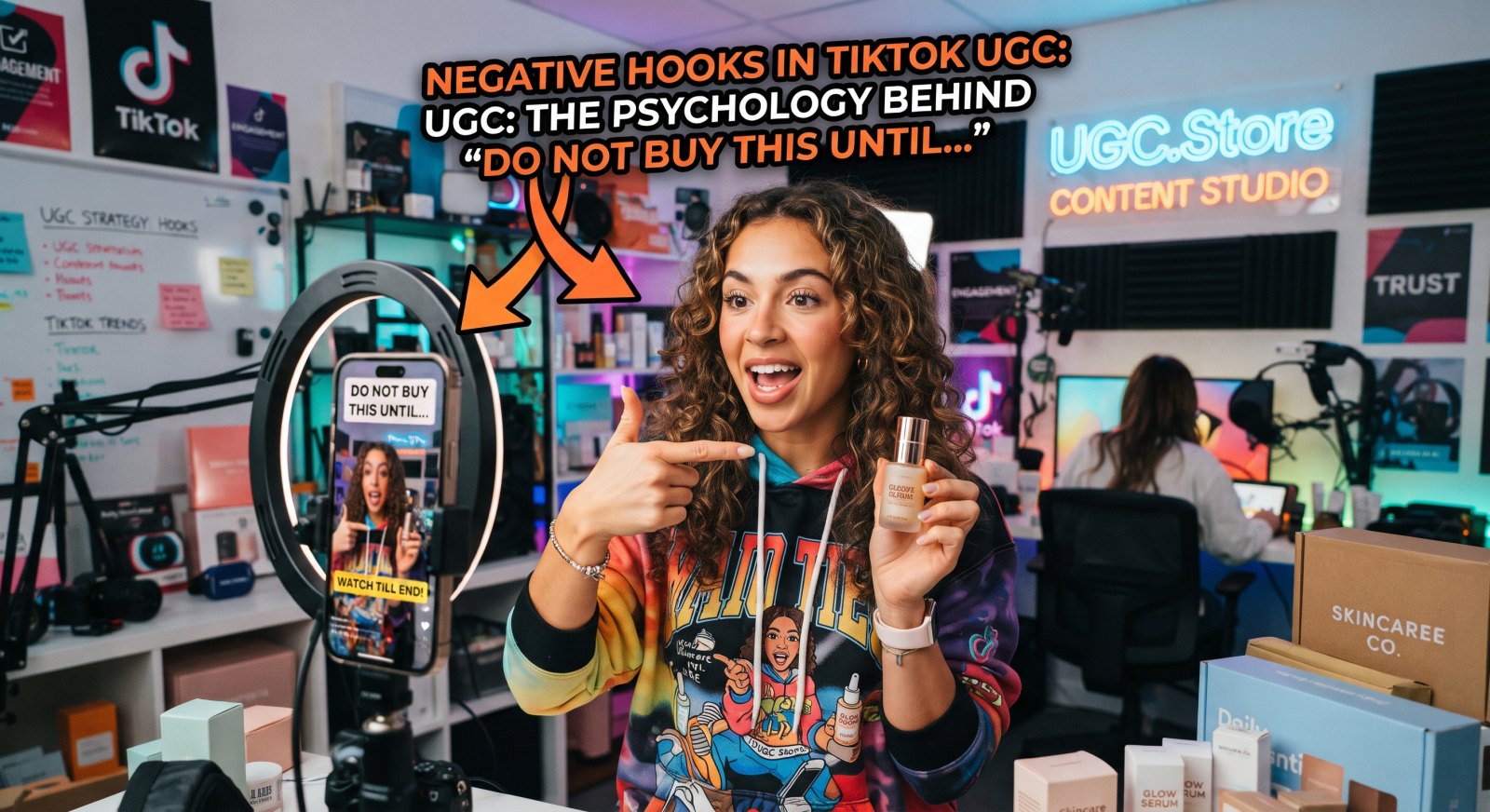
Executive Overview
The negative hook is the most counterintuitive structure in TikTok UGC and one of the most effective when executed correctly. By opening with “Do not buy this until…” or “You should not get this if…”, the creator intentionally inverts the standard advertising promise, triggering a reactance response that forces the viewer’s brain to pause and evaluate the warning. The mechanism is simple but ruthless: the viewer’s ad-defense system is calibrated to filter out positive claims, and a negative claim bypasses that filter entirely. The viewer stops because they want to know why they are being warned, and in that window of attention, the creator earns the right to pitch. The danger is equally ruthless. If the warning is fake—if the video turns into a standard sales pitch after the hesitation—the viewer’s trust collapses, the comment section turns hostile, and the ad account takes the hit.
Theoretical Basis and Psychology of Mechanics
The psychology of the negative hook is rooted in a principle that standard advertising systematically ignores: the viewer’s primary defense against ads is not skepticism, it is prediction. The viewer knows what an ad is going to say before the ad says it. “This product is great,” “You need this,” “Link in bio.” The brain processes these patterns and dismisses them before conscious attention engages. A negative hook breaks the prediction. The viewer expects a pitch, and instead receives a warning. The mismatch forces conscious processing, and conscious processing is the hook.
The first mechanism is psychological reactance. Reactance theory holds that when a person’s freedom to choose is threatened, they experience an aversive motivational state that drives them to restore that freedom. A standard ad threatens the viewer’s freedom by implying they should buy. A negative hook does the opposite—it tells the viewer not to buy—and paradoxically restores their sense of autonomy. The viewer feels respected rather than pressured, and the respect earns attention. The hook works not because the viewer wants the product but because the viewer wants to know why the creator is willing to talk them out of it.
The second mechanism is selective exclusivity. The line “Do not buy this until…” is followed by a condition: “unless you are a student,” “if you hate spreadsheets,” “if you want results in a week.” The condition is the actual target. The viewer who matches the condition feels specifically seen, and the viewer who does not match it feels relieved to have been warned off. Both responses are conversion mechanisms. The matching viewer now has a reason to buy that feels earned rather than advertised. The non-matching viewer now trusts the creator enough to consider a different product later. The negative hook does not just convert. It filters.
The third mechanism is the credibility asymmetry. Positive claims are cheap. Any brand can say its product is great. A negative claim is expensive because it requires the creator to give up the easiest persuasive move available. When a creator says “Do not buy this if you want overnight results,” they are spending credibility to buy trust. The viewer’s brain registers the cost and interprets the creator as someone who is not desperate to sell. The high-performing UGC accounts use negative hooks sparingly and deliberately for this reason. The technique works because it is rare, and it stops working when every video uses it.
The fourth mechanism is the honesty floor and compliance safety. The negative hook is also a compliance tool. In categories where hype claims trigger platform restrictions and legal exposure, the negative hook reduces the surface area for violations. A script that opens with “Do not buy this if you want a cure” has already acknowledged the limitation that a compliance reviewer would flag. The warning is not just a hook. It is a preemptive disclosure, and it does the compliance work while doing the persuasion work. The brands that combine the negative hook with genuine limitations get both trust and legal safety from the same sentence.
Step-by-Step Algorithm & Methodology
The framework below sequences a negative hook UGC asset from cold open to conversion, with each phase engineered to earn trust through restraint while delivering the product pitch the warning promised.
Phase 1 — The Negative Command (0–3 seconds). The creator opens with a direct instruction not to buy, delivered to camera with calm confidence. The line is specific and has a condition attached: “Do not buy this until you have read the reason it might not be for you.” or “If you want overnight results, do not get this.” The creator does not smirk. The creator does not look like they are about to reveal a trick. The delivery is sincere and slightly serious, and that seriousness is what makes the viewer stop. The visual is the creator’s face, mid-expression of someone who is about to save the viewer some money.
Phase 2 — The Honest Limitation (3–10 seconds). The creator names the real drawback or requirement the product has. The limitation is specific and it is not a humblebrag disguised as a flaw: “This takes three weeks before you see anything and if you miss a day you have to restart.” The viewer’s skepticism is disarmed because the creator is describing the actual friction of using the product. The screen can show the product, but the focus is the creator’s face. The limitation must be one that would cause a specific type of buyer to fail or regret the purchase.
Phase 3 — The Filter Condition (10–18 seconds). The creator names who should buy it by describing the person who will succeed: “You should get this if you already have a routine and you just need the part that was missing.” The condition is narrow and it is earned by the limitation that preceded it. The viewer who matches the condition now feels the product is for them specifically, not for everyone. The viewer who does not match feels the creator saved them time. The script is not pitching. It is routing.
Phase 4 — The Proof (18–26 seconds). The creator shows the product working for the person who matched the condition. This is the demo, and it is framed as evidence rather than promotion: “This is what it did for me, and I am exactly the person I just described.” The screen shows the app, the result, or the routine. The proof is visible and imperfect—the creator does not claim magic. The honesty of the limitation makes the honesty of the proof believable.
Phase 5 — The Reverse CTA (final 5–7 seconds). The creator closes with a CTA that reinforces the warning rather than contradicting it. “The link is below, but only if you are the person I described. If you are not, save your money and come back when you are.” The viewer who watched the whole video has self-selected into the audience that matches the condition. The CTA does not pressure. It respects the filter. The final frame shows the creator’s face or the product result, not a hard-sell end card. The video’s trust architecture depends on the ending matching the opening.
Ready-to-Use Working Templates & Scripts
Script One: “The Three-Week Warning” (Format: skincare/wellness UGC, 36 seconds).
Opening frame: creator’s face, calm and sincere, no product visible. Hook text: do not buy this until week three. Dialogue: “Do not buy this if you want overnight results. I am serious. This takes three weeks before you see anything, and if you miss a day, you basically start over.” Honest limitation: creator holds up the product but keeps focus on the face. “It is not magic. The first week I looked exactly the same and I almost threw it away.” Filter condition: “You should only get this if you already have a routine and you just need the part that was missing. If you are starting from zero, this is not the thing.” Proof: screen shows the before-and-after over three weeks, honest and unretouched. “This is week three. I am the person I described, and this is what happened.” Reverse CTA: face direct to camera. “The link is below, but only if you are already doing the other things. If you are not, save your money and come back when you are.”
Script Two: “The Spreadsheet Condition” (Format: productivity app UGC, 34 seconds).
Opening frame: creator’s face, slightly serious, phone in hand. Hook text: do not download this if you love your spreadsheet. Dialogue: “Do not download this if you actually like your spreadsheet. This app replaces it, and if you are the kind of person who enjoys building formulas, you will hate it.” Honest limitation: screen shows the app’s import screen. “You have to import everything at once. It took me twenty minutes and I got one column wrong and had to redo it.” Filter condition: “This is for people who have a spreadsheet they hate and who just want the data to be somewhere else. If you like your spreadsheet, keep it.” Proof: screen shows the app’s dashboard, clean and legible. “This is what it looks like after the import. I am the person I described. I hated my spreadsheet.” Reverse CTA: “Link is below. Import your data first. If you like the spreadsheet better, you can always go back. I did not.”
Script Three: “The No-Overnight Clause” (Format: fitness app UGC, 38 seconds).
Opening frame: creator’s face in a gym or living room, no music. Hook text: do not get this if you want results this month. Dialogue: “Do not get this if you want to see a change in thirty days. I am not going to pretend. The first month is basically learning the app and being bad at it.” Honest limitation: screen shows the app’s workout log, early entries visibly inconsistent. “This is my first two weeks. I missed three sessions. The app did not fix that.” Filter condition: “This is for people who can be bad at something for a month and keep going anyway. If that is not you, this will not work.” Proof: screen shows the consistent weeks after the initial mess. “This is week nine. I am the person I described. The first month was terrible.” Reverse CTA: “Link is below. If you can survive being bad at it for a month, it is worth it. If you cannot, come back when you can.”
Comparative Analysis Matrix
| Parameter | Positive Hook (“You Need This”) | Negative Hook (“Do Not Buy This Until”) |
|---|---|---|
| Primary psychological mechanism | Aspiration and desire | Reactance and trust through restraint |
| Viewer’s ad-defense response | Immediate pattern match and filter | Prediction break and conscious processing |
| Audience effect | Broad reach, low specificity | Narrow reach, high specificity |
| Trust architecture | Creator’s endorsement | Creator’s willingness to lose the sale |
| Comment behavior | “What app is this” | “This is actually honest” and self-identification |
| Compliance exposure | High if claims are exaggerated | Lower; limitation is disclosed upfront |
| Conversion mechanism | Desire | Earned permission through filtering |
| Friction Point | Positive Hook Failure | Negative Hook Solution |
|---|---|---|
| Ad skepticism | Viewer assumes exaggeration | Viewer assumes honesty because creator is warning them |
| Generic targeting | Everyone is pitched, nobody feels seen | Filter condition names the specific buyer who succeeds |
| Post-purchase regret | Buyer discovers limitation after install | Limitation disclosed before purchase; expectations match reality |
| Comment hostility | “This is an ad” | “I appreciate the honesty” |
| Platform scrutiny | Unsubstantiated claims trigger review | Preemptive limitation reduces claim surface area |
| Performance Metric | Benchmark (Standard UGC) | Negative Hook Target |
|---|---|---|
| Hook rate (3-second) | 55–65% on cold traffic | Above 65% via prediction break |
| Hold rate (15-second) | 35–45% | Above 50% via earned trust |
| Comment sentiment | Mixed; skeptical | High positive; “finally someone honest” |
| Install-to-retention alignment | Weak if hype overstated | Strong if filter condition matches onboarding |
| CPI versus category | At benchmark | Below benchmark via Spark amplification |
Real-World Case Study Breakdown
A skincare app launched on TikTok in early 2026 with a creative library built entirely on positive hooks: glowing results, quick transformations, and enthusiastic testimonials. The production was polished and the hooks were energetic, but performance was diagnostic of the ad-defense mechanism: CPI settled at $4.80** against a benchmark of **$3.50–$4.50, with 15-second hold rate at 28%, and comment sections that were either empty or hostile (“another miracle cream,” “I have seen this a hundred times”). The hooks were positive and completely predictable. The viewer’s brain knew what was coming and scrolled before the first sentence ended.
The strategic pivot rebuilt the creative around negative hooks with a specific constraint: every video had to open with a warning and name a real limitation. The team recruited six creators with follower counts between 8,000 and 40,000, selected for one criterion: their content already contained honest product criticism. The brief contained one rule: “Open by telling the viewer not to buy. Mean it. The product comes later.”
The winning asset came from a creator with 14,000 followers whose opening line was: “Do not buy this if you want overnight results. I am serious. This takes three weeks and the first week I looked exactly the same.” The video showed her actual unretouched skin at week one, the product’s actual ingredients (with a disclaimer that it is not a cure), and her honest recommendation at week three. The filter condition was: “This is only for people who already have a routine. If you are starting from zero, this is not the thing.” The reverse CTA was: “Link is below, but only if you are already doing the other things.”
The video ran for six weeks, generated 1.2 million views, and drove 4,200 attributed installs at a blended CPI of $3.10—35% below the positive-hook baseline. The comment section filled with viewers saying “finally someone honest” and “I appreciate that you told me not to buy it.” The governing insight: the product had been pitched as a miracle, and the viewer’s ad-defense system had filtered it as predictable. The warning broke the prediction, and the honesty did the selling.
Real-World Engineering & Creative Feedback
“The negative hook is a trust transaction. You are giving up the easiest sale to buy credibility. The viewer knows that no brand would tell them not to buy unless there was a reason, and the reason is the hook. The mistake is using it as a trick. If the video turns into a sales pitch after the warning, the trust evaporates and the comment section turns on you. The warning has to be real. The limitation has to be real. The filter has to mean something.” — Tasha Moreau, UGC Creator, 42K followers
“We killed every positive hook in our skincare pipeline after the first testing sprint. Not because they did not convert—they did, sometimes—but because the churn was brutal. The negative hook is retention-aligned. The viewer who downloads after being warned about the three-week timeline is not surprised when it takes three weeks. Expectation matching is the whole game.” — Ben Achterberg, Head of User Acquisition, Cartwheel Health
“The filter condition is the part most creators get wrong. They say ‘do not buy this unless you want results’ and then pitch everyone. That is not a filter. That is a sales line with a warning attached. The filter has to be narrow enough that some viewers actually leave. The viewers who leave are the proof that the filter is real, and the viewers who stay are the proof that they were specifically seen.” — Priya Deshmukh, Creative Strategy Lead, Pixel & Pulse Agency
“The compliance benefit is underrated. A positive claim about a skincare product is a claim a reviewer has to evaluate. A negative hook that says ‘this is not a cure and it takes three weeks’ is a disclosure. It is not just a creative choice. It is risk reduction. The brands that understand this use the negative hook as a compliance tool and a conversion tool at the same time.” — Marcus Lehto, Performance Marketing Director, Northline Interactive
“We almost cancelled the negative-hook brief because the first batch of creators made the warnings sound like humblebrags. They would say ‘do not buy this if you hate making money’ and then laugh. The viewer sees through it instantly. We rewrote the brief: ‘the warning has to be something that would actually make someone not buy. If it does not cost you a sale, it is not a warning.’ The difference in output was immediate. The CPI dropped by a third.” — Elena Vasquez, Brand Director, Mosaic Wellness
Production Self-Check Checklist
Real warning confirmed — the negative hook names a genuine limitation or requirement that would cause a specific type of buyer to regret the purchase.
No wink or smirk — the creator delivers the warning sincerely; the video does not signal that the warning is a trick before the product is revealed.
Limitation is specific — the drawback is named in concrete terms (“takes three weeks,” “requires import,” “you have to be consistent”) rather than vague hedging.
Filter condition is narrow — the script names who should buy the product with enough specificity that some viewers self-select out.
Proof matches the filter — the creator demonstrates the product working for the exact type of person described in the filter condition.
CTA reinforces the warning — the closing line respects the filter rather than contradicting it (“only if you are this person”).
No bait-and-switch — the video does not open with a warning and pivot to an unrelated or exaggerated pitch; the warning is the frame for the entire video.
Comment sentiment monitored — the comment section is checked for “this was honest” versus “this was fake”; hostile honesty comments indicate the warning was not real enough.
Compliance surface reduced — the limitation disclosed in the hook covers the claim a platform reviewer might flag in the category.
Formula is not overused — the negative hook is deployed sparingly across the campaign; if every video opens with a warning, the prediction break disappears.
Advanced FAQ
How does a brand ensure the negative hook is real and not a disguised humblebrag?
The test is simple: would the warning cost a sale? If the answer is no, the warning is fake. “Do not buy this if you hate saving money” costs no sale. “Do not buy this if you cannot commit to twenty minutes a day for three weeks” costs a sale because the viewer who cannot commit will leave. The fake negative hook is detectable at scroll speed because the viewer has seen a thousand versions of it, and the detection is fatal to trust. The real warning has to name a friction that the creator has actually experienced, and the filter condition has to describe a person who would actually fail with the product. The viewer’s reaction to a real warning is “thank you.” The reaction to a fake one is “this is an ad.”
What is the correct balance between the warning and the pitch within a single video?
The warning owns the first 30–40% of the video, and the proof owns the rest. The warning establishes the trust; the proof earns the conversion. The CTA is short and it reinforces the warning. The mistake is a video that spends five seconds on the warning and twenty-five seconds on the pitch. That ratio signals that the warning was a formality. The strong structure spends ten to fifteen seconds on the limitation and the filter, and the remaining time on the proof for the person who matched. The proof is still selling, but it is selling to the self-selected viewer who was told the product is not for everyone and decided they were the exception.
How does the negative hook affect the audience size and targeting efficiency?
The negative hook narrows the audience and increases efficiency. The broad positive hook reaches everyone and converts a small fraction. The negative hook reaches everyone and actively filters out the viewers who would churn, complain, or return the product. The result is fewer installs but higher retention, higher satisfaction, and lower customer acquisition cost over time. The metric that reveals this is install-to-retention alignment: if the negative-hook campaign drives fewer installs but the users who install are retained at a higher rate, the campaign is working as designed. The brand should not judge the negative hook by raw install volume alone.
Should the negative hook be used for every product in a portfolio?
No. The negative hook works best for products with real friction—apps with learning curves, skincare with timelines, fitness with consistency requirements. A product with no meaningful friction has no real warning to give, and a fake warning will be detected. The negative hook also works best in categories with high ad skepticism: skincare, fitness, finance, and anything that has been overpromised. In a category where the audience has been burned, the willingness to warn is the strongest trust signal available. In a category where the audience is not skeptical, the negative hook can read as unnecessarily negative.
What is the measurement stack for negative hooks beyond CPI?
CPI alone will undercount the format’s value because the negative hook filters rather than maximizes volume. The correct stack includes comment sentiment classification: what percentage of comments express appreciation for the honesty versus accusations of fakeness? A real warning generates “finally someone honest” comments. A fake one generates “this is an ad.” The second metric is refund rate or churn rate for users acquired through the negative hook compared to users acquired through positive hooks. The negative hook should produce lower churn because the expectation was set before the install. The third metric is filter validation: do the users who install match the profile described in the filter condition? If the ad said “only if you have a routine” and the acquired users have no routine, the filter did not work as intended.
Custom Contextual Conclusion
The negative hook is the only hook in the UGC playbook that asks the viewer to leave. That request is the mechanism. The viewer’s ad-defense system is built to resist pressure, and the negative hook applies none. It applies honesty, and honesty is the one thing the ad-defense system cannot filter. The warning is not a trick. It is a transaction: the creator gives up the easy sale to buy the viewer’s trust, and the viewer gives up their skepticism to hear the reason. The brands that win with this format are not the ones that deploy it as a gimmick on every product. They are the ones that have a real limitation to disclose and the courage to disclose it before the pitch. The warning is the hook. The limitation is the proof. The filter is the targeting. The only job of the script is to make the viewer believe that the creator would rather lose the sale than lie.