
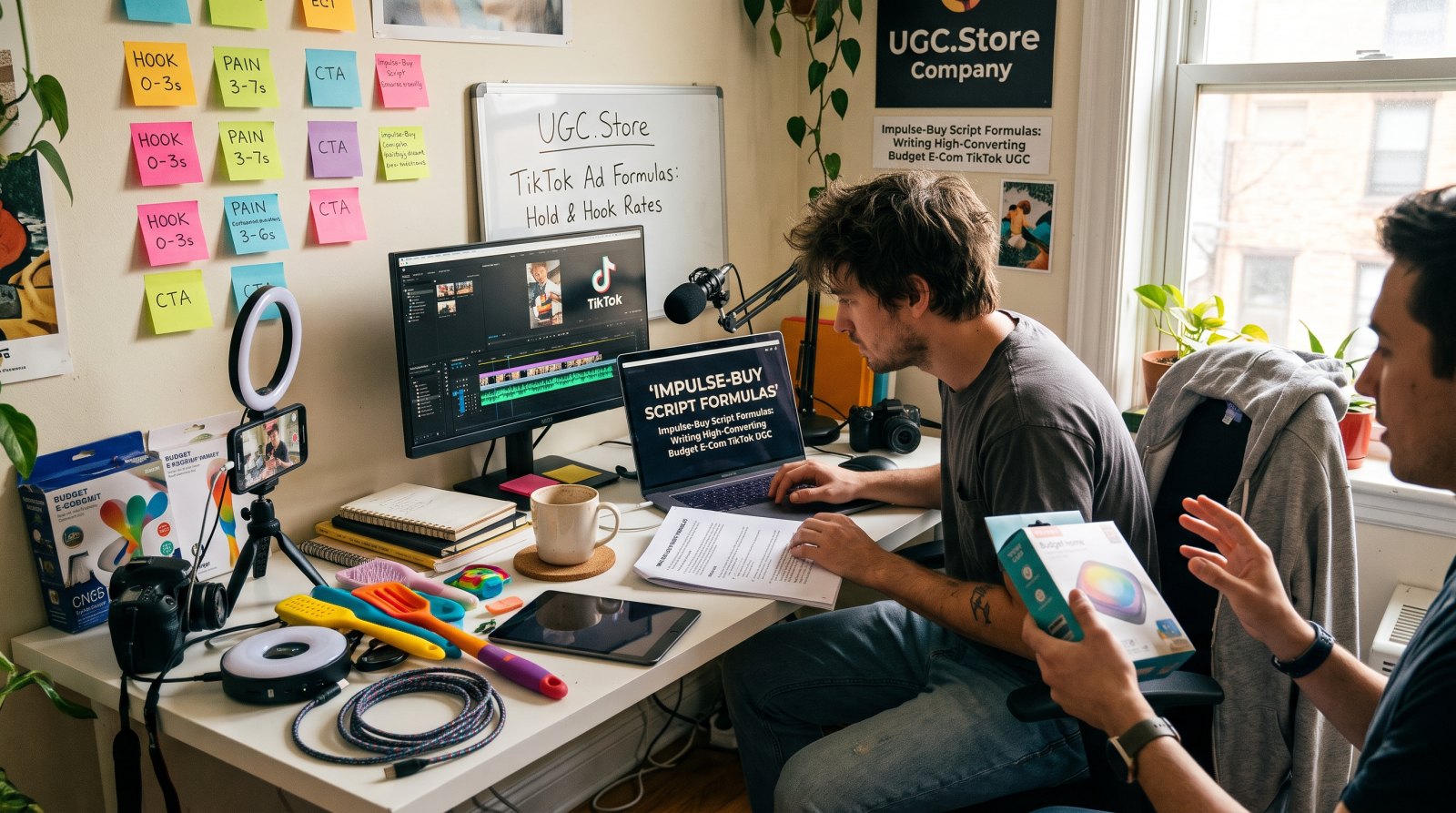
Executive Summary
High-converting TikTok UGC for budget e-commerce converts impulse shoppers by solving the tension between immediate sensory dopamine and friction-free purchase logic within a 15-to-25-second window. The operational blueprint relies on a 3-second pattern-interrupt visual hook paired with an overt cognitive paradox, transitioning into aggressive pain-point agitation and a concrete social proof anchor. Executing this architecture systematically delivers a Hook Rate exceeding 35%, a Hold Rate above 12%, and scales sub-$40 products to predictable sub-$12 Customer Acquisition Costs across broad TikTok Ads targeting.
The Physics of Attention: Cognitive Drivers and Platform Mechanics
Direct-response performance marketing on TikTok operates on radically different algorithmic and behavioral mechanics than native organic content or traditional top-of-funnel Meta placements. Budget e-commerce items—typically priced under the critical impulse threshold of $40—do not demand considered decision-making or extensive brand equity. Instead, they require the rapid manufacture of immediate perceived utility and urgent scarcity to trigger instant checkout behavior before rational analytical skepticism can intervene.
Understanding the technical architecture of the TikTok recommendation system explains why standard ad formats routinely fail. TikTok’s engine prioritizes initial engagement velocity, evaluating retention data within the first 1,000 to 2,500 milliseconds of impression delivery. If a video fails to register an active screen hold during this opening frame, the automated auction penalizes the ad unit by elevating effective cost per thousand impressions (CPM) and throttle-limiting ad set delivery. Successful performance creative bypasses this barrier through visual disruption that interrupts native scrolling behavior without triggering the internal advertising defenses of the user.
+---------------------------------------------------------------------------------------+
|                              THE IMPULSE-BUY CONVERSION ARC                           |
|                                                                                       |
|  [ 0s - 3s ]           [ 3s - 8s ]             [ 8s - 16s ]           [ 16s - 22s ]   |
|  VISUAL DISRUPTION --> PAIN/BENEFIT FRICTION --> CONCRETE DEMO/PROOF --> FRICTIONLESS |
|  Subconscious Hook     Dopamine Contrast       Sensory Validation      Impulse Trigger|
|  (>35% Hook Rate)      (Hold Rate Lift)        (Reversing Doubt)       (Low CAC/High CR)|
+---------------------------------------------------------------------------------------+
Impulse-buy decision architecture relies on the neurological interplay between dopamine anticipation and perceived financial friction. High price tags activate the insular cortex, the region of the brain associated with psychological pain and perceived loss. When an e-commerce item sits below the consumer's disposable budget threshold, that pain response remains muted. The primary cognitive challenge shifts from justifying product cost to manufacturing acute urgency and immediate visual desire. The script must build an intense cognitive contrast: the baseline frustration of an everyday friction versus the effortless satisfaction of the immediate fix.
To achieve this state, the video's presentation must actively counter the visual hallmarks of commercial production. Polished lighting, calibrated color grading, and broadcast-quality audio telegraph commercial intent, prompting users to swipe away instantly. High-performing user-generated content simulates raw, unvarnished peer-to-peer communication. Shot on handheld smartphones under everyday ambient lighting with authentic room resonance, the creative embeds commercial direct-response mechanics inside native platform formats. The resulting ad does not register as an overt sales pitch, keeping audience defenses down while systematically delivering a performance conversion pitch.
Step-by-Step Impulse Script Architecture and Timeline Pacing
Engineering an impulse-buy conversion requires strict discipline over every fraction of a second. Every frame, audio beat, on-screen text layer, and voiceover syllable must serve a specific structural function within the conversion engine.
00s ---------- 03s ---------- 08s ----------------- 16s ----------------- 22s
 |  VISUAL HOOK | PAIN-AGITATE | PRODUCT DEMONSTRATION | MICRO-OFFER & CTA |
 |  Pattern-    | Emotional    | Real-Time Utility    | No-Brainer Value  |
 |  Interrupt   | Validation   | & Visual Proof       | & Risk Reversal   |
0 to 3 Seconds: The Pattern-Interrupt Hook
The opening frame must break visual expectations within the first 500 milliseconds. This is achieved by combining three elements: physical kinetic movement, a counter-intuitive visual paradox, and high-contrast native text overlays. The audio must lead with an intriguing declarative statement or an abrupt sonic hook, bypassing pleasantries, company logos, or contextual setup. If the viewer's eye does not register unexpected motion or tension before their thumb initiates the next scroll motion, the impression is lost.
3 to 7 Seconds: Agitation and Friction Amplification
Once the hook stops the scroll, the creator must immediately contextualize the user's implicit frustration. This phase identifies a relatable everyday friction and validates the viewer's annoyance. The creator quickly frames the status quo as inefficient, messy, or overpriced. This step sharpens audience intent: non-buyers drop off, while high-intent prospects lean in as they recognize their own frustration on screen.
7 to 15 Seconds: The Dopamine Payoff and Frictionless Demo
This segment serves as the core direct-response proof engine. The narrative shifts from identifying the problem to demonstrating its instant solution. Pacing accelerates through rapid jump cuts showing the product in active, practical use. High-converting creative emphasizes tactile sensory details: the satisfying snap of a latch, the smooth peel of a film, or an immediate visual transformation. The voiceover focuses strictly on outcomes and utility rather than technical specifications, demonstrating real-world results that overcome viewer skepticism in real time.
15 to 22 Seconds: Risk Reversal and Frictionless Call to Action
The final sequence turns peak visual desire into immediate checkout behavior. Because budget e-commerce relies on low decision friction, the call to action must avoid corporate sales language. Instead, the script uses actionable, community-oriented prompts combined with natural scarcity drivers, such as restock alerts or temporary promotion windows. The creative directs viewers straight to the storefront link while reassuring them on shipping speed and return policies, eliminating lingering purchase hesitation at the checkout threshold.
Battle-Tested Script Blueprints for Budget E-Commerce
Script 1: The "I Was Today Years Old" Flawless Demonstration
This format leverages perceived discovery and naive curiosity to disarm user defenses before transitioning into an effortless utility demonstration.
Target Product Profile: Ergonomic kitchen tools, home organization gadgets, car cleaning accessories ($15–$30 price range).
Core Conversion Mechanism: Transforms a neglected everyday chore into a satisfying, gamified visual payoff.
Visual (0:00 - 0:02): Handheld phone camera tracking the creator aggressively scrubbing an air fryer basket with a basic sponge, getting visibly frustrated by the burnt residue.
SFX: Harsh scraping audio amplified for tactile discomfort.
On-Screen Text (Native TikTok Font): Stop cleaning your air fryer like this 💀
Voiceover (Fast pace, conversational): "If you are still scrubbing your air fryer basket with a standard sponge, you are genuinely wasting twenty minutes of your night."
Visual (0:02 - 0:06): Hard cut. The creator pulls a heat-resistant, custom-fit textured silicone liner from a package, drops it into the basket with one hand, and tosses seasoned chicken wings straight onto it.
SFX: Clean, resonant "pop" sound effect on the drop.
On-Screen Text: Just use this instead...
Voiceover: "I found this reusable silicone tray on TikTok for under twelve bucks, and it completely changed my dinner routine."
Visual (0:06 - 0:12): Quick cuts showing the wings cooked to perfection, followed by the creator effortlessly pulling the liner out with two fingers. The basket underneath remains spotless. The creator rinses the liner under the faucet in three seconds flat.
SFX: Water whoosh sound effect, followed by an upbeat, satisfying ASMR transition.
On-Screen Text: Dishwasher safe / Zero residue.
Voiceover: "Nothing sticks to it. The food stays crispy, and instead of scrubbing baked-on grease, you just rinse it or toss it in the dishwasher."
Visual (0:12 - 0:18): Creator faces the camera holding the pack of three liners, gesturing toward the bottom-left corner of the interface.
On-Screen Text: Under $15 today only + tap below
Voiceover: "They sold out twice last month, but the three-pack is back in stock at the link below. Grab yours before the current batch sells out."
Script 2: The Direct Competitor Price Shaming Hook
This format leverages direct financial contrast, anchoring the product's value against an overpriced incumbent brand to make the purchase feel like an obvious financial win.
Target Product Profile: Direct-to-consumer cosmetics, minimalist EDC gear, budget audio tech ($20–$40 price range).
Core Conversion Mechanism: Combines financial outrage with undeniable side-by-side performance parity.
Visual (0:00 - 0:03): Split screen or rapid cut. Creator holds a $120 designer perfume bottle in one hand and an unbranded, sleek pocket atomizer in the other, shaking their head directly at the lens.
SFX: Sharp vinyl scratch sound effect.
On-Screen Text: Spending $120 on cologne in 2026 makes no sense
Voiceover (Direct, authoritative tone): "Please stop spending over a hundred dollars on designer fragrance just to pay for a luxury brand's billboard budget."
Visual (0:03 - 0:08): Macro close-up of the pocket atomizer being extracted, misted onto the wrist in ultra-fine slow motion, showing rich, premium aerosolization.
SFX: Crisp, satisfying mist spray sound.
On-Screen Text: Same exact notes. 1/5th the price.
Voiceover: "This extracted dupe uses the identical base notes of French amber and smoked vanilla, but it costs under twenty-five dollars."
Visual (0:08 - 0:14): Creator in an authentic public setting (e.g., college campus or casual cafe) asking a friend to blind-test two wrist sprays, with the friend immediately picking the affordable option.
SFX: Quick comedic chime.
On-Screen Text: Blind test never lies 👀
Voiceover: "It lasts eight hours on skin, fits directly in your pocket, and literally every single person I've tested this on thought it was the luxury version."
Visual (0:14 - 0:20): Creator points directly down to the screen overlay while slipping the atomizer effortlessly into a coin pocket.
On-Screen Text: Grab the bundle before the sale ends
Voiceover: "Hit the showcase link right down here. If you grab the two-pack today, shipping is completely free. Don't overpay for the big label."
Script 3: The "Trolling the Skeptics" Extreme Stress Test
This format relies on visual proof and conflict resolution, opening with negative consumer feedback to hook viewers through dramatic real-time product validation.
Target Product Profile: Indestructible charging cables, spill-proof drinkware, stain-resistant apparel ($15–$35 price range).
Core Conversion Mechanism: Drives engagement through conflict, disarming skepticism with undeniable real-time durability tests.
Visual (0:00 - 0:03): Creator displays a real or mocked-up negative comment sticker on-screen reading: "There is no way a $15 charging cable survives a desk chair rolling over it every day." The creator smirks, placing the cable directly under the hard plastic wheel of an office chair.
SFX: Low dramatic bass drop.
On-Screen Text: Replying to @tech_critic: Bet.
Voiceover (Challenging, confident): "Someone left this comment claiming budget braided cables always snap within two weeks. Let's find out."
Visual (0:03 - 0:09): The creator rolls the chair back and forth over the braided cable three times, then immediately plugs it into an iPhone on screen.
SFX: High-pitched, authentic iOS charging confirmation chime.
On-Screen Text: Unbroken. 100W Fast Charge.
Voiceover: "Not only does it instantly charge, but the zinc-alloy connector head didn't bend an absolute millimeter."
Visual (0:09 - 0:15): Creator bends the strain relief joint aggressively 180 degrees multiple times on camera, showing the heavy-duty nylon weave and the high-speed wattage meter running on an active laptop.
SFX: Tension creak sound, followed by snappy rhythmic music.
On-Screen Text: 20,000+ Bend tested.
Voiceover: "It handles up to one hundred watts of fast power delivery, meaning it powers your laptop just as fast as your phone, without overheating."
Visual (0:15 - 0:21): Creator holds two different length variants of the cable toward the camera lens, tapping the purchase prompt.
On-Screen Text: Get the 2-pack via TikTok Shop below
Voiceover: "Stop buying flimsy factory cables that fray in a month. Tap the link below and get the dual-pack while the bundle promo is active."
Tactical Framework: Script Styles, Metrics, and Production Trade-Offs
| Script Strategy Archetype | Target Performance Metrics | Ideal Product Verticals |
The "I Was Today Years Old" Discovery Centers on an unexpected daily life-hack or revelation. Uses gentle pattern interrupts followed by rapid visual relief. | Hook Rate: 38% - 46% Hold Rate: 14% - 18% Target CTR: 2.8% - 3.9% | Kitchen Gadgets, Home Storage, Everyday Cleaning Supplies, Novel Hardware Tools |
Direct Competitor Price Shaming Exposes high brand markups by comparing high-end items to budget-friendly alternatives on concrete performance. | Hook Rate: 42% - 52% Hold Rate: 11% - 15% Target CTR: 3.2% - 4.8% | Dupe Cosmetics, Minimalist Accessories, Entry-Level Consumer Electronics, Apparel |
Skeptic Stress Test & Proof Engine Opens with a controversial customer claim or doubt, disproving it through an immediate stress-test demonstration. | Hook Rate: 45% - 58% Hold Rate: 16% - 22% Target CTR: 2.4% - 3.5% | Heavy-Duty Cables, Stain-Resistant Textiles, Protective Tech Cases, Pet Supplies |
Case Study: Scaling a Budget Car Cleaning Gel to $240K/Month
+---------------------------------------------------------------------------------------+
|                              CAMPAIGN SCALE-UP TRAJECTORY                             |
|                                                                                       |
|  $250k +                                                                              |
|  $200k +                                                                * [$242,400]  |
|  $150k +                                                  * [$145,000]                |
|  $100k +                                    * [$82,000]                               |
|   $50k +                      * [$38,500]                                             |
|     $0 +--------* [$12,400]-----------------------------------------------------------+
|               Month 1       Month 2       Month 3       Month 4       Month 5         |
|             (Baseline)    (ASMR Hook)   (Hook Iter.)  (Broad Scale) (Mature Run)      |
+---------------------------------------------------------------------------------------+
The Initial Challenge
A direct-to-consumer e-commerce brand selling a specialized car interior cleaning gel ($14.99 retail price, $2.10 unit manufacturing cost) struggled to maintain sustainable acquisition economics on TikTok Ads. The account was burning budget with broad-targeted interest ad sets, averaging an unsustainable Customer Acquisition Cost (CAC) of $21.40 and an unviable ROAS of 0.70.
An audit of the historical creative revealed classic production mistakes: polished studio lighting, uninspired opening shots of the container sitting on an office desk, and scripted actors delivering stilted sales pitches. The ads averaged a dismal Hook Rate of 14.2% and an average watch time of just 2.1 seconds.
The Creative Pivot and Iterative Testing
The team overhauled its creative workflow, shifting from agency-style studio shoots to a high-volume Creator Content Engine producing six script variations weekly. The winning angle, titled The ASMR Vent Peel, abandoned traditional voiceover intros entirely:
The 2-Second Disruptive Hook: The video opens on an uncomfortably dusty dashboard vent inside a commuter vehicle. Without introductory narration, a hand jams the neon-colored cleaning compound deep into the louvers.
The Sensory Payoff: High-gain field audio captures the squelch of the gel settling into the vent, followed by a clean, satisfying peel that extracts years of dust in a single sweep.
The Narrative Pivot: At second 4, the creator transitions to handheld smartphone footage, speaking naturally while cleaning cup holders, door seams, and gearshift gaps:
"If your car interior collects dust and you hate buying compressed air cans, this reusable compound costs eight bucks and lasts six months."
The Call to Action: The final four seconds demonstrate the gel being sealed back into its container, accompanied by a clean on-screen checkout incentive pointing directly to the storefront link.
Campaign Performance Breakdown
| Strategic Parameter | Baseline Legacy Creative | Iterative UGC Scale Phase | Performance Variance |
| Top-of-Funnel Hook Rate (0-3s) | 14.2% | 44.8% | +215.4% improvement |
| Creative Hold Rate (0-6s) | 4.8% | 18.6% | +287.5% improvement |
| Outbound Click-Through Rate (CTR) | 0.82% | 3.41% | +315.8% improvement |
| Customer Acquisition Cost (CAC) | $21.40 | $8.22 | -61.5% cost reduction |
| Blended Return on Ad Spend (ROAS) | 0.70x | 2.65x | +278.5% margin lift |
By running winning video iterations through broad demographic targeting with open bidding, monthly revenue scaled from an initial $12,400 run rate to over $242,400 within 120 days. Creative fatigue was managed by producing multiple hook variations for the winning core demonstration, testing three to five new opening hooks every Monday to sustain stable blended performance.
Field Feedback: Frontline Insights from Creative Strategists
"The biggest mistake media buyers make with budget TikTok e-commerce is over-scripting the resolution. This audience has zero patience for high-production storytelling. If you don't show the physical product solving an annoying problem within the first two seconds, your cost per click triples. We don't even use lighting kits anymore; our top-converting creative of all time was shot inside a dirty 2014 Honda Civic using late-afternoon natural light."
— Marcus Vance, Head of Creative Strategy at Elevate Direct
"When scripting for sub-$30 impulse buys, stop treating the copy like a traditional direct-response sales letter. On TikTok, the true pitch is the visual pacing and audio texture. The moment the creator's voice shifts from casual peer recommendation to polished commercial announcer, your retention graph drops off a cliff. Write scripts the way people actually send voice notes to their friends—informal, direct, and slightly unpolished."
— Elena Rostova, Performance Creative Director & TikTok UGC Producer
"The goldmine is in the comments section of your competitor's worst reviews. We find out exactly what customers hate about existing products, turn those specific complaints into our opening video hooks, and let our product solve that exact issue on camera. It generates instant, authentic validation that no polished corporate commercial can replicate."
— Devin Cole, Senior Media Buyer at Chronos Scale Partners
Pre-Flight Production Checklist
Before uploading creatives to your ad sets or handing scripts off to UGC creators, run your creative assets through this production checklist.
[ ] First-Frame Visual Movement: Does the video feature clear physical motion or a visual surprise within the first 500 milliseconds?
[ ] Visual Clarity Without Audio: Can a viewer understand the problem, see the solution, and recognize the product with the sound muted?
[ ] Safe Zone Adherence: Are all text overlays, captions, and stickers clear of native platform UI elements (right-hand engagement icons, bottom captions, sound discs)?
[ ] Native Font Integration: Are on-screen text overlays set in native platform fonts rather than polished third-party desktop designs?
[ ] Early Problem Demonstration: Does the real-world frustration appear before the 3-second mark, rather than being delayed behind exposition?
[ ] Clear Tactile Audio: Are practical sounds (clicks, pops, mechanical movements) enhanced to create an immersive ASMR effect?
[ ] Authentic UGC Lighting: Is the video lit with everyday ambient lighting, avoiding the flat, corporate look of studio ring lights?
[ ] Frictionless Clear CTA: Does the closing sequence give a simple, direct instruction pointing to the showcase link, without vague corporate calls to action?
Frequently Asked Questions
What is an acceptable Hook Rate benchmark for budget e-commerce on TikTok?
In performance marketing on TikTok, Hook Rate is measured as a 2-second or 3-second continuous video view divided by total impressions. For impulse-buy budget e-commerce, aim for a baseline Hook Rate of 35% to 40%. Anything below 30% indicates that the visual pattern-interrupt failed, allowing users to scroll past before processing the offer. Top-tier creative scripts operating in high-volume scaling environments routinely clear 45% to 55% Hook Rates on broad audiences.
How many script variations are needed each week to combat creative fatigue?
Creative fatigue scales with ad spend. At a daily spend between $1,000 and $3,000, you need three to five new creative variations per week to keep performance stable. You do not have to reshoot the entire video for every variation. Instead, shoot two core demonstrations and film four distinct opening hooks for each. Splicing unique 3-second hooks onto a proven demonstration body gives you eight fresh creative combinations with minimal production overhead.
What is the ideal video run-time for impulse products?
For products priced under $40, keep total video duration between 15 and 22 seconds. Creative testing consistently shows that retention drops sharply after 25 seconds for impulse products, because these lower-ticket items do not require deep feature breakdowns. Every added second past the 20-second mark introduces another exit opportunity before the user reaches the call to action.
How should creators handle pricing in the script?
Address pricing strategically based on your campaign setup. If the price point is a genuine competitive advantage (e.g., a $12 alternative to an $80 name brand), state the price directly to filter out low-intent clicks. If you are using dynamic TikTok Shop affiliate showcases or run frequent on-site sales, use relative pricing anchors—such as "for less than the cost of a fast-food lunch" or "under twenty bucks right now". This keeps the video evergreen and prevents viewer confusion when promotions or prices change.
Should I prioritize Spark Ads or standard Non-Spark Dark Ads for budget products?
Start by testing both concurrently. Spark Ads—which run through an authenticated creator's actual platform profile—typically yield higher social engagement, stronger initial watch time, and lower overall cost per click thanks to organic social proof. However, standard Dark Ads (direct upload from an advertiser profile) allow total control over creative edits, captions, landing page destinations, and fast copy iterations without waiting for creator approval. A proven testing split is to discover winning concepts using fast dark ad testing, then license top-performing angles through creator accounts via Spark Ads for maximum scale.