
Executive Overview
Language learning apps face a creative paradox that EdTech marketers rarely name out loud: the product’s core value is speaking, but the content format that converts is not a lesson. The viewer does not want to watch a tutorial. They want to watch someone struggle with the exact silence they know—the moment the brain freezes, the words vanish, and the conversation moves on without them. The dialogue-driven UGC format solves this by opening with the inner monologue of the struggle, not the product, and closing with the spoken line that proves the fix. The category is massive and growing: the global language learning apps market reached $7.36 billion in 2025** and is projected to hit **$8.55 billion in 2026, on a trajectory toward $28.32 billion by 2034 at a 16.15% CAGR . The brands winning on TikTok are not the ones with the best curriculum. They are the ones whose creators say the quiet part out loud before they show the app.
Theoretical Basis and Psychology of Mechanics
The dialogue-driven language learning format operates on a psychological mechanism that is distinct from every other EdTech creative pattern. Grammar explainers sell competence. Vocabulary demos sell progress. The dialogue-driven script sells the end of a specific silence—the moment the viewer has lived through a hundred times and never seen reflected back at them. The mechanism is recognition of the freeze, and the app enters as the thing that unfreezes it.
The first mechanism is the silent struggle as identity mirror. The most relatable language learning content does not show fluency. It shows the gap between knowing the words and being unable to say them. The viral Stimuler format that generated 8.2 million views on a single video and scaled to 100 million organic views across 45 creators was not a lesson. It was a five-to-six second clip where the creator showed the relatable struggle of studying English but not being able to speak it, then revealed the app as the solution . The format worked because the struggle was pre-linguistic: the viewer did not need to understand the creator’s native language to recognize the frustration. The freeze is universal. The app is the exit.
The second mechanism is the dialogue as proof of change. Language learning is invisible in the short term. You cannot show a viewer that you now understand the past tense. But you can show them a conversation that would have been impossible before. The dialogue-driven script uses a before-and-after conversation structure—the same exchange, first in silence or stutter, then in spoken confidence. The proof is not a testimonial. It is a performance of the skill, and the performance is the demo. This is why the highest-performing language UGC often feels like a story rather than an ad: the viewer is watching a character change, not a product feature .
The third mechanism is the micro-lesson as value exchange. The viewer who stops for the struggle must receive something in return for their attention. The dialogue-driven script embeds one small, immediately usable language moment—a phrase, a pronunciation fix, a cultural nuance—that the viewer can take without downloading. This is the format’s reciprocity engine. The viewer does not feel sold to. They feel taught, and the teaching earns the CTA. The Stimuler campaign’s second-tier formats used celebrity clips and cultural hooks to create educational content that felt like entertainment, driving engagement that pure lesson content could not sustain . The lesson is the gift. The app is the continuation.
The fourth mechanism is the localization imperative. Language learning is the most locale-sensitive category on TikTok. A script that works for Spanish-speaking learners in Mexico will fail for Portuguese-speaking learners in Brazil, and both will fail for Korean learners of English. The Stimuler campaign succeeded because it recruited 45 Spanish-speaking creators across LATAM, each with authentic audiences in the education and lifestyle niches, and localized the humor, cultural references, and creator archetypes to the region . The dialogue must sound like the viewer’s own inner voice, in their own language, with their own specific obstacles. A generic “learn English fast” script is invisible in every market.
Step-by-Step Algorithm & Methodology
The framework below sequences a dialogue-driven language learning UGC asset from cold open to download, with each phase engineered to convert the silent struggle into spoken proof while remaining native to TikTok’s entertainment-first grammar.
Phase 1 — The Freeze Cold Open (0–3 seconds). The creator opens mid-silence, not mid-sentence. The first frame shows a social situation where speech is required—a coffee shop counter, a phone call, a group conversation—and the creator’s face carries the specific panic of someone whose words have disappeared. The dialogue is not spoken to the camera. It is the inner monologue, voiceover or whispered: “She asked me what I wanted and I knew the word for coffee. I knew it. And I said nothing.” No greeting, no app name, no promise. The viewer must recognize the freeze before they know what the video is about. This is the hook that Stimuler scaled across LATAM: the relatable struggle of studying but not being able to speak .
Phase 2 — The Specific Gap (3–8 seconds). The creator names the exact linguistic moment that broke them, with enough specificity to confirm the story is real. “I have been studying for six months. I know the grammar. I know the vocabulary. But the moment someone actually talks to me, my brain goes to static.” The gap is named in plain language, without shame and without academic terminology. The viewer who has studied for years and still cannot order food is now inside the story.
Phase 3 — The App as Practice Space (8–16 seconds). The app enters not as the teacher but as the place where the freeze gets practiced away. The screen shows the creator using a conversation feature—a speaking prompt, a dialogue exercise, a simulated exchange—and the creator’s voice narrates what is happening: “This is the first time I have practiced the actual conversation instead of just the vocabulary. It asks me the question. I have to say the answer. Out loud.” The screen recording is the demo, and the demo’s value is the rehearsal, not the curriculum. The app is the gym where the conversation muscle is built.
Phase 4 — The Dialogue Proof (16–26 seconds). The creator shows the same conversation that froze them in Phase 1, now performed with the words available. The setting is the same. The question is the same. But this time the creator speaks—imperfectly, with hesitation, but speaking. “I want a coffee. Medium. With oat milk.” The proof is not fluency. It is the absence of silence. The creator’s face after the spoken line carries the specific relief of someone who has been holding their breath and finally exhaled. This is the format’s emotional peak and its conversion engine.
Phase 5 — The Honest Friction Note (26–32 seconds). The creator names what the app cannot do and what the process actually requires. “The app does not make you fluent. I still freeze sometimes. But I freeze less, and the freeze is shorter, and I can hear myself getting through it.” This phase is the trust mechanism and the compliance mechanism simultaneously. It acknowledges that the product is a practice tool, not a transformation. The viewer who has been burned by “fluent in 30 days” promises is disarmed by a creator who says “this will take time and I am still in the middle of it.”
Phase 6 — The Shared Freeze CTA (final 5–7 seconds). The creator closes with a question that invites the viewer’s own freeze story into the comments. “Tell me the sentence you have been trying to say for months. Not the grammar. The sentence. I will go first: ‘Can I have a table for two?’ Your turn.” The CTA does not ask for downloads. It asks for confessions, and the confessions are the conversion mechanism. The comment section becomes a shared archive of the sentences people are afraid to say, and the viewer who reads ten of them before downloading is already inside the app’s social context.
Ready-to-Use Working Templates & Scripts
Script One: “The Coffee Shop Freeze” (Format: speaking-practice UGC, 38 seconds).
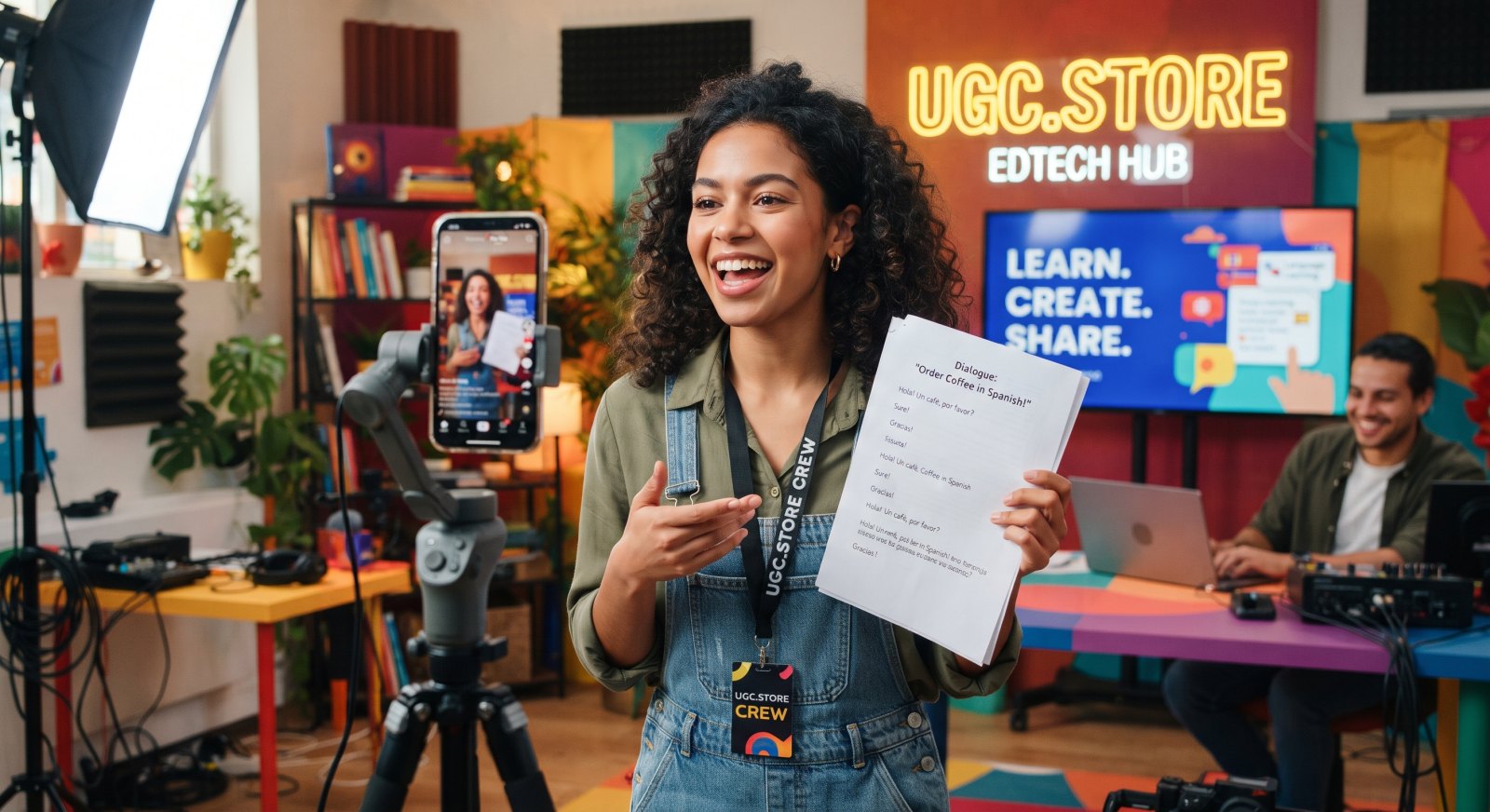
Opening frame: creator’s face in a coffee shop, phone propped against a cup, expression of remembered panic. Hook text: “i knew the word for coffee and i still said nothing”. Dialogue, voiceover: “She asked me what I wanted. I had practiced this. I had studied this. And my brain just—static. I pointed at the menu and said ‘that one.’” Specific gap: face to camera, slight laugh. “I have been studying English for eight months. I can read a news article. I cannot order a coffee without pointing.” App reveal: screen shows a speaking exercise, the prompt visible, creator’s voice heard responding. “This is the first thing that made me practice the actual conversation instead of just the words. It asks me the question. I have to answer out loud. It is awkward. It works.” Dialogue proof: cut back to the coffee shop, creator speaking to an off-screen barista, voice clear but imperfect. “Can I have a medium latte? With oat milk. Please.” Face after: a small, genuine exhale. Honest friction: face to camera. “I still freeze sometimes. The app does not fix that. It just makes the freeze shorter.” CTA: direct to camera. “Tell me the sentence you have been trying to say for months. Not the word. The sentence. I will go first: ‘Can I have a table for two?’ Your turn.”
Script Two: “The Phone Call” (Format: conversation-simulation UGC, 34 seconds).
Opening frame: creator holding a phone, not calling, just staring at it. Hook text: “i have been avoiding this phone call for three weeks”. Dialogue: “It is a dentist appointment. That is all. I need to say ‘I would like to make an appointment’ and then understand what they say back. Two sentences. I have written them down four times.” Specific gap: screen shows a notes app with the sentences written and rewritten. “I know the words. I know the grammar. The problem is that the other person does not know I have been practicing. They just talk at normal speed and I panic.” App reveal: screen shows a dialogue simulation, the app speaking a prompt, the creator responding. “This is the closest thing I have found to the actual pressure. It talks back. It does not wait for me to be ready.” Dialogue proof: creator on the phone, voice slightly shaky but functional. “Hi, I would like to make an appointment. For next week. Yes, Tuesday works.” Face after: a quiet “okay” and a nod. Honest friction: face to camera. “It was not perfect. I had to ask her to repeat the time. But I did it. The app did not do it for me. It just made the practice feel like the real thing.” CTA: “What is the phone call you have been avoiding? I need to know I am not the only one who writes scripts for basic human interactions.”
Script Three: “The Group Chat” (Format: social-confidence UGC, 40 seconds).
Opening frame: creator in a living room, phone in hand, reading a message. Hook text: “everyone in the group chat is making plans and i am typing nothing”. Dialogue: “They are all talking in English. I can read it. I understand every word. But by the time I compose a response in my head, the conversation has moved on and the plan is already made.” Specific gap: face to camera, resigned smile. “I am not bad at English. I am slow at English. And slow means invisible.” App reveal: screen shows a timed speaking drill, the creator responding to a prompt under mild pressure. “This is the first thing that made me practice speed instead of accuracy. It does not let me think for ten seconds. I have to say something now, even if it is not perfect.” Dialogue proof: cut to creator typing in a group chat, then a voice message recorded. “I am in for Saturday. Where are we meeting?” Face after: a small, surprised laugh. “I sent a voice message. I have never sent a voice message.” Honest friction: face to camera. “I still take too long sometimes. But the gap is smaller. And I am in the chat now instead of reading it from the outside.” CTA: “What is the message you have typed and deleted the most? No judgment. I have deleted ‘sounds good’ approximately four hundred times.”
Comparative Analysis Matrix
| Parameter | Lesson-Based Language UGC | Dialogue-Driven Language UGC |
|---|---|---|
| Core emotional mechanism | Aspiration and competence | Recognition of the freeze and the silence |
| Primary visual | Grammar explainer, vocabulary list, teacher talking head | Social situation, inner monologue, spoken proof |
| Hook structure | “Here is how to use the past tense” | “I knew the word and I still said nothing” |
| Viewer response | “That is useful” | “That is literally me” |
| Comment behavior | “What app is this” | Shared freeze sentences and avoided conversations |
| Trust architecture | Educational authority | Peer struggle and imperfect proof |
| Localization requirement | Moderate; grammar translates | High; the freeze must sound native -1 |
| Friction Point | Lesson-Based Failure Mode | Dialogue-Driven Solution |
|---|---|---|
| Speaking anxiety | Viewer learns rules but never practices speech | Creator rehearses the actual conversation on screen |
| Fluency myth | “Fluent in 30 days” triggers skepticism | Honest friction note names the remaining freeze |
| Relevance gap | Generic curriculum does not match viewer’s life | Specific scenario (coffee shop, phone call, group chat) |
| Cultural mismatch | Script sounds translated, not native | Creator’s own language and local references -1 |
| Install intent | Driven by curiosity, fragile after lesson one | Driven by recognition, durable through the practice |
| Performance Metric | Category Benchmark (EdTech UGC) | Dialogue-Driven Target |
|---|---|---|
| Hook rate (3-second) | 50–60% on cold traffic | Above 65% via freeze recognition |
| Hold rate (15-second) | 30–40% | Above 50% via dialogue proof |
| Comment rate | 0.5–1% of views | 2–4% via shared sentence CTA |
| CPI versus category | At benchmark | Below benchmark via Spark amplification |
| Day-7 retention signal | Weak; install driven by curiosity | Stronger; install driven by a specific scenario to practice |
Real-World Case Study Breakdown
A language learning app focused on conversational English launched a TikTok UA campaign in early 2026 with a creative library built entirely on lesson demonstrations: grammar explainers, vocabulary drills, and a teacher-style talking head describing the app’s curriculum. The production was clean and the pedagogy was sound, but performance was diagnostic of the category’s core creative failure: CPI settled at $4.80** against a benchmark of **$3.00–$4.00 for EdTech apps on TikTok, with 15-second hold rate at 27% and comment sections that were either empty or transactional (“what app”). The lessons were useful and completely forgettable. The viewer did not need another teacher. The viewer needed to see someone survive the silence.
The strategic pivot abandoned lesson demonstration entirely and rebuilt the creative around dialogue-driven scripting. The team recruited nine creators across three markets, ranging from 8,000 to 40,000 followers, selected for one criterion: their comment sections were full of people describing their own speaking anxiety. The brief contained a single rule: “Open with the moment you froze. Do not teach. Show the conversation you could not have before.”
The winning asset came from a creator with 16,000 followers whose opening line was: “I knew the word for coffee and I still said nothing.” The video showed her actual coffee shop freeze, her actual practice session on the app, and her actual imperfect order at the counter. The honest friction note was: “I still freeze sometimes. The app does not fix that. It just makes the freeze shorter.” The comment section filled with viewers posting their own avoided sentences, and the creator pinned one with the reply: “we are all pointing at the menu.”
The video ran for six weeks as organic and Spark-boosted content, generated 920,000 views, and drove 3,600 attributed installs at a blended CPI of $3.20—33% below the lesson-demo baseline. The governing insight: the app had been selling a curriculum, when the buyer needed to see someone survive the silence they had been living in for years. The Stimuler campaign’s 100 million organic views across 45 LATAM creators demonstrated the same mechanism at scale: the struggle is the hook, and the app is the exit .
Real-World Engineering & Creative Feedback
“The freeze is the hook. Not the grammar, not the vocabulary, not the promise of fluency. The moment the creator says ‘I knew the word and I said nothing’ is the moment the viewer stops scrolling because they have been saying nothing for years. The app is the reward for surviving the freeze. Get the sequence wrong and you are selling a textbook to someone who is already ashamed they cannot speak.” — Camila Reyes, Language Learning UGC Creator, 52K followers
“We killed every grammar-explainer hook from our creative library after the first testing sprint. Not because they did not convert—they did, sometimes—but because the CPI was inconsistent and the churn was brutal. The dialogue format is not just cheaper. It is retention-aligned. The viewer who downloads after a freeze story knows the app is a practice space, not a magic pill. They are not expecting fluency on day one. They are expecting a place to rehearse the conversation they have been avoiding. That expectation matches the product.” — Ben Achterberg, Head of User Acquisition, Cartwheel EdTech
“Localization is not a nice-to-have in language learning UGC. It is the entire format. The Stimuler campaign worked because the creators were Spanish-speaking, the humor was LATAM-specific, and the struggle sounded like the viewer’s own inner voice. A generic ‘learn English fast’ script translated into five languages is still a generic script. The freeze has an accent. The script has to have the same one.” — Priya Deshmukh, Creative Strategy Lead, Pixel & Pulse Agency
“Spark Ads are mandatory for this format. A freeze confession on a brand account reads as a desperate attempt to be relatable. The same confession on a creator’s account, with their real followers commenting ‘I pointed at the menu yesterday,’ reads as a community archive. The 27% CPI reduction from Spark is real, but the format-specific lift is bigger because the silence needs a social context to convert. Silence in a vacuum is just shame. Silence in a comment section is solidarity.” — Marcus Lehto, Performance Marketing Director, Northline Interactive
“We almost cancelled the dialogue brief because the first batch of creators made the videos too sad. They were opening with despair and the comments were sympathetic but nobody was downloading. We rewrote the brief: ‘name the freeze, do not perform the pain. The viewer is not looking for a tragedy. They are looking for someone who froze and then spoke anyway.’ The difference in output was immediate. The tone shifted from shame to resolve. The CPI dropped by a third. The lesson: the freeze is the hook. The spoken line is the conversion. You cannot sell the exit from inside the silence.” — Elena Vasquez, Brand Director, Mosaic Learning
Production Self-Check Checklist
Freeze-first hook verified — the opening three seconds show a social situation where speech is required and the creator’s silence or panic; no greeting, no app name, no grammar terminology.
Specific gap named — the creator names the exact linguistic moment that broke them (the word they knew, the question they could not answer), not a generic “I struggled with English.”
App enters as practice space, not teacher — the screen recording shows the creator rehearsing a conversation, not watching a lesson or reading a vocabulary list.
Dialogue proof delivered — the creator performs the same conversation that froze them, imperfectly but audibly, and the performance is the demo.
Honest friction note spoken — the creator names the remaining freeze and what the app cannot fix; no “fluent in X days” claims surviving the edit .
Localization integrity confirmed — the script sounds like the creator’s native voice, with local references and humor that match the target market; no translated-feeling dialogue .
Micro-lesson embedded — the viewer receives one immediately usable phrase or pronunciation moment, earning the CTA through value exchange.
CTA invites shared sentence, not download — the closing prompt asks for the viewer’s own avoided sentence, generating comment-section confessions.
Spark authorization and usage rights secured — the creator’s account is the primary distribution vehicle; Spark code and paid amplification permissions documented before boosting.
Accessibility and safe zones cleared — captions cover 100% of spoken dialogue including the imperfect proof line; text and face remain inside TikTok’s safe zones.
Advanced FAQ
How does a brand script the freeze without making the viewer feel shame or inadequacy?
The boundary is who the freeze belongs to. A script that says “you should be embarrassed that you cannot speak” activates shame and triggers scroll. A script that says “I was embarrassed and I am still here” activates recognition and triggers watch time. The creator must own the freeze first, before the viewer has a chance to feel judged. The line that works is not “this is your problem” but “this was my problem.” The app then enters as the creator’s solution, not the viewer’s obligation. The viewer who feels seen is more likely to download than the viewer who feels accused. The Stimuler campaign’s viral format succeeded because the struggle was self-deprecating, not instructional . The creator was the joke, and the app was the punchline’s resolution.
What is the correct way to handle the “I do not have time to practice” objection that dominates language learning comment sections?
Do not argue with the time objection. Reframe the practice as smaller than the viewer thinks. The dialogue-driven script shows the practice happening in real dead time: waiting for coffee, sitting in a car, the two minutes before a meeting. The line is not “you need thirty minutes a day” but “I practice while the kettle boils.” The objection is not actually about time; it is about the belief that language learning requires a dedicated study block that the viewer cannot sustain. The app’s value is the micro-practice, and the script’s job is to make the micro-practice visible. The viewer who believes the practice takes three minutes is more likely to install than the viewer who believes it takes an hour.
Should dialogue-driven UGC use subtitles or captions in the creator’s native language, and if so, how?
Use captions for the spoken proof and the inner monologue, but do not caption the app screen. The captions should follow TikTok’s native style: hardcoded, high-contrast, positioned inside safe zones, and timed to the spoken line. The inner monologue captions should be first-person and lowercase, matching the intimacy of the voiceover. The spoken proof captions should be exact, including the imperfections (“can I have a medium latte with oat milk please” without punctuation). The imperfection is the proof. Do not clean up the dialogue in the captions. The viewer who reads the imperfect sentence recognizes their own imperfect speech. The app screen should be legible without captions—zoom or scale the interface if necessary—because the screen is the evidence, not the text .
How does the format perform differently for English-learning apps targeting non-native speakers versus apps teaching other languages to English speakers?
The mechanism is identical, but the power dynamic shifts. For English-learning apps targeting non-native speakers, the freeze is often tied to social stakes: the job interview, the immigration meeting, the moment someone treated the creator differently because of their accent. The dialogue must acknowledge the stakes without exploiting them. For apps teaching Spanish, Japanese, or Korean to English speakers, the freeze is often tied to cultural desire: the trip, the relationship, the media the viewer wants to consume without subtitles. The dialogue must locate the freeze in the desire, not the deficiency. The MochiKanji campaign succeeded because the creator showed her life in Japan as the motivation, not the kanji struggle as the problem . The freeze is universal. The stakes are market-specific.
What is the right measurement stack beyond CPI for this format?
CPI alone will mislead because the dialogue-driven format attracts users who are already motivated and may install with expectations that the app does not meet if the onboarding does not deliver the rehearsal the ad promised. The correct stack includes first-session speaking completion: do users acquired through this creative actually complete a speaking exercise in the first session, or do they browse the curriculum and leave? The format is working if the acquired user speaks out loud in the first five minutes, matching the ad’s rehearsal promise. The secondary metric is day-7 practice return: do users come back to the speaking feature specifically, not just the vocabulary or grammar sections? The freeze mechanism is the practice loop, and the loop is only valuable if the user returns to rehearse. The third metric is comment sentence correlation: if the comment section is full of viewers posting their own avoided sentences and the day-7 practice return is high, the funnel is functioning. If the comments are full of “I downloaded it and it just wants me to pay,” the onboarding failed the reciprocity contract the ad established.
Custom Contextual Conclusion
Language learning apps have spent years selling fluency to people who are still frozen in the coffee shop, and wondering why the downloads do not stick. Fluency is a destination. The viewer is not there yet. The viewer is standing at a counter, knowing the word for coffee, and saying nothing. The dialogue-driven script does not ask them to be a different person who speaks three languages. It asks them to rehearse the sentence they have been avoiding, which is the only thing that has ever preceded speech. The market is growing at 16.15% annually toward $28 billion . The competition is fierce. The brands winning on TikTok are not the ones with the best curriculum or the most sophisticated AI. They are the ones that understood the script’s first line must name the freeze the viewer has lived, and the final line must invite the viewer to say the sentence out loud. The freeze is the hook. The rehearsal is the proof. The download is the first attempt. The only job of the script is to make the viewer believe that speaking is possible, even imperfectly, even slowly, even now.