
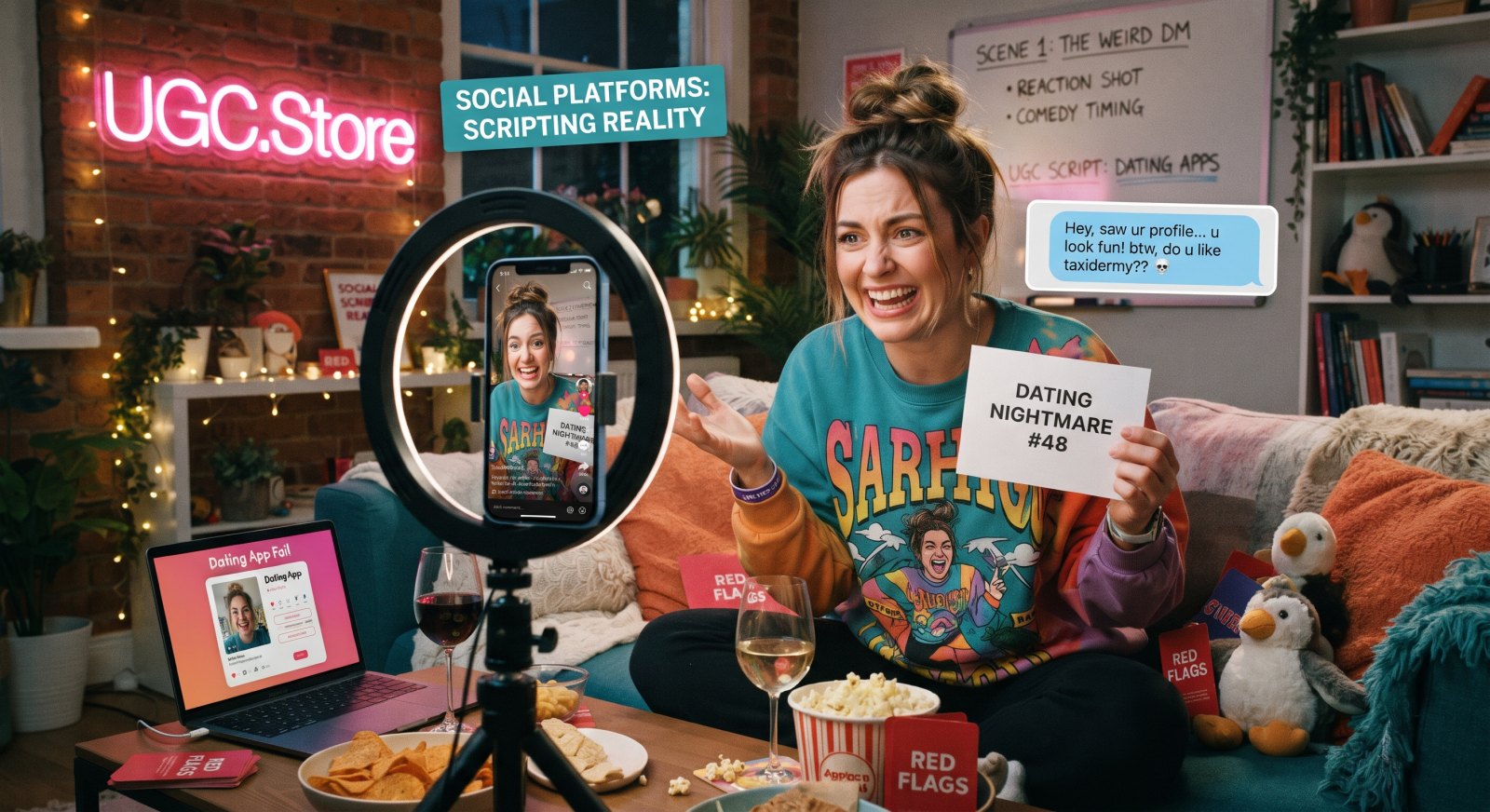
Executive Overview
Dating app UGC operates on a psychological paradox that no other vertical shares: the product exists because the experience is frequently terrible. Users do not download dating apps because they love dating apps. They download them because the alternative is worse, and the content that converts is not aspirational romance but relatable nightmare—the specific, slightly exaggerated, deeply recognizable failure that makes a viewer say “this is literally my life.” The format is validated by platform data: TikTok creator collaborations drove 16% ROAS lift and 20% CPA reduction for Hily, with creator-led dating stories and compatibility-test content outperforming polished brand assets . The mechanism is not humor for humor’s sake. It is shared misery as trust architecture, and the script’s job is to make the viewer feel seen before they feel sold to.
Theoretical Basis and Psychology of Mechanics
The relatable nightmare format succeeds because it inverts the standard advertising emotional arc. Most dating app marketing sells hope: the match, the connection, the relationship that starts with a swipe. The nightmare script sells recognition: the ghosting, the talking stage that never ends, the date that should have been a phone call. Recognition converts because it bypasses the viewer’s ad-defense system entirely. The viewer is not evaluating a product. They are validating an experience they have already had.
The first mechanism is shared misery as social proof. Dating content on TikTok runs on what practitioners describe as “shared misery plus hope,” and the audience is fluent in the vocabulary of failure: situationships, breadcrumbing, the talking stage, the ick . A script that names one of these experiences with surgical specificity signals that the creator is not an advertiser but a fellow sufferer. The viewer’s brain does not process “this is an ad for a dating app.” It processes “this person has been through what I have been through.” The trust that follows is not earned through claims but through accurate pain description.
The second mechanism is the specificity premium. Generic dating complaints (“dating sucks,” “men are terrible”) are invisible because they describe everyone and therefore no one. The nightmare script must name a hyper-specific moment that the viewer recognizes from their own life: the text that took four hours to compose and got a one-word reply, the first date that felt like a job interview, the profile photo that was clearly from 2019. The hook “he said one thing on the first date and I knew” outperforms “dating is hard” because the first names an exact moment thousands of viewers are sitting in right now . Specificity is the scroll-stopper.
The third mechanism is the anonymization contract. The nightmare script is built on real experience, but it cannot expose real people. The format’s credibility depends on the creator’s willingness to be self-deprecating rather than accusatory—the story is funny because the creator is the butt of the joke, not because a specific ex is being humiliated. Audiences increasingly side against creators who expose identifiable people, and the platform’s dating ad policies explicitly prohibit content that is exploitative or dishonest . The script must change identifying details, remove names and screenshots, and locate the humor in the creator’s own poor decisions rather than the other person’s failures.
The fourth mechanism is the compliance floor. Dating app ads on TikTok are a restricted category: they require 18+ targeting, approval through a TikTok sales representative, and landing pages that point to an app store or website . The content cannot portray single life as a negative lifestyle, cannot feature models who appear to be 21 or younger, and cannot include sexually suggestive language or imagery . The nightmare script is structurally safer than romance-based creative because it focuses on comedic frustration rather than sexual or romantic intimacy, but the boundary is real. The script sells the shared experience of app fatigue, not the promise of love, sex, or escape from loneliness.
Step-by-Step Algorithm & Methodology
The framework below sequences a relatable nightmare UGC asset from cold open to install, with each phase engineered to maximize recognition and trust while staying inside the dating category’s compliance boundary.
Phase 1 — The Specific Failure Cold Open (0–3 seconds). The creator opens mid-story, not mid-introduction. The first line names the exact moment of the nightmare with no setup: “He asked me what my love language was and then talked for forty-five minutes about himself.” or “I matched with a guy whose entire profile was just photos of his truck.” The opening frame is the creator’s face, expression frozen in the specific emotion of the memory—disbelief, resignation, or the particular smile of someone who has made peace with chaos. No greeting, no app name, no context. The viewer must recognize the experience before they know what the video is about.
Phase 2 — The Escalation Detail (3–10 seconds). The creator adds one or two specific, slightly absurd details that confirm the story is real and not manufactured. “And the truck had a name. He had named the truck. The truck had a gender.” The escalation is not exaggeration for comedy; it is precision for recognition. The viewer who has encountered a version of this person is already commenting mentally. The B-roll here is the creator’s face in close-up, reacting to their own memory, with no cuts and no graphics. The intimacy of the single shot is the format’s native visual language.
Phase 3 — The Self-Deprecating Turn (10–18 seconds). The creator pivots the story from the other person’s behavior to their own complicity or poor judgment. “And I went on a second date. Because I thought, maybe the truck thing was a one-off. It was not a one-off.” This phase is the format’s trust engine. The viewer who was laughing at the other person now trusts the creator because the creator is willing to be the fool. The script never positions the creator as a victim; it positions them as a willing participant in their own ridiculousness. This is the difference between a nightmare story that converts and one that generates hostile comments.
Phase 4 — The App Reveal (18–25 seconds). The dating app enters not as the solution to the nightmare but as the context in which the nightmare occurred. The creator shows the app screen—a match, a conversation, a profile—and names the specific feature that made the nightmare possible or the specific feature that would have prevented it. “This is where we matched. This is the conversation. This is the moment I should have known.” The app is not the hero. The app is the setting, and the creator’s willingness to show its role in the disaster is what makes the eventual CTA feel honest rather than promotional.
Phase 5 — The Honest Friction Note (25–32 seconds). The creator names what the app cannot fix. “The app cannot stop you from ignoring red flags because the red flags are attached to someone who texts back immediately and that is a hell of a drug.” This is the format’s compliance and trust mechanism simultaneously. It acknowledges that the product is a tool, not a transformation. The viewer who has been burned by dating app promises (“find your soulmate”) is disarmed by a creator who says “this app will not save you from yourself, but it will show you more people who are also not saving themselves.”
Phase 6 — The Shared Nightmare CTA (final 5–7 seconds). The creator closes with a question that invites the viewer’s own nightmare into the comments. “Tell me the worst first-date question you have ever been asked. I need to know I am not alone.” The CTA does not ask for installs. It asks for confessions, and the confessions are the conversion mechanism. The comment section becomes a shared nightmare archive, and the viewer who reads ten confessions before downloading is already inside the app’s social context.
Ready-to-Use Working Templates & Scripts
Script One: “The Truck Guy” (Format: dating app nightmare UGC, 38 seconds).
Opening frame: creator’s face in close-up, natural light, expression of someone who has told this story before and is still processing it. Hook text: “i went on three dates with a man who named his truck”. Dialogue: “His name was—okay, I’m not going to say his name, but his truck was named Barbara. Barbara had a gender. Barbara had feelings. He told me Barbara was ‘the only woman who had never let him down.’” Escalation: creator’s face, slight pause. “I asked him what he meant by that. He said, and I quote, ‘Barbara doesn’t talk back.’” Self-deprecating turn: creator laughs at themselves. “And I went on a second date. And a third. Because I thought, maybe he’s just nervous. Maybe the truck thing is a bit. It was not a bit. It was a lifestyle.” App reveal: screen shows a dating app conversation, creator’s thumb scrolling. “We matched on here. His profile said he was ‘looking for a co-pilot.’ I thought that was a metaphor. It was not a metaphor.” Honest friction: face to camera. “This app cannot stop you from dating a man who loves Barbara more than he will ever love you. That is a you problem. But it will show you his profile photos with the truck in every single one, so at least you know what you are getting into.” CTA: direct to camera. “Tell me the most specific red flag you have ever ignored because the person was hot. I need to feel better about Barbara.”
Script Two: “The Interview” (Format: first-date nightmare UGC, 34 seconds).
Opening frame: creator in a coffee shop, phone propped against a cup, face in deadpan. Hook text: “he brought a list of questions to the first date”. Dialogue: “Not like conversation topics. A list. On his phone. In the notes app. He had prepared questions.” Escalation: “Question four was ‘what is your relationship with your father.’ Question five was ‘do you consider yourself financially literate.’ Question six was ‘what is your five-year plan, and I mean specifically.’” Self-deprecating turn: creator’s face, a small grimace. “I answered all of them. I answered them well. I treated it like a job interview because I am a person who cannot let a challenge go unanswered.” App reveal: screen shows the app’s profile prompt. “We matched on here. His prompt was ‘I am looking for someone who is serious about building a life.’ I thought that meant he was mature. It meant he had a spreadsheet.” Honest friction: face to camera. “The app does not screen for people who treat dating like a performance review. That is not a feature. That is a risk. But at least the app showed me he was six feet tall, which I now understand was the only part of the interview I actually qualified for.” CTA: “What is the worst first-date question you have ever been asked? Wrong answers only, I want chaos.”
Script Three: “The Ghost Who Came Back” (Format: texting-stage nightmare UGC, 40 seconds).
Opening frame: creator’s face, phone in hand, expression of bewildered amusement. Hook text: “he ghosted me for three weeks and then sent this”. Dialogue: “No apology. No explanation. Just a message that said, and I am going to read it exactly, ‘hey stranger, how have you been?’” Escalation: “Stranger. I knew his mother’s name. I knew about his childhood dog. I knew why he hated his brother. And I was a stranger.” Self-deprecating turn: creator’s face, a resigned smile. “And the worst part is that I replied. I replied because I am a person with no self-control and a deep need for closure that I will never get.” App reveal: screen shows the chat thread, the timestamp gap visible. “This is where we met. This is the conversation. This is the three-week silence and the message that broke my brain.” Honest friction: face to camera. “The app cannot stop someone from treating you like a stranger after three weeks of talking every day. But it does show you their online status. Which means I knew he was online. For three weeks. And I still replied.” CTA: “What is the most unhinged message you have ever sent or received on a dating app? I need to know the bar is lower than I think.”
Comparative Analysis Matrix
| Parameter | Aspirational Romance UGC | Relatable Nightmare UGC |
|---|---|---|
| Core emotional mechanism | Hope and desired connection | Recognition and shared frustration |
| Primary visual | Couple imagery, engagement rings, happy endings | Creator’s face reacting to their own bad memory |
| Hook structure | “How I met my boyfriend on this app” | “He named his truck Barbara” |
| Viewer response | “I want that” | “This is literally my life” |
| Comment behavior | “So happy for you” and “where is he from” | Confession threads and shared nightmare stories |
| Compliance exposure | High; romance claims and age ambiguity | Lower; comedic frustration avoids sexual and romantic claims |
| Trust architecture | Testimonial-based; dependent on believability | Recognition-based; dependent on specificity |
| Friction Point | Aspirational Failure Mode | Nightmare Format Solution |
|---|---|---|
| Ad blindness | Polished romance reads as advertisement | Self-deprecating failure reads as peer storytime |
| Trust skepticism | “Nobody actually meets on apps” | Creator’s own willingness to be the fool proves authenticity |
| Age ambiguity | Young models trigger policy flags | Creator’s real age and comedic framing avoid 21-and-under modeling -4 |
| Comment hostility | “This is fake” | Specificity of detail confirms lived experience |
| Install intent | Driven by hope, fragile after first bad date | Driven by shared context, durable through bad dates |
| Performance Metric | Category Benchmark (Dating App UGC) | Relatable Nightmare Target |
|---|---|---|
| Hook rate (3-second) | 55–65% on cold traffic | Above 70% via specific nightmare |
| Hold rate (15-second) | 35–45% | Above 55% via escalation detail |
| Comment rate | 1–2% of views | 3–5% via confession CTA |
| CPI versus category | At benchmark | 20–30% below via Spark amplification -10 |
| Install-to-retention alignment | Weak if romance promise overstated | Strong if shared frustration matches app experience |
Real-World Case Study Breakdown
A dating app focused on serious relationships launched a TikTok UA campaign in mid-2026 with a creative library built entirely on success stories: couples who met on the app, engagement announcements, and testimonials about finding “the one.” The production was warm and the couples were real, but performance was diagnostic of a category-wide problem: CPI settled at $4.60** against a benchmark of **$3.00–$4.00 for dating apps on TikTok, with 15-second hold rate at 29% and comment sections that were either empty or hostile (“this is an ad,” “nobody looks like that”). The success stories were believable and completely unrelatable. The viewer had not found their person. The viewer was still in the nightmare.
The strategic pivot abandoned aspirational testimonial entirely and rebuilt the creative program around relatable nightmare scripting. The brand recruited six creators with follower counts between 8,000 and 40,000, selected for one criterion: their comment sections were full of people sharing their own dating disasters. The brief contained a single rule: “Tell a story about a date or a match that went wrong. You are the joke, not the other person. The app is the setting, not the solution.”
The winning asset came from a creator with 14,000 followers whose opening line was: “I matched with a man whose profile said he was ‘fluent in sarcasm’ and then he got mad at me for being sarcastic.” The video showed her recounting the escalating misunderstanding, with her face carrying the specific exhaustion of someone who has explained this to friends already. The app reveal was a single screen showing the match and the first message, with the creator’s comment: “This is where it started. This is the exact moment I should have swiped left.” The honest friction note was: “This app cannot fix the fact that ‘fluent in sarcasm’ is a warning sign, not a personality. But it does show you the warning sign before you waste a Thursday night.” The video ran for six weeks, generated 1.3 million views, and drove 3,800 attributed installs at a blended CPI of $3.10—33% below the success-story baseline . The comment section filled with viewers posting their own “fluent in sarcasm” horror stories, and the creator pinned one with the reply: “we are all the same person.” The governing insight: the app had been selling the end of the nightmare, when the buyer needed to see the nightmare shared before they could believe the app was worth trying.
Real-World Engineering & Creative Feedback
“The nightmare story is the only dating content that does not feel like an ad. The moment a creator says ‘I found my person,’ the viewer is gone. The moment a creator says ‘he named his truck Barbara,’ the viewer is in. The difference is not humor. It is recognition. The viewer is not laughing at the creator. They are laughing at themselves for having a Barbara story too. That laughter is the trust.” — Brittni Pristine, Dating and Lifestyle Creator, 138K followers
“We killed every success-story creative in our dating pipeline after the compliance review. Not because they did not convert—they did, sometimes—but because the CPI was inconsistent and the churn was high. The nightmare format is not just cheaper. It is retention-aligned. The viewer who downloads after a nightmare story knows the app is not magic. They are not expecting a soulmate on day one. They are expecting more Barbaras and a better filter. That expectation matches the product.” — Ben Achterberg, Head of User Acquisition, Cartwheel Dating
“The specificity rule is non-negotiable. ‘Dating is hard’ is invisible. ‘He brought a list of questions to the first date and question four was about my father’ is a video. I brief creators with one instruction: name the exact moment the nightmare became undeniable. The moment is the hook. The rest is context. The app is the setting. The comment section is the confession booth. That is the whole format.” — Priya Deshmukh, Creative Strategy Lead, Pixel & Pulse Agency
“Spark Ads are mandatory for this format. A nightmare story on a brand account reads as a desperate attempt to be relatable. The same story on a creator’s account, with their real followers commenting ‘this happened to me on Tuesday,’ reads as a community archive. The 27% CPI reduction from Spark is real, but the format-specific lift is bigger because the nightmare needs a social context to convert. A bad date in a vacuum is just a bad date. A bad date in a comment section is a shared identity .” — Marcus Lehto, Performance Marketing Director, Northline Interactive
“We almost cancelled the nightmare brief because the first batch of creators told stories that were too mean. They were making fun of the other person, and the comments were siding with the other person. We rewrote the brief: ‘you are the joke. The other person is the context.’ The difference in output was immediate. The comments shifted from ‘you are being harsh’ to ‘I have done the exact same thing.’ The lesson: the nightmare format only works when the creator is the fool. Cruelty is not relatable. Self-deprecation is universal.” — Elena Vasquez, Brand Director, Mosaic Dating
Production Self-Check Checklist
Specific nightmare hook verified — the opening three seconds name a concrete, recognizable dating failure with no greeting, no app name, and no generic complaint language.
Self-deprecation check passed — the creator is the butt of the joke; the story locates the humor in the creator’s own choices or complicity, not the other person’s character or appearance.
Anonymization confirmed — no names, no identifiable screenshots, no timeline details that could expose a real person; minor details changed where necessary .
Age compliance verified — the creator appears clearly over 21; no models who could be perceived as under 21 appear in any frame .-4
No single-life negativity — the script does not portray being single as a negative lifestyle or a condition to be pitied; the tone is shared frustration, not desperation .
App reveal is contextual, not salvific — the app enters as the setting of the nightmare, not as the solution to the creator’s worth or happiness.
Honest friction note delivered — the creator names what the app cannot fix, spoken to camera with a shift in emotional register from humor to honesty.
CTA invites confession, not purchase — the closing prompt asks for the viewer’s own nightmare, generating comment-section UGC and social proof.
Spark authorization secured — the creator’s account is the primary distribution vehicle; Spark code and usage rights documented before boosting .
Market eligibility confirmed — dating app ads are only permitted in approved markets with 18+ targeting and TikTok sales representative approval .
Advanced FAQ
How does a brand script a relatable nightmare without crossing into cruelty or violating the platform’s exploitative content prohibition?
The boundary is who bears the weight of the joke. Cruelty positions the other person as the punchline: their appearance, their intelligence, their worth. The nightmare format positions the creator’s own judgment as the punchline: why did they ignore the red flag, why did they go on the second date, why did they reply to the ghost. The other person is the context, not the target. TikTok’s dating ad policy prohibits content that is exploitative or dishonest, and the self-deprecating frame satisfies both requirements: the creator is exploiting their own experience, not someone else’s, and the story is truthful about the creator’s role in the disaster . The internal review question is simple: if the other person saw this video, would they feel humiliated or would they recognize the creator’s own foolishness as the point? If the former, the script fails.
What is the correct way to handle the “all dating apps are the same” objection that dominates male and female comment sections?
Do not argue with the objection. Agree with it, then differentiate through the nightmare’s specificity. The script acknowledges the fatigue directly: “I know. I have deleted this app four times. I have downloaded it five times. I am not here to tell you it is different. I am here to tell you the nightmare is at least more interesting than the nightmare on the other apps.” The differentiation is not a feature claim. It is a tone claim: this app is where these specific nightmares happen, and the shared language of those nightmares is the community. The viewer who is exhausted by dating apps is not looking for a better app. They are looking for an app that acknowledges the exhaustion without pretending to solve it. The nightmare script is that acknowledgment.
How does the format perform differently for serious-relationship apps versus casual-dating apps, given the compliance restrictions?
The format works for both, but the nightmare content must match the app’s promise. For serious-relationship apps, the nightmare is the wasted time: the interview date, the three-week ghost, the person who was clearly not looking for anything real. The script’s honest friction note acknowledges that the app cannot make people serious, but it can filter for people who are at least trying. For casual-dating apps, the nightmare is the misaligned expectation: the person who wanted a relationship when the creator wanted something casual, the match who treated a hookup like a job interview. The friction note acknowledges that the app cannot guarantee alignment, but it can make the misalignment visible earlier. Both versions must avoid the prohibited territory: no portrayal of single life as negative, no sexually suggestive content, no transactional relationship framing . The nightmare is always about frustration and miscommunication, never about sexual performance or romantic failure as a personal deficiency.
How should the comment section be managed when the confession CTA generates hundreds of nightmare stories?
Do not moderate the confessions—curate and amplify them. The comment section is the format’s secondary conversion funnel, and the brand’s role is to keep it alive and visible. Pin the most specific, self-deprecating confession. Reply with genuine engagement that asks for details (“what did the list of questions say about your five-year plan”). Do not reply to comments that name or attack real people; those should be hidden or addressed with a neutral reminder to anonymize. The comment section should read like a group chat, not a customer service portal. The only comments requiring intervention are those that express genuine distress or self-harm ideation; these should be handled with a supportive reply and, where appropriate, a pinned resource. The format’s greatest strength is its shared vulnerability. Its greatest risk is that the vulnerability becomes a pile-on, and the creator’s self-deprecation is the model the comment section should follow .
What is the right measurement stack beyond CPI for this format?
CPI alone will mislead because the nightmare format attracts users who are already fatigued and may install with low expectations that the app does not meet. The correct stack includes first-week match quality: do users acquired through nightmare creative report higher satisfaction with their matches than users acquired through success-story creative? The hypothesis is that the nightmare format pre-qualifies users for realistic expectations, and realistic expectations correlate with higher early satisfaction. The secondary metric is comment-to-install correlation: if the comment section is full of confessions and the install rate is high, the shared identity funnel is working. If the comments are full of agreement but the install rate is low, the format generated resonance without a bridge to action, and the CTA needs adjustment. The third metric is creative decay rate: nightmare stories may fatigue faster than aspirational content because the humor depends on novelty. A nightmare video that runs for eight weeks is likely coasting on algorithmic momentum rather than genuine engagement. The format requires high creative velocity, and the measurement stack should track refresh cadence alongside performance .
Custom Contextual Conclusion
The dating app category has spent years selling the person the viewer might become—the partnered, the settled, the no-longer-single. The nightmare format sells something more useful: the person the viewer already is, standing in a coffee shop while a stranger reads question four from a notes app. That recognition is the only trust signal that survives the viewer’s ad-defense system, because it does not ask the viewer to believe in a future they cannot imagine. It asks them to laugh at a past they have already survived. The brands winning dating app UGC on TikTok are not the ones with the best success stories or the most attractive couples. They are the ones that understood the script’s first line must name a nightmare the viewer has lived, and the final line must invite the viewer to name one too. Hily’s creator-led testing strategy proved the format scales when the content feels native . The nightmare is the native language. The confession is the conversion. The app is just the place where the confessions happen.