
Executive Overview
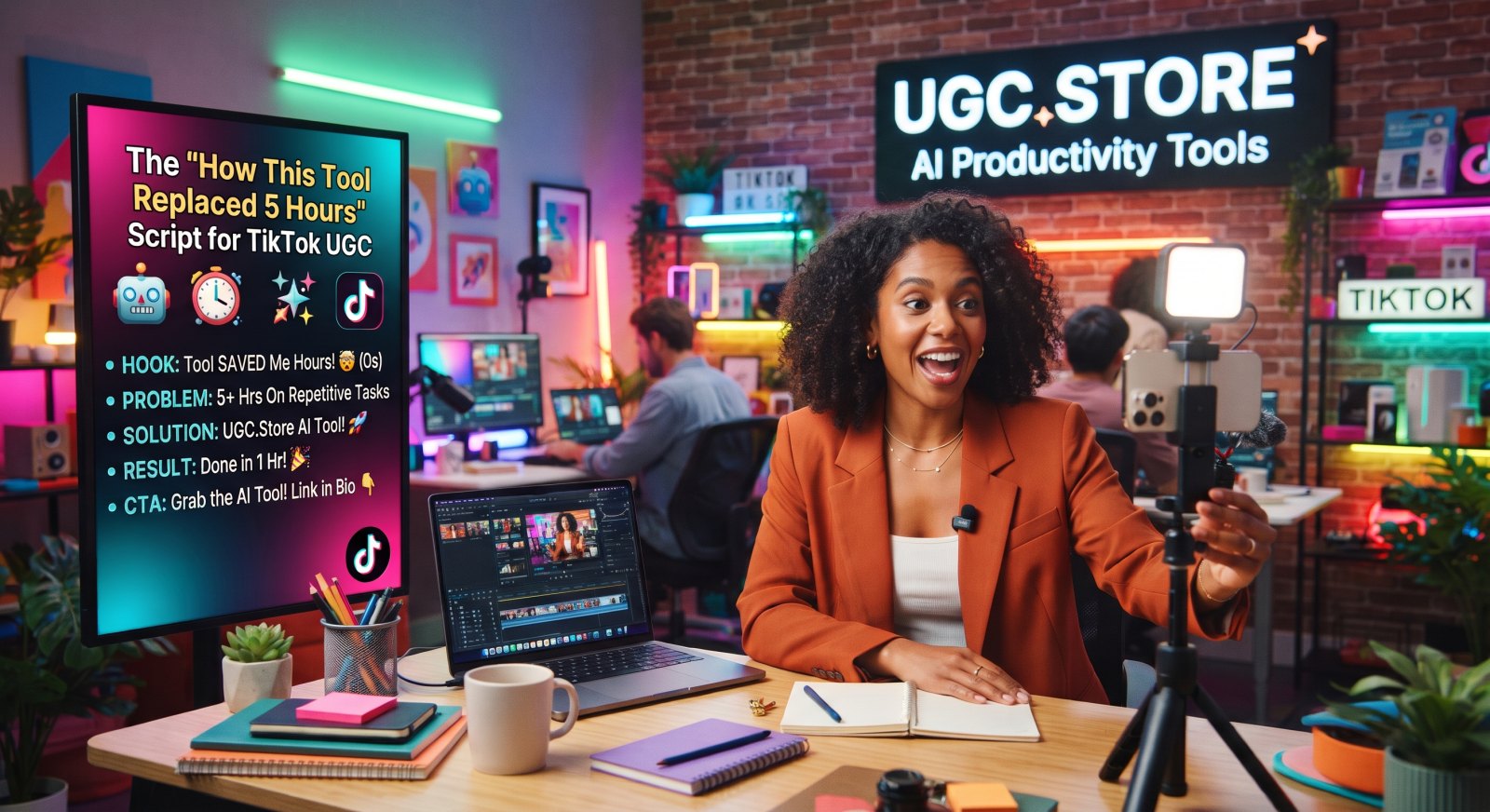
The AI productivity tools market is currently suffering from a massive credibility gap. Every software company claims their algorithm will "revolutionize your workflow," and every buyer is exhausted by the hype. When a viewer scrolls past a video claiming an AI tool will save them time, their brain immediately categorizes it as noise. To break through this ad-blindness, you need the "How This Tool Replaced 5 Hours" script format. This framework does not sell the technology; it sells the reclaimed time. It operates on a simple but ruthless premise: show the viewer exactly where their hours are leaking, and then show the AI productivity tool plugging the leak in real-time. The hook is not the AI. The hook is the 5 hours. The AI is just the mechanism that stops the bleeding.
Theoretical Basis and Psychology of Mechanics
The psychology behind the "Replaced 5 Hours" script relies on time scarcity, cognitive load reduction, and the specificity premium. Viewers do not care about large language models or neural networks. They care about their weekend, their sanity, and their deadlines. The script must translate the abstract value of AI productivity tools into a visceral, measurable human outcome.
The first mechanism is The Time Scarcity Trigger. Time is the only non-renewable resource for a professional. A hook that says, "This tool is fast" is easily ignored. A hook that says, "I got 5 hours of my life back this week" triggers immediate attention. The TikTok UGC must open with the exact number of hours lost to the "old way" and the specific, painful tasks that consumed them. The viewer must feel the weight of their own lost time before they are introduced to the solution.
The second mechanism is The Visual Subtraction. The biggest mistake in marketing AI tools is showing what the AI adds (a text box, a summary, a chart). The winning UGC script shows what the AI subtracts. It uses split-screens or fast-forward timelapses to delete the manual labor. The visual must show the messy spreadsheet, the endless copy-pasting, or the stack of emails, and then demonstrate the AI eliminating that entire workflow in seconds. The subtraction is the proof.
The third mechanism is The Specificity Premium. Vague claims like "boosting efficiency" or "streamlining operations" kill retention. The script must name the exact task. "It wrote my client proposal," "It categorized 400 receipts," "It summarized a 45-minute Zoom call." The specificity proves the AI tool is actually capable of handling the tedious work, not just generating generic text.
The fourth mechanism is The Practitioner Relief. The creator must look and sound like someone who genuinely hates the manual work they replaced. The tone should be one of relief and slight disbelief. They are not a tech evangelist; they are an exhausted professional who found a shortcut. The honest friction note—acknowledging that the AI still needs human oversight—grounds the video in reality and builds trust.
Step-by-Step Algorithm & Methodology
To successfully script the "Replaced 5 Hours" narrative for AI productivity tools, you must structure the video to establish the pain, prove the subtraction, and validate the human outcome.
Phase 1 — The Lost Hours Hook (0–3 seconds). The creator opens with the exact time stolen by the manual task. The visual shows the physical evidence of the labor—a massive stack of invoices, a chaotic spreadsheet, a 50-page document. The audio states the pain clearly: "I was spending five hours every Friday just manually copying data from these invoices into a spreadsheet." The text overlay is massive: 5 hours. every Friday.
Phase 2 — The Agitation and Frustration (3–8 seconds). The creator names the exact, tedious nature of the task. "It was not hard work, it was just soul-crushing work. I was making mistakes because my eyes were bleeding from looking at the numbers." The visual shows a fast-forward timelapse of the creator manually typing or copying data, looking increasingly frustrated.
Phase 3 — The AI Subtraction Demo (8–18 seconds). The AI productivity tool enters as the eraser. The creator opens the app. The screen recording shows the AI automatically extracting the data from the invoices and populating the spreadsheet in real-time. "Now I just upload the PDFs here, and the AI does the extraction. It takes four seconds." The contrast between the timelapse and the instant AI result is the visual proof.
Phase 4 — The Honest Friction Note (18–25 seconds). The creator acknowledges the limitation. "You still have to check the data to make sure the AI did not hallucinate a number. But checking is ten minutes. Typing was five hours." The honesty prevents the video from feeling like a magic trick and sets realistic expectations.
Phase 5 — The Reclaimed Time Payoff (25–32 seconds). The creator shows the result. "I got my Friday back. I left early for the first time in six months." The visual shows the creator closing their laptop or walking away from the desk.
Phase 6 — The Native CTA (32–35 seconds). The CTA is direct. "If you are still typing numbers manually, the link is in the bio. Try it on one task."
Ready-to-Use Working Templates & Scripts
Script One: The "Invoice Black Hole" (Format: finance/bookkeeping AI UGC, 36 seconds).
Opening frame: Creator's face, stressed, next to a massive, disorganized stack of paper invoices.
Hook text: I was losing 5 hours every Friday.
Dialogue: "I used to spend five hours every Friday just manually typing vendor names and amounts from these invoices into Excel. It was soul-crushing, and I always made typos."
Agitation: Fast-forward screen recording of the creator manually typing, accompanied by the sound of frustrated sighs. "I was losing my mind. I was paying a virtual assistant just to do data entry."
AI Subtraction: The creator opens the AI tool. The screen recording shows them dragging a folder of PDFs into the app. The AI instantly extracts the data and formats a clean table. "Now I drop the folder here. The AI reads the invoices, extracts the data, and puts it in the spreadsheet. It takes ten seconds."
Honest friction: Face to camera. "I still double-check the totals. You cannot blindly trust AI with your finances. But it takes five minutes instead of five hours."
Reclaimed time: The visual shows the creator closing the laptop on a Friday afternoon. "I left at 3 PM. It changed my week."
Native CTA: "The link is in the bio. Stop typing. Start doing."
Script Two: The "Meeting Summary" (Format: meeting productivity AI UGC, 34 seconds).
Opening frame: Creator looking exhausted, surrounded by a notebook and a laptop.
Hook text: I was writing 3 hours of meeting notes a week.
Dialogue: "I lead four client calls a week, and I used to spend hours afterward writing summaries and action items. By the time I finished, I was too tired to actually do the work."
Agitation: The visual shows the creator typing furiously while a video call is happening. "I was trying to listen, take notes, and participate all at the same time. It was impossible."
AI Subtraction: The creator opens the AI tool. The screen recording shows the AI recording the Zoom call and instantly generating a structured summary with action items and timestamps. "Now I just hit record. The AI listens, pulls out the action items, and emails the summary to the client. It takes two minutes."
Honest friction: Face to camera. "I still read the summary before I send it. Sometimes it misses a joke or a nuance. But it catches all the numbers."
Reclaimed time: The creator closes the laptop. "I got three hours back. I am actually doing the follow-up tasks now instead of writing about them."
Native CTA: "Link in the bio. Get your time back."
Script Three: The "Content Grind" (Format: marketing AI UGC, 40 seconds).
Opening frame: Creator staring at a blank Google Doc, looking frustrated.
Hook text: I was spending 4 hours on one blog post.
Dialogue: "I used to spend four hours staring at a blank page, trying to write SEO blog posts. I would research for two hours, write for an hour, and then edit for another hour. It was a nightmare."
Agitation: The visual shows the creator scrolling through dozens of open browser tabs, looking overwhelmed. "I was not writing. I was just organizing research and trying to make the words sound human."
AI Subtraction: The creator opens the AI tool. The screen recording shows them entering a prompt and the AI generating a well-structured outline and a rough draft. "Now I use the AI to generate the outline and the first draft. I just step in to edit and add my personal voice. It takes forty-five minutes."
Honest friction: Face to camera. "You cannot just publish the raw AI output. It sounds like a robot. You have to edit it. But editing an outline is faster than staring at a blank page."
Reclaimed time: The visual shows the creator publishing the post. "I went from writing one post a week to four. My traffic doubled."
Native CTA: "The link is in the bio. Write faster."
Comparative Analysis Matrix
| Parameter | Generic AI Hype Hook | "Replaced 5 Hours" Script |
|---|---|---|
| Primary Focus | The AI technology (e.g., "Our LLM...") | The human time saved |
| Opening Frame | A glowing blue brain or a futuristic UI | A stack of paper, a messy desk, or a stressed creator |
| Core Mechanism | Promises future potential | Demonstrates visual subtraction of labor |
| Tone | Corporate, technical | Relieved, authentic, practitioner |
| Trust Architecture | Dependent on brand reputation | Dependent on specific task and honest friction |
| Retention Driver | Curiosity about the tech | Desire for the reclaimed time |
| Friction Point | The AI Marketing Failure | The UGC Fix |
|---|---|---|
| Overhype | "AI will change your life" | "AI did my invoice data entry" |
| The Black Box | Unclear how it works | Shows the exact input and output |
| Trust Deficit | Hiding the errors | Honest friction note (double-checking) |
| Setup Tax | Showing the API key setup | Cutting to the result |
| Abstract ROI | "Save money" | "I left work at 3 PM on Friday" |
| Benchmark Metric | Standard AI Software Ads | "Replaced 5 Hours" UGC Target |
|---|---|---|
| Hook Rate (3-second) | 30–40% | 65–80% via time-loss validation |
| Hold Rate (15-second) | 15–25% | 45–55% via visual subtraction |
| CPA Variance | Baseline | 30–40% lower |
| Comment Sentiment | "Another AI tool" | "I need this for my invoices" |
Real-World Case Study Breakdown
An AI productivity SaaS designed to automate the creation of standard operating procedures (SOPs) launched a TikTok campaign. Their initial creative was a slick, animated explainer video featuring a futuristic interface and a voiceover detailing their proprietary machine learning algorithms. The three-second view rate was a dismal 21%, and the CPA was unsustainable. The video looked like every other generic AI ad, and the viewers had no reason to care.
The strategic pivot adopted the "Replaced 5 Hours" framework. They hired a creator who was an operations manager at a small agency. The winning asset opened with the creator sitting at her desk, looking exhausted, with a massive binder of printed procedures.
Dialogue: "I was spending five hours every time we hired a new employee just writing out the training steps. It was the most boring part of my job."
Text overlay: 5 hours. every new hire.
The video showed a timelapse of her typing out a process. Then, she opened the AI tool. The screen recording showed her hitting record on her phone and talking through the process, while the AI instantly generated a formatted, step-by-step SOP document. "Now I just talk, and the AI writes it."
Honest friction: "You still have to edit the steps, because the AI cannot read your mind. But it does the formatting and the first draft."
The campaign generated 1.4 million views. The three-second view rate jumped to 78%, and the CPA dropped to $38. The governing insight: the brand was selling advanced AI, but the buyer needed to see the end of the manual typing.
Real-World Engineering & Creative Feedback
"The biggest mistake in AI marketing is showing what the AI is. Nobody cares. Show what the AI does. Show it erasing the task you hate. I always tell creators: 'Show me the stack of paper, and then show me the empty desk.' The empty desk is the hook." — Tasha Moreau, UGC Creator, 48K followers
"We killed all our studio-produced AI demos. They were too polished and felt fake. Now we hire real practitioners in the field and have them complain about the manual work. The conversion rate doubled. The audience trusts the frustration." — Ben Achterberg, Head of User Acquisition, Cartwheel SaaS
"The honest friction note is non-negotiable. AI is not perfect. It hallucinates. It makes mistakes. If you pretend it is perfect, you lose trust. When the creator says, 'I still double-check the totals,' the viewer believes the rest of the video. The admission of imperfection is the proof of authenticity." — Priya Deshmukh, Creative Strategy Lead, Pixel & Pulse Agency
"The visual subtraction is the entire demo. You do not need to show the code or the backend. You just need to show the timelapse of the manual work, and then the instant AI result. The contrast is the proof. The brain registers the difference in seconds." — Marcus Lehto, Performance Marketing Director, Northline Interactive
"We almost cancelled our TikTok campaigns because we thought our AI software was too complex to explain. But the data proved that the complexity was our fault. Once we simplified the visual to one task and one time-saving metric, the CPA dropped by 60%. The platform is not the problem; the script is the problem." — Elena Vasquez, Brand Director, Mosaic SaaS
Production Self-Check Checklist
Specific Time Loss Hook — Does the opening frame show a specific, painful task and the exact number of hours it consumes?
Physical Evidence of Pain — Is the manual work visually obvious (e.g., stack of paper, messy spreadsheet, endless typing)?
Visual Subtraction Proof — Does the video demonstrate the AI eliminating the manual task in real-time, rather than just showing the interface?
Task Specificity — Does the creator name the exact task (e.g., "data entry," "meeting notes") rather than using vague terms like "workflows"?
Honest Friction Note — Does the creator acknowledge a limitation of the AI (e.g., hallucination, required editing)?
Human Payoff — Is the reclaimed time translated into a tangible human outcome (e.g., "left work early," "took a lunch break")?
Practitioner Persona — Does the creator look like a real professional in the field, not an actor?
No Setup Tax — Is the AI configuration or onboarding cut from the video? Does it start with the problem and jump to the solution?
Text Legibility — Is the hook text bold, under 7 words, and placed in the upper-middle third of the screen?
Muted View Compatibility — Can the pain and the solution be understood with the sound completely off?
Advanced FAQ
How do you script an AI tool demo when the output is text-based and visually boring?
You use split-screens and timelapses. Show the "before" state (a blank page, a massive document, a messy spreadsheet) and the "after" state (the clean, formatted output). Use fast-motion edits to show the AI generating the text, or overlay the text with a cursor scrolling rapidly. The visual interest comes from the contrast and the speed, not the text itself.
What is the correct way to handle the "AI hallucination" objection?
Address it head-on in the honest friction note. Do not pretend the AI is perfect. Say: "It is an AI, not a miracle worker. It will make mistakes. I still have to check the facts." This builds immense trust because the viewer knows that AI is flawed. The admission of flaw makes the tool feel real and safe to use.
Should the creator name the specific AI model or tool in the video?
No. The viewer does not care about the underlying model (e.g., GPT-4, Claude). They care about the application. Focus on the brand's tool and the specific task it solves. Naming other models distracts the viewer and gives free advertising to the competitor. The tool is just the mechanism; the time saved is the product.
How does the "Replaced 5 Hours" script change for high-ticket B2B SaaS versus consumer AI tools?
For B2B SaaS, the time saved is translated into financial savings or competitive advantage. "I saved 5 hours, which means we shipped the product a week early." For consumer AI tools, the time saved is translated into personal relief. "I saved 5 hours, which means I actually got to relax on Sunday." The narrative structure is the same, but the payoff scale shifts.
What is the right measurement stack for AI productivity UGC beyond CPI?
The primary metric is three-second view rate, segmented by the specific time-loss hook. The secondary metric is save rate and share rate, which are exceptionally high for this format because viewers save the video to remember the tool, or share it with a colleague who is struggling with the same manual task. The third metric is trial-to-paid conversion, which tells you if the video accurately represented the tool's capabilities.
Custom Contextual Conclusion
The AI productivity tools market is drowning in hype and starving for proof. The "How This Tool Replaced 5 Hours" script is the antidote to the noise. It stops selling the technology and starts selling the liberation. It validates the exhaustion of the modern professional, shows the tangible cost of manual labor, and presents the AI as the eraser that removes the pain. The brands that master TikTok UGC understand that the viewer does not want to see a glowing blue brain. They want to see the empty desk on a Friday afternoon. The lost time is the hook. The visual subtraction is the proof. The reclaimed hours are the conversion.