
UGC Pricing: How Much to Charge for Your First 10 Videos

You have built your portfolio. You have set up your UGC.Store profile. You have even sent a few pitches. And then a brand replies with the question that makes every beginner freeze: “What are your rates?”
Pricing is where most aspiring UGC creators get stuck. Charge too little and you attract nightmare clients who demand unlimited revisions for pocket change. Charge too much too soon and brands ghost you before the conversation starts. There is no universal price list for UGC content. But there is a pricing ladder that takes you from your first $50 video to your first $500 project — and this guide is that ladder.
By the end of this article, you will know exactly what to charge for each of your first ten UGC videos, how to structure add-ons that double your income, and why the creators earning $10,000 per month are not necessarily better filmmakers — they are simply better pricers.
“My first UGC video paid $40. I was embarrassed to tell my friends. Six months later, my rate was $450 per video for the exact same deliverable. Nothing about my filming skills changed dramatically. What changed was my confidence, my understanding of value, and my willingness to say no to low-ball offers.”
— Danielle R., UGC Creator (Beauty & Lifestyle), $8K/month average
Why UGC Pricing Feels So Confusing
Unlike traditional freelance fields where hourly rates are standardized, UGC pricing lives in the Wild West. One creator charges $50 for a 30-second video. Another charges $500 for the same length. Both might be equally skilled. So why the gap?

UGC pricing depends on four variables:
- Your experience level — Beginners charge less. Proven creators charge more.
- The niche — SaaS and tech brands typically pay more than food and fashion brands.
- Usage rights — A video for one Instagram post costs less than perpetual rights across all ad platforms.
- Deliverables — Raw footage, multiple hooks, scripts, and rush delivery all add value.
Most beginners only think about variable one — their experience — and ignore the other three. That is why they undercharge. A beginner who understands usage rights and deliverables can earn 2x more than a beginner who does not, even with the exact same filming skills.
This guide fixes that. We will walk through your first ten videos one by one, showing you exactly what to charge and why.
The UGC Pricing Ladder: Your First 10 Videos
Think of your first ten videos as a staircase. Each step builds your confidence, your portfolio, and your proof of value. You do not jump from $50 to $500 overnight. You climb.
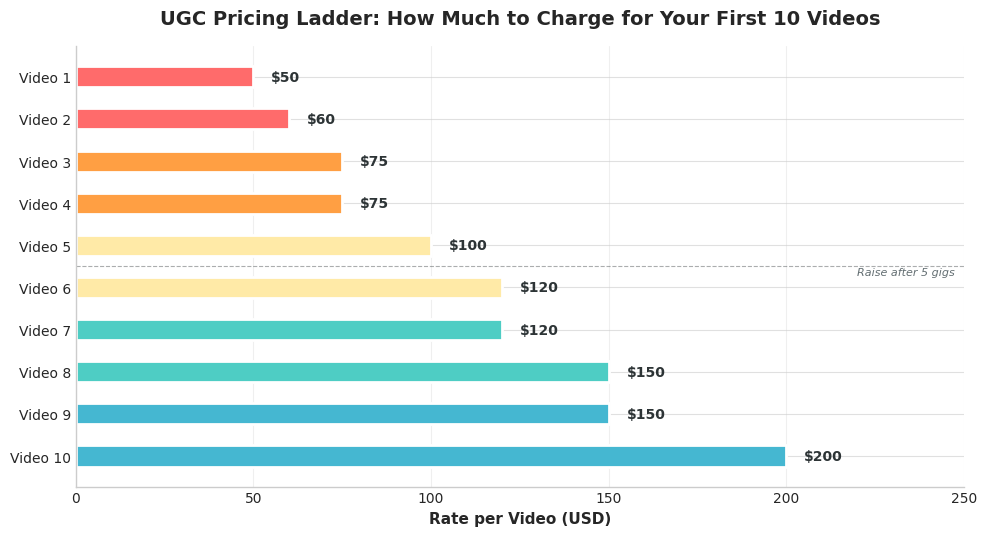
Video 1: $50 — The Proof-of-Concept Rate
Your first paid UGC video is not about the money. It is about proof. Proof that a real brand will pay real money for your creative work. Proof that you can deliver on a brief, handle feedback, and meet a deadline. Proof that this is a real business, not a fantasy.
At this stage, you are competing against other beginners and against the brand’s temptation to just film something in-house. Your rate needs to be low enough to remove any risk from the brand’s decision.
What $50 includes:
- One UGC video, 15–30 seconds
- One round of revisions
- Delivery within 5 business days
- Usage rights for 30 days on organic social only
What it does NOT include:
- Raw footage
- Multiple hook variations
- Script writing (the brand provides the brief)
- Paid ad usage
- Perpetual rights
When to charge $50: Your first 1–2 paid gigs, or when working with a micro-brand that has a tiny budget but offers creative freedom and a strong testimonial.
“I charged $50 for my first video and I do not regret it. That brand referred me to three other companies. One of those became a $1,200 monthly retainer. Your first rate is an investment, not a paycheck.”
— Marcus T., UGC Creator (Pet & Home Tech)
Video 2: $60 — The Confidence Bump
You have one gig under your belt. You know the workflow. You know you can deliver. Now you raise your rate by 20%.
This is not about greed. It is about psychology. Charging $60 signals to the second brand that you are slightly more established than a total beginner. It also starts training your brain to associate your work with growing value.
What changes at $60: Nothing in the deliverables. The package is identical to Video 1. The only difference is your price — and the confidence behind it.
Videos 3–4: $75 — The Portfolio Builder Phase
By your third and fourth videos, you should have a small but solid portfolio. You have worked with 2–3 brands. You have learned how to read a brief, handle feedback, and deliver on time. You are no longer a risky experiment for brands. You are a proven creator with samples.
What $75 includes:
- One UGC video, 15–45 seconds
- One round of revisions
- Delivery within 4 business days
- Usage rights for 60 days on organic social
- Optional: One additional hook variation (3-second alternate opening)
The hook variation is your first upsell. Brands running paid UGC ads need to test multiple openings to see which grabs attention. Offering a second hook for the same video shows you understand performance marketing — and justifies the higher rate.
Video 5: $100 — The First Milestone
Video 5 is a psychological milestone. You have now created enough UGC content to call yourself an experienced beginner. You have probably encountered a difficult client, a vague brief, and a revision request you did not agree with. You have survived. That experience has value.
What $100 includes:
- One UGC video, 15–60 seconds
- One round of revisions
- Delivery within 3–4 business days
- Usage rights for 90 days on organic + paid social
- Two hook variations included
Notice the usage rights expansion. At $100, you are no longer limiting the brand to organic posts. You are allowing paid UGC ads — which means the brand can directly monetize your content. That expanded usage has real monetary value, and your pricing should reflect it.
Videos 6–7: $120 — The Intermediate Threshold
By videos 6 and 7, you should have at least one brand testimonial or review on your UGC.Store profile. You should also have performance data if any of your previous videos were used in paid ads. “This video achieved a 3.2% CTR for the brand” is worth more than any film school credential.
What $120 includes:
- One UGC video, 15–60 seconds
- Two rounds of revisions
- Delivery within 3 business days
- Usage rights for 6 months across all social platforms
- Two hook variations
- Raw footage clips (unedited snippets the brand’s editor can use)
The raw footage add-on is a game-changer. Brands love having extra clips to remix, re-edit, and test across different campaigns. It costs you almost nothing — you already filmed the footage — but it adds massive perceived value.
Videos 8–9: $150 — The Rising Creator Rate
At this point, you have 7+ paid videos in your portfolio. You have worked with multiple brands. You have reviews, possibly repeat clients, and a clear understanding of your niche. You are no longer a beginner. You are a rising UGC creator with a track record.
What $150 includes:
- One UGC video, 15–60 seconds
- Two rounds of revisions
- Delivery within 2–3 business days
- Usage rights for 12 months across all digital platforms
- Three hook variations
- Raw footage clips
- Optional script consultation (you help refine the brand’s brief into a stronger hook)
The script consultation is your second major upsell. Many brands, especially smaller ones, write terrible briefs. They do not know what hooks work on TikTok. They do not understand pacing. By offering to help refine their brief, you position yourself as a creative partner, not just a video vendor. That partnership justifies premium pricing.
Video 10: $200 — The Double-Century Mark
Your tenth paid UGC video is a celebration and a statement. You have completed a full pricing ladder. You have proven to yourself and the market that your work has consistent value. From here, your rates are no longer tied to a formula. They are tied to your results.
What $200 includes:
- One UGC video, 15–60 seconds
- Two rounds of revisions
- Delivery within 2 business days
- Usage rights for 12 months across all digital platforms
- Three hook variations
- Raw footage clips
- Script consultation
- Priority scheduling (you guarantee faster turnaround than standard clients)
At $200 per video, you are earning more per hour than most traditional freelancers. A well-executed UGC video takes 2–3 hours total (filming + editing). At $200, that is $67–$100 per hour. And that is before add-ons.
The Add-On Menu: How to Double Your Income Without Filming More Videos
Smart UGC creators do not just raise their base rates. They build an add-on menu that lets brands customize their purchase while increasing the total project value.
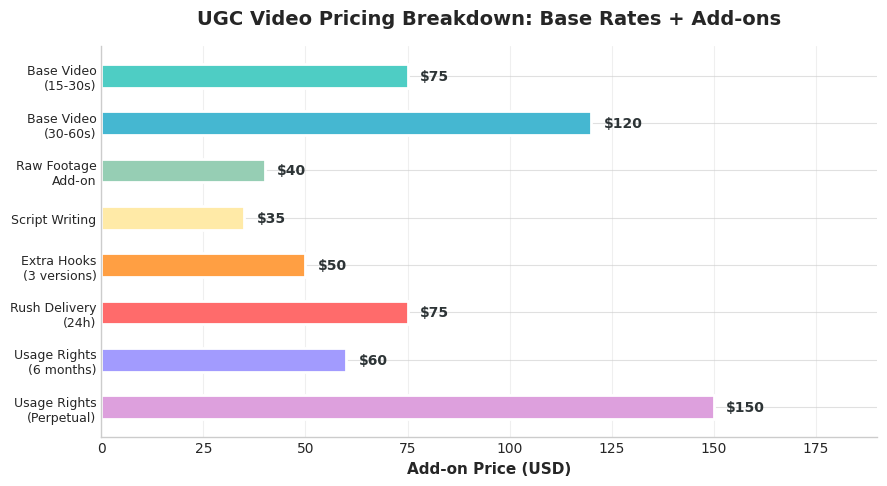
Here is the standard add-on structure used by intermediate UGC creators:
| Add-On | Price | When to Offer |
|---|---|---|
| Raw footage clips | +$40 | Always — easiest upsell |
| Extra hook variations (3 total) | +$50 | For brands running paid ads |
| Script writing / hook consultation | +$35 | When the brand’s brief is weak |
| Rush delivery (24–48 hours) | +$75 | For urgent campaigns |
| Extended usage (6 months) | +$60 | When brand wants longer rights |
| Perpetual usage rights | +$150 | For evergreen product pages |
A brand orders one video at $120. Then they add raw footage (+$40), three hooks (+$50), and perpetual rights (+$150). Your $120 video just became a $360 project. You filmed the same amount of content. You just packaged it smarter.
This is how UGC creators scale from $2,000 per month to $6,000 per month without working triple the hours. They do not create more videos. They create more valuable packages.
Usage Rights: The Pricing Lever Most Beginners Ignore
The single biggest pricing mistake beginners make is giving away unlimited usage for their base rate. They charge $75 for a video and let the brand use it forever in paid ads, on their website, in email campaigns, and on billboards. That is not $75 worth of value. That is thousands of dollars worth of value, given away for free.
UGC usage rights fall into four tiers:
Tier 1 — Organic Social Only (30 days): The brand can post on their own social channels. No paid promotion. This is your base rate.
Tier 2 — Paid Social (60–90 days): The brand can run the video as a paid UGC ad on Meta, TikTok, and other platforms. This directly drives revenue. Charge 25–50% more.
Tier 3 — All Digital (6–12 months): The brand can use the video on their website, in emails, in app stores, and across all digital channels. Charge 50–100% more than base.
Tier 4 — Perpetual / All Media: The brand owns the content forever and can use it anywhere, including TV, print, and out-of-home. This is full buyout territory. Charge 200–300% more than base.
Always specify usage rights in your contract or platform agreement. On UGC.Store, usage terms are built into the brief structure, so both sides know exactly what is included before work begins.
Learn more about how UGC.Store structures creator payments
Niche Pricing: Why SaaS Pays More Than Snacks
Your niche directly impacts your earning potential. A 30-second UGC video for a $5 protein bar and a 30-second video for a $500 software subscription require the same filming time. But the software brand has a higher customer lifetime value, which means they can afford to pay more for content that converts.
High-paying niches (average $300–$500 per video for intermediate creators):
- SaaS and productivity apps
- B2B software and tools
- Finance and investment platforms
- High-ticket e-commerce (luxury goods, electronics)
Mid-tier niches (average $150–$300 per video):
- Beauty and skincare
- Health and wellness supplements
- Tech and gadgets
- Pet products
Volume niches (average $75–$150 per video, but high order frequency):
- Fashion and apparel
- Food and beverage
- Home decor and organization
This does not mean you should automatically choose the highest-paying niche. A creator who loves fashion and can produce ten videos per week at $100 each earns more than a creator who hates SaaS and struggles to deliver one $400 video per month. Passion drives consistency, and consistency drives income.
How to Raise Your Rates Without Losing Clients
The most common fear among beginner UGC creators is that raising prices will scare away all their clients. Here is the reality: raising prices filters out the worst clients and attracts the best ones.
The 3-client rule: Once you have three clients paying your current rate, raise your rate for the next client by 20%. If you still get hired at the new rate, keep it. If you get rejected three times in a row, hold at your current rate for two more clients, then try again.

How to announce a rate increase to existing clients:
“Hi [Name], I wanted to give you a heads-up that I am updating my rates starting [Date] to reflect the expanded deliverables and usage rights I have been including in recent projects. Your current projects are locked in at the existing rate, and I would love to continue working together under the new structure. Here is the updated pricing — let me know if you have any questions.”
Most professional brands expect rate increases as you gain experience. The ones who complain or threaten to leave were never going to be long-term clients anyway. Let them go. Better clients will replace them.
The UGC.Store Advantage: Transparent Pricing for Everyone
One of the hardest parts of UGC pricing is the information asymmetry. Beginners do not know what brands expect to pay. Brands do not know what creators expect to earn. Both sides guess, negotiate awkwardly, and often leave money on the table.
UGC.Store solves this by making pricing transparent. Creators list their base rates and add-ons directly on their profiles. Brands see these rates before they reach out. Everyone enters the conversation with clear expectations.
This transparency benefits creators in three ways:
- No more ghosting after price reveals. Brands who contact you already know your rate fits their budget.
- No more awkward negotiations. Your listed rate is your starting point. Negotiation happens around deliverables, not around whether you are worth $50 or $500.
- Market benchmarking. Browse other creators in your niche on UGC.Store to see what similar experience levels charge. Adjust your rates based on real market data, not guesswork.
Create your creator profile with transparent rates on UGC.Store
Your First 10 Videos: Cumulative Earnings
Let us look at what your first ten videos actually earn under this pricing ladder:

Video 1: $50
Video 2: $60
Videos 3–4: $75 × 2 = $150
Video 5: $100
Videos 6–7: $120 × 2 = $240
Videos 8–9: $150 × 2 = $300
Video 10: $200
Total for first 10 videos: $1,100
That is $1,100 earned while you are still learning. While you are building your portfolio. While you are figuring out your niche and your workflow. And that is base rate only — without any add-ons.
Add raw footage to half your projects (+$20 average). Add hook variations to a third (+$25 average). Charge for one rush delivery (+$75). Your actual earnings for the first ten videos will likely land between $1,400 and $1,800.
For a side hustle built on a phone and a $90 starter kit, that is not bad money. For a business that scales to $5,000+ per month by video 50, that is an incredible foundation.
Pricing Mistakes That Cost Beginners Thousands
Mistake 1: No usage rights in your contract. A brand uses your $50 video in a $50,000 ad campaign. You get nothing extra. Always specify usage.
Mistake 2: Charging by the hour.UGC is not hourly work. A 30-second video might take 2 hours or 6 hours depending on the brief. Charge by the deliverable, not the clock.
Mistake 3: Unlimited revisions. One round of revisions is standard. Two is generous. Three+ means your brief was unclear or the brand is indecisive. Charge for additional revision rounds.
Mistake 4: Giving away raw footage for free. Raw footage is valuable. Brands use it for months. Charge for it.
Mistake 5: Never raising rates. If you are fully booked at your current price, you are underpriced. Raise rates until 20–30% of inquiries say no. That is the sweet spot.
Mistake 6: Copying someone else’s rates. A creator in Los Angeles with five years of experience charges differently than a creator in Manila with two months under their belt. Your rates must reflect your market, your niche, and your value — not someone else’s Instagram bio.
Your Pricing Journey Starts With One Number
You do not need a perfect pricing strategy on day one. You need a starting point and the willingness to adjust. Pick a number for your first video — $50, $75, whatever feels slightly uncomfortable but not absurd. Deliver great work. Collect a review. Then raise your rate for the next client.

Every video you create is data. Every brand response is feedback. Every paid gig is proof that your work has market value. By video 10, you will have earned over $1,000, built a reputation, and developed the confidence to charge what you are worth.
The creators earning $500 per video are not magically better than you. They simply started at $50, climbed the ladder one gig at a time, and never stopped raising their rates.
Your first price is just a starting line. The only wrong price is the one that keeps you from starting at all.
Register as a creator on UGC.Store and list your first rate today.
