
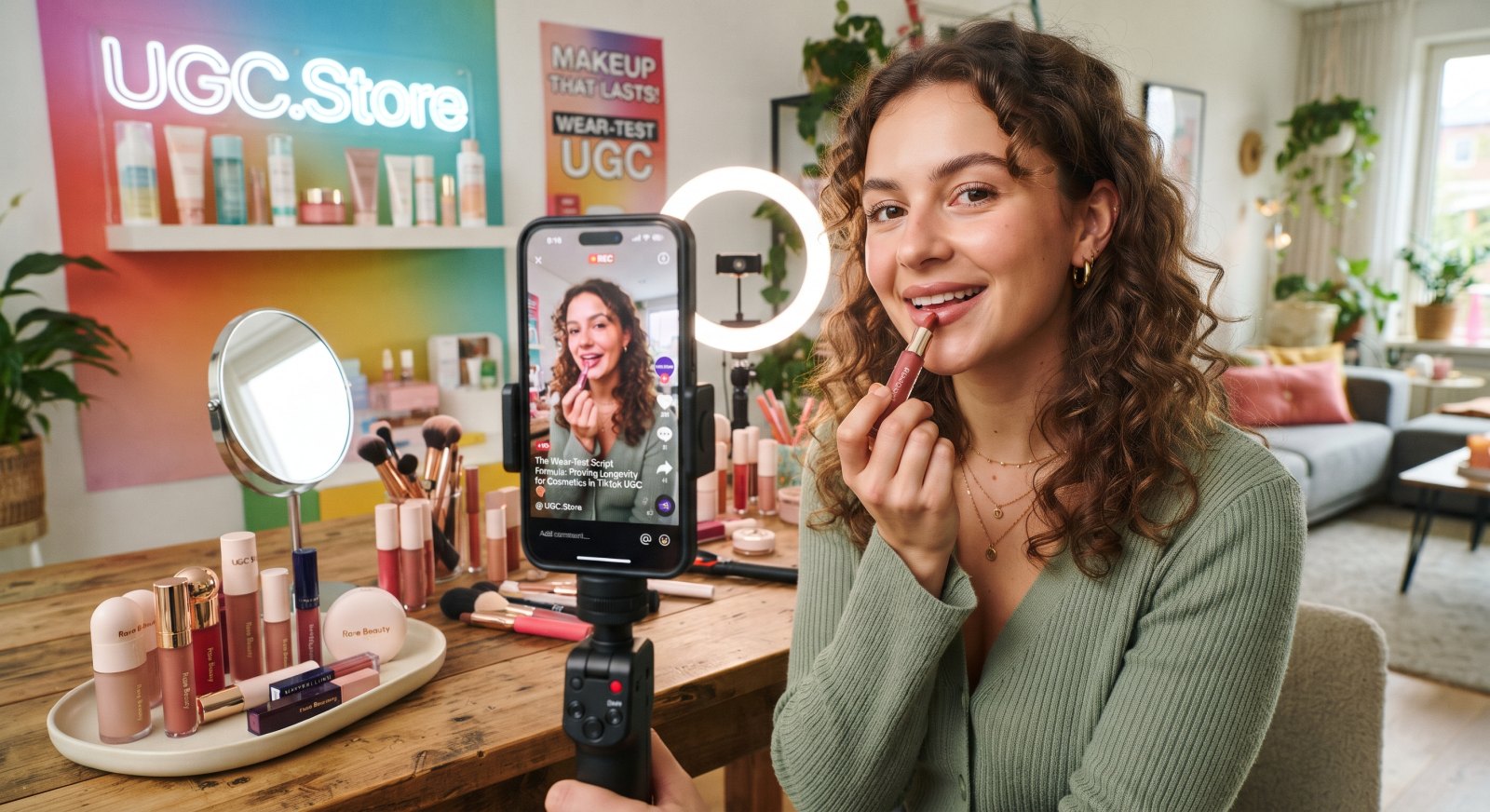
Executive Overview
The wear-test script formula is a structured UGC methodology in which a creator demonstrates a cosmetic product's longevity not through brand claims, but through timestamped, self-documented evidence — a morning application, mid-day stress checkpoints, and an evening reveal, all captured on camera in real conditions. In the cosmetics category, longevity is the highest-stakes purchase anxiety: the buyer's core fear is not "will this look good at 8 AM" but "will this betray me by 3 PM in fluorescent office light," and no studio demo resolves that fear. This is why wear-test formats have become the category's most durable creative archetype — across a dataset of 748 beauty ads tracked from October 2025 to August 2026, ads structured around demonstration and routine held meaningfully longer than testimonial formats, with routine and stack ads surviving at 51% past thirty days versus just 32% for straight testimonials . The brands compounding this advantage are scripting wear-tests as narrative events — with named stress variables, honest checkpoint framing, and a reveal engineered for the algorithm's completion-rate signal — then amplifying winners through Spark Ads.
Theoretical Basis and Psychology of Mechanics
Longevity is the most lied-about attribute in cosmetics, and every makeup buyer knows it. Decades of "24-hour wear" packaging claims followed by afternoon oxidation have trained the category's audience into a default posture of disbelief. This skeptical baseline is the single most important psychological fact a wear-test script must engineer around: the viewer does not arrive hoping to be convinced — they arrive expecting to catch the creator cheating. The wear-test format converts only when it is built to survive an adversarial viewer, and every mechanic below follows from that premise.
The first mechanic is evidentiary pacing through narrative suspense. A wear-test is structurally a story with a withheld ending: the viewer knows the reveal is coming and stays to audit it. This produces elevated completion rates — the algorithm's most heavily weighted ranking signal — because suspense is a retention architecture, not a hook trick. The checkpoint structure (morning, midday, evening) gives the viewer three natural re-engagement moments, and each checkpoint is an opportunity for the comment section to reactivate as viewers timestamp their own experiences. A straight review answers the question in the first five seconds; a wear-test makes the viewer wait forty-five seconds for the answer they came for, and the waiting is what makes the answer believable.
The second mechanic is controlled stress credibility. The viewer's implicit audit question is "what did she do all day?" A credible wear-test names the stress variables before they happen: eight hours at a desk under dry HVAC air, a commute with mask friction, a midday gym session, a wedding with tears. Naming variables in advance functions as experimental pre-registration — it converts an anecdote into evidence by showing the creator anticipated the audit. The creator who says "I have a full day of meetings and it's 31 degrees outside" has already passed the skepticism screen before the first checkpoint arrives.
The third mechanic is imperfection as proof. The counterintuitive rule of longevity content: a flawless evening reveal converts worse than a mostly-good reveal with one honest flaw named. "Eleven hours in — slight fading along my jawline where my mask rubbed, but the center of my face is intact" outperforms "still perfect!" because the flaw functions as calibration evidence — it proves the creator's eyes work and her standards are real. Analyses of top-performing beauty creative consistently show that demo-proof and authority-anchored framing outperforms overclaiming; across the 748-ad dataset, authority anchor hooks — opening on a credential, a stat, or the reason the product exists — held at 66% past thirty days, the strongest hook category measured .
The fourth mechanic is the platform's documentary authenticity bias. TikTok's feed rewards content that looks captured rather than produced — handheld check-ins, car-seat selfies at hour six, elevator lighting honesty. This is where UGC's structural advantage lives: ads featuring user-generated content achieve roughly 4× higher click-through rates than traditional ads, and beauty products with customer video convert 45% higher . The wear-test is the format most native to this bias because its entire grammar — timestamps, check-ins, real lighting — is documentary by design. Finally, the trust environment amplifies everything: 92% of consumers trust peer recommendations over brand messages, which means the wear-test's creator is operating with a credibility reserve that no brand-produced demo can access .
Step-by-Step Algorithm & Methodology
The formula below sequences a longevity wear-test from cold open to conversion, with each phase carrying a defined evidentiary function.
Phase 1 — The Stakes Hook (0–3 seconds). The creator opens with the longevity challenge itself, not the product: "I put this foundation on at 7 AM and I'm going to show you every hour until 9 PM — no touch-ups, no filter." The hook must state three variables instantly: the product, the duration, and the no-intervention rule. The no-touch-up pledge is the hook's engine — it is the viewer's guarantee that the test means something. Target hook rate: above 70% on cold audiences.
Phase 2 — The Application Baseline (3–12 seconds). Fresh application on camera in honest morning light: one side natural light, texture visible, shade match acknowledged. The creator narrates application behavior that affects longevity — primer choice, tool, setting method — because a wear-test that hides its conditions is audit-bait. On-screen text stamps the time. SFX: product sounds, room tone, no music bed yet.
Phase 3 — Variable Declaration (12–20 seconds). The creator names the day's stressors in advance: "I have nine hours at my desk, a subway commute with a mask, and it's hot." This phase is short, spoken directly to lens, and it is the script's credibility keystone — skipping it converts evidence back into anecdote. Where the brand's product has a genuine edge (transfer resistance, mask-proofing), one variable should be chosen that specifically exercises that edge.
Phase 4 — Checkpoint Beats (20–70% of runtime). Two to three checkpoint appearances, each filmed where the day actually happens — desk, car, gym mirror. Each checkpoint follows a fixed micro-structure: timestamp on screen, lighting named ("harsh bathroom light, so you can really see"), one honest observation, one verdict word. Checkpoints should shorten as the video progresses — the rhythm accelerates toward the reveal, protecting completion rate.
Phase 5 — The Reveal (final 15 seconds). Evening lighting, full face to camera, zoom-adjacent framing. The reveal script names what survived and what didn't, using the two-truth structure: one honest flaw first, then the verdict. "Jawline faded where the mask sat — everything else is genuinely intact at hour eleven. That's the best this category has ever done on me." The flaw-first ordering matters: it front-loads calibration evidence so the praise lands as measured rather than purchased.
Phase 6 — The Verdict CTA (final 5 seconds). A rating frame converts longevity into a shareable artifact: "Longevity score: 8.5 out of 10 — the half-point is the jawline." Then the comment-bait question: "What's the longest any foundation has lasted on you? I need to know if I'm just lucky." Product link lives in caption and pinned comment.
Ready-to-Use Working Templates & Scripts
Script One: "The Desk-to-Dinner Audit" (Standard 10-hour wear-test, 55 seconds).
Opening frame: creator at bathroom mirror, towel on head, holding the foundation. Dialogue: "It's 7:15 in the morning. This foundation claims twelve-hour wear. I'm going to show you my face at every checkpoint until dinner — no touch-ups, no powder, no mercy." B-roll: application in window light, half-face blend comparison. On-screen text: 7:15 AM. Variable declaration: "Today I have a full day of meetings, lunch outside, and a forty-minute train home. It's warm." Checkpoint one, 12:40 PM, car selfie framing: "Three and a half hours, post-lunch. No separation around my nose, which is where every foundation dies on me." On-screen text: 12:40 PM. Checkpoint two, 4:15 PM, desk lamp framing: "Office light is brutal, so this is the honest view. Slightly less glow than this morning — nothing has moved." Reveal, 9:05 PM: "Eleven hours. Look at the center of my face — intact. The mask took some product off my chin on the train, I'm not going to pretend otherwise. But for a non-matte formula, this is the longest-wearing thing I've tested this year." Verdict CTA: "Longevity score: 9 out of 10. Tell me in the comments what survived your longest workday."
Script Two: "The Sweat Test" (Extreme-condition stress test, 48 seconds).
Dialogue: "Everyone tests foundation at a desk. Nobody tests it at the gym. So today — forty minutes of cardio, this foundation, one camera." Variable declaration: "I sweat a lot. That's the whole point of this video." Demo: pre-workout application, close-up of texture set. Checkpoint one, post-cardio, bathroom mirror: "Direct light, no flattering angles. There is sweat — and the foundation is still structurally here." Blotting test on camera: tissue pressed to cheek, minimal transfer shown. SFX: gym ambience, tissue press. Boundary statement: "Is it perfect? No. My forehead moved. But my cheeks, where I blush, are fully covered." Verdict CTA: "If you need a foundation that survives a workout, this one passed. Rate my sweat level in the comments, honestly."
Script Three: "The Occasion Gauntlet" (Event-based longevity narrative, 60 seconds).
Dialogue: "My best friend's wedding is today. It's 9 AM. This makeup needs to survive a ceremony, photos in the sun, dinner, and at minimum one emotional speech." B-roll: getting-ready montage, application, setting ritual. Checkpoints: ceremony seating selfie, golden-hour outdoor photo check with flash test ("flashback check — passed"), dinner table low-light check. Reveal, 11 PM: "Fourteen hours. I cried twice. There was dancing. The eyeliner surrendered around hour twelve — the base did not." Verdict CTA: "Wedding-season approved. Save this for your next event and comment what you're testing it at."
Comparative Analysis Matrix
| Core evidence type | Controlled lighting, single moment | Timestamped checkpoints across real hours |
| Skepticism handling | Claims ignored until reviews | Pre-registered stress variables disarm audit |
| Retention architecture | Result shown in first five seconds | Suspense-driven completion to the reveal |
| Imperfection strategy | Flawless finish required | One named flaw as calibration evidence |
| Runtime sweet spot | 15–25 seconds | 45–60 seconds, checkpoints accelerate pacing |
| Creative longevity | Fatigues as audience memorizes demo | Fatigues slowly; day contexts provide infinite variants |
| Lighting disclosure | Unnamed, flattering wherever possible | Named at every checkpoint, harshest light chosen |
| Timestamp mechanics | Forgotten or inconsistent | On-screen text at every beat, synced to real time |
| Stress variables | Vague ("a busy day") | Specific and pre-declared (mask, heat, cardio, tears) |
| Verdict framing | Binary pass/fail | Numeric or fractional score, shareable artifact |
| Flaw handling | None admitted | One honest flaw delivered before the verdict |
| 30-day ad survival rate | 32% of tracked beauty ads | Rises to 51% via routine/demo-adjacent framing |
| Hook category strength | Confession hooks held at 31% | Authority-anchor framing held at 66% |
| Comment behavior | Emoji reactions and tag comments | Timestamped viewer experiences, comparison threads |
| Save behavior | Low; review answers once | High; functions as purchase reference pre-shop |
| Production requirement | Single sitting, one environment | Full-day commitment, three-plus filming windows |
Real-World Case Study Breakdown
A mid-market complexion brand launched a skin-tint-meets-foundation hybrid in mid-2026 positioned on a "twelve-hour skin-like wear" claim. The launch creative followed the standard playbook: fifteen lifestyle creators filming glow-lit application videos in golden-hour lighting, each opening with the product and closing with "it lasted all day." Initial performance looked acceptable and then decayed within three weeks: a 0.9% CTR, blended CPA stuck at $57, and — the diagnostic that mattered — the top comments under every ad were the same question, posted in dozens of variations: "all day" according to whom, doing what?
The strategic solution was a full pivot to the wear-test script formula. The brand commissioned ten creators with diverse skin types and genuinely different daily routines — an office worker with a mask commute, a fitness instructor, a wedding photographer working fourteen-hour event days, a nurse on shift work — and briefed them on the phase methodology with two hard rules: every checkpoint must carry an on-screen timestamp, and every reveal must name one flaw before the verdict. The creative bundle shipped as a stress-variable portfolio: four desk-to-dinner audits, three sweat tests, two occasion gauntlets, and one controlled "split-face" test pitting the product against a category-leading competitor, with usage rights secured for Spark amplification.
Final empirical telemetry after a ten-week window: CTR climbed from 0.9% to 2.1%, blended CPA fell from $57 to $33, and the split-face wear-test emerged as the portfolio's champion — its head-to-head framing generated comment threads where viewers self-reported their own brand loyalties, effectively free qualitative research beneath a paid placement. The nurse creator's shift-work audit, filmed across three lighting environments at genuine hour intervals, ran for nine weeks before fatigue and became the brand's highest-save-rate asset of the year. The deepest lesson mirrored the dataset evidence: the brand had been paying creators to say the product lasted; the wear-test formula paid them to prove it, and proof — timestamped, stressed, and imperfect — is what the skeptical cosmetics buyer has been waiting a decade to be shown.
Real-World Engineering & Creative Feedback
"The flaw-first rule is the whole game in longevity content. Every brand wants the flawless reveal; every viewer is waiting for the moment the creator flinches. When the creator names the flaw before the viewer finds it, the trust transfer is complete — and the verdict that follows converts at a rate the flawless version can't touch. We A/B tested it repeatedly. Flaw-first wins every single time." — Cassidy Monroe, Performance Creative Director, Velvetline Media
"Wear-test scripts live or die on the checkpoint discipline. We lost two weeks of media budget before we figured out why our wear-test ads underperformed: creators were filming all three checkpoints on the same afternoon, changing shirts between takes. Viewers caught the light. The comment section did the rest. Now every brief requires unedited screen-recorded timestamps from the phone's camera roll before we accept delivery." — Andre Baptiste, Media Buyer and Founder, Signal & Scale Agency
"The variable declaration phase is the most skipped and the most valuable. 'I'm going to the gym, it's hot, and I cry at weddings' is not small talk — it's pre-registration, and it converts the viewer from auditor into witness. When we mandated stress-variable naming in every brief, our wear-test completion rates jumped by double digits, because the viewer now has a reason to stay: they know what the product is about to be subjected to." — Yuki Tanaka, UGC Strategist, Halcyon Beauty Collective
"Two platform shifts hit longevity content in the past year. First, TikTok's enforcement started flagging ads where the on-screen timestamps didn't match real-world plausibility — a twelve-hour test uploaded three hours after filming got rejected under misleading-claims review. Second, the AI-content crackdown caught brands using digitally aged 'hour-9' makeup simulations. Our compliance stack now includes raw-footage audit, real-time metadata checks, and a blanket ban on any simulated checkpoint. Authenticity isn't just a conversion strategy anymore — it's the only version that survives review." — Priya Nair, Paid Social Lead, Criterion Performance Group
"The unconventional insight from running complexion accounts at scale: your best wear-test creators are the ones with genuinely bad skin days on record. A creator whose grid includes a foundation that failed on them publicly has audit credibility money can't buy — when that person says a product survived, her audience knows she isn't protecting anyone. We've started recruiting creators specifically from the comments of failed-wear-test videos. Their first brief with us outperforms our established roster almost every time." — Lena Kowalczyk, Beauty Vertical Lead, Fieldcraft Studio
Production Self-Check Checklist
Before final export and ad platform upload, every wear-test UGC asset must clear the following quality gates:
- Stakes hook verified — duration, product, and the no-touch-up pledge all stated within the first three seconds, with zero preamble.
- Baseline integrity confirmed — application filmed in honest morning light with texture visible, shade match acknowledged, and prep behavior (primer, tool, setting) disclosed on camera.
- Stress variables pre-declared — at least two specific, named variables spoken before the first checkpoint, with one variable selected to exercise the product's genuine longevity edge.
- Timestamp authenticity audited — every checkpoint carries on-screen time text consistent with real-world plausibility; raw-footage metadata retained for compliance review.
- Checkpoint lighting named — each beat identifies its lighting condition, with at least one deliberately unflattering environment included.
- Flaw-first reveal enforced — the reveal opens with one honest limitation before any verdict language; any edit that removed the flaw has been rejected and returned.
- Verdict artifact formatted — a numeric or fractional longevity score appears on screen as a shareable final frame.
- Sound design intentional — room tone and real-environment audio preserved at checkpoints; no music bed masking the reveal dialogue.
- Claims compliance cleared — duration claims match the demonstrated window; zero absolute guarantees ("never fades," "all day for everyone") survive the edit; documentation stored with the asset.
- CTA mechanics functional — comment-bait longevity question delivered on camera, pinned comment prepared, Spark Ads authorization code generated where applicable.
- Accessibility layer complete — captions covering 100% of spoken dialogue, safe-zone compliant timestamps, 9:16 vertical integrity confirmed.
- Freshness logged — asset entered into rotation tracking with stress-variable tag, so variable-fatigue review triggers at day fourteen.
Advanced FAQ
How long should a wear-test video actually be, and does the multi-day filming commitment kill creator economics?
The performance sweet spot sits between 45 and 60 seconds — long enough for two checkpoints plus a reveal, short enough to protect completion rate. The full-day filming commitment does raise per-asset cost, typically 30–50% above a single-session testimonial, but the economics invert at the media layer: scripted wear-tests survive roughly twice as long in rotation as testimonial creative before fatigue, meaning the cost-per-live-day frequently lands below the cheaper asset's. The efficiency unlock is batching — a creator films one application and one reveal but captures checkpoints across a genuinely full day, delivering three stress-variable variants (desk day, active day, event day) from a single production commitment.
Can wear-test scripts work for color cosmetics like lipstick and blush, or only complexion products?
The formula transfers directly and, for color cosmetics, often outperforms because the stress variables are more theatrical: eating, drinking, mask friction, kissing tests, and coffee-cup transfer leave visible, timestamp-able evidence that complexion products cannot match. The checkpoint structure compresses naturally — a twelve-hour lipstick wear-test sustains two-to-three-minute spacing between check-ins because transfer events happen on camera. The one adaptation: the reveal for color products should include a wear-pattern description ("center-fade but defined edge — the good kind of fading") since viewers evaluate color degradation differently than coverage loss.
How should a brand handle a wear-test where the product genuinely underperforms?
Ship the honest version with a narrower claim — and treat it as strategy, not failure. The formula's credibility engine depends on the creator's calibration evidence being real; a brand that re-shoots or suppresses a mediocre result trains its creator pool to perform rather than document, and the audience eventually audits. If the product survived eight honest hours, the script claims eight hours and the honest score converts better than the inflated one, because the comment section under an 7.5-out-of-10 reveal fills with "that's more believable than every 10/10 on this app" — social proof purchased with candor. Where the product failed a specific variable (heat, friction), that variable becomes a content gift: "what it survives versus what it doesn't" comparison assets are among the highest-save formats in the category.
What checkpoint cadence maximizes completion rate without boring viewers?
Cadence follows a compression curve: the gap between checkpoints should shrink as the video progresses. A standard 55-second structure opens with a 12-second application beat, jumps 4–5 hours to checkpoint one (10 seconds), 3 hours to checkpoint two (8 seconds), and 2 hours to the reveal (15 seconds). The accelerating rhythm mirrors narrative suspense logic — each beat arrives faster, carrying the viewer to the ending. Checkpoint one is the retention cliff: if viewers survive the first jump, completion probability rises dramatically, so checkpoint one must deliver the first concrete evidence statement within its opening sentence.
Do wear-test scripts require creators with large followings, or does the format favor micro-creators?
The format structurally favors micro-creators, and the data supports the bias. Longevity claims are audit-driven, and audit credibility lives in documentary authenticity rather than reach — a creator with eight thousand followers filming genuine hour-interval check-ins from a real workplace outperforms a large creator staging a test in a single afternoon. The mechanism compounds: micro-creator audiences reply to stories and comment as peers, and those peer-audited comment threads become the ad's second life. Selection criteria should prioritize environmental authenticity (real job, real commute, real schedule) and demonstrated honesty track record over follower counts, then amplify winners through Spark Ads to borrow scale the creator's profile doesn't provide.
Custom Contextual Conclusion
The wear-test script formula is what happens when a category stops asking to be believed and starts submitting evidence. Cosmetics longevity has been the most overpromised attribute in beauty for a generation, and the audience raised on those promises now audits everything — the lighting, the timestamps, the plausibility of the day. The brands winning this audit are not the ones with the best twelve-hour claim; they are the ones whose creators pre-register their stress variables, name their flaws before their verdicts, and let a full day of real life cross-examine the product on camera. Suspense does what superlatives cannot, checkpoints do what packaging cannot, and one honest flaw does what a flawless reveal never will. Script the test like an experiment, film it like a documentary, and let the evening reveal close the sale — because in longevity marketing, the viewer doesn't want to be impressed. They want to be shown, hour by hour, that this time the promise survived the day.