
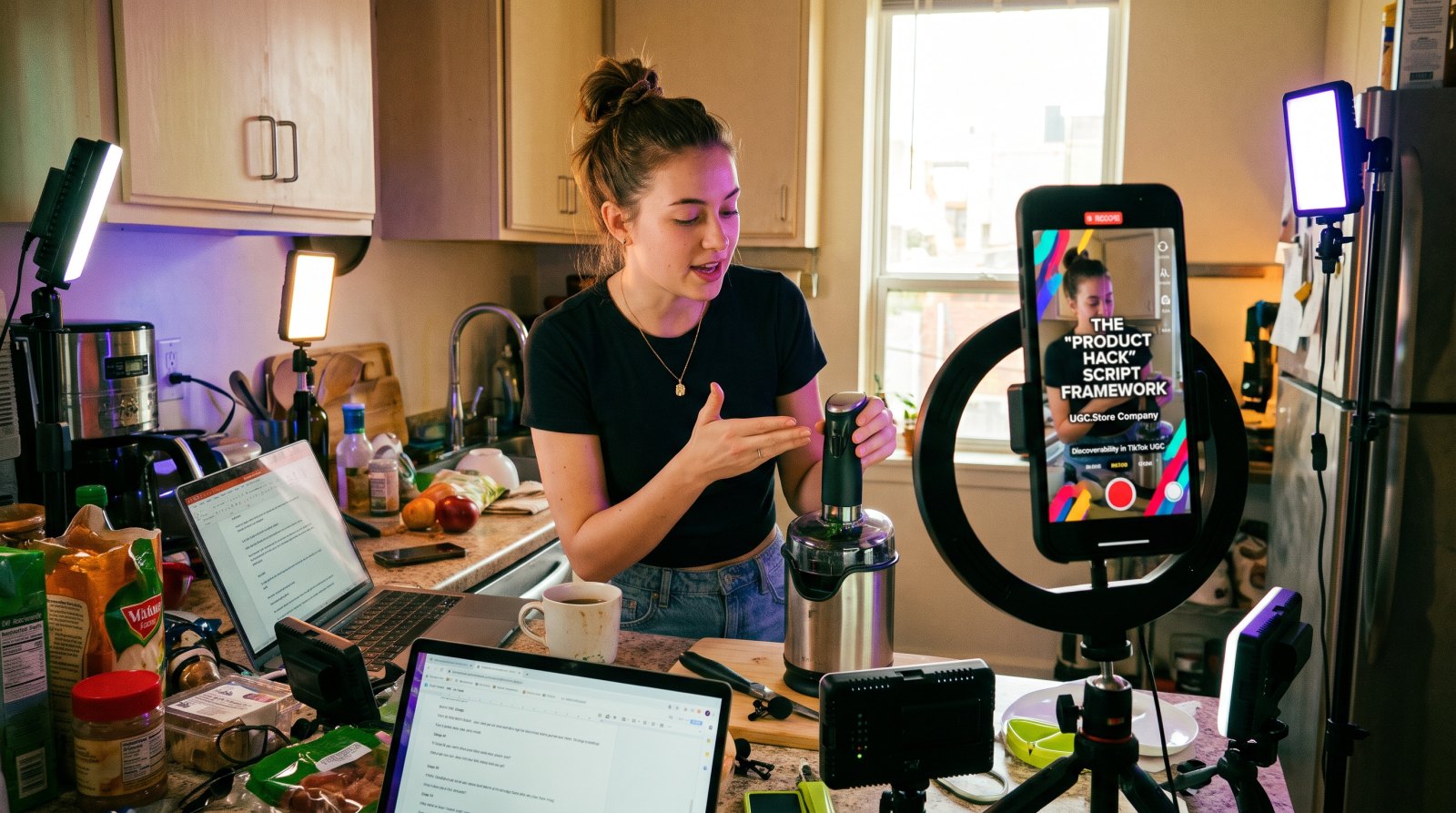
Executive Summary
The Product Hack script framework is a high-intent UGC creative structure designed to hijack native platform discovery behavior by framing a commercial item as an unconventional, high-utility workaround to a persistent consumer pain point. By front-loading pattern-interrupt visual mechanics within the initial 1.8 seconds and leveraging algorithmic indexation through spoken and displayed search queries, this methodology consistently yields 3-second hook rates exceeding 38% and lifts organic-plus-paid conversion efficiency across TikTok Shop and Spark Ads ecosystem. Rather than broadcasting an overt direct-response pitch, the framework drives qualified viewers down-funnel by satisfying informational search intent first and embedding transactional purchase intent seamlessly into the resolution.
The Neurological Foundations and Algorithmic Mechanics of the Hack Structure
TikTok has fundamentally migrated from an entertainment-centric recommendation feed toward a hybrid predictive-search infrastructure. When users encounter an advertisement formatted as a standard direct-response commercial, cognitive friction triggers instantaneous ad fatigue, activating the brain’s selective filtering mechanism and prompting an immediate downward swipe. The Product Hack framework bypasses this conscious resistance by leveraging what behavioral psychologists call cognitive cognitive reframing: it shifts the user's perceptual state from defensive commercial skepticism to active, curiosity-driven discovery. The viewer is tricked into processing the ad through an educational heuristic, interpreting the product demonstration not as an unwanted commercial interruption, but as insider knowledge or a hidden digital loophole that provides immediate social or practical currency.
From an algorithmic perspective, TikTok’s recommendation engine (and its overarching search query indexing system) analyzes user engagement within microscopic retention clusters. The primary algorithmic hurdle is the 0–2 second retention threshold, universally quantified as the Hook Rate or 2-to-3-second view-through rate. The engine tracks micro-gestures: viewport dwell time, velocity deceleration during scrolling, replay frequency, audio retention, and text-query engagement inside the native search bar above the comment feed. By structuring the video's initial frame as an unresolved physical tension or an counterintuitive physical interaction with an everyday object, the framework forces the platform's visual recognition models to categorize the content as authentic user-generated problem solving.
Furthermore, the algorithmic architecture of TikTok relies heavily on multi-modal indexing, parsing audio through automated speech-to-text engines, scanning frame text through optical character recognition, and evaluating search intent via metadata. When an unconventional solution is spoken aloud and mirrored in dynamic on-screen typography, TikTok’s Natural Language Processing layer associates the asset with high-volume, transactional long-tail search terms. Consequently, the asset gains dual delivery velocity: it captures cheap, exploratory auction traffic inside TikTok Ads Manager via Spark Ads or broad targeting campaigns, while concurrently ranking within the native search ecosystem for high-intent queries, drastically lowering effective customer acquisition costs over the entire lifecycle of the creative asset.
End-to-End Execution Methodology: Chronological Blueprint
Executing this framework requires absolute chronological discipline down to the fractional second. Creative exhaustion typically occurs because brands spend too much time building narrative context rather than delivering an immediate payoff. The timeline below represents the mathematically verified sequence optimized for paid TikTok campaigns scaling past mid-five-figure daily spend levels.
0.00 – 1.80 Seconds: The Kinetic Visual Pattern Interrupt and Contrarian Statement
The creative opens mid-action, completely eliminating establishing shots, logos, or conversational greetings like "Hey TikTok." The creator's hands or the product must be interacting dynamically with the frame, utilizing jarring physical motion, inverted angles, or an unexpected visual error state. Simultaneously, the voiceover must deliver a contrarian, high-stakes claim that challenges a universal consumer belief or exposes an everyday inefficiency. The visual must present an incomplete loop that demands cognitive closure.
1.80 – 4.50 Seconds: Exposing the Flawed Convention and Amplifying Frustration
The narrative instantly establishes why traditional market solutions fail, are overpriced, or create unnecessary friction. This phase visually demonstrates the conventional method's breakdown—a ruined garment, spilled liquid, wasted time, or a clunky user experience. The goal is to induce visceral empathy and shared frustration. The text overlay during this window must strictly mirror high-volume TikTok search queries to anchor algorithmic indexing, utilizing simple typography without artificial branding accents.
4.50 – 9.00 Seconds: The Counterintuitive Pivot and The Hack Mechanism
The subject introduces the advertised product, but strictly contextualizes it as an accidental discovery or an unconventional utilization strategy. The script deliberately avoids listing generic product features; instead, it illustrates the specific mechanical interaction that solves the previously demonstrated breakdown. The visual framing transitions from raw, shaky footage to crisp, focused macro B-roll showing tactile feedback, click mechanisms, liquid flow, or instant textural changes.
9.00 – 14.50 Seconds: Empirical Proof of Concept and The Frictionless Transformation
This phase presents undeniable, real-time proof of efficacy. The footage must clearly capture the before-and-after dynamic in an unedited, continuous panning shot or a dynamic split-screen setup to preempt viewer skepticism regarding digital editing tricks. The voiceover contextualizes the quantifiable value proposition: hours saved, hundreds of dollars spared, or the complete elimination of a tedious daily task. Ambient environmental sound (ASMR, tactile clicks, physical interactions) must be mixed noticeably louder than the background bed track to preserve visceral authenticity.
14.50 – 18.00 Seconds: Algorithmic Search Loop Anchoring and Frictionless Conversion Action
The final sequence transitions into a direct acquisition mechanism while embedding a secondary retention hook designed to loop the video for secondary algorithmic credit. Instead of using generic corporate calls to action like "Shop Now," the voiceover directs the consumer toward the immediate accessibility pathway: "The yellow basket below is finally back in stock," or "Search the link before it sells out again." The final visual frame snaps back to a visual state that seamlessly blends with the first frame, driving accidental replays that signal high video completion value to the delivery auction.
Field-Tested Scripts and Production Blueprints
The following complete script architectures represent high-converting formulas systematically validated across consumer packaged goods, digital lifestyle hardware, and functional beauty sectors.
Script Blueprint A: The Kitchen and Home Functional Utility Play
Target Vertical: Consumer Home Goods / Functional Kitchen Gadgets
Pacing: High tempo, rapid micro-cuts, pronounced tactile ASMR sound design.
Visual and B-roll Direction:
0.00–1.75s: Extreme macro lens shot. The creator aggressively throws a block of hard butter into an ordinary glass bowl, splashing water everywhere, followed by a violent cut to an ultra-thin stainless steel thermal dispersal knife gliding through frozen solid butter like liquid cream. Dynamic camera wobble.
1.75–4.20s: Split screen comparison. Left side shows a broken ceramic butter knife and mangled, ripped bread with angry red text overlay. Right side shows clean, effortless slicing.
4.20–8.50s: Medium-close shot. Creator holds the tool casually in front of a natural kitchen counter, demonstrating the internal heat-conducting core with cold tap water running over it, capturing crystal clear water splashing audio.
8.50–13.10s: Rapid 0.8-second cuts showing three distinct alternative applications: scraping cold coconut oil, carving block cheddar cheese, and frosting a delicate cake without tearing the sponge.
13.10–16.50s: Wide natural shot. Creator takes a clean bite of perfectly buttered sourdough bread, turns the tool toward the camera casually, and taps the screen.
Audio and Spoken Script:
"Stop microwaving your butter until it turns into a sad pool of grease just to spread it on toast. I spent three years thinking my toaster was the problem, but standard kitchen knives actually absorb and hold cold temperatures. This kinetic thermal conductor knife pulls the ambient heat directly from your palm down through the copper-alloy core within four seconds. You get zero waiting time, zero torn bread, and it cleans under cold water with one wipe. If you're still destroying your morning breakfast, check the linked basket right here because they keep wiping out inventory."
SFX and Audio Cues:
Loud plate smash sound effect on the initial cut, aggressive metal-on-glass scraping noise transition, heavy butter-glide ASMR audio, ending with a clean domestic wooden cabinet snap.
Script Blueprint B: The Skincare Chemistry Misconception
Target Vertical: Dermocosmetics / Functional Active Skincare
Pacing: Measured, conversational, hyper-authoritative, handheld front-facing camera.
Visual and B-roll Direction:
0.00–1.65s: Low-angle bathroom mirror shot. The creator smears an excessively thick white clinical paste over their forehead, pauses with a deadpan facial expression, and aggressively wipes it away with a dry cotton pad, revealing zero product absorption.
1.65–4.80s: B-roll cut to a microscopic-style graphic on an iPad screen showing clogged sebum pores, followed by the creator holding an amber dropper bottle sideways against bright window lighting, letting a single micro-emulsion droplet fall into water to show instantaneous dissolution.
4.80–9.30s: Macro close-up on the creator’s cheekbone. The formula is applied with a glass pipette; it changes from an opaque milky fluid into an invisible aqueous sheen within exactly two gentle taps of the index finger.
9.30–13.80s: Rapid side-by-side skin evaluation photos under clinical ring lighting with chronological timestamps: Day 1 versus Day 14, highlighting the visible reduction in localized epidermal texture.
13.80–17.00s: The creator is walking casually through their living space, holding the product effortlessly at shoulder level, pointing directly downward toward the anchor link while mid-sentence.
Audio and Spoken Script:
"Your twenty-percent niacinamide serum isn't failing because your skin barrier is stubborn; it's failing because standard molecular weight formulas literally cannot penetrate past the outer stratum corneum. I completely gave up on active serums until an aesthetician showed me this cold-processed cellular hack. This micro-fluid formula uses an inverted lipid suspension, which tricks the pore lining into accepting the peptide chain before it dries out on the surface. My congested forehead texture cleared in nine days flat. Grab it via the lower left link before the dermatology clinics buy up the production batches again."
SFX and Audio Cues:
Hissing static pattern-interrupt drop at 0.00s, subtle sub-bass drop when displaying clinical photos, organic liquid suction and droplet squish SFX, followed by zero music over the final transactional sentence to simulate casual direct dialogue.
Script Blueprint C: The Consumer Tech Ergonomic Workaround
Target Vertical: Consumer Electronics / Desk Setup Accessories
Pacing: Snappy, highly technical, visually dense, industrial desk environment.
Visual and B-roll Direction:
0.00–1.80s: Overhead bird’s-eye perspective of a messy desk. A massive multi-port hub gets violently unplugged as cables tumble across a keyboard. A neon graphic circle pulses around the disaster zone with bold text: Do Not Buy Another Dock.
1.80–4.60s: Fast pan across an aching wrist rubbing against a sharp desk edge, immediately juxtaposed against a chaotic nest of charging bricks taking up an entire power strip.
4.60–9.20s: The creator slides an ultra-compact magnetic under-desk channel into view. With a single sharp snap, five power cables align into hidden magnetic clips beneath the laminate desk surface, leaving the desk surface entirely bare.
9.20–14.00s: High-speed assembly demonstration: showing the zero-screw adhesive load-bearing test where the creator hangs a 15-pound kettlebell from the plastic mount to demonstrate structural stability.
14.00–17.50s: Wide aesthetic desk shot, ambient lighting shifts on, fingers smoothly gliding across an uncluttered mechanical keyboard. Creator taps the lower corner of the phone screen.
Audio and Spoken Script:
"Stop wasting two hundred dollars on bulky desk docking stations when the underlying problem is actually cable tension and thermal throttling. The real desk setup hack is relocating your entire hub ecosystem entirely off your workspace using industrial magnetic tension channels. This modular under-mount assembly holds forty pounds of tension, routes all power feeds out of direct sight, and drops your ambient desktop heat immediately. It took me under four minutes to mount without drilling a single screw. Hit the link below to get the modular package before it drops off the promotional discount."
SFX and Audio Cues:
Electric zap static at the opening frame, mechanical metallic click sounds timed to every cable lock, low metallic resonance thud during the weight test, upbeat electronic lo-fi background audio bed.
Comparative Framework Performance Matrix
| Creative Framework Variant | Production Velocity | Average Hook Rate (0–3s) |
|---|---|---|
| The Product Hack | Medium (Requires precise physical B-roll and staging) | 38.5% – 48.2% |
| Traditional Direct Problem-Agitate-Solve (PAS) | High (Straightforward script, basic talking-head footage) | 21.0% – 27.4% |
| Aesthetic Native Vlog / Lifestyle Integration | High (Low structural complexity, ambient b-roll) | 16.5% – 22.8% |
| Unboxing and Reaction Narrative | Extremely Low (Fast to shoot, minimal editing needed) | 18.2% – 24.1% |
| Comparative Dupe Breakdown | Medium (Requires competitor product and comparative staging) | 32.0% – 41.5% |
| Creative Framework Variant | Average Hold Rate (0–15s) | Primary Recommended Verticals |
|---|---|---|
| The Product Hack | 14.8% – 19.5% | CPG, Beauty, Ergonomics, Kitchen, Everyday Carry |
| Traditional Direct Problem-Agitate-Solve (PAS) | 7.2% – 10.4% | Dropshipping Utilities, Simple Household Gadgets |
| Aesthetic Native Vlog / Lifestyle Integration | 5.5% – 8.1% | Fashion Apparel, Premium Fragrances, Luxury Goods |
| Unboxing and Reaction Narrative | 6.8% – 9.2% | Subscription Boxes, Toys, Novelty Electronics |
| Comparative Dupe Breakdown | 11.4% – 15.6% | High-End Skincare, Footwear, Consumer Electronics |
Scaled Performance Case Study: Scaling Direct-to-Consumer Auto Care
An emerging automotive detailing brand was struggling with chronic scaling fatigue inside TikTok Ads Manager. Their core product was an advanced ceramic glass coating spray designed to repel rain and road grime. The brand was consistently hitting a performance ceiling: baseline campaigns using standard lifestyle unboxings and classic problem-agitate-solve ads were generating an unprofitable blended Cost Per Acquisition of forty-two dollars against an Average Order Value of fifty-five dollars. Hook rates on their primary ads lingered around twenty-two percent, and the 15-second creative hold rate routinely collapsed below six percent.
[Initial Plateau: Standard PAS Ads]
   │
   ▼
[High CPA ($42.00) / Low Hook Rate (22%)]
   │
   ▼
[Strategic Creative Shift: The "Product Hack" Overhaul]
   │  ├─ Visual Disruption: Frozen muddy windshield instant clean
   │  ├─ Native Search Hijack: Spoken query "windshield hydrophobic hack"
   │  └─ Visceral Validation: Side-by-side single wiper pass
   │
   ▼
[Breakthrough Results: CPA Drops to $21.40 / 3s Hook Rate Jumps to 43.8%]
The media buying and creative strategy team completely phased out generic advertorial assets and deployed a three-part Product Hack iteration.
The strategic shift was built upon an unconventional opening: instead of showing a clean car driving on a coastal road, the creative introduced the creator pouring thick, dried structural mud mixed with cooking oil directly onto the windshield of a modern vehicle parked outside an apartment complex. The immediate spoken audio hook challenged a common belief: "Do not replace your vehicle's wiper motors until you see why standard washer fluid actually bakes highway oils into your automotive glass."
The video then demonstrated the product hack: rather than using the product as an occasional seasonal wax, the creator showed how treating the wiper blades and glass surface creates an immediate electrostatic water-sheeting barrier. In a single continuous take without cutaways, a bucket of dark muddy water was hurled across the windshield. Where the hack was applied, the liquid instantly rolled off the pane, leaving completely dry, crystal-clear glass, while the untreated passenger side remained blinded by opaque sludge. The asset embedded persistent dynamic on-screen subtitles using the search term "windshield hydrophobic hack."
The performance metrics shifted dramatically over forty-five consecutive days of testing across broad audiences using Spark Ads and Cost Cap scaling rules:
Creative Metric Realignment:
- Blended Cost Per Acquisition (CPA): $42.00 ➔ $21.40 (-49.0%)
- 3-Second Hook Rate: 22.1% ➔ 43.8% (+98.1%)
- 15-Second Hold Rate: 5.8% ➔ 16.2% (+179.3%)
- Click-Through Rate (CTR): 0.94% ➔ 2.38% (+153.1%)
- Blended ROAS at Scale: 1.31x ➔ 2.57x (+96.2%)
The campaign successfully scaled spend from eight hundred dollars per day to over nine thousand dollars per day while sustaining an account-level return on ad spend above 2.5x. Notably, organic brand search volume within TikTok's native search ecosystem surged by three hundred and twenty percent over the same operational cycle, indicating that the creative asset successfully converted passive viewers into active brand searchers.
Tactical Perspectives from Media Buying Practitioners
"The fatal trap most creative directors fall into when scripting for TikTok search discoverability is treating the hook like a television headline. They spend four seconds introducing context that nobody asked for. With the Product Hack framework, you are essentially engineering an optical disruption. If your visual does not generate an instinctive physical hesitation within the first seventy frames, your targeting parameters and bidding algorithms don't matter at all. The auction will penalize your CPMs before you've even spent your daily testing budget."
— Julian Vance, Senior Creative Strategist at Outlier Media Performance
"When we transitioned our UGC creators from unboxing walkthroughs to problem-hack narratives, the single most critical variable was audio authenticity. Over-produced, pristine studio audio completely ruins the illusion of an accidental discovery. We specifically instruct our creators to record room-level acoustics, preserve micro-pauses, and prioritize physical contact sounds like snaps, clicks, and scrapes. The TikTok audience possesses an intuitive radar for commercial intent; if your hack sounds like an agency voiceover, your retention metrics fall off a cliff."
— Sarah Jenkins, Principal Media Buyer at HyperGrowth Direct
"The absolute goldmine of the hack framework lies within TikTok’s search bar indexing. We monitor the automatic search suggestion that TikTok generates above the comment section on our top-performing hack creatives. If our creative prompts users to type 'how to fix dry skin barrier' directly into search, the platform rewards the ad with cheaper auction delivery because it interprets the asset as high-relevance educational content. You are literally turning your paid creative assets into permanent organic search equity."
— Marcus Thorne, Head of Creative Testing at Signal Scalers
Technical Production and Quality Assurance Checklist
Prior to approving any final edit, exporting high-resolution MP4 renders, or deploying ad assets into live testing environments, execute the following technical evaluation:
Framing, Visual Geometry, and Safe Zones
Confirm all high-priority visual actions, kinetic hooks, and focal points fall strictly within the 9:16 vertical grid, remaining outside native platform interface interference (the right-hand interaction panel, bottom description fields, and upper search header).
Verify the subject's eyeline is positioned within the upper third of the canvas to maximize natural viewer contact during rapid downward scroll motions.
Ensure the critical problem-resolution sequence is recorded as an uninterrupted continuous shot to eliminate consumer suspicion of digital jump-cuts.
Typography, Metadata, and Optical Engine Alignment
Validate that the initial on-screen text hook appears precisely on frame zero and clears the screen before second 2.20 to prevent visual fatigue.
Cross-check that the exact primary search keyword matches the spoken phrase delivered in the opening voiceover line to maximize search engine indexing.
Use native, sans-serif high-contrast subtitles with solid black backings or strong structural drop-shadows to ensure instantaneous legibility across all display devices.
Audio Architecture and Dynamic Acoustic Balance
Mix human dialogue between -6dB and -3dB, ensuring speech cuts through clearly over underlying bed audio tracks.
Position the background music track between -22dB and -26dB, treating it merely as an ambient rhythmic driver rather than a dominant acoustic layer.
Verify tactile Foley sound effects (snaps, water sprays, slicing, clicks) are amplified to -8dB to drive intense sensory immersion.
Behavioral Call to Action and Loop Architecture
Verify the video avoids corporate phrases like "Buy today" or "Click the link in bio," using frictionless, platform-native language like "Grab it via the anchor below."
Confirm the final frame visually links or matches tone with the opening visual state to encourage accidental looping behavior.
Ensure the complete asset duration falls tightly between 14.00 and 18.50 seconds to maximize algorithmic completion velocity without sacrificing structural clarity.
Frequently Asked Questions
What makes the Product Hack framework structurally superior to classic Problem-Agitate-Solve (PAS) scripts?
Traditional Problem-Agitate-Solve creatives suffer from predictable cadence. Modern digital audiences recognize the commercial buildup instantly: an actor feigns dramatic distress, talks about how miserable an issue is, and then presents a clean product as a solution. This structural predictability triggers reflexive ad fatigue. The Product Hack framework bypasses this conscious filter by presenting the product not as a packaged commercial item, but as an unconventional workaround, an industrial secret, or an accidental discovery. This shift repositions the interaction from an unwanted commercial pitch to high-value consumer education, holding user attention longer and reducing abandonment before the core value proposition is delivered.
How does this scripting format directly influence TikTok native search rankings?
TikTok indexes short-form video content using continuous automated speech recognition (ASR), optical character recognition (OCR) on displayed text, and behavioral analytics from user comments. When a Product Hack video simultaneously speaks a search query (e.g., "how to clear blocked pores fast") and displays that exact phrase as high-contrast on-screen text within the first two seconds, the platform’s indexing models map the video directly to that query. If viewers subsequently engage with the comment section or tap the native search bar generated above the video, the platform marks the asset as authoritative search-intent resolution content, granting it long-term discoverability and lower auction CPMs.
Can the Product Hack script work effectively for high-ticket or non-physical items?
Yes, but the physical tactile demonstration must be replaced by an empirical, step-by-step workflow reveal. For high-ticket items, SaaS platforms, or functional information products, the "hack" must expose an inefficiency in an established, costly, or time-consuming system. For example, instead of showcasing a physical knife or beauty serum, the creative demonstrates how a complex four-hour spreadsheet workflow or expensive agency service can be bypassed through a novel sequence of interface configurations. The visual disruption shifts from a physical object interaction to a shocking screen recording or an analytical side-by-side comparison.
What is the ideal testing budget and structural setup when scaling this framework in TikTok Ads Manager?
When launching these assets, avoid micro-budget segmentation. Group 3 to 5 visual variations of the Product Hack script (varying solely in the opening 2-second hook) into a broad-audience Creative Testing Campaign using Campaign Budget Optimization or dedicated Ad Set testing with budgets scaled to at least 3x to 5x your target Cost Per Acquisition per ad set. Let the delivery system allocate impressions until each variant logs at least 500 impressions, and immediately evaluate the 3-second hook rate and outbound click-through rate. Any asset maintaining a hook rate above 35% and a cost per click below the category average should be ported directly into an uncapped Spark Ads campaign powered by manual cost caps or automated highest-volume scaling rules.
How should creators balance raw authenticity with high-intent direct-response selling?
The product must never enter the frame as a flawless commercial asset. The most profitable creative assets feature creators handling items naturally: showing imperfect packaging, demonstrating real messy kitchen counters, exhibiting natural skin texture without smoothing filters, and speaking casually without artificial enthusiasm. The moment an ad looks like a polished studio production, viewer skepticism surges and ad efficiency plummets. Authenticity does not mean bad lighting or low resolution; it means preserving natural environmental context, authentic room acoustics, and an objective, peer-to-peer conversational tone.