
Executive Overview
The "I Can't Beat This Level" hook is the most psychologically sophisticated and compliance-fragile format in mobile gaming TikTok UGC. It works by inducing a specific cognitive state—vicarious frustration—that compels the viewer to mentally intervene, and the conversion mechanism is the install that lets them do so. The format is validated by performance data: challenge hooks consistently outperform problem-solution hooks in gaming UA because they recruit the viewer's ego and competence identity rather than their need state . But the hook sits on a knife's edge: the frustration must be authentic to real gameplay and the level must be plausibly beatable, because the post-Playrix regulatory environment has made fake difficulty the most scrutinized creative pattern in the category . The brands winning with this hook are not the ones manufacturing the most outrageous failure—they are the ones making the viewer believe they are the one who could finally beat it.
Theoretical Basis and Psychology of Mechanics
The "I Can't Beat This Level" hook operates on a psychological mechanism that is fundamentally different from every other gaming UGC format. Most hooks recruit desire: the viewer wants the reward, the progression, the satisfaction of the loop. This hook recruits competence threat. When a creator visibly struggles with a level that looks simple, the viewer's brain does not process "this game is hard"—it processes "this person is failing at something I could do." The gap between the creator's displayed incompetence and the viewer's perceived ability is the engine. The install is the viewer's attempt to close that gap.
The first mechanism is vicarious frustration and the intervention impulse. Research on gaming ad psychology identifies the frustration of failure as one of the most reliable emotional triggers in the category, alongside the satisfaction of organization and the desire for progression . The "I Can't Beat This Level" format weaponizes this by making the viewer a witness to failure that feels unnecessary. The key distinction is between failure that feels earned (the game is genuinely hard) and failure that feels stupid (the creator is making obvious mistakes). The latter triggers a stronger response: the viewer does not feel sympathy, they feel mild contempt mixed with the urge to demonstrate. The comment section fills with "how are you struggling with this" and "let me do it," and every one of those comments is a conversion signal disguised as mockery.
The second mechanism is the noob versus pro identity gap. The mobile gaming ad industry has long known that "Noob vs. Pro" comparisons outperform almost every other creative structure across hyper-casual, merge, RPG, and simulation genres . The "I Can't Beat This Level" hook is a single-character version of that structure: the creator occupies the noob position, and the viewer is implicitly invited into the pro position. The viewer does not need to see the pro gameplay to want it. The absence of competent play is the invitation. The script's job is to make the noob's failure legible and specific—the wrong move is visible, the correct move is obvious to anyone watching—so that the viewer's internal pro voice activates before the video ends.
The third mechanism is resolution hunger. Analysis of high-performing mobile game TikTok funnels has identified a metric called resolution hunger—how badly the viewer needs to complete an action the video left unfinished—as a direct predictor of install spikes . The "I Can't Beat This Level" format is structurally built around incompletion: the level is not beaten, the frustration is not resolved, the creator gives up or fails at the moment of near-success. The video ends in a state of unclosed tension, and the only closure available to the viewer is the install. This is why the format converts despite—and because of—its negativity. A video that ends in success closes the loop. A video that ends in failure opens a loop the viewer must close themselves.
The fourth mechanism is authentic rage as trust signal. The format's credibility depends on the creator's frustration reading as real, not performed. This is where the format diverges from polished advertising: a creator genuinely losing composure at a level, swearing under their breath, or restarting with visible annoyance carries the same authenticity weight as a flaw-first review in other categories. The gaming audience has been trained by years of fake reaction content to detect performance, and the detection is instant. The brands that succeed with this hook cast creators who are actually capable of getting frustrated—not actors reading a script, but players who will genuinely lose their temper when the level does what the level does. The rage is the proof that the game is real, and the proof is the conversion mechanism .
Step-by-Step Algorithm & Methodology
The framework below sequences the "I Can't Beat This Level" hook from cold open to install, with each phase engineered to maximize competence threat and resolution hunger while staying inside the compliance boundary of authentic gameplay.
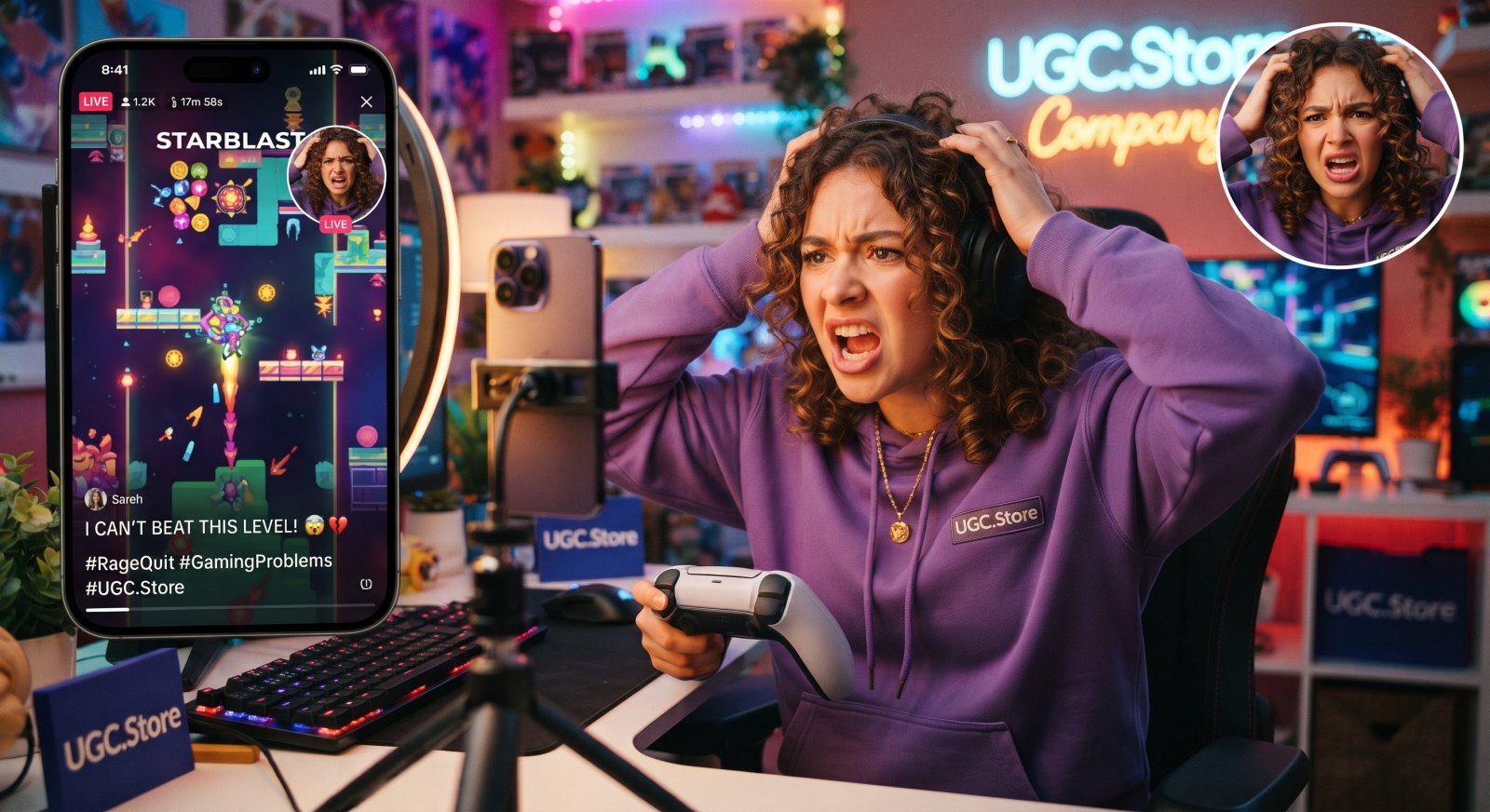
Phase 1 — The Failure Cold Open (0–3 seconds). The creator opens mid-failure, not mid-introduction. The screen shows the game in a state of visible collapse—the character falling, the block misplacing, the level timer expiring—and the creator's face or voice delivers the hook line in real time. The dialogue is not "I can't beat this level" as a statement. It is the live utterance of the failure: "No. No, no, no—how did that not work?" or "I have lost this level eleven times and I am starting to take it personally." The first frame must contain visible failure and audible frustration simultaneously. The compliance rule here is absolute: the gameplay shown must be the actual game, the level must be real, and the failure must be plausibly reproducible by a real player .
Phase 2 — The Specific Struggle (3–10 seconds). The creator names the specific mechanic or moment that is causing the failure, in plain language. "It's the timing on the third jump. The first two are fine. The third one just—" and the character fails again on screen. This phase establishes that the difficulty is structural, not the result of random incompetence. The viewer must believe that the creator understands the level but cannot execute, because that is the state that activates the viewer's own competence identity. If the creator seems confused about what to do, the viewer disengages. If the creator knows exactly what to do and still fails, the viewer leans in.
Phase 3 — The Near-Miss Escalation (10–18 seconds). The creator gets close to succeeding, then fails at the moment of highest tension. This is the format's resolution hunger engine. The near-miss must be visible and legible: the goal is in sight, the final action is initiated, and the failure occurs in the last possible moment. The creator's reaction to the near-miss is the emotional peak of the video—genuine disbelief, a frustrated laugh, a quiet "you have got to be kidding me." The screen should show the failure state clearly, not cut away. The viewer must see the exact moment the level took it away.
Phase 4 — The Competence Invitation (18–25 seconds). The creator turns to the camera and makes the implicit explicit: "I know this is a skill issue. I know someone is going to comment 'just do it like this.' Please. Tell me. I am asking." This phase converts the viewer's silent judgment into an active invitation. The creator cedes the pro position openly, which is counterintuitively higher-converting than pretending to be competent. The viewer who has been thinking "I could do that" is now being told "then show me." The comment section becomes the install funnel.
Phase 5 — The Honest Difficulty Note (25–32 seconds). The creator names the actual difficulty level or the number of attempts, with a specificity that establishes authenticity. "This is level 47. I have been on it for two days. My roommate beat it in four tries and I have not spoken to him since." The number must be true and plausibly beatable—not an invented statistic like "only 2% of players pass this," which is the same misleading-advertising exposure as fake gameplay . The honest note does the compliance work and the trust work simultaneously: it tells the viewer the level is hard but not impossible, which is exactly the state that makes them want to try.
Phase 6 — The Unresolved CTA (final 5–8 seconds). The video ends without resolution. The creator does not beat the level. The screen shows the failure state or the restart screen. The CTA is delivered over this unresolved visual: "I'm going back in. If you think you can do better, the link is right there. Prove it." The final frame is the game screen in a state of incompletion, not a branded end card. The loop is open. The install is the only closure.
Ready-to-Use Working Templates & Scripts
Script One: "The Timing Issue" (Format: puzzle/platformer failure UGC, 35 seconds).
Opening frame: screen recording of a simple-looking platformer, character falling into a pit. Creator's voice, off-screen but close: "No—that was not a timing issue, that was a personal attack." Cut to facecam, creator's expression genuinely annoyed, game paused in the background. "Okay. I have lost this level fourteen times. Fourteen. And the thing is, I know exactly what I'm supposed to do." Screen returns, character approaches the same jump. "It's the third platform. The first two are muscle memory. The third one has a half-second delay that my brain refuses to accept." Character jumps, fails, falls. Creator's facecam: a long blink, a deep breath. "I beat my roommate's high score on every other level. This one. This one is my villain origin story." Near-miss attempt: character reaches the final platform, pauses, jumps—falls short by inches. Creator's voice, quiet: "I'm not okay." Competence invitation: facecam, direct to camera. "If you are watching this and thinking 'just jump earlier,' please, I am begging you, comment the exact frame. I will try it. I am not too proud." Honest note: "Level 47. Two days. I have watched three tutorials and they all say the same thing and it does not work for me." Unresolved CTA: game screen showing the restart button. "I'm going back in. Link's below if you want to watch me suffer in real time or, you know, do it yourself."
Script Two: "The Obvious Solution" (Format: logic/puzzle failure UGC, 32 seconds).
Opening frame: screen recording of a match-3 or sorting puzzle, a move made that visibly creates a worse board state. Creator's voice, flat: "I know. I know that was wrong. I know." Facecam: creator staring at the screen with the expression of someone who has made a mistake they cannot explain. "The thing about this level is that it looks like you should do the obvious thing. You should match the blues. But if you match the blues, the board locks, and then you're here—" screen shows the locked board, "—and the only move left is the one that ends the run." Restart. "So you don't match the blues. You do the weird thing. You move the green over here for no reason, and it works for like six moves, and then—" screen shows a cascade that ends in failure. "It's not a skill issue. It's a 'the game is designed by someone who hates joy' issue." Competence invitation: facecam. "I know one of you is going to comment the exact sequence. Do it. I'm asking." Honest note: "I have spent forty minutes on this level. My screen time report is going to be embarrassing." Unresolved CTA: restart screen. "I'm going again. If you beat it before I do, screenshot it and tag me. I need to see it's possible."
Script Three: "The Rage Quit That Didn't Quit" (Format: action/reflex failure UGC, 38 seconds).
Opening frame: fast-paced action game, creator's character dying in a visibly unfair-looking moment. Creator's voice, immediate and loud: "Oh, that is—that is actually not real. That is not a real hitbox." Facecam: creator leaning back, hands off the controller, eyes wide. "I have died to this boss nine times. Nine. And six of those were because of that exact move. The dash. I dash, I'm behind it, and somehow—" screen replay shows the character getting hit anyway. "Somehow the hitbox extends backwards in time. That's the only explanation." Near-miss: creator gets the boss to 10% health, then dies. The facecam shows a full-body freeze, then a quiet "no." The creator picks the controller back up without a word. Competence invitation: facecam, tired smile. "I know this is a skill issue. I know the timing is learnable. I know because I've seen the clips. I just cannot make my hands do it." Honest note: "The boss is the third one in the level. I've seen people do it hitless. I am not those people." Unresolved CTA: title screen, the boss's name visible. "I'm going back in. If you're better than me—and statistically you probably are—the link is below. Show me the clip. I'll pin it."
Comparative Analysis Matrix
| Parameter | Manufactured Fake Difficulty | Authentic
Hook
"I Can't Beat This Level" |
|---|---|---|
| Gameplay shown | Mini-game or mechanic not in the actual app | Real level from the real game, verifiable on install |
| Creator's failure | Performed incompetence for the camera | Genuine frustration at a genuinely hard level |
| Difficulty claim | Invented statistics ("only 2% pass") | Honest attempt count and level number |
| Viewer reaction | Anger at being manipulated | Competence threat and intervention impulse |
| Comment behavior | "This is fake" and "reported" | "Just do it like this" and "I could beat that" |
| Regulatory exposure | High; post-Playrix enforcement risk -1 | Low; gameplay and claims are truthful |
| Retention outcome | Immediate churn; negative reviews | Install with realistic expectations |
| Hook Variant | Psychological Trigger | Best Genre Fit | Compliance Risk |
|---|---|---|---|
| "I've lost this level 14 times" | Challenge and ego recruitment -1 | Puzzle, platformer, casual | Low if count is true |
| "How did that not work?" | Vicarious frustration and intervention impulse | Action, reflex, arcade | Low; genuine reaction |
| "The timing is impossible" | Competence threat and skill-flattery | Rhythm, timing-based games | Low; structural difficulty |
| "My roommate beat this in four tries" | Social comparison and noob/pro identity -6 | Any competitive or score-based game | Low if true |
| "Only 2% of players pass this" | Invented scarcity and challenge | Hyper-casual at scale | High; misleading statistic -1 |
| Performance Metric | Category Benchmark (Gaming UGC) | Authentic Difficulty Hook Target |
|---|---|---|
| Hook rate (3-second) | 55–65% on cold traffic | Above 70% via visible failure |
| Hold rate (15-second) | 35–45% | Above 55% via near-miss escalation |
| Comment rate | 0.8–1.5% of views | 2–3% via competence invitation |
| CPI versus category | At or above benchmark | 25–35% below via Spark amplification -4 |
| Install-to-retention alignment | Mismatch if fake difficulty | Aligned if level is real and beatable |
Real-World Case Study Breakdown
A mid-core puzzle game launched a UA campaign in early 2026 with a creative library built entirely on polished gameplay showcases: smooth screen recordings of high-level play, satisfying cascades, and a narrator describing the game's depth. The assets were beautiful and completely inert. CPI settled at $4.20** against a category benchmark of **$2.50–$3.50 for mid-core puzzle, CTR was 0.6%, and the comment sections were silent—not hostile, just empty. The gameplay was impressive but emotionally flat. Viewers watched the skill and felt nothing about their own skill.
The strategic pivot rebuilt the creative around the "I Can't Beat This Level" hook with a single compliance guardrail: every failure shown had to be a real level from the shipped game, and the creator's attempt count had to be true. The team recruited seven creators in the puzzle and casual gaming niche, ranging from 15,000 to 60,000 followers, and briefed them with a constraint rather than a script: "Find a level in the game that genuinely frustrates you. Film yourself trying to beat it. Do not beat it on camera. Do not fake the failure. If you accidentally beat it, we will use a different take."
The winning asset came from a creator with 22,000 followers whose opening line was delivered mid-failure: "I have lost this level eleven times and I am starting to think the game is personally mad at me." The video showed her actually failing at the same jump eleven times across three sessions, with visible escalation in frustration—a quiet "okay" at attempt four, a muttered "this is fine" at attempt seven, and a full hands-off-the-phone moment at attempt ten. The near-miss at attempt eleven ended with her character falling one pixel short of the platform, and her facecam captured a genuine, unscripted "are you serious" that the editing preserved. The honest note was: "Level 63. Two days. I've watched the tutorials. They make it look easy and I believe them and I still can't do it."
The video ran for six weeks as organic and Spark-boosted content, generated 890,000 views, and drove 4,100 attributed installs at a blended CPI of $2.40—43% below the polished showcase baseline. The comment section became the install funnel the format promised: hundreds of comments with specific timing advice, frame-by-frame screenshots, and "I beat it in three tries" brags that other viewers clicked through to verify. The governing insight: the game had been selling competence, when the buyer needed to feel competence threatened. The install was not a purchase. It was a rebuttal.
Real-World Engineering & Creative Feedback
"The 'I Can't Beat This Level' hook only works if the creator actually can't beat the level. The moment you script the failure, the audience smells it. I have seen creators try to fake frustration and the comments are brutal—'why is your face doing that,' 'this is an ad.' The real ones, the ones who genuinely lose their temper, those are the assets that scale. You cannot manufacture a near-miss. You have to find a level that produces one." — Tasha Moreau, Mobile Gaming UGC Creator, 41K followers
"We killed every 'only X% of players' hook from our creative library after the compliance review. The performance data on those hooks was real—they converted—but the risk profile was insane. One regulator screenshot and you are in a Playrix situation. The replacement was honest attempt counts: 'I've lost this level fourteen times.' Same psychological trigger, zero misleading claim. The CPI difference was within noise. The legal exposure was not." — Ben Achterberg, Head of User Acquisition, Cartwheel Games
"The near-miss is the entire video. If the creator fails early and gives up, the viewer feels nothing. If the creator gets to the final moment and then fails, the viewer's brain screams. We brief creators to keep filming until they get a near-miss, even if it takes an hour. The near-miss is the asset. The rest is setup." — Priya Deshmukh, Creative Strategy Lead, Pixel & Pulse Agency
"Spark Ads changed the math on this format completely. A rage video on a brand account reads as desperate. The same video on a creator's account, with their real followers commenting 'this is why I stopped playing,' reads as a community moment. The 27% CPI reduction from Spark is real, but the format-specific lift is bigger because the negativity needs a social context to convert. Rage in a vacuum is just anger. Rage in a comment section is a challenge." — Marcus Lehto, Performance Marketing Director, Northline Interactive
"We almost cancelled this format because the first batch of creators beat the levels on camera. The brief said 'find a level that frustrates you' and they picked levels that frustrated them for thirty seconds. We rewrote the brief: 'find the level you have been stuck on for at least a day.' The difference in output was immediate. The frustration was real. The near-misses were real. The comments were real. The CPI dropped by a third. The lesson: the hook is only as good as the creator's genuine relationship with difficulty. You cannot cast your way out of a bad brief." — Elena Vasquez, Brand Director, Mosaic Mobile
Production Self-Check Checklist
Gameplay authenticity verified — every level shown is a real, shipped level from the actual game; no mini-game footage, no CGI, no gameplay that does not exist in the app .
Attempt count is true — the number of failures cited in the hook matches the creator's actual attempts; no invented statistics and no "only X% of players" claims .
Near-miss present — the video contains at least one attempt where success is visibly close and failure occurs at the moment of highest tension; this is the resolution hunger trigger .
Frustration reads as genuine — the creator's reaction is not performed; the casting and filming process prioritized authentic difficulty over scripted emotion.
No resolution on camera — the video ends without the level being beaten; the CTA is delivered over an unresolved game state, not a branded end card.
Competence invitation spoken — the creator explicitly cedes the pro position and invites correction in the comments; the line is delivered to camera, not buried in text.
Difficulty note is specific and plausible — the level number, attempt count, or time spent is named, and the level is plausibly beatable by a real player.
Spark authorization secured — the creator's account is the primary distribution vehicle; Spark code and usage rights are documented before boosting .
Comment section monitored for compliance — pinned comment clarifies that the level is real and in the game; any comment suggesting the footage is fake is addressed, not ignored.
Accessibility and safe zones cleared — captions cover 100% of dialogue including frustrated utterances; gameplay text and UI remain legible after TikTok compression.
Advanced FAQ
How does a brand find a level that genuinely frustrates creators without manufacturing difficulty?
The search is curatorial, not creative. The brand does not need to design a new level; it needs to identify existing levels that have already produced frustration in the player base. The most reliable signal is community complaint density: levels that generate disproportionate forum posts, Reddit threads, or Discord complaints are the candidates. The brand's job is to pull a shortlist of these levels and hand them to creators with a single instruction: "Try this. If it does not genuinely frustrate you within thirty minutes, we will try the next one." The creator's genuine difficulty is the casting criterion. A level that frustrates one creator may be trivial for another, and the format only works when the frustration is real to the person on camera .
What is the compliance boundary between "authentic difficulty" and "misleading advertising" in this format?
The boundary is verifiability. A misleading ad shows gameplay that does not exist in the game, or claims a difficulty statistic that is not true. An authentic difficulty hook shows a real level from the real game and cites an attempt count that the creator actually experienced. The post-Playrix regulatory standard holds that if a player installs the game and can find the exact level shown in the ad, the ad is not deceptive—even if the creator's failure was dramatic . The compliance checklist is therefore simple: can a player who installs this game navigate to the level shown in the video and experience the same difficulty structure? If yes, the ad is defensible. If no, the ad is a liability. The attempt count must also be true, because an invented statistic ("only 2% pass") is the same exposure as fake gameplay .
Does the "I Can't Beat This Level" hook work for hyper-casual games, or is it better suited to mid-core and puzzle titles?
The format works across genres, but the mechanism shifts with CPI economics. For hyper-casual titles at ~$0.40 Android installs, the format's value is **volume and hook rate**: the failure must be instantly legible, the level must be beatable in seconds, and the video must be short enough to generate high throughput . The frustration is light and the near-miss is quick. For **mid-core and puzzle** titles at $3–6 CPI, the format's value is pre-qualification: the creator's struggle signals that the game has depth and a learning curve, which filters for players who will survive onboarding and potentially pay. The video is longer, the near-miss is more elaborate, and the honest difficulty note does more work because the viewer is being asked to invest more time and attention . The hook is universal; the pacing and depth are genre-specific.
How should the comment section be managed when the format's conversion mechanism is viewers claiming they could do better?
Do not moderate the brags—amplify them. The commenter who says "I beat this in three tries" is the format's highest-value asset, because they are providing the social proof that the level is beatable and the challenge is real. The brand's role is to pin the most specific brag, reply with genuine engagement ("what was your timing on the third jump"), and use the comment thread as a secondary demonstration that the game rewards skill. The only comments that require moderation are accusations of fakeness, and those should be addressed with a direct, non-defensive reply: "It's level 63 in the actual game. Try it and tell us we're wrong." The comment section is not a liability to be managed. It is the conversion funnel's second stage.
What is the correct way to measure whether the format is working beyond CPI?
CPI alone will mislead on this format because the hook attracts challenge-motivated players who may install quickly but churn if the game does not deliver the specific difficulty they were promised. The correct measurement stack includes level-specific retention: do players acquired through this creative reach the level shown in the video, and what is their retention at that level versus players acquired through other creatives? The format is working if the acquired players find the level, attempt it, and stay past it. If they install, play for ten minutes, and never reach the level shown, the hook was a bait-and-switch in practice even if the gameplay was real. The secondary metric is comment-to-install correlation: if the comment section is full of specific gameplay advice and the install rate is high, the funnel is functioning. If the comments are full of "this is fake" and the install rate is low, the authenticity check failed before the compliance check did .
Custom Contextual Conclusion
The "I Can't Beat This Level" hook is not a trick. It is a psychological contract: the creator admits incompetence, the viewer accepts the implicit challenge, and the install is the viewer's attempt to prove the creator wrong. The contract only holds if the incompetence is real, the level is real, and the failure is something the viewer could plausibly experience themselves. The moment any of those three conditions breaks—the creator fakes the struggle, the level is a mini-game that does not exist in the app, the failure is scripted for the camera—the contract becomes a deception, and the viewer's response shifts from "I could do that" to "this is a scam." The brands scaling this format in 2026 are not the ones manufacturing the most dramatic failure. They are the ones who found creators who were already stuck, pointed a camera at them, and let the frustration do the work. The hook is not "I can't beat this level." The hook is "I can't beat this level and I know you think you can." The install is the viewer's answer. The only job of the script is to make the question impossible to ignore.