
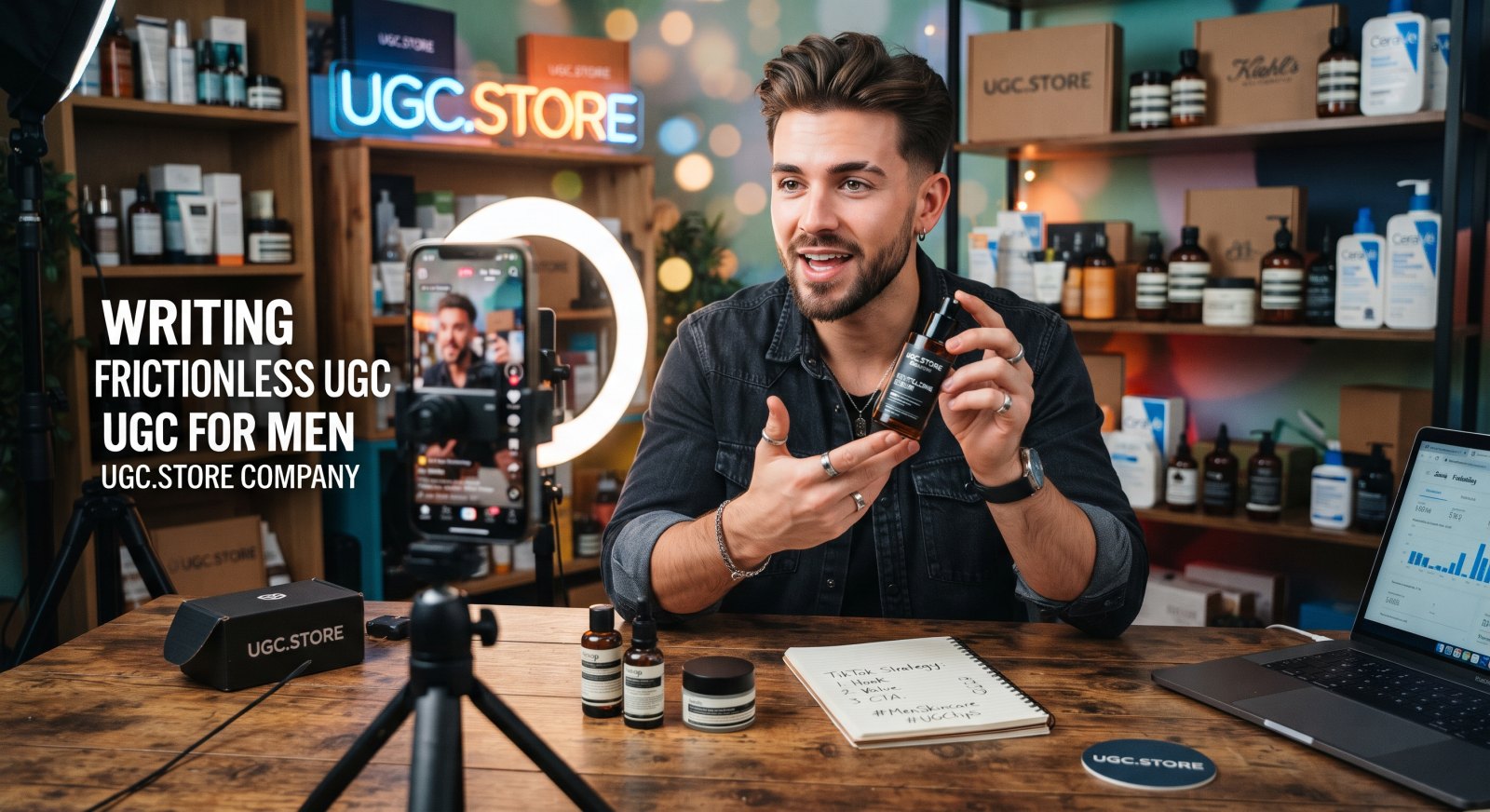
Executive Overview
Men’s grooming and skincare is the fastest-growing content territory on TikTok Shop, with the male care category surging 224% year-over-year while the platform’s beauty sales hit $3.2 billion . The core creative problem is not visibility but friction: male audiences arrive with defensive skepticism toward anything resembling a beauty routine, and every script that sounds like a skincare ad triggers immediate scroll behavior. The solution is frictionless UGC—peer-led, low-fuss, results-anchored content that treats grooming as maintenance rather than transformation, and positions the creator as a slightly self-deprecating friend who found something that works, not a beauty expert selling a regimen.
Theoretical Basis and Psychology of Mechanics
The male grooming audience on TikTok operates under a distinct psychological operating system that diverges sharply from the female skincare buyer’s decision architecture. Linguistic analysis of men’s skincare advertising reveals that constructing masculinity is the dominant communicative feature, appearing in 62% of male-targeted captions, while women’s skincare marketing leans on empty adjectives and intensifiers that would read as performative or suspicious to male viewers . The male buyer does not want to be told he needs improvement; he wants to be told there is a simple fix for a specific annoyance he already recognizes.
The first friction point is the routine resistance. Men are not opposed to looking better; they are opposed to the performance of self-care. The phrase “skincare routine” carries an implicit admission of vanity that many male viewers are not ready to make in their bathroom mirror. The frictionless script sidesteps this by reframing the behavior entirely: it is not a routine, it is a fix. It is not a regimen, it is three minutes before you leave. The winning male grooming content does not ask the viewer to become a different kind of person who does skincare; it asks him to add one step to the person he already is.
The second mechanism is report talk versus rapport talk. Genderlect theory distinguishes male communication patterns oriented toward reporting information and establishing status from female patterns oriented toward building connection and rapport . Men’s grooming UGC that works on TikTok is overwhelmingly report talk: the creator reports a problem, reports a product, reports a result. He does not ask the viewer how he feels about his skin. He does not build a sisterhood of shared insecurity. He says: “My beard was itchy. This oil fixed it. It costs fourteen dollars.” The informational density is the trust signal, and the absence of emotional labor is the friction remover.
The third mechanism is the looksmaxxing undercurrent. A significant segment of the young male TikTok audience is already primed to invest in appearance improvement through the looksmaxxing content ecosystem, where physical optimization is framed as a competitive advantage rather than vanity . This audience does not need to be convinced that grooming matters; it needs to be convinced that a specific product is not a scam. The frictionless script speaks directly to this audience by leading with evidence rather than aspiration: visible results, honest timelines, and a creator who acknowledges the product is not magic but it does work.
The fourth mechanism is the peer credibility floor. Male grooming buyers are not looking for experts; they are looking for someone slightly further along who is not trying to sell them a lifestyle. Analysis of TikTok Shop personal care performance shows that men’s grooming creators convert their audience hard precisely because followers come specifically for grooming guidance and product picks, and an often-underserved niche with high intent rewards creators who treat the category with directness rather than mystique . The frictionless script sounds like a text from a friend who happens to know about this stuff, not a brand ambassador who was paid to care.
Step-by-Step Algorithm & Methodology
The framework below sequences a frictionless men’s grooming UGC asset from cold open to conversion, with each phase engineered to reduce a specific friction point in the male buyer’s decision process.
Phase 1 — The Specific Annoyance Hook (0–3 seconds). The creator opens with a problem the viewer already has, named in plain language with zero preamble. No greeting. No product in frame. The line is something the viewer has thought in his own head: “My face was red every single time I shaved.” or “I had that shiny forehead thing and I just accepted it.” The hook’s job is recognition, not curiosity. Male viewers do not stop for mystery; they stop for a mirror. Target hook rate: above 65% on cold male audiences, with the threshold slightly lower than female beauty because male scroll behavior is faster and less exploratory.
Phase 2 — The Cost of Ignoring (3–7 seconds). The creator briefly names what the annoyance costs him, in concrete terms without emotional exaggeration. “It looked like I was angry at everybody.” “I was buying new pillowcases every two weeks because the oil situation was out of control.” This phase establishes that the problem is worth fixing without framing it as a crisis. Male audiences reject melodrama; they accept practical consequences. The B-roll here is the problem made visible: the redness, the oily sheen, the dry patch—shown without shame and without a filter.
Phase 3 — The Product Entry (7–12 seconds). The product enters as a tool, not a hero. The creator picks it up mid-sentence, shows the label for exactly as long as it takes to read it, and continues talking. There is no slow-motion reveal, no spray-mist aesthetic, no product worship. The line is functional: “My sister left this in the bathroom and I used it because I’m not above stealing.” or “I bought it because it was twelve dollars and the reviews were not insane.” The product’s origin story should feel accidental or cheap, because accidental discovery is more credible than a planned regimen.
Phase 4 — The Demo (12–25 seconds). This is where male grooming UGC diverges most sharply from female skincare content. The demo is fast, functional, and visibly real. The creator applies the product while talking, not in reverent silence. The application is two to three strokes, not a ritual. The camera stays on the face or the area of concern, not on the bottle. The sensory channel is the application sound—the splash of water, the rub of product, the razor against skin. Men’s grooming UGC that preserves ambient application audio rather than layering music over it converts at higher rates because the sound is proof the product is actually being used, not just displayed.
Phase 5 — The Honest Timeline (25–35 seconds). The creator states exactly how long the result took and what the result actually is, with a built-in limitation. “It took about a week before my skin stopped freaking out after I shaved. It’s not a miracle. It’s just less angry.” The honest timeline is the male grooming category’s equivalent of the flaw-first reveal: it disarms the viewer who has been burned by “overnight results” claims and positions the creator as someone who respects the viewer’s intelligence. The limitation should be specific and practical: “It smells like nothing, which I like, but if you want cologne-level scent this is not it.”
Phase 6 — The Low-Commitment CTA (final 5–8 seconds). The closing action is not “buy now.” It is a question that routes the comment section into shared grooming frustration: “What’s the one grooming thing you refuse to give up on, even though it probably doesn’t work?” or “Drop the product you stole from your girlfriend and actually kept.” The CTA generates UGC-on-UGC: male viewers writing their own confessions, which the algorithm reads as deep engagement and the brand reads as free creative research into the exact language that resonates.
Ready-to-Use Working Templates & Scripts
Script One: “The Shaving Fix” (Format: problem-solution UGC, 42 seconds).
Opening frame: creator in a bathroom, towel around neck, face slightly red, natural overhead light. Dialogue: “Every time I shaved, my neck looked like I had been in a fight with a cat and lost.” B-roll: close-up of razor burn, creator touching the irritated area, the razor sitting on the sink edge. SFX: water running, razor tap against porcelain. Product entry: creator picks up a tube from the counter without ceremony. “My roommate had this. I used it because I ran out of my stuff and I’m not proud of it, but here we are.” Demo: two pumps, applied to the neck in quick strokes, no massage, no reverence. “It’s not a shaving cream, it’s a post-shave thing. You put it on after, it burns for like three seconds, and then the redness just… stops escalating.” Honest timeline: “Two weeks in, my neck still gets a little angry, but it’s not the crime scene it was. It’s not magic. It’s just better.” CTA: “What’s the one grooming product you stole from someone and never gave back? I need to know I’m not alone.”
Script Two: “The Three-Minute Face” (Format: routine-integration UGC, 38 seconds).
Dialogue: “I am not a skincare guy. I have never been a skincare guy. But I am a guy who does not want to look tired at 9 AM meetings, and there’s a difference.” B-roll: creator in a plain t-shirt, kitchen counter, phone propped against a coffee maker. SFX: coffee dripping, low room tone, the click of a cap. Product entry: creator holds a face wash and a moisturizer, two products only. “Two things. A wash and a lotion. That’s the whole system. If it was three things I would not do it.” Demo: splash water, quick wash, pat dry with a hand towel, one pump of moisturizer, done. “This takes under three minutes including drying my hands. I timed it.” Honest limitation: “The moisturizer is not going to fix your life. It’s just going to stop your face from feeling like sandpaper after you wash it. That’s the whole pitch.” CTA: “If you have a three-step routine, you’re already doing more than me. Tell me what step two is because I’m curious.”
Script Three: “The Beard Situation” (Format: grooming maintenance UGC, 45 seconds).
Dialogue: “Nobody tells you that growing a beard is the easy part. Keeping it from looking like you live in the woods is the hard part.” B-roll: creator’s beard in natural light, slightly uneven, then a trimmer and a small bottle on the counter. SFX: trimmer hum, oil bottle cap, the brush against the beard. Product entry: “I use two things: a trimmer that cost me forty dollars and this oil that I buy because it smells like a barbershop and not like a candle store.” Demo: trimmer run along the jawline, oil dropped into palm, worked into the beard with fingers, brushing it down. “The oil is not for the hair, it’s for the skin underneath. That’s the part that gets itchy and flaky and makes you want to shave the whole thing off.” Honest note: “It does not make your beard thicker. It makes it softer and less chaotic. If you want thicker, talk to your dad.” CTA: “Beard guys: what’s the one product you actually repurchase, not just the one you got as a gift? I’m building a list.”
Comparative Analysis Matrix
| Parameter | Standard Men’s Grooming Approach | Frictionless Direct-Response Approach |
|---|---|---|
| Opening hook | “Check out this amazing new moisturizer” | “My face was red every time I shaved” |
| Creator framing | Expert or brand ambassador | Peer who found a fix by accident |
| Routine framing | Multi-step regimen as aspiration | One product as practical maintenance |
| Demo style | Polished application with music bed | Fast, functional application with ambient sound |
| Product entry | Product in frame from second one | Product enters as solution after problem is named |
| Claim language | “Transforms your skin” | “It took about a week before it stopped being angry” |
| CTA mechanic | “Link in bio, shop now” | Confession-based comment prompt |
| Friction Point | Male Buyer Behavior | Script Solution |
|---|---|---|
| Vanity resistance | Rejects anything framed as self-care performance | Reframes product as fix, not regimen |
| Expertise skepticism | Distrusts beauty-industry language and polish | Uses plain language and self-deprecating admission |
| Time scarcity | Abandons content that implies a long routine | Names the actual time cost on camera |
| Result doubt | Has been burned by overnight claims | States honest timeline with visible limitation |
| Scent sensitivity | Rejects products that smell like cologne or flowers | Describes scent in functional terms (“smells like nothing”) |
| Performance Metric | Category Benchmark | Frictionless UGC Target |
|---|---|---|
| Hook rate (3-second) | 55–60% on male cold traffic | Above 65% |
| Hold rate (15-second) | 35–40% | Above 50% |
| Comment rate | 0.5–1% of views | 1.5–2.5% via confession CTA |
| Save rate | Low for grooming historically | 2–3% via routine-reference value |
| Creator activation rate | 15–20% industry average | 35%+ with zero-script seeding |
Real-World Case Study Breakdown
A men’s grooming brand launched a post-shave repair balm in early 2026 into a category where the dominant creative pattern was before-and-after transformation content: red, angry skin on the left, calm, clear skin on the right, with a creator voiceover describing the “journey.” The brand’s initial asset bundle followed this template with polished production values and a creator with 180,000 followers who had built his audience on fitness content. Performance was diagnostic: 0.9% CTR, high three-second view rate but a steep drop-off at the eight-second mark when the creator began describing the product’s ingredient profile. Comment analysis revealed the friction: “this feels like an ad,” “bro just tell me if it works,” and the category’s signature dead-end question, “does this actually do anything or is it just lotion.”
The strategic pivot abandoned transformation framing entirely and rebuilt the creative program around frictionless peer testimony. The brand commissioned eleven creators with follower counts between 4,200 and 28,000, selected not for production quality but for comment-section behavior: each creator had a history of answering grooming questions in their comments with plain, specific language. The brief contained three product facts, one forbidden word (“transformation”), and one required beat: name the exact number of days before you noticed a difference. Creators were instructed to film in their actual bathrooms, use their actual razors, and speak at the pace they would speak to a friend.
The winning asset came from a creator with 6,800 followers whose opening line was: “I have sensitive skin and I shave my neck every day, which is basically a hate crime against my own face.” The video showed his actual redness, his actual application (two pumps, no massage), and his actual timeline: “Five days before the razor burn stopped showing up immediately. It still shows up if I shave twice in one day, but I don’t do that anymore because I’m not a psychopath.” The video ran for nine weeks, generated 2.1 million views organically, and drove $47,000 in attributed sales before fatigue. Blended CTR across the eleven-creator bundle climbed from 0.9% to 2.4%, and the comment sections shifted from “does this work” to viewers describing their own shaving frustrations and asking follow-up questions about application order. The governing insight: the brand had been selling a better face, when the male buyer was only willing to buy a less angry neck .
Real-World Engineering & Creative Feedback
“The biggest mistake brands make with men’s grooming UGC is casting the creator as someone who has their life together. Male viewers do not trust the guy with the perfect bathroom and the three-step routine. They trust the guy who admits he stole the product from his roommate. The confession is the conversion mechanism. I have never seen a polished male grooming video outperform a slightly messy one where the creator says ‘I don’t really know how this works but it does.’” — Marcus Chen, Men’s Grooming Creator, 89K followers on TikTok
“We ran a split test across forty creatives. The version with music over the application audio converted at 1.8%. The version with the raw sound of the razor and the water running converted at 3.2%. Male grooming buyers are not watching for aesthetic pleasure. They are watching for evidence. The sound of the product being used is evidence. The music is decoration. Kill the music.” — Derek Okafor, Creative Director, Forge Performance Studio
“Honest timeline is the entire game in male skincare. The moment a creator says ‘you will see results in three days,’ the male viewer mentally files the video under ‘scam’ and scrolls. The moment the creator says ‘it took about two weeks and my skin still gets a little red sometimes,’ the viewer files it under ‘real’ and keeps watching. The limitation is not a weakness in the script. The limitation is the script.” — Priya Raman, Paid Social Lead, Northline Agency
“We recruit male grooming creators by looking at their DMs, not their follower count. A creator whose comments are full of guys asking ‘what about for sensitive skin’ or ‘does this work with a beard’ has a buying audience. A creator with 500K followers and emoji-only comments has a reach audience. In this category, a 7,000-follower creator with an engaged grooming niche beats a 200,000-follower lifestyle account every single time. We have the data.” — Jordan Ellis, Influencer Partnerships Director, Meridian Male Grooming Collective
“The three-minute framing changed everything for us. We stopped saying ‘skincare routine’ and started saying ‘three minutes before you leave.’ Same product. Same result. Double the conversion rate. Male buyers are not avoiding the product. They are avoiding the identity that they think the product requires. The moment you tell them the identity is optional, the product becomes possible.” — Leah Goldstein, Brand Strategist, Routine & Ritual Consultancy
Production Self-Check Checklist
Problem-first hook verified — the opening three seconds name a specific annoyance the viewer already recognizes, with zero greeting, zero product presence, and zero beauty-industry language.
Vanity friction removed — the script contains no language that frames grooming as self-care, wellness, or pampering; the product is consistently framed as a fix or a tool.
Application audio preserved — the raw sound of water, razor, trimmer, or product application is retained in the edit; no music bed masks the demo sound.
Product entry is accidental or cheap — the product is introduced as a discovery, a steal, a roommate’s leftover, or a cheap purchase, not as a planned regimen component.
Demo is functional, not ceremonial — application occurs in two to three strokes with the creator talking through it; no slow-motion mist shots, no reverent silence, no ritual framing.
Honest timeline delivered — the script names an exact number of days or weeks before results appeared and includes a specific limitation spoken on camera.
Scent described in functional terms — if the product has a fragrance, the creator describes it as “smells like nothing,” “smells like a barbershop,” or another concrete reference; never “smells amazing” or “smells so good.”
Creator casting based on comment behavior — the creator has a demonstrated history of answering grooming questions in comments with plain, specific language, not just high follower count.
CTA is confession-based — the closing prompt invites viewers to share their own grooming frustration or product steal, generating comment-section UGC rather than purchase intent alone.
Accessibility and disclosure complete — captions cover 100% of spoken dialogue including product claims; Paid Partnership label activated where applicable; usage rights and Spark permissions documented.
Advanced FAQ
How does a brand script for the looksmaxxing audience without endorsing the more extreme corners of that community?
The looksmaxxing audience is not monolithic, and the frictionless script targets the practical maintenance segment of that audience rather than the extremity. The correct approach is to borrow the evidence-first framing that looksmaxxing content uses—visible results, honest timelines, no mystique—while explicitly avoiding the language of optimization hierarchy, rating scales, or the implication that appearance determines worth. The script says: “Here is a product that makes your skin less angry.” It does not say: “Here is a product that makes you a higher-value man.” The male viewer who identifies with the maintenance mindset will convert; the viewer who identifies with the extremity was never going to be a repeat customer for a twelve-dollar face wash anyway. The brand’s job is to occupy the practical middle of the male appearance conversation, where most of the buying happens .
What is the correct way to handle the “skincare is gay” objection that still circulates in male comment sections?
Do not argue with the objection. Pre-empt it with the creator’s own admission. The highest-converting male grooming scripts include a line where the creator acknowledges his own hesitation before the viewer can weaponize it: “I thought this was stupid for a long time. I thought it was a whole thing. It’s not a thing. It’s a tube that makes my face not hurt.” The creator’s willingness to name the stigma without defending against it removes the stigma’s power. The brand does not need to win a cultural argument in the comments; it needs the viewer who is quietly curious to feel safe enough to watch and eventually buy. The script serves the quiet viewer, not the loud commenter .
Should men’s grooming UGC use before-and-after visuals, and if so, how?
Use them, but de-emphasize the transformation. The before-and-after is evidence, not entertainment. The frictionless version shows the “before” as a state the viewer recognizes (redness, oil, dry patch) and the “after” as marginally better, not dramatically transformed. The line is not “look at the difference” but “look at the difference after two weeks of using it every other day, and also my skin still gets a little red if I shave twice.” The dramatic transformation visual triggers the viewer’s scam detection; the marginal, honest improvement triggers recognition and trust. The before-and-after should occupy three seconds or less of screen time, not the emotional center of the video.
How does a brand brief male grooming UGC without accidentally writing a female skincare script?
The destructive brief contains the words glow, radiant, nourish, hydrate as a feeling, and routine as identity. The productive brief contains three product facts, one required honesty beat (exact timeline), one forbidden phrase list (“game-changer,” “holy grail,” “glass skin”), and total freedom over the creator’s bathroom, language, and confession. The test is simple: read the brief aloud in a normal conversational voice. If it sounds like something a man would say to a friend in a parking lot, it is frictionless. If it sounds like something a brand would say in a focus group, it is a female skincare script wearing a male model. The male audience detects the difference at scroll speed, and the detection is fatal.
What is the right approach for beard and facial hair products specifically, given the unique grooming concerns of that subcategory?
Beard products convert on the itch and the chaos, not on aesthetics. The frictionless beard script names the specific sensory problem (itch, flaking, uneven growth, the “homeless lumberjack” phase) and positions the product as maintenance for the skin underneath the hair, not styling for the hair itself. The demo shows the trimmer and the oil in sequence, with the oil applied to the skin, not the beard strands. The honest note is that the product does not make the beard thicker or fuller—it makes it softer and less irritating. The CTA invites beard-specific confessions: “What’s the one beard product you actually repurchase, not the one you got as a gift?” This generates the highest-intent comment section in the entire male grooming category, because beard guys are already invested in the maintenance conversation and are looking for the next tool, not the next identity .
Custom Contextual Conclusion
The male grooming buyer on TikTok is not a harder sell than the female skincare buyer. He is a differently defended buyer. He has spent his entire content-consuming life scrolling past beauty advertising that was never designed for him, and he has developed a reflex that fires the moment a script sounds like it wants something from him. The frictionless UGC script does not try to outrun that reflex. It walks directly into it, names it, and then hands the viewer something so plain and specific that the reflex has nothing to grab onto. A red neck. A stolen tube. A timeline that is honest about the fact that the redness is still there but it is not a crime scene anymore. The brands winning the 224% growth in men’s care on TikTok Shop are not winning with better production values or more charismatic creators . They are winning because they stopped writing scripts for an audience that does not exist and started writing for the guy standing in his bathroom, towel around his neck, wondering if the thing on the counter is worth the three minutes. The script that answers that question without flinching—without glow, without radiant, without a single word that sounds like a beauty ad—is the script that converts.