
Executive Overview
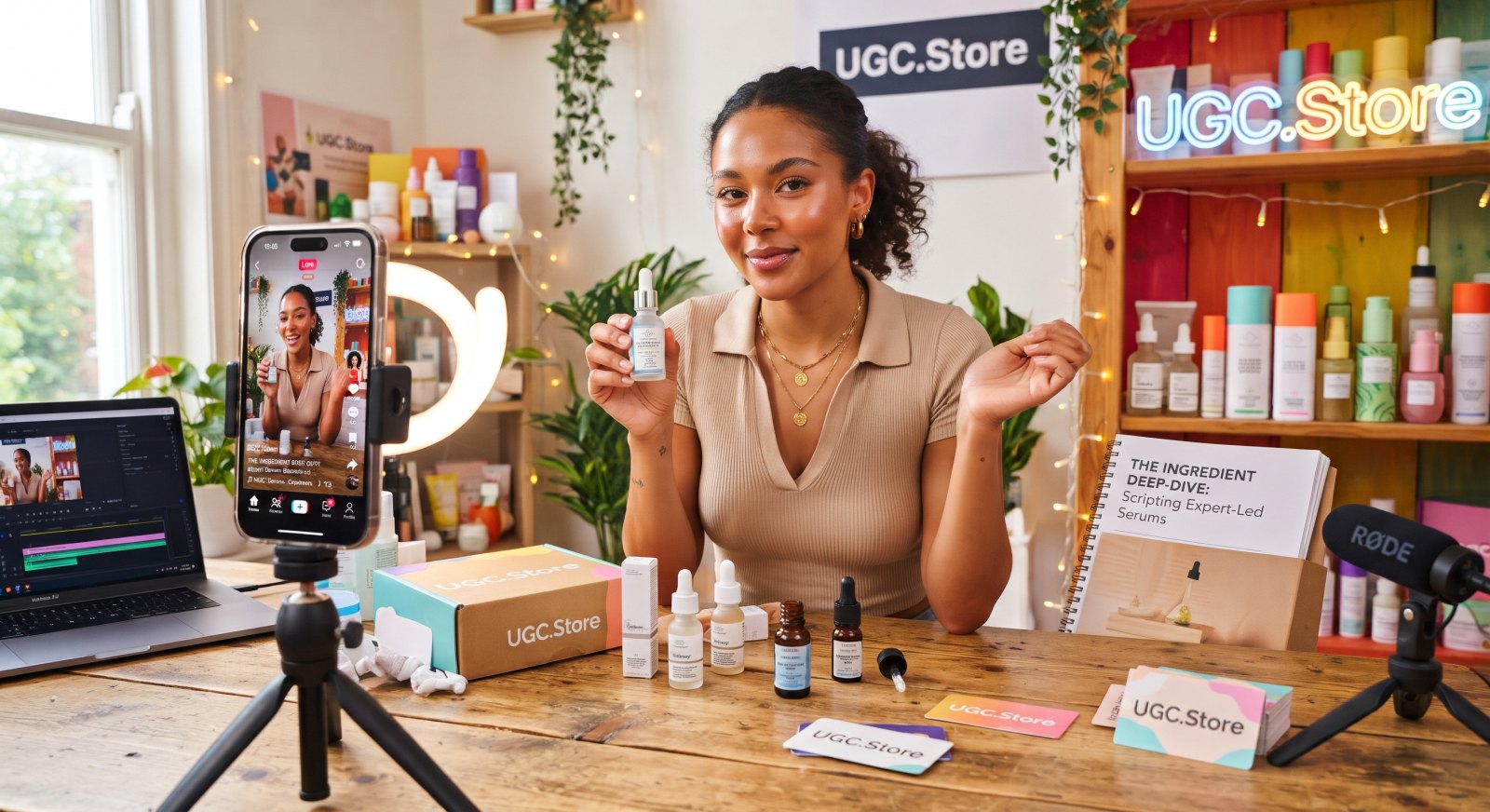
Ingredient deep-dive UGC for serums and creams is a conversion framework in which the creator acts as a translating authority — taking one active ingredient, one formulation decision, or one concentration claim and explaining it to the viewer in the language of personal benefit rather than laboratory jargon. On TikTok, ingredient curiosity is no longer a niche behavior but a mass-market force: retinol alone has accumulated approximately 8.7 billion TikTok views, niacinamide roughly 4.9 billion, and peer-reviewed analysis of Google Trends and TikTok analytics confirms that cosmeceutical search interest rises in direct correlation with social video viewership . The skincare brands winning in 2026 have understood that ingredient transparency is now a top-three purchase trigger in beauty e-commerce , and they are scripting their UGC accordingly — not with celebrity endorsements, but with creators who can open a bottle, read an INCI list aloud, and make the viewer feel smarter for having watched.
Theoretical Basis and Psychology of Mechanics
The modern skincare buyer has undergone a quiet but total transformation. Five years ago, the purchase decision ran through brand prestige, packaging, and influencer testimony. Today it runs through INCI-list literacy — the ability, and increasingly the expectation, that a consumer can interrogate a formula before committing money to it. The rise of ingredient scanner applications such as OnSkin and Oasis has institutionalized this behavior: millions of shoppers now photograph a product label before purchase and expect a plain-language verdict within seconds . This shift creates the psychological foundation for expert-led UGC, because the viewer is no longer passively receiving a pitch — they are actively auditing one.
The first mechanic at work is authority transfer. Classic persuasion research has long established that expertise functions as a powerful peripheral cue, but on TikTok the traditional markers of expertise — white coats, clinic settings, diplomas on walls — have been replaced by something more native: fluency. A creator who can say "this is a 5% niacinamide at a pH that actually keeps it stable, and here's why that matters" demonstrates competence in seconds, and competence is the currency that buys the next thirty seconds of attention. The viewer does not need to verify the claim; the fluency itself is the verification signal. This is why expert-led creator scripts consistently outperform testimonial-only creative in the serum and cream category: the testimonial says the product is good, the ingredient deep-dive proves the creator knows what good looks like.
The second mechanic is the intelligence dividend. When a viewer watches an ingredient deep-dive and walks away understanding why a ceramide-to-cholesterol-to-fatty-acid ratio matters, they have received value before any purchase. That value creates a reciprocity debt the CTA can collect: the viewer converts partly out of gratitude and partly out of a desire to validate their newly acquired knowledge by acting on it. Comment sections under successful ingredient content prove this — viewers quote back the creator's explanations to each other, correct misconceptions, and tag friends with "watch this, this is exactly what I was telling you." That peer-to-peer redistribution is organic reach no paid budget can replicate.
The third mechanic is skepticism pre-emption. The skincare category suffers from a decade of overclaiming, and serum buyers in particular carry high defensive skepticism because they have been trained by the same ingredient culture that now benefits honest brands. A creator who volunteers the limitations of an ingredient — "hyaluronic acid won't hydrate you if you live in a dry climate and don't seal it with a cream" — disarms the viewer's entire defensive apparatus. The deep-dive format structurally rewards this honesty because formulation nuance reads as expertise, whereas blanket praise reads as advertising. The result is a creative format that converts doubt into attention.
Finally, there is the algorithmic layer. Ingredient deep-dives generate save-rate behavior that most beauty content never achieves: viewers save videos to re-watch before shopping, to build routines, to compare products. TikTok's recommendation system interprets saves as the strongest quality signal available, and ingredient explainers in the cosmeceutical space routinely exceed baseline beauty engagement benchmarks, with top skincare accounts achieving 9–13% engagement rates on educational content . The deep-dive is not merely persuasive — it is algorithmically privileged.
Step-by-Step Algorithm & Methodology
The framework below sequences an expert-led serum or cream UGC asset from cold open to conversion, mapped to TikTok's attention economy.
Phase 1 — The Authority Hook (0–3 seconds). The creator opens mid-thought with a contrarian or clarifying ingredient claim: "Everyone is using niacinamide wrong, and I can prove it in thirty seconds." Alternatively, the label-reading opener: creator holds the bottle to the camera and says, "Let me show you what this formula is actually doing." The objective is competence signaling within one second of exposure — the viewer must immediately understand that this video contains information, not promotion. Target hook rate: above 72% on cold audiences.
Phase 2 — The Context Layer (3–10 seconds). Before naming the product, the creator establishes why the ingredient matters at category level — what problem it solves, who it serves, what it is commonly confused with. This phase borrows the empathy framework's patience: the product stays off-stage while the viewer's curiosity is being qualified. The deep-dive fails when it opens with the bottle; it wins when the bottle arrives as the answer to a question the viewer has already agreed is worth asking.
Phase 3 — The Deep-Dive Core (10–30 seconds). This is the engine of the asset. The creator translates one to three formulation specifics into benefit language: concentration, supporting ingredients, texture technology, packaging logic. Every technical fact must be immediately followed by its "so what" translation — not "it contains 5% panthenol" but "5% panthenol, which is the dose studies actually used, so this isn't a sprinkle-in." The pacing rule: one concept every six to eight seconds, never two concepts stacked. Visual direction alternates between label close-ups, texture squeezes, and the creator's face delivering translations directly to lens.
Phase 4 — The Boundary Statement (30–38 seconds). The highest-trust line in the entire script: an honest limitation. "This won't replace your retinoid." "If you're under twenty-five, you don't need this yet." "Skip this if your barrier is currently compromised." Boundary statements convert expertise into trust and trust into saves — viewers save boundary-heavy content at elevated rates because it functions as a reference artifact.
Phase 5 — The Placement & Ritual (38–48 seconds). Where the product lives in a routine, in what order, over what timeline, paired with what. This phase converts ingredient understanding into usage confidence — the moment the viewer mentally moves from "interesting" to "I could do this." Demo beats here are functional: dropper application, absorption wait-time, layering sequence with the companion cream.
Phase 6 — The Curiosity CTA (48–55 seconds). The closing question is an ingredient question, never a purchase command: "Comment your skin type and I'll tell you whether this serum or the cream version fits you better." This activates the algorithm's engagement loop, generates routine-building data in the comments, and routes high-intent traffic to the pinned link.
Ready-to-Use Working Templates & Scripts
Script One: "The Label Autopsy" (Format: bottle-side forensic review, 50 seconds).
Opening frame: creator at a desk, product in hand, no greeting. Dialogue: "I'm going to read this ingredients list to you out loud, because this is what you're actually buying." B-roll: macro close-up of the INCI list, slow pan. SFX: paper label texture, quiet desk ambience. Context layer: "This is a barrier-repair cream, and barrier repair is having its moment for a reason — everyone's over-exfoliated." Deep-dive core: "Ceramide NP first in the actives block — good, that's the one your skin recognizes fastest. Cholesterol right behind it — that's the ratio that matters, ceramides alone without cholesterol don't rebuild properly. And no fragrance, no essential oils, which for a repair cream is non-negotiable." Texture beat: squeeze of the cream onto the back of the hand, slow spread. SFX: soft product sound. Boundary statement: "This is not a glow serum. It will not brighten anything. It will stop your face from feeling tight by week two, and that's the whole job." Ritual placement: "Last step at night, over damp skin, and in the morning your sunscreen goes on top." CTA: "Drop your current routine in the comments and I'll tell you where this fits."
Script Two: "The Confusion Corrector" (Format: myth-busting explainer, 46 seconds).
Dialogue: "Niacinamide and vitamin C do not cancel each other out, and I need this myth to die." B-roll: both bottles side by side on a bathroom shelf. Context: "This rumor came from one outdated lab study using pure ascorbic acid at a low pH — nothing like modern stabilized formulas." Deep-dive core: "Look at this serum — 10% niacinamide, and the vitamin C derivative here is gentle by design. Stacked together, niacinamide actually helps the vitamin C do its job more evenly across tone." Demo: three drops of serum, pat-in technique, absorption wait in real time. SFX: droplet sound, ambient bathroom tone. Boundary statement: "If your skin is actively flaking, don't stack actives yet — repair first, play later." Ritual: "Niacinamide in the morning, vitamin C at night, or together if your barrier is healthy." CTA: "Save this for your next Sephora run, and follow for the retinol deep-dive next week."
Script Three: "The Concentration Decoder" (Format: dose-skeptic authority review, 52 seconds).
Dialogue: "The most important number on this bottle isn't the price — it's this." B-roll: finger tapping the percentage on the label, macro shot. Context: "Peptides are everywhere right now, but most formulas have them at fairy-dust levels — just enough to print on the box." Deep-dive core: "This one lists a 3% peptide complex as the lead active, ahead of the emollients. That's the difference between marketing and formulation." Texture beat: serum drag on skin, no pilling on camera. Boundary statement: "Peptides are slow. This is a ninety-day relationship, not a ninety-minute glow." Ritual: "Two pumps, neck included, morning and night — and don't waste it on skin that's mid-flare." CTA: "Comment 'formula' and I'll send you the full breakdown of what each peptide in here actually does."
Comparative Analysis Matrix
| Opening frame | "I've been using this for a month" | "Let me read this formula to you" |
| Persuasion mechanism | Social proof and relatability | Authority transfer and intelligence dividend |
| Primary metric strength | Watch time and likes | Saves, shares, and comment-thread redistribution |
| Skepticism handling | Ignored until the comment section | Pre-empted via boundary statements |
| Save-rate profile | Near beauty-category baseline | Elevated; content functions as reference material |
| Creative longevity | 2–3 week fatigue window | Extended by sequencing into series formats |
| Ingredient naming | Jargon recitation without translation | Every technical fact followed by a "so what" line |
| Concentration claims | Absent or vague | Specific percentages tied to studied dose ranges |
| Boundary honesty | Overclaiming everything | One named limitation per asset |
| Visual evidence | Studio product beauty shots | Macro label reads and real-time texture behavior |
| CTA mechanics | Verbal "link in bio" push | Ingredient-question comment bait plus pinned link |
| First exposure | "Someone like me likes it" | "This person knows more than me" |
| Consideration phase | Ambiguous evidence of fit | Concrete criteria to self-qualify |
| Pre-purchase doubt | Nothing; doubt surfaces at reviews | Disarmed by boundary statements |
| Post-purchase validation | None | Saved video becomes usage reference |
| Community behavior | Passive consumption | Quoting, correcting, tagging, restacking |
Real-World Case Study Breakdown
A prestige-adjacent DTC brand launched a two-step serum-and-cream system in early 2026 with clinically meaningful concentrations: a 10% niacinamide serum and a ceramide-dominant barrier cream, both formulated at transparent, study-referenced doses. The launch creative followed the conventional playbook — ten lifestyle creators, glow-lit morning routines, soft-focus texture shots. Initial results were respectable and then stalled: a 1.1% CTR, a $68 blended CPA, and a comment section dominated by a single skeptical question the brand's ads never answered — "okay but what's the actual percentage?" The performance team recognized the mismatch immediately: the product's entire differentiation was formulation rigor, and the creative was hiding it behind aesthetic.
The strategic pivot was a complete rebuild around expert-led ingredient deep-dive UGC. The brand commissioned eight creators with demonstrated formula fluency — three with esthetics credentials, two science-communication accounts, three high-trust skincare reviewers known for INCI-level analysis — and briefed them on the phase methodology with a strict mandate: every asset must read the label on camera, name at least one concentration, and state one honest limitation. The creative bundle shipped as a four-week narrative arc — niacinamide deep-dive, barrier-science deep-dive, stacking-ritual explainer, and a myth-correction finale — with each video engineered to reference the previous one, converting single assets into a serialized trust funnel.
Final empirical telemetry after the ten-week test window: CTR climbed from 1.1% to 2.3%, blended CPA fell from $68 to $39, and the save-rate on deep-dive assets ran at roughly 3.8 times the brand's lifestyle creative. The decisive metric, however, was comment quality: under the first deep-dive video, viewers began posting their own ingredient analyses, one comment dissecting the ceramide ratio receiving over two thousand likes and functioning as unpaid expert endorsement pinned beneath the paid placement. The niacinamide myth-correction asset alone, Spark-boosted for five weeks, drove approximately 23% of launch-quarter revenue. The lesson generalized beyond this launch: when the product's advantage lives in the formula, the creative's only job is to read the formula out loud.
Real-World Engineering & Creative Feedback
"The mistake I see in ninety percent of ingredient-led briefs is asking creators to mention ingredients instead of asking them to explain decisions. 'Mentions ceramides' produces a laundry list. 'Explain why cholesterol sits next to ceramides in this formula' produces a video people save. Fluency is the hook — the ingredient is just the evidence." — Dr. Lena Moreau, Cosmetic Chemist and UGC Creative Consultant, Forma Labs
"We track saves as the primary health metric on expert-led skincare creative now, and it's changed everything. Likes flatter you; saves tell you the viewer is building a reference library with your content in it. A saved video sells three weeks later when that viewer is standing in front of a shelf. Nobody's attribution model credits the save, but the revenue shows up anyway." — Jordan Whitfield, Head of Performance Creative, Alder & Finch Media
"Boundary statements feel like creative suicide to every brand client the first time they see them in a script. Then the comments arrive — 'finally someone honest' — and the CPA drops. I now put the limitation line in bold in every brief. It's the single highest-converting sentence in ingredient deep-dive UGC, and brands resist it until the data slaps them." — Renata Castillo, Senior Strategist, TrueNorth Social
"Platform enforcement on cosmetic claims has tightened twice in eighteen months, and it hit ingredient content hardest because creators love saying 'repairs your barrier' as if it's a medical claim. Our fix was building a claims lexicon with our legal team and training creators on it in onboarding. Journey language, formulation language, experience language — all safe. Treatment language gets flagged. Creators who learn the lexicon get rebooked; those who don't get one warning." — Marcus Adeyemi, Paid Social Director, Lumen Collective
"The unconventional play nobody talks about: your best ingredient deep-dive creators often come from the comment section of your myth-busting videos. We've recruited four of our top performers by DM-ing viewers who wrote technically accurate corrections under our paid ads. They arrive pre-trained, pre-credible, and their audiences already believe them. It's talent scouting disguised as community management." — Sofia Lindqvist, Beauty Vertical Lead, Catalyst Content Studio
Production Self-Check Checklist
Before final export and ad platform upload, every expert-led serum and cream UGC asset must clear the following quality gates:
- Hook fluency verified — the opening three seconds demonstrate ingredient competence with zero throat-clearing, zero greetings, and a claim specific enough to be checked.
- Label evidence present — at least one macro close-up of the actual INCI list or concentration callout appears on camera, legible at mobile viewing resolution.
- Translation rule enforced — every technical term or percentage is followed within one sentence by its practical "so what" meaning for the viewer's routine.
- Concentration specificity confirmed — named actives carry named doses where the label permits, with language avoiding unsupported comparisons to clinical outcomes.
- Boundary statement intact — at least one honest limitation survives every edit; if a brand requested its removal, the strategist escalates before shipping.
- Claims lexicon compliance cleared — zero treatment, cure, repair, or medical-outcome language; formulation and experience framing throughout; documentation stored with the asset.
- Sound design intentional — no music bed competing with explanation during the deep-dive core; label taps, texture sounds, and room tone preserved.
- Ritual completeness checked — application order, pairing logic, timeline expectations, and usage frequency all delivered verbally, not buried in caption.
- CTA mechanics functional — ingredient-question comment bait delivered on camera, pinned comment prepared, Spark Ads authorization generated where applicable.
- Accessibility layer complete — captions covering 100% of spoken dialogue, safe-zone compliant on-screen text, 9:16 vertical integrity confirmed.
- Series continuity logged — asset registered in the narrative arc tracker so cross-references to previous deep-dives remain accurate and sequenced.
Advanced FAQ
How technical can an ingredient deep-dive get before it loses the mass TikTok audience?
The ceiling is higher than brands assume, provided the translation rule is enforced rigorously. A creator can discuss pH stability, derivative forms, and penetration enhancers successfully — TikTok's cosmeceutical viewership, measured in the billions for retinol and niacinamide, demonstrates sustained appetite for real formulation content . The failure point is never the concept's difficulty; it is the creator's fluency. A viewer abandons a deep-dive not because it was too technical but because a technical term arrived without its "so what." Rule of construction: if a sentence requires the viewer to already know something, the preceding sentence must teach it.
Should expert-led UGC creators have formal credentials, or is demonstrated fluency enough?
Demonstrated fluency converts comparably to formal credentials on TikTok, and in some formats outperforms them. The white-coat aesthetic triggers advertisement-pattern recognition in a feed built on peer intimacy; a creator at their bathroom counter reading a label fluently triggers peer trust. What cannot be faked is accuracy — the skincare comment community audits claims aggressively, and a technically wrong deep-dive attracts corrective pile-ons that damage the placement directly. Selection criteria should therefore prioritize verifiable fluency — past content, comment-section track record, ability to pass a brief-based formulation quiz — over credentials as a proxy.
How should a brand sequence multiple ingredient deep-dive assets to avoid audience fatigue?
Sequence as a curriculum, not a campaign. The methodology that wins is arc-based deployment: open with a category-level myth correction to capture cold attention, follow with the hero ingredient deep-dive to build authority, add a ritual and stacking explainer to convert understanding into usage, and close with a boundary-heavy comparison asset that qualifies skeptics. Each video references the prior one verbally, training the algorithm to associate the creator with a serialized topic and training viewers to return. Arc-sequenced ingredient content measurably extends creative lifetime because the series itself becomes the retention mechanism — individual assets fatigue while the curriculum compounds.
What is the correct way to handle ingredient percentages when the brand's formulas are mid-tier concentrations?
Name them anyway, and reframe the value axis. Mid-tier concentrations convert through context engineering: the creator explains what the dose is optimized for, why higher is not universally better — 10% niacinamide can be more irritating than 5% with superior supporting ingredients — and what the formulation trades concentration for, such as stability or tolerability. The deep-dive format is uniquely suited to this defense because its persuasive engine is fluency, not bravado. Hiding the percentage while competitors name theirs reads as concealment; naming it with formulation rationale reads as expertise, and expertise is what closes the sale.
Do ingredient deep-dive scripts work for creams and moisturizers, or only for actives-heavy serums?
They work for creams, and arguably with less competition. The serum category is saturated with percentage-marketing; the cream and moisturizer category remains dominated by testimonial and texture creative, leaving an authority vacuum that fluent creators fill cheaply. Barrier-repair formulas, ceramide ratios, occlusive-versus-humectant architecture, and packaging-airtightness logic are all deep-dive-ready topics with genuine viewer utility. Brands pairing a serum deep-dive with a cream deep-dive in one arc also gain a routine-lock advantage — the viewer who understands both products individually converts to the bundle at elevated rates because the pairing logic itself has been taught.
Custom Contextual Conclusion
The ingredient deep-dive is what happens when a category's customers become more literate than its advertising. TikTok's skincare audience no longer wants to be told a serum is good — it wants to be shown how to know, handed the criteria, and trusted with the limitations. Expert-led UGC wins in this environment because it treats the viewer as a student rather than a target, and students convert into customers with a loyalty that testimonial buyers never carry: they bought because they understood, and understanding defends the purchase against every cheaper alternative that follows. Script your serums and creams the way a generous chemist would explain them over coffee — label in hand, doses named, one honest caveat delivered without flinching — and let the algorithm's save button and the comment section's quoting culture do what no media budget can. In the deep-dive economy, transparency is not a compliance posture. It is the product, and the creator who reads it aloud is the salesperson.