
Executive Overview
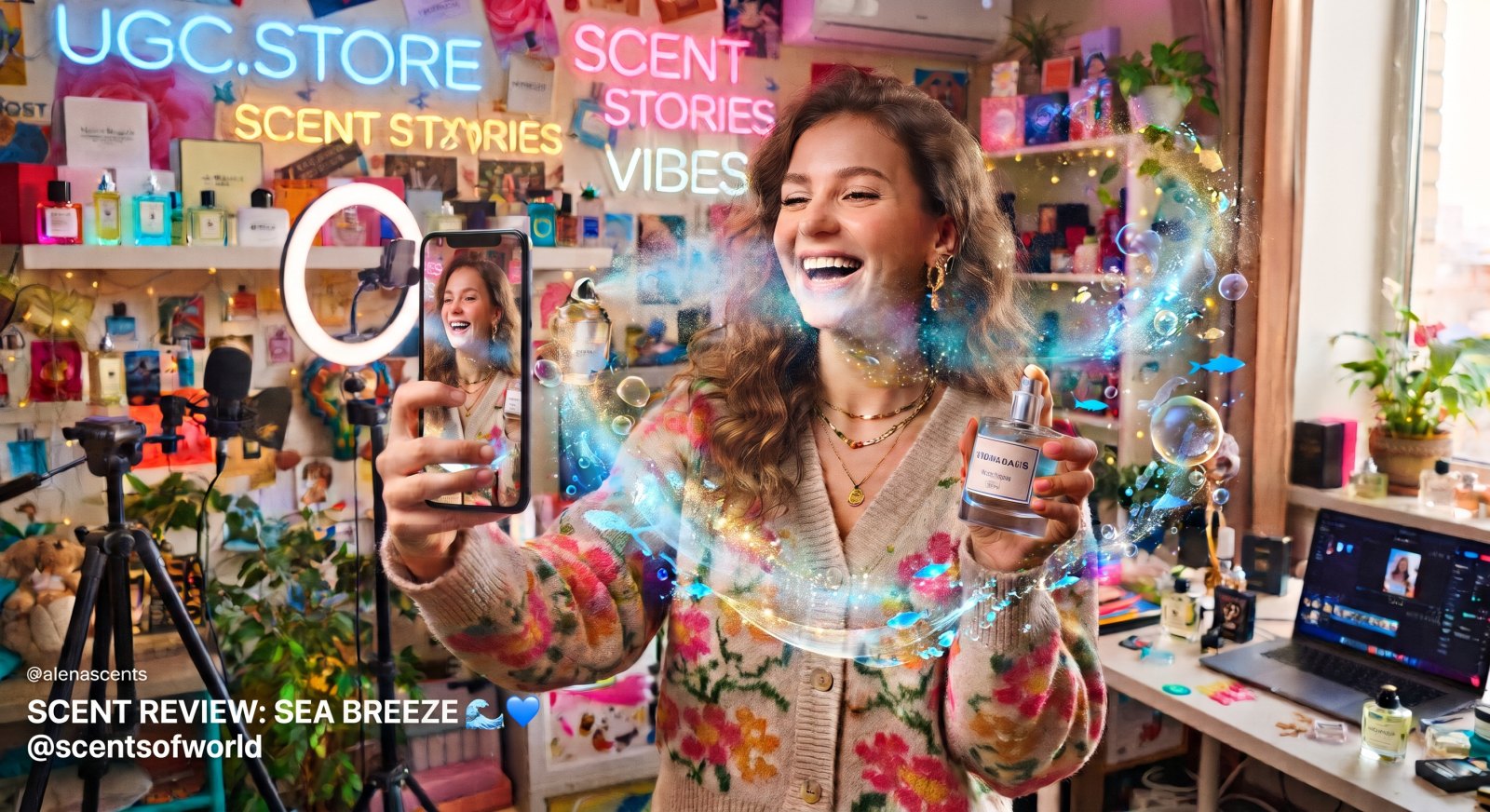
Metaphorical fragrance UGC is a creative methodology for solving the only marketing problem unique to perfume: the product is fundamentally un-demonstrable on screen — a viewer cannot smell a video, and every attempt to describe a scent with notes alone collapses into abstraction. The solution is not better product photography but scent translation: the systematic conversion of olfactory experience into visual metaphor, situational memory, and tactile language that lets the viewer feel a fragrance before ever spraying it. The commercial stakes are enormous — the global perfume market is projected to reach $88.7 billion in 2026, with #PerfumeTok surpassing 6.4 billion views and viral scents selling out before reaching department store shelves . Roughly 45% of social-media-driven fragrance purchases begin with a TikTok view, and the content that converts is not polished advertising but creator-led formats where scent is woven into ritual, memory, and metaphor . The brands winning fragrance on TikTok have stopped describing their perfumes and started rendering them — one metaphor per script, one memory per hook, one sensory sentence per beat.
Theoretical Basis and Psychology of Mechanics
Fragrance is the only major beauty category where the product's core value proposition is physically inaccessible at the point of content consumption. Skincare shows texture, makeup shows transformation, haircare shows recovery — perfume shows a bottle. Academic analysis of perfume advertising identifies exactly three master metaphors through which scent is communicated across all media — fragrance is attraction, fragrance is emotion, and fragrance is object — and TikTok UGC inherits this framework while adding a fourth, uniquely native mechanic: fragrance is memory.
The first psychological mechanism is cross-modal translation. When a creator says "this smells like the first warm day of the year when you finally open the windows," the viewer's brain does not process a comparison — it runs a simulation, pulling the stored sensory memory of that day and attaching it to the product. This is not poetic decoration; it is the operational mechanism by which invisible products become purchasable. Research on fragrance influence behavior confirms the pattern: instead of mimicking smell online, successful creators turn fragrance into feeling, social proof, and personal style . The metaphor is not a flourish on the script — the metaphor is the product demo.
The second mechanism is the wardrobe shift in buyer identity. Gen Z consumers now own an average of 8 to 12 fragrances, compared with 2 to 3 for Baby Boomers, and treat scent as a situational wardrobe rather than a single signature . This behavioral change rewrites the creative brief: the viewer is not searching for "the one" but for "the next one for this specific context," which means fragrance UGC converts through situation-matching metaphors — office-scent metaphors, date-night metaphors, rainy-Sunday metaphors — far more reliably than through quality claims. The creator who says "this is what wearing an expensive sweater to a bookshop smells like" is doing product-market fit at the speed of a sentence.
The third mechanism is memory-anchored storytelling as the category's strongest conversion driver. Analysis of fragrance content performance found that memory- and mood-led storytelling stands out as one of the strongest conversion formats in the category, precisely because fragrance resists note-based selling but yields to narrative anchoring — connect a scent to a season, a city break, or a getting-ready routine, and it becomes real to the viewer . This is why roughly 60% of top organic fragrance posts are GRWM videos — scent lands inside a daily ritual far better than in a static product shot .
The fourth mechanism is the credibility architecture of nano and micro creators. In a category where trust must substitute for the missing sense of smell, smaller creators convert at rates larger accounts cannot match — nano creators delivering 2 to 3 times the conversion rate of macro campaigns — because their recommendations read as tips from a friend rather than advertising . The unscripted quality of metaphor is itself a trust signal: "this smells like a clean white shirt after a late summer dinner" lands precisely because no brand brief writes that sentence . Platform-native, slightly imperfect, deeply specific sensory language is the fragrance category's equivalent of the flaw-first reveal.
Step-by-Step Algorithm & Methodology
The framework below sequences a metaphorical fragrance UGC asset from cold open to conversion, with each phase translating an aspect of the invisible product into a perceivable experience.
Phase 1 — The Sensory Hook (0–3 seconds). The creator opens mid-metaphor, never mid-pitch: "This perfume smells like the exact moment a summer storm starts." The hook's job is to force a sensory simulation within the first sentence — the viewer must feel something before they see the bottle. Target hook rate: above 70% on cold audiences. The bottle is forbidden from appearing in the opening frame; curiosity about the metaphor outperforms curiosity about the product.
Phase 2 — The Memory Scene (3–10 seconds). The creator expands the metaphor into a brief cinematic vignette — two or three concrete visual details: "You know that first raindrop on hot pavement, the light going green-gold, everyone running inside except you." B-roll instruction: creator walking through actual weather, or lighting a candle that visually matches the metaphor's palette. This phase is doing the work of a scent strip in a department store: it gives the viewer an experience to anchor the purchase to.
Phase 3 — The Bottle Reveal (10–15 seconds). The product enters as the source of the metaphor, not the subject of the video. Dialogue pattern: "I didn't believe a bottle could smell like that either — this is [product]." Visual: label close-up, spray mechanism in slow motion, mist catching light. SFX: the spray itself — fragrance UGC is one of the few verticals where the product's sound is its only native sensory channel, and the hiss of the atomizer is demo-as-ASMR.
Phase 4 — The Situational Wardrobe Beat (15–30 seconds). The creator places the scent in the wardrobe framework: when it is worn, what it pairs with, what it would replace. "This is my bookshop sweater scent — it does not go to the gym, and it knows that." This phase converts metaphor into usage confidence, the fragrance equivalent of the ritual demonstration in other verticals, and it feeds the wardrobe mentality that defines the modern buyer.
Phase 5 — The Honest Projection Note (30–40 seconds). Fragrance's equivalent of the flaw-first reveal: the creator names one limitation in sensory terms — "It sits close to the skin after two hours. It becomes a secret instead of an announcement, and you have to decide if that's what you want." Projection and longevity honesty is the fragrance category's highest-converting candor, because every buyer has been burned by an overpromising review.
Phase 6 — The Memory CTA (final 5–10 seconds). The closing question routes the comment section into shared metaphor territory: "Tell me a smell you wish someone would bottle — best answer gets my next review pick." This generates UGC-on-UGC: commenters writing their own scent metaphors, which the algorithm reads as deep engagement and the brand reads as free creative research.
Ready-to-Use Working Templates & Scripts
Script One: "The Weather Memory" (Format: atmospheric metaphor UGC, 45 seconds).
Opening frame: creator at a window, rain starting outside, natural light shifting. Dialogue: "This perfume smells like the exact minute a summer storm starts — that first cold breath before the rain hits." B-roll: rain on glass, street light going amber, creator's hand on the window. SFX: rain ambience, distant thunder, the spray hiss. Memory scene: "Hot pavement, green-gold light, everyone's running inside and you're standing there because it finally stopped being 35 degrees." Bottle reveal: "I bought this because the description used the word 'petrichor' and I was fully prepared to hate it. I don't." Macro: mist catching window light. Situational beat: "This is not an office scent. This is a walking-home-late scent. It knows its job." Honest note: "Two hours in, it gets quiet — it stops announcing and starts whispering. If you want a scent that enters the room before you do, this is not your bottle." CTA: "Describe a weather you wish you could wear — I read every single comment."
Script Two: "The Texture Metaphor" (Format: tactile-visual translation UGC, 50 seconds).
Dialogue: "Some perfumes you smell. This one you touch with your nose — if that makes sense." B-roll: cashmere sweater against skin, latte steam, warm lamp light. Memory scene: "It smells like the inside of an expensive sweater — that soft, fuzzy warmth that isn't sweet and isn't clean, it's just soft." Bottle reveal: spray on wrist, wrist raised to camera, slow inhale with genuine expression. SFX: fabric rustle, quiet room tone. Situational beat: "This is my staying-in scent. Ordering food, watching a film, not performing for anyone." Honest note: "On me it lasts about five hours. On my friend it lasted eight. Skin chemistry is real and anyone who tells you a perfume lasts the same on everyone is selling something." CTA: "What's your staying-in scent? Drop it below — I'm building a whole list."
Script Three: "The Character Reference" (Format: personality-metaphor UGC, 48 seconds).
Dialogue: "If this perfume were a person, it would be the friend who shows up to brunch having already read the book, done the workout, and forgiven the ex." B-roll: creator getting dressed, applying the fragrance, keys and bag by the door. Memory scene: "Confident, but quiet about it. Creamy vanilla underneath, but there's a green edge on top that keeps it from being sweet — like matcha next to dessert." Bottle reveal: label macro, two sprays, mist in sunlight. SFX: spray hiss, door closing, city ambience. Situational beat: "First date? Yes. Job interview? Only if you want them to remember you specifically." Honest note: "It's everywhere right now — the algorithm found it before you did. If you need your scent to be a secret, skip it. If you want to know what the hype smells like, here it is." CTA: "Describe your personality as a perfume — wrong answers only, I want the comments chaotic."
Comparative Analysis Matrix
| Opening frame | Bottle and note pyramid on screen | Weather, texture, or memory scene before product |
| Scent communication | "Top notes of bergamot, heart of jasmine" | "The first warm day you open the windows" |
| Viewer cognition | Translation burden on the buyer | Immediate sensory simulation |
| Emotional register | Product evaluation | Memory and identity recognition |
| Comment behavior | "Where can I buy this" only | Shared scent memories, metaphor contests, saves |
| Creator requirement | Fragrance vocabulary | Sensory storytelling fluency |
| Metaphor selection | Generic ("smells expensive") | Specific and cinematic ("rain on hot pavement") |
| Bottle reveal timing | Frame one | After the metaphor has already created desire |
| Spray sound design | Removed in edit | Preserved as ASMR demo beat |
| Projection honesty | "Lasts all day" blanket claim | Named hour range with skin-chemistry caveat |
| Wardrobe integration | Absent; one-scent framing | Situational placement matching the 8–12 scent wardrobe |
| CTA mechanics | Product link push | Memory-based comment bait generating UGC-on-UGC |
| First exposure | A list to decode | A feeling to recognize |
| Consideration | Abstract quality signal | Concrete imagined experience |
| Objection handling | None; doubt persists | Skin-chemistry honesty disarms review skepticism |
| Emotional resonance | Low | Memory transference — the strongest scroll-stopper in the category |
| Community behavior | Passive consumption | Commenters writing their own metaphors under the ad |
Real-World Case Study Breakdown
An independent fragrance house launched a niche eau de parfum in early 2026 with an unusual composition — a matcha-and-musk profile positioned at the intersection of two of the year's fastest-rising search territories, with matcha note interest surging 173% year-over-year and the broader wellness-greens category reshaping fragrance demand . The launch creative followed the legacy fragrance playbook: elegant bottle photography, perfumer interviews describing the note pyramid, and a launch film that the founder described as "cinematic." Performance was dismal and diagnostic: a 0.6% CTR, high view-through but near-zero click-through, and comment sections full of the category's signature dead-end question — "but what does it actually smell like?" The content was describing the perfume beautifully and selling nothing, because a note pyramid is a spec sheet and spec sheets do not create desire for an invisible product.
The strategic pivot rebuilt the entire creative program around metaphorical UGC. The brand commissioned fourteen nano and micro creators across distinct sensory-archetypes — the weather-memory narrator, the texture poet, the character-reference humorist, the GRWM ritualist — with one brief: you are not allowed to use a note name until you have used a metaphor. Each creator received the same three product facts and total freedom over the memory, scene, and wardrobe context they attached to them. The creative bundle shipped as a metaphor portfolio: five atmospheric weather memories, four tactile texture pieces, three character-reference humor scripts, and two GRWM ritual integrations, with layering sequences included because layering content was pulling approximately 8.1 million weekly views on the platform .
Final empirical telemetry after a ten-week window: CTR climbed from 0.6% to 2.2%, blended CPA fell from $74 to $41, and the winning asset — a sixty-second weather-memory script from a creator with eleven thousand followers — became the launch's revenue engine, running for eleven weeks before fatigue and driving approximately 26% of launch-quarter revenue when Spark-boosted. The deeper transformation was qualitative: the comment sections stopped asking "what does it smell like" and started answering it themselves — viewers describing their own matcha mornings, rainy walks, and quiet Sundays, attaching their memories to the brand's bottle. The governing insight: the brand had spent its launch budget trying to describe an invisible product with precision, when the category's proven mechanic was to make the invisible product feel visible through the viewer's own memories. The metaphor was not a creative layer on the strategy. The metaphor was the strategy.
Real-World Engineering & Creative Feedback
"Every fragrance brief I've ever received from a brand leads with the note pyramid, and I rewrite every single one. Notes are for the back of the box. The video opens with the moment. 'This smells like being the first one awake in a house full of people you love' — that sentence sells more bottles than bergamot ever will. Brands that hand me three product facts and freedom over the memory outperform brands that hand me a script. Every time." — Camille Fontaine, Fragrance Creator and Scent Storyteller, 340K followers on #PerfumeTok
"The sound of the spray is the most undervalued asset in fragrance creative. We fought an entire edit team to keep the atomizer hiss in every deliverable — they kept treating it as noise to clean up. It's the only sensory channel the product has on screen. That hiss is the demo. Remove it and you've shot a silent film for a product defined by sensation." — Dario Mensah, Creative Director, Maison Performance Studio
"Honesty about projection is the highest-converting sentence in fragrance UGC and the one brands delete most often. 'It gets quiet after two hours' sounds like weakness until you see the comments: 'finally someone said it,' 'buying because you were honest.' The fragrance audience has been burned by a decade of '12-hour longevity' claims. One hour-accurate review converts the skepticism of a hundred buyers at once." — Ingrid Solberg, Paid Social Lead, Nordic Bloom Agency
"We recruit fragrance creators by auditing their comment sections, not their follower counts. A creator whose comments are full of people sharing their own scent memories has built a sensory community — and that community buys. A creator with ten times the reach and emoji-only comments has an audience, not a market. In fragrance, the metaphor-competent micro creator is the entire growth engine." — Theo Marchetti, Influencer Partnerships Director, Essence & Ember Media
"The wardrobe insight changed our campaign architecture completely. When you understand that Gen Z owns eight to twelve scents and shops by situation, you stop asking 'why should they buy this perfume' and start asking 'which moment does this perfume own.' We now brief every campaign with a moment map — office, gym, date, rain, Sunday — and assign one creator per moment. Situation-matched metaphor outperforms quality-claim creative by margins that would embarrass our old agency." — Leila Haddad, Brand Strategist, Wardrobe Scent Consultancy
Production Self-Check Checklist
Before final export and ad platform upload, every metaphorical fragrance UGC asset must clear the following quality gates:
- Metaphor-first hook verified — the opening three seconds contain a complete sensory metaphor with zero bottle presence and zero greeting; the viewer must feel something before seeing anything.
- Specificity audit passed — the metaphor names concrete, cinematic details (weather, texture, light, occasion) rather than generic luxury language; "smells expensive" and "so good" categorically rejected.
- Spray sound design preserved — the atomizer hiss retained in the edit as the product's only native sensory channel; no music bed masking the spray beat.
- Bottle reveal sequencing confirmed — product enters after the metaphor has established desire, framed as the source of the feeling rather than the subject of the video.
- Projection honesty delivered — a named longevity range in hours with a skin-chemistry caveat spoken on camera; zero "lasts all day" blanket claims surviving the edit.
- Sensory language originality checked — metaphors screened against the creator's prior content to prevent repetition across the campaign portfolio.
- CTA mechanics functional — memory-based comment bait delivered on camera, pinned comment prepared, Spark Ads authorization generated where applicable.
- Accessibility layer complete — captions covering 100% of spoken dialogue including metaphor lines, safe-zone compliant text, 9:16 vertical integrity confirmed.
Advanced FAQ
Can metaphor-driven scripts work for mass-market fragrances, or only niche and luxury bottles?
Metaphor UGC scales across every price tier, and the mechanism actually compounds at mass-market levels where discovery — not prestige — drives purchase. TikTok's fragrance economy is powered by accessible viral hits as much as niche bottles, and the GRWM and layering formats that dominate organic fragrance content are inherently democratic . The adaptation for mass-market is speed and relatability: metaphors anchored in everyday moments — the bus in October, the supermarket at 9 PM — rather than cinematic scenes. A twenty-dollar body mist described as "smelling like the good part of being sixteen" converts precisely because the metaphor is cheap to imagine and the product is cheap to try, and 89% of buyers say they would purchase more fragrance if sampling were more accessible, making low-risk formats and creator codes a natural pairing .
How does a brand handle the "I need to smell it first" objection that dominates fragrance e-commerce?
Engineer the trial path into the creative rather than fighting the objection in comments. The compliant, proven pattern is a content-to-sampling funnel: metaphor UGC drives discovery and desire, a discovery-size offer (2 ml to 8 ml vials, or bundled minis) converts the uncertainty, and follow-up creator content — wear-test and dry-down reviews of the same scent — closes the full-bottle upgrade. This mirrors exactly how the category's best-performing funnels already work, with nano and micro creators delivering 2 to 3 times the conversion of macro campaigns at the discovery layer . The script should name the trial path in the caption and pinned comment, never as a verbal caveat that undercuts the metaphor's spell mid-video.
Should fragrance UGC scripts name notes at all, or go pure metaphor?
Name them — but only after the metaphor, and only as validation rather than information. The correct sequence is feeling first, anatomy second: "It smells like the first warm day you open the windows — and then you look at the notes and of course, there's bergamot." The note name functions as a receipt that the creator actually knows the product, converting aesthetic trust into technical credibility. Note-first scripts fail because they demand the viewer translate; metaphor-first scripts succeed because the note arrives as confirmation of something the viewer already felt. The ratio that wins: one metaphor per note name, never two note names in a row.
How does a brand brief metaphor creation without scripting the creator's authenticity away?
Brief the constraint, not the sentence. The destructive version is a brand-written metaphor list; the productive version is a sensory territory brief: three product facts, two forbidden generic words ("expensive," "sexy"), one required honesty beat (projection hours), and total freedom over memory, scene, and wardrobe context. Research on fragrance influencer campaigns consistently shows that over-scripted briefs backfire — campaigns perform better when creators receive clear rules on claims and disclosures but retain their own voice, and mixed pros-and-cons reviews read as more believable than uniform praise . The brand's job is to define the territory and the guardrails; the metaphor itself must be the creator's, because borrowed metaphors are detectable at scroll speed.
What is the correct way to brief fragrance UGC for layering products and duo sets?
Brief the combination as a story with two characters, not a product bundle. Layering content is one of the category's highest-traffic formats at roughly 8.1 million weekly views, and its conversion mechanic is narrative tension — what happens when the two scents meet . The script structure: metaphor one (the base scent's personality), metaphor two (the topper's personality), then the meeting scene ("the vanilla arrives and suddenly the green note stops being polite"). Application footage shows the actual order and dry-wait between layers — sequence knowledge is the practical value that makes the video save-worthy. Close with a single combined metaphor for the duo ("together they smell like staying out too late in the best way"), which gives the comment section one shareable sentence to quote.
Custom Contextual Conclusion
Perfume is the one product whose entire value lives on the far side of a screen — and TikTok, the most visual medium ever built, is where the category is exploding anyway. That paradox resolves the moment you stop seeing it as a problem of demonstration and start seeing it as a problem of translation: scent does not need to be shown, because scent was never really perceived by the nose alone — it was always perceived through memory, weather, texture, and the people we were when we smelled it. The metaphorical script is not a workaround for the missing sense; it is the restoration of the sense's true mechanism. One rainstorm, one warm sweater, one honest hour-range, one creator who sounds like a friend describing a feeling rather than a brand describing a bottle — that is the entire apparatus. The fragrance brands compounding on #PerfumeTok's billions of views have understood that in this category, the winning creative does not say "smell this." It says "remember this" — and then quietly hands the viewer a bottle that smells like it.