
Executive Overview
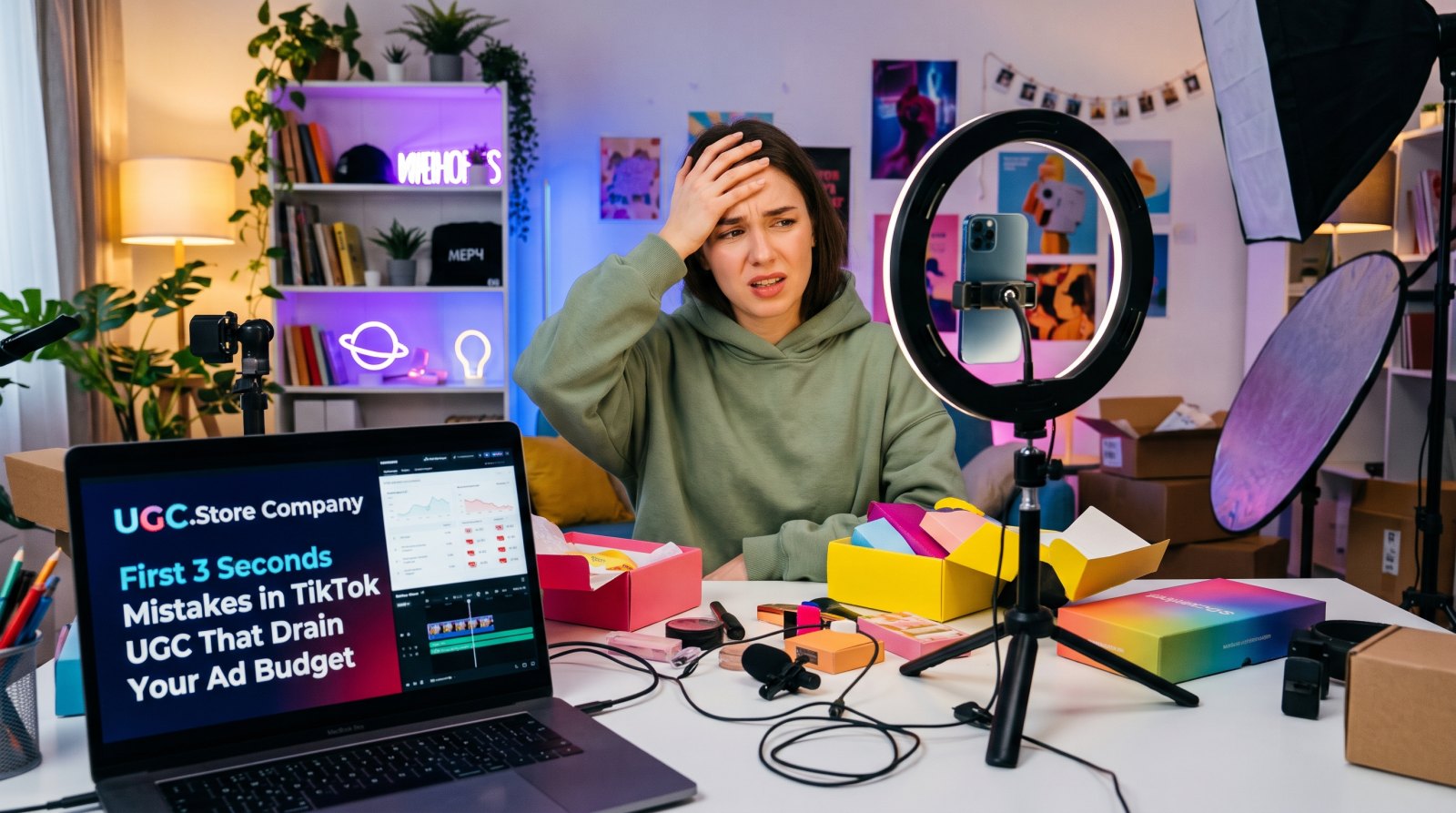
In the world of TikTok UGC and performance marketing, the first three seconds are not an introduction; they are the entire economic engine of your ad campaign. Every second that a viewer remains undecided is a second your ad budget is burning without a return. The most common reason campaigns fail on TikTok is not poor targeting or a bad offer—it is a fatal structural flaw in the opening frame that triggers immediate ad-blindness. Brands hemorrhage thousands of dollars on TikTok ads because their UGC creatives commit first 3 seconds mistakes that signal to the viewer, "This is an ad, scroll past." To protect your ad budget and achieve profitable CPA (Cost Per Acquisition), you must ruthlessly eliminate these opening flaws. The hook must be a scroll-stopper, not a slow build. This diagnostic guide breaks down the exact errors draining your media buying budget and the precise structural fixes required for high-converting TikTok UGC.
Theoretical Basis and Psychology of Mechanics
The psychology behind the first 3 seconds of TikTok UGC is a brutal test of pattern recognition and cognitive load. The viewer’s brain is a highly efficient filtering machine, constantly scanning for signals of low-value content to conserve energy. When your UGC video opens, the brain asks one question: "Is this worth my time?" If the answer is delayed by even a fraction of a second, the thumb swipes. Understanding the mechanics of these first 3 seconds mistakes is essential for optimizing your ad spend.
The first mechanism is the Prediction Failure. Standard advertising follows a predictable script: greeting, brand introduction, problem, solution. The brain has a template for this, and it filters it out instantly. A first 3 seconds mistake is adhering to this template. You must break the prediction. A TikTok UGC hook that starts with a visual contradiction, a mid-action drop, or a shocking statement forces a pattern interrupt. The brain cannot categorize the content, so it pauses to gather more data. This pause is the only thing that protects your ad budget from the swipe.
The second mechanism is the Cognitive Load Trap. If your opening frame requires the viewer to read a dense paragraph of text, figure out what the creator is holding, and process a spoken greeting all at once, you have overloaded their working memory. The brain defaults to the easiest action: scrolling. TikTok UGC must distribute cognitive load across channels. The text must be short, the visual must be instantly legible, and the audio must be clear. A first 3 seconds mistake is making the viewer work too hard to understand the premise.
The third mechanism is the Value Delay. Every video promises a payoff—a result, a secret, a transformation. A first 3 seconds mistake is burying that payoff behind a slow setup. If the viewer does not know what the video is about or what they will get out of it by second two, they have no reason to stay. The UGC hook must name the value proposition immediately, even if the full proof takes thirty seconds to deliver. The audience trades their time for the promise of value. Delay the promise, and you lose the trade.
The fourth mechanism is the Production Polish Paradox. High production value—cinematic lighting, scripted acting, professional sets—signals to the viewer that they are watching a commercial. A commercial triggers ad-blindness. A first 3 seconds mistake is making the UGC content look too good. The most effective TikTok UGC looks native, raw, and authentic—like a video from a friend. The lack of polish signals credibility and protects the ad budget by bypassing the viewer's defensive filters.
Step-by-Step Algorithm & Methodology
To stop wasting your ad budget, you must systematically eliminate first 3 seconds mistakes from your TikTok UGC production workflow. This framework outlines the exact sequence for engineering a hook that protects your media buying investment.
Phase 1 — The Zero-Second Visual Interrupt (0–1 seconds). The most critical first 3 seconds mistake is starting with a static frame. The video must open with motion on two planes—the subject moves and the camera moves. Drop the viewer into the middle of an action. A hand reaching, a result appearing, a product being slammed on a table. There is no greeting. No logo. No slow fade. The visual interrupt is the only thing standing between your UGC ad and the scroll.
Phase 2 — The One-Second Audio/Text Promise (1–2 seconds). The audio and text must simultaneously establish the value proposition. The most expensive first 3 seconds mistake is redundancy—having the voice say the exact same thing as the text. Instead, use channel separation. The text states the specific result or the contradiction. The audio delivers the emotional stakes or the context. This dual-channel approach ensures the TikTok hook lands even if the viewer is watching muted.
Phase 3 — The Two-Second Open Loop (2–3 seconds). By the end of the third second, the viewer must be caught in an open loop. They must have a question they need answered. The UGC hook creates a narrative gap—a problem introduced but not solved, a result shown but not explained, a secret teased but not revealed. If the video has fully explained its premise by second three, the viewer has no reason to watch the rest of the UGC.
Phase 4 — Eliminating the Setup Tax (Pre-Production). A massive first 3 seconds mistake is the setup tax—forcing the viewer to watch the account creation, the app loading, or the long-winded explanation of the problem. The script must cut the setup entirely. The video starts at the climax. The explanation comes later, if at all.
Phase 5 — The Retention Cliff Check (Post-Production). Review the footage with the sound off and the volume at zero. If the visual does not make sense without the audio, the video is failing the cognitive load test. Review the analytics: if the drop-off at the three-second mark is above 40%, the UGC hook is a failure, regardless of how good the rest of the video is.
Ready-to-Use Working Templates & Scripts
Template One: Fixing the "Greeting" Mistake (Format: productivity app UGC, 32 seconds).
The Mistake: Opening with "Hey guys, welcome back to my channel, today I want to show you..."
The Fix: Drop the greeting entirely. Start with the result.
Opening frame: The creator’s face, mid-frustration, slamming a notebook shut.
Dialogue: "I was losing forty minutes every morning just writing a to-do list. Forty minutes. So I deleted every app and tried this."
On-screen text: forty minutes. gone.
Why it saves budget: It respects the viewer's time. The value proposition (saving time) is established in the first two seconds without any wasted pleasantries.
Template Two: Fixing the "Static Product Shot" Mistake (Format: skincare UGC, 34 seconds).
The Mistake: Opening with a beautifully lit, static shot of a serum bottle on a marble counter.
The Fix: Start with the physical sensation of the problem.
Opening frame: Extreme close-up of the creator’s hand rubbing a textured cream into their skin. The audio is the raw sound of the rubbing.
Dialogue: "If your skin feels tight and sandy after you wash your face, you are using the wrong cleanser. Stop buying the expensive one."
On-screen text: stop buying the expensive one.
Why it saves budget: The sensory visual hook and the specific call-out bypass the ad filter. The viewer stays because they recognize the physical feeling.
Template Three: Fixing the "Burying the Lede" Mistake (Format: fitness app UGC, 36 seconds).
The Mistake: Opening with a long explanation of the fitness philosophy before showing the app.
The Fix: Lead with the contrarian claim.
Opening frame: Creator directly to camera, intense eye contact.
Dialogue: "You do not need a gym membership. You need to stop doing thirty minutes of cardio. Here is the app that replaced my gym."
On-screen text: you don't need a gym.
Why it saves budget: The contrarian hook forces a pattern interrupt. The viewer stays to hear the justification for the bold claim.
Comparative Analysis Matrix
| Parameter | Budget-Draining Hook | High-Retention Hook |
|---|---|---|
| First 3 Seconds | Greeting, logo, slow setup | Mid-action drop, visual interrupt |
| Cognitive Load | High; requires reading and parsing | Low; instant visual comprehension |
| Ad-Defense Trigger | High; looks like a commercial | Low; looks native and raw |
| Value Proposition | Delayed; buried in the story | Immediate; stated in the first second |
| Text Overlay | Dense paragraph restating the audio | 3–7 word compressed promise |
| Audio | Polished voiceover or loud music | Raw product sounds or spoken urgency |
| Friction Point | The Mistake That Drains Budget | The UGC Fix |
|---|---|---|
| Setup Tax | Showing the app loading or onboarding | Cut to the result. Explain the setup later. |
| Channel Redundancy | Text says exactly what the voice says | Text shows the result; voice explains the problem |
| Slow Pacing | Holding a static shot for 2+ seconds | Continuous motion; camera and subject moving |
| Generic Claims | "This is the best app for productivity" | "I saved 47 minutes every morning" |
| Fake Authenticity | Studio lighting and scripted actors | Natural lighting and genuine reactions |
| Benchmark Metric | Standard Flawed UGC | Optimized UGC Target |
|---|---|---|
| Hook Rate (3-second) | 30–45% (Budget drain) | 70–80% (Budget protection) |
| Hold Rate (15-second) | 15–25% | 45–55% |
| CPA Variance | Baseline (High) | 30–40% lower |
| Ad Spend Efficiency | High burn, low return | Low burn, high return |
Real-World Case Study Breakdown
A D2C skincare brand launched a TikTok UGC campaign with a substantial ad budget. The initial creative followed a standard format: a beautiful model with flawless skin, a slow pan over a clean bathroom counter, and a voiceover saying, "Hey guys, I want to talk about my skincare journey." The three-second view rate hovered at 35%, and the CPA was an unsustainable $65. The ad budget was draining at an alarming rate because the first 3 seconds were signaling a predictable, polished commercial—triggering instant ad-blindness.
The strategic pivot involved a complete reconstruction of the UGC hooks to eliminate the opening mistakes. The brand hired a creator who looked like a real customer, not a model. The winning asset opened with a tight close-up of the creator’s face, slightly red and textured, holding a bottle.
Dialogue: "I woke up with red, angry skin again. But I am not buying another expensive cream. I am throwing this out."
Visual: The creator drops the expensive cream into the trash can.
Text on screen: throwing out my $80 cream.
The result was immediate. The visual interrupt (throwing the product away) and the specific value proposition (saving money, stopping the redness) bypassed the ad-defense system. The campaign ran for four weeks, generated 1.2 million views, and drove 4,800 installs. The three-second view rate jumped to 76%, and the CPA dropped to $28. The governing insight: the brand was burning its ad budget on polite introductions. The moment they started with a disruptive action and a specific result, the TikTok UGC became profitable.
Real-World Engineering & Creative Feedback
“The biggest mistake I see is the 'Hey guys' opening. It is an instant budget killer. I literally delete the first two seconds of every single UGC video I edit. The video should start with the action, not the introduction. If the creator is holding the product, the video starts with them using it. The context comes later. The hook is the action.” — Tasha Moreau, UGC Creator and Editor, 45K followers
“We killed every UGC script that started with the creator introducing themselves. We ran a split test: one video with a greeting, one video starting mid-demo. The mid-demo video had a 50% lower CPA. The greeting cost us money. Our media buying strategy now strictly forbids the first 3 seconds from containing any form of 'hello.'” — Ben Achterberg, Head of User Acquisition, Cartwheel Tech
“The Setup Tax is the most expensive mistake in TikTok UGC. Brands want to show the user journey from the app store to the login screen to the dashboard. That is a budget killer. The viewer does not care about the login screen. They care about the result. You must start at the result. The only exception is if the setup is the joke or the point of the video.” — Priya Deshmukh, Creative Strategy Lead, Pixel & Pulse Agency
“If the viewer has to read a paragraph of text to understand what the video is about, you have failed the cognitive load test. The brain is scrolling at a million miles an hour. It wants to understand the image in a glance. The text should be three words. The visual should do the heavy lifting. The audio is the bonus layer for the people who unmute.” — Marcus Lehto, Performance Marketing Director, Northline Interactive
“We almost cancelled a massive UGC campaign because the creator refused to stop saying 'So, I bought this product.' We finally convinced them to open with the product already in use, right at the moment of a problem. The difference in retention was night and day. The viewers were not leaving because the product was bad; they were leaving because the opening was boring.” — Elena Vasquez, Brand Director, Mosaic Apps
Production Self-Check Checklist
Zero-Second Motion Check — Does the video open with immediate motion or a visual interrupt? No static frames or fade-ins.
Elimination of the Greeting — Has the "Hey guys," "Welcome back," or any introductory filler been completely removed from the first 3 seconds?
Value Proposition Clarity — Is the specific benefit or problem introduced within the first two seconds via audio or text?
Channel Separation Confirmed — Does the on-screen text provide a different angle than the spoken audio, avoiding redundancy?
Text Legibility — Is the TikTok hook text under 7 words and placed in the upper-middle third safe zone?
Cognitive Load Reduction — Is the visual immediately understandable without needing to read a long paragraph?
Setup Tax Removed — Does the video skip the onboarding, loading screens, or slow explanations and start at the climax?
Native Authenticity — Does the video look like it was shot by a real person on a phone, avoiding overly polished commercial lighting?
Open Loop Generation — Does the first 3 seconds create a question that forces the viewer to keep watching for the answer?
Muted-View Compatibility — Does the hook make sense with the volume completely off, relying on the visual and text?
Advanced FAQ
How do I fix a UGC video that already has a bad hook without reshooting the whole thing?
You can often save the ad budget by cutting the first few seconds. If the creator started with a two-second greeting or a slow setup, cut it out. Start the video right at the moment the action begins. You may need to add a fast, bold text overlay to bridge the gap ("I almost gave up until this..."), but a hard cut is better than a slow hook. Test the new cut on a small budget before scaling it back up.
What is the most expensive first 3 seconds mistake for B2B SaaS UGC?
For B2B SaaS, the most expensive mistake is the Corporate Jargon Hook. Opening with "Our innovative platform streamlines enterprise workflows" is a budget killer. The viewer is a human scrolling TikTok, not a procurement officer reading a whitepaper. The fix is to translate the jargon into a specific, relatable pain point. "You are losing hours every week because your team is copy-pasting between three different tabs." That is the hook. The software is the solution.
Should the UGC creator look directly at the camera in the first 3 seconds?
Not necessarily. Eye contact is powerful, but it can also feel like a direct pitch. Sometimes, watching the creator look at the product or the screen with an expression of shock or realization is a stronger visual hook. The viewer wants to see what the creator is looking at, not just the creator's face. A mix of both—starting with the action, then cutting to the creator's reaction—is the most effective way to protect the ad budget.
How do I measure the exact impact of the first 3 seconds on my ad budget?
Look at the three-second view rate and the CPA together. If a video has a high three-second view rate but a terrible CPA, the hook was a curiosity trap that failed to deliver value. If the video has a low three-second view rate, the hook is the primary reason your ad budget is draining. You cannot optimize the bottom of the funnel if no one is making it past the top. The hook is the bottleneck.
What is the role of trending audio in fixing first 3 seconds mistakes?
Trending audio can be a double-edged sword. If the trending audio is too loud or mismatched with the visual, it can increase cognitive load and trigger ad-blindness. The best use of audio in TikTok UGC is native audio—the sound of the product being used, the creator's real voice, or a specific sound effect that creates a pattern interrupt. Trending music is a crutch. If the visual and the text are strong, you do not need trending music to protect your budget.
Custom Contextual Conclusion
Your ad budget is not being drained by the algorithm. It is not being drained by your targeting. It is being drained by the first three seconds of your TikTok UGC. The viewer does not owe you their attention. You have to earn it in a fraction of a second by proving that your video is not a waste of their time. The first 3 seconds mistakes—the slow intros, the static shots, the polite greetings, the corporate jargon—are expensive luxuries you cannot afford in the performance marketing landscape. The brands that scale profitably on TikTok are ruthless editors. They cut the fluff. They start at the climax. They respect the viewer’s intelligence and their own ad budget. The hook is not just the beginning of the video. It is the entire business case for your campaign.