
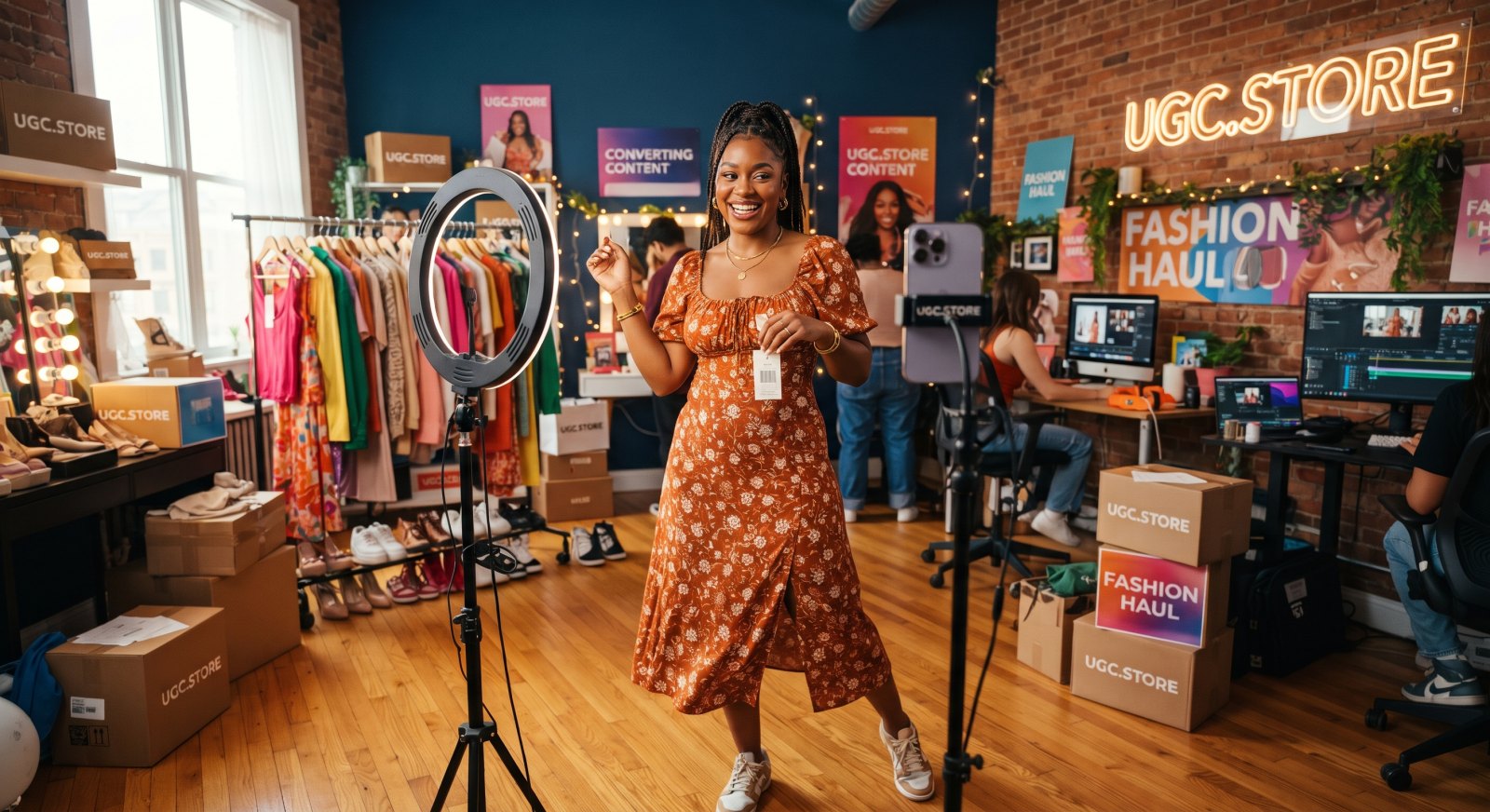
Executive Summary
Fashion and apparel try-on hauls on TikTok can be transformed into high-converting performance marketing assets by shifting from passive influencer showcases to problem-solving, narrative-driven UGC ads. By embedding strict pacing frameworks—such as an aggressive 0-to-3-second visual hook, a core fit-and-fabric proof point within 15 seconds, and a seamless native call-to-action—media buyers can consistently achieve a Hook Rate above 45% and a Hold Rate exceeding 18%, driving sustainable scale and lowering overall Customer Acquisition Costs (CAC).
Theoretical Basis and Psychology of the Mechanic
The modern TikTok consumer operates in an environment of extreme sensory saturation and content fatigue. Traditional, polished studio lookbooks trigger an immediate banner-blindness reflex, signaling to the user that they are viewing a paid advertisement that can be safely swiped away within milliseconds. Transforming an apparel try-on haul into a performance UGC powerhouse requires a deep understanding of neuro-marketing, cognitive biases, and the specific mechanics of short-form video algorithms.
At the core of this transformation is the manipulation of the viewer's dopamine pathways through authenticity and immediate utility. When a creator opens a package on camera with raw, unfiltered emotion, the viewer experiences a mirror-neuron activation known as pseudo-ownership. The brain mentally places the garment onto the viewer's own body, instantly evaluating fit anxiety, fabric texture, and social validation. This psychological simulation bypasses the logical skepticism associated with traditional e-commerce product pages and directly stimulates impulse intent.
Simultaneously, TikTok’s recommendation algorithm relies heavily on completion rate, engagement velocity, and retention at the critical three-second mark. If a video fails to arrest the user's thumb swipe within this narrow window, distribution drops exponentially. Therefore, the architecture of a high-performing fashion haul must deliberately weaponize pattern interrupts—such as a jarring visual transition, a polarizing statement about sizing flaws in mainstream retail, or an immediate close-up of a problematic clothing feature being expertly resolved by the featured item.
Furthermore, apparel performance marketing is fundamentally a risk-mitigation exercise for the buyer. Online clothing shoppers carry an intrinsic fear of size discrepancies, poor fabric quality, transparency issues, and inaccurate color representation. A structured try-on haul systematically dismantles these anxieties one by one through granular visual evidence. By showing the garment from multiple angles, demonstrating stretch recovery, zooming into stitching quality, and addressing how the piece moves during natural walking or sitting, the creator acts as a trusted proxy stylist. This eliminates the friction of uncertainty and directly accelerates the path from top-of-funnel discovery to bottom-of-funnel conversion.
+-----------------------------------------------------------------------+
|                THE PSYCHOLOGICAL FUNNEL OF UGC FASHION                |
+-----------------------------------------------------------------------+
|  1. Thumb-Stopping Hook (0-3s)     -> Disrupts pattern recognition    |
|  2. Empathy & Problem Setup (3-7s) -> Triggers shared sizing pain     |
|  3. Sensory Proof & Fit (7-25s)    -> Activates pseudo-ownership      |
|  4. Conversion Action (25-30s)     -> Removes purchase hesitation     |
+-----------------------------------------------------------------------+
Step-by-Step Algorithm and Methodology
Executing a predictable and scalable fashion try-on haul campaign requires a strict adherence to chronological pacing. Media buyers cannot rely on creators to wing their presentations; every second must be optimized to maximize user retention and fulfill performance marketing Key Performance Indicators. Below is the definitive structural methodology for producing high-converting fashion UGC.
The first phase spans from second zero to second three and is designated entirely as the Hook Phase. During this window, the creator must establish context while violating expectations. Instead of a generic greeting, the video must open mid-action—such as ripping open a shipping mailer while stating a controversial or highly relatable problem regarding apparel shopping. The visual frame must feature high-contrast lighting, rapid movement, and on-screen dynamic text that mirrors the spoken hook. The primary metric governing this phase is the Hook Rate, where top-tier fashion creatives target a minimum of 45% to 60% of viewers staying past the three-second mark.
The second phase covers seconds three through seven, functioning as the Problem Amplification and Empathy Phase. Here, the creator validates the target audience's specific frustration. If the brand sells premium denim for curvy body types, this segment highlights the universal struggle of waist gaps and tight thighs. The creator establishes immediate authority and peer-to-peer trust by pointing out why standard industry sizing fails. By naming the exact pain point, the viewer feels profoundly understood, drastically reducing drop-off rates and setting the stage for the product introduction.
The third phase spans from seconds seven to fifteen, representing the Product Introduction and First Impression Phase. The creator pulls the specific garment from the package and holds it up to the camera, emphasizing texture, weight, and color fidelity under natural lighting. Crucially, the creator must immediately state their exact height, weight, and typical sizing dimensions to allow the viewer to instantly benchmark their own body type against the creator. This transparency is vital for minimizing post-purchase return rates and building long-term brand equity.
The fourth phase covers seconds fifteen to twenty-five, known as the Core Try-On and Sensory Proof Phase. The camera angle shifts to a full-body or three-quarter view. The creator puts on the garment and performs specific kinetic movements that demonstrate real-world utility. For a dress or skirt, this means spinning to show movement and checking for opacity under studio or sunlight. For pants or bodysuits, it involves deep squats, sitting down to check for rolling or pinching, and demonstrating stretch capacity. Every movement is narrated with direct sensory descriptors, moving away from generic praise toward granular specifics like butter-soft modal fabric, double-lined non-see-through cotton, or hidden elastic waistbands that do not dig into the skin.
The final phase, spanning from second twenty-five to thirty, is the Offer and Call-to-Action Phase. The creator synthesizes their verdict, reiterates the exact sizing advice, and delivers a high-urgency call to action tied to a specific promotional incentive or limited stock warning. The visual frame simultaneously displays the discount code, free shipping threshold, or bundle deal, paired with a persistent clickable shopping link. The overarching goal of this structured pacing is to maintain a cumulative Hold Rate of at least 15% to 22% at the completion mark, ensuring maximum algorithmic push from the ad network.
Ready-to-Use Working Templates and Scripts
To operationalize the methodology outlined above, performance creative teams must deploy tested script blueprints. Below are three distinct, production-ready script templates tailored for different apparel sub-niches: everyday essentials, occasion wear, and athleisure fit-checks.
Script Template 1: The Problem-Solver Try-On (Everyday Denim / Basics)
Visuals and B-roll open with a close-up shot of a pair of jeans being thrown onto a bed in frustration. The creator looks directly into the camera with an exasperated expression, holding up a measuring tape.
Voiceover script: If you are built like an actual human woman with hips and thighs, stop scrolling. I bought five pairs of viral TikTok jeans, and four of them gave me the dreaded waist gap or cut off my circulation. But then I found these.
Visuals shift to a bright natural light setting. The creator holds up the denim waistband, stretching it outward to show extreme elasticity, while dynamic text highlights 98% Cotton, 2% Elastane.
Voiceover script: For reference, I am five feet four inches, usually a size ten, and I ordered a medium. Watch this—zero waist gap when I squat down, and look at how deep these actual functional pockets are. No fake pocket nonsense here.
Visuals transition to a full-body mirror shot. The creator does a 360-degree spin, wearing the jeans paired with a simple white tee, walking toward and away from the camera to show the drape and leg elongation.
Voiceover script: The fabric has heavy structured weight without feeling stiff, and they hold their shape all day without bagging out at the knees. If you hate shopping for jeans as much as I do, click right here below this video. They are currently running a bundle discount with free shipping, but sizes are selling out fast.
Sound effects include a crisp fabric snap at the beginning, a satisfying zipper sound during the try-on, and a subtle modern pop sound accompanying the appearance of the discount code on screen.
Script Template 2: The Luxury Look Dupe Try-On (Occasion Wear / Dresses)
Visuals and B-roll open with a split-screen layout comparing a designer silk dress priced at three hundred dollars alongside the brand's parcel arriving in a sleek branded box. The creator taps the screen over the expensive option with a red X icon.
Voiceover script: Stop spending three hundred dollars on dresses for summer weddings when you can get this exact silhouette for a fraction of the cost, with zero transparency issues. Let’s unbox it.
Visuals shift to the creator delicately pulling a rich emerald-green satin midi dress out of the packaging, bringing the camera within inches of the fabric to showcase the heavy weave and matte sheen.
Voiceover script: I was genuinely skeptical because satin online is usually paper-thin and shows every single bump. But this is completely double-lined. Let me repeat that—it is heavy, double-lined, buttery satin that feels like butter against your skin.
Visuals transition to the creator stepping back for a full-length reveal, wearing the dress with strappy heels. The creator walks dynamically toward the camera, twirls to demonstrate the flare, and checks the side slit height.
Voiceover script: I am five-seven, 140 pounds, wearing a small, and it fits like a custom couture piece. The cowl neckline stays completely in place without needing fashion tape, and the back has a hidden adjustable tie. Grab this before your next big event; link is pinned below.
Sound effects include the gentle rustle of tissue paper, a luxurious fabric swoosh during the spin, and an upbeat chime right as the final call-to-action appears.
Script Template 3: The High-Performance Fit-Check (Athleisure / Activewear)
Visuals and B-roll open with the creator mid-workout stretch on a yoga mat, suddenly stopping, looking at the camera, and panting slightly while pulling at the waistband of their current leggings in annoyance.
Voiceover script: If your leggings roll down every time you touch your toes or turn completely sheer during a heavy deadlift, we need to talk. I tested three viral activewear brands for thirty days, and only one survived leg-day testing.
Visuals cut to a clean, well-lit studio backdrop. The creator holds up the high-waisted leggings, stretching the waistband aggressively to show instant recovery and structural integrity.
Voiceover script: These are the Sculpt-Tech crossover leggings. I’m five-eight, athletic build, wearing a medium. Notice how the waistband is V-shaped to contour the waist without digging in, and there is no center front seam—meaning zero awkward camel toe.
Visuals transition to the creator performing dynamic movements: deep squats, high knees, and lunges directly facing the camera, with a close-up insert showing the squat test against direct studio lighting.
Voiceover script: Squat-proof rating is a solid ten out of ten. Zero show-through, sweat-wicking fabric that actually hides sweat patches, and pockets deep enough for an iPhone Pro Max. Tap below to get twenty percent off your first set with code TIKTOK20.
Sound effects include an energetic gym atmosphere muffled in the background, a sharp whoosh on the movement transitions, and a bright cash register ding at the promotional code reveal.
Comparative Metrics and Performance Benchmarks
Evaluating the success of fashion try-on haul UGC ads requires analyzing a specific matrix of performance indicators. The table below outlines the core metrics, target benchmark ranges, and operational complexities associated with scaling apparel campaigns on TikTok.
| Performance Metric | Target Benchmark Range | Strategic Significance & Operational Focus |
| Hook Rate | 45% to 65% | Measures the percentage of users who stop scrolling within the first 3 seconds; heavily driven by pattern interrupts, visual framing, and polarizing opening statements. |
| Hold Rate (Retention) | 18% to 28% | Evaluates the percentage of viewers who stay past the 15-second midpoint; optimized through rapid pacing, sensory proof, and sizing transparency. |
| Click-Through Rate (CTR) | 2.5% to 4.8% | Indicates the effectiveness of the mid-video product utility demonstration and the psychological pull of the final call-to-action overlay. |
| Return on Ad Spend (ROAS) | 2.2x to 4.5x | The primary profitability threshold for performance media buyers, dictated by blending broad targeting with high-converting creative hooks. |
| Customer Acquisition Cost | 20% to 35% below target AOV | The ceiling for acquisition expenses; successfully compressed when try-on UGC accurately pre-qualifies sizing and reduces return rates. |
Case Study Breakdown: Scaling D2C Denim via Try-On UGC
A prominent direct-to-consumer denim and apparel brand struggling with high customer acquisition costs and stagnant scaling capacity revamped their entire creative strategy by pivoting from studio lookbooks to structured try-on haul UGC scripts.
The Initial Challenge
The brand was experiencing a plateau in ad spend efficiency. Their existing creative assets consisted of high-budget, highly polished fashion films shot in professional studios by professional models. While aesthetically pleasing, these ads suffered from severe ad fatigue, yielding an average Hook Rate of 22%, a Hold Rate of 7%, and a Blended ROAS hovering around 1.1x, which was unsustainable against their target acquisition thresholds. Consumers perceived the ads as corporate commercials, leading to immediate thumb-swipes and high cost-per-acquisition metrics.
The Strategic Solution
The media buying and creative strategy team audited the funnel and executed a complete overhaul based on native TikTok try-on principles. They recruited a roster of micro-creators spanning diverse body types (sizes zero through sixteen) and provided them with strict scripting frameworks mirroring Script Template 1. Rather than scripting every word, creators were given precise structural pillars: a polarizing sizing hook in the first three seconds, an immediate display of weight and stretch metrics, an unedited try-on showing movement, and a clear value proposition tied to bundling.
The Execution and Creative Iteration
The brand launched an iterative testing matrix consisting of thirty distinct UGC variations simultaneously across broad and lookalike audiences. Within the first seven days, data analysis revealed that videos featuring creators explicitly stating their exact height, weight, and sizing struggles outperformed generalized try-ons by 310% in conversion rate. The winning creative—featuring a creator with an hourglass figure demonstrating the waist-gap prevention feature—was scaled aggressively.
Final Metrics and Results
Over a 45-day scaling period, the winning try-on UGC campaign achieved transformative performance metrics:
Hook Rate increased from 22% to 58%.
Hold Rate climbed from 7% to 21%.
Click-Through Rate reached 4.2%.
Blended ROAS surged to 3.6x, allowing the brand to scale daily ad spend by 450% while simultaneously reducing their overall Customer Acquisition Cost by 34%. Furthermore, post-purchase return rates dropped by 12% due to the enhanced sizing transparency provided in the videos.
Field Feedback: Insights from Senior Media Buyers and Creators
"The biggest mistake apparel brands make in UGC is treating creators like billboard models instead of trusted stylists. When a creator honestly admits that a pair of pants fits slightly snug in the hips and explains how they size up, conversion rates double because the consumer's inherent skepticism is completely disarmed."
— Marcus Vance, Senior Performance Media Buyer & D2C Growth Consultant
"As a creator, the moment I stopped trying to make my bedroom look like a clean-room studio and started filming with natural morning window light while showing real-life movement like sitting down and walking, my brand retention metrics tripled. Brands need to realize that flaw-acknowledgment is our strongest conversion lever."
— Elena Rostova, Top-Tier TikTok Fashion UGC Creator & Strategist
Experienced media buyers and seasoned UGC creators agree that the era of deceptive, overly filtered fashion advertising is over. The modern consumer possesses an acute radar for inauthentic presentation. When brands empower creators to showcase the unvarnished reality of apparel—addressing fabric weight, opacity under direct light, and exact sizing nuances—they build an unbreakable bridge of trust. The operational takeaway from the field is clear: performance success in apparel is not a function of production budget, but of psychological alignment, radical transparency, and rigorous structural pacing.
Production Checklist Before Launch
Before exporting final video assets or uploading creative variations into the TikTok Ads Manager, media buyers and creative producers must systematically verify compliance with the following quality criteria:
[ ] First 3 Seconds Hook Check: Does the opening frame immediately feature high-contrast visual movement, dynamic on-screen text, and a compelling problem statement or pattern interrupt?
[ ] Sizing Transparency Verification: Does the creator explicitly state their height, weight, and specific size worn within the first fifteen seconds of the video?
[ ] Sensory and Kinetic Proof: Does the try-on sequence include active movement (squatting, walking, stretching, spinning) to demonstrate real-world fabric behavior and fit?
[ ] Audio and Pacing Quality: Is the voiceover crisp, free of disruptive background noise, and paced at a rapid cadence without awkward dead air?
[ ] Call-to-Action Clarity: Is there a clear, persistent visual and verbal call to action detailing the offer, discount code, or shipping incentive during the final five seconds?
[ ] Platform Compliance: Are all native TikTok safe-zones respected, ensuring that captions, buttons, and profile icons do not obscure critical text overlays or product details?
Expanded FAQ
How do I handle sizing variance when working with a diverse roster of UGC creators for apparel ads?
The most effective approach is to build a creator matrix that covers the brand's core sizing spread, typically ranging from XS to 3XL or petite to curvy fits. Rather than forcing creators to wear the exact same size, instruct each creator to order their true size and openly articulate how it fits their specific body type. This turns sizing variance into a feature rather than a bug, allowing you to target specific lookalike audiences with the creator whose body type most closely matches theirs.
What is the ideal video length for a high-converting fashion try-on haul on TikTok?
While TikTok supports videos up to several minutes long, optimal performance for paid performance ads consistently concentrates in the 25 to 35-second range. This duration allows sufficient time to establish the hook, build empathy, demonstrate sensory proof, and deliver a clean call to action without triggering viewer fatigue or causing sharp drop-offs in the retention curve.
How many creative variations should a media buyer test per week to find a winning fashion UGC ad?
A healthy testing velocity requires launching a minimum of 10 to 15 distinct creative variations per week. This should involve testing at least three different hook variations paired with two distinct body types and various visual backdrops. Rapid iteration allows media spend to be funneled exclusively toward ads maintaining a Hook Rate above 45% and a Hold Rate exceeding 18%.
Should captions be hardcoded into the video or added via native TikTok text tools?
Hardcoding bold, high-contrast captions directly into the video during editing is strongly recommended for performance ads. Many users consume short-form video with the sound muted initially, and hardcoded captions ensure the core hook and sizing metrics are communicated instantly. Additionally, supplementing this with native platform text stickers can help blend the ad organically into the user's For You Page feed.
How can I prevent high return rates when scaling try-on haul ads on TikTok?
High return rates in apparel are almost always driven by mismatched expectations regarding fit, fabric weight, or color. To counteract this, mandate that your creators include close-up macro shots of the fabric texture, demonstrate whether the material is sheer under direct light, and provide unambiguous verbal sizing advice. Transparency in UGC acts as an immediate filter, ensuring that only informed buyers complete the purchase transaction.