
Executive Overview
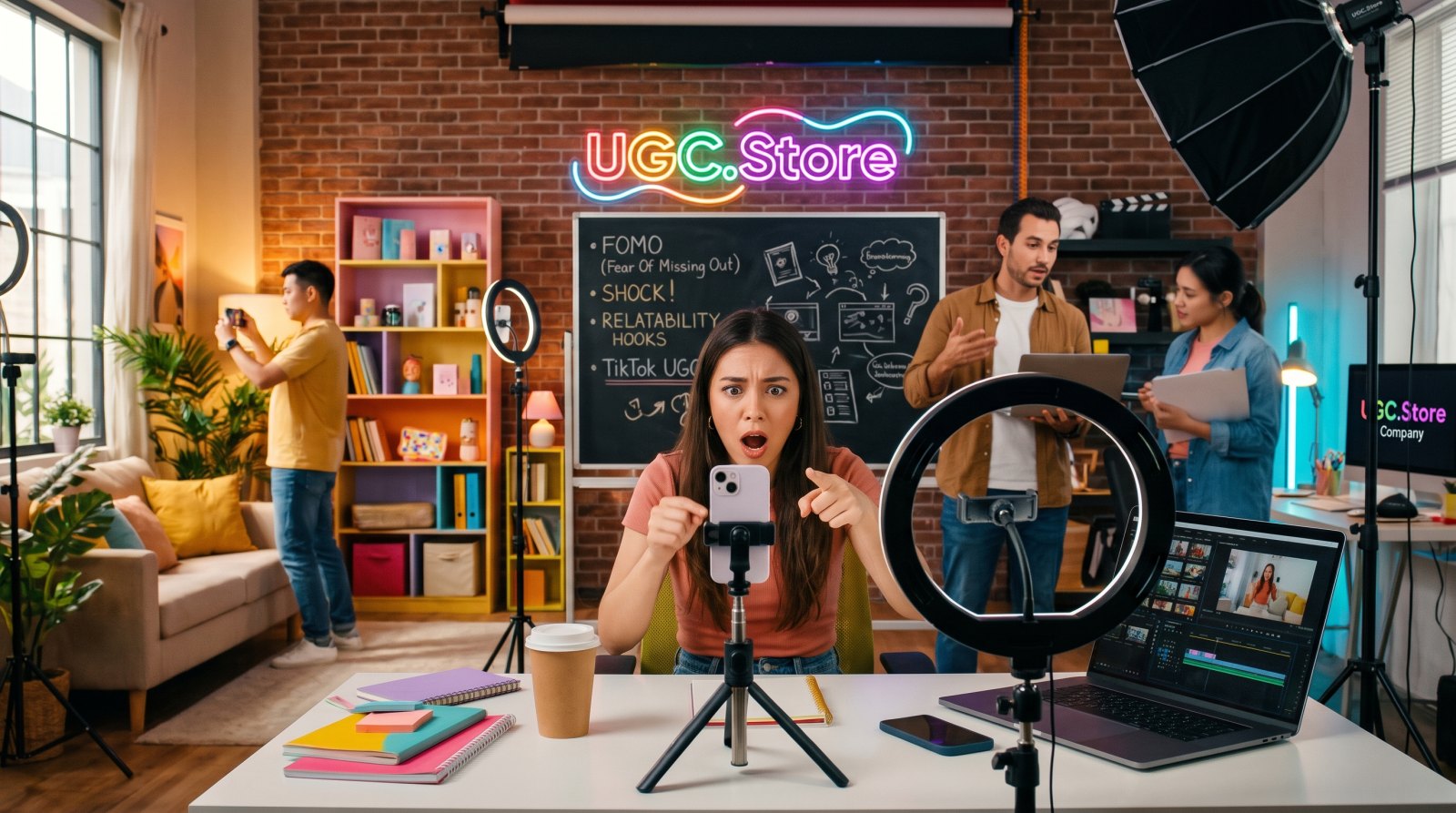
The most dangerous misconception in TikTok UGC is that viewers make logical decisions about products. They do not. The viewer’s thumb stops moving based on an instantaneous, subconscious emotional reaction. Emotional triggers are the invisible architecture of every high-performing TikTok UGC video. While standard marketing relies on features and benefits, the most effective emotional triggers—specifically FOMO (Fear Of Missing Out), shock, and relatability hooks—bypass the viewer’s logical ad-defense system entirely. The brands that scale on TikTok do not sell products; they engineer physiological responses. They make the viewer feel an immediate threat of exclusion (FOMO), a cognitive jolt that demands resolution (shock), or a profound sense of being understood (relatability). Mastering these three psychological levers is the difference between a video that gets scrolled and a UGC asset that empties the warehouse.
Theoretical Basis and Psychology of Mechanics
The psychology of emotional triggers in TikTok UGC rests on the speed of the amygdala, the brain’s emotional processing center. The amygdala reacts to stimuli in roughly twelve milliseconds, long before the neocortex—the logical brain—has even processed what the video is about. The hook must target the amygdala. It must trigger an emotional spike that forces the brain to allocate attention to the screen.
The first mechanism is the FOMO exclusion threat. FOMO is not just a feeling; it is a survival mechanism. Evolutionarily, being excluded from the tribe meant death. Today, being excluded from a trend, a financial opportunity, or a social secret triggers the same ancient panic. A FOMO hook works by explicitly stating that a group is gaining an advantage the viewer is currently missing. The phrasing must be exclusive: "If you are still doing X, you are already behind." The emotional trigger here is the sudden fear of being the only one who did not get the memo.
The second mechanism is the shock pattern interrupt. Shock is the fastest way to break the scroll trance. But shock in TikTok UGC does not have to mean graphic content. It means a cognitive contradiction. A visual or verbal statement that violates the viewer’s established expectations creates a spike of dissonance. When a creator violently destroys a product in the first second, or makes a wildly counterintuitive claim ("Eating more fat will make you leaner"), the brain experiences shock. It must stay to resolve the contradiction. The shock opens the curiosity gap, and the resolution of the shock keeps the viewer watching.
The third mechanism is the relatability validation loop. Relatability is the emotional equivalent of a warm blanket. It works because viewers are starved for validation of their own struggles. A relatability hook names a highly specific, mundane, and often embarrassing behavior that the viewer thought they were alone in doing. "You know that feeling when you open your banking app and just pray?" The emotional trigger is the sudden release of tension—the realization that "I am not crazy, someone else does this." This validation builds immense parasocial trust, making the creator’s eventual product recommendation feel like advice from a trusted friend.
The fourth mechanism is the emotional congruence requirement. The emotional trigger must perfectly match the product being sold. FOMO works for stocks, crypto, and high-ticket courses. Shock works for cleaning products, fitness gadgets, and disruptive tech. Relatability works for skincare, mental health apps, and everyday utilities. If the emotional trigger contradicts the product's core value, the conversion dies. A FOMO hook for a meditation app ("You are the only one not meditating!") feels aggressive and pushes the viewer away. The trigger must be the emotional bridge to the product.
Step-by-Step Algorithm & Methodology
The framework below sequences emotional triggers from cold open to conversion, with each phase engineered to hijack the viewer’s nervous system.
Phase 1 — The Trigger Drop (0–3 seconds). The creator opens with a statement or visual designed to spike the specific emotion instantly. No introductions. No context. For FOMO, the line is an exclusion threat: "If you are not using this app yet, you are paying the 'lazy tax'." For shock, the visual is a contradiction: a creator dropping a product off a roof. For relatability, the line is a shared confession: "I have been lying to my dentist for four years." The emotional trigger is raw and immediate.
Phase 2 — The Physiological Response (3–8 seconds). The creator names the emotional consequence of the trigger. For FOMO, the creator shows the cost of missing out (the lost money, the missed opportunity). For shock, the creator explains why the contradiction exists (the physics, the hidden truth). For relatability, the creator describes the exact feeling the viewer is experiencing right now. This phase validates the initial emotional spike and grounds it in a specific narrative.
Phase 3 — The Product as the Emotional Resolution (8–16 seconds). The product enters as the only logical answer to the emotional spike. If the trigger was FOMO, the app is the tool that gets the viewer back into the exclusive group. If the trigger was shock, the product is the mechanism behind the wild claim. If the trigger was relatability, the app is the shared solution to the shared problem. The product is not a feature; it is the emotional rescue.
Phase 4 — The Honest Friction Note (16–25 seconds). The creator names the limitation of the product, but frames it through the emotional lens. For FOMO, the limit is: "You have to actually use it to get the advantage. It is not magic." For shock, the limit is: "It looks crazy, but the science holds up." For relatability, the limit is: "It does not fix everything, but at least we are not doing it alone." The limitation proves the creator is still grounded in reality despite the emotional hook.
Phase 5 — The Shared Emotion CTA (final 5–7 seconds). The creator closes with a prompt that forces the viewer to express the emotion in the comments. For FOMO: "What is the biggest trend you missed out on?" For shock: "What is the craziest thing you have ever done to save money?" For relatability: "What is your secret habit? I need to know I am not the only one." The comment section becomes an emotional echo chamber, driving immense engagement.
Ready-to-Use Working Templates & Scripts
Script One: The FOMO Hook – "The Lazy Tax" (Format: finance app UGC, 36 seconds).
Opening frame: creator’s face, intense eye contact, leaning into the camera. Hook text: you are paying the lazy tax.
Dialogue: "If you are still transferring money manually every month, you are paying the lazy tax. And the people who know better are getting richer while you are doing math in your notes app."
Emotional response: screen shows a graph of a bank account slowly losing money to fees. "This is what happens when you do not automate. You miss a transfer, you get an overdraft fee, you lose track of your savings. The people using automated apps are not smarter than you. They just stopped paying the tax."
Product resolution: screen recording of the automation feature in the app. "This app automates the whole thing. It moves the money before you even see it in your checking account. It puts you in the group that is not paying the tax."
Honest friction: face to camera. "You still have to actually set up the automation once. It takes five minutes. But after that, you are in the club."
Shared emotion CTA: "What is the dumbest financial fee you have ever paid? I need to know I am not the only one who paid the lazy tax."
Script Two: The Shock Hook – "The Destroyed Product" (Format: tech case UGC, 34 seconds).
Opening frame: creator holds a brand-new smartphone, then violently throws it onto a concrete floor. The screen cracks. Hook text: why I destroy my phone on purpose.
Dialogue: "I just threw my phone at a wall on purpose. And I am going to do it again. This is the only case that survived."
Emotional response: creator picks up the phone, shows it is perfectly fine, then drops it again from waist height. "The shock is the point. The case is made of a material that absorbs impact instead of transferring it to the screen. Every other case I have tried just looks tough. This one actually is."
Product resolution: close-up of the case material and the phone. "I have dropped this thing eleven times in the last month. Not a scratch. The case takes the shock so the phone does not have to."
Honest friction: face to camera. "It makes the phone a little bulky. It does not fit in my small pocket anymore. But I will take a bulky pocket over a shattered screen."
Shared emotion CTA: "What is the craziest way you have ever broken a phone? I need to know I am not the only one who has done this."
Script Three: The Relatability Hook – "The Dentist Lie" (Format: dental/skincare app UGC, 38 seconds).
Opening frame: creator in a bathroom, whispering, looking guilty. Hook text: I lied to my dentist for 4 years.
Dialogue: "I have been lying to my dentist for four years. Every time they ask if I floss, I say yes. I do not floss. I have never flossed. I just brush my teeth and hope for the best."
Emotional response: creator shows a close-up of their gums. "I was terrified of the bleeding. I thought if I flossed, my gums would just fall out. So I lied. And I lived in fear of the dentist chair."
Product resolution: screen recording of the app's routine feature. "This app has a two-minute timer for flossing. It is not about being perfect. It is about doing it for two minutes so I do not have to lie to a medical professional anymore."
Honest friction: face to camera. "I still hate flossing. It is boring. But the app makes it a game and my gums stopped bleeding in a week. I am not cured, but I am honest now."
Shared emotion CTA: "What is the biggest lie you have ever told your dentist or doctor? I need to know I am not the only one."
Comparative Analysis Matrix
| Parameter | Feature-Based Hook | Emotional Trigger Hook |
|---|---|---|
| Primary focus | Product specifications | Viewer's psychological state |
| Hook mechanism | Information delivery | FOMO, shock, or relatability |
| Viewer response | "That looks useful" | "I am missing out," "That is insane," or "That is me" |
| Ad-defense system | Triggered by standard pitch | Bypassed by emotional hijack |
| Trust architecture | Dependent on brand reputation | Dependent on emotional resonance |
| Friction Point | Failed Emotional Hook | Successful Emotional Hook |
|---|---|---|
| Trigger mismatch | Using FOMO for a calming meditation app | Matching the trigger to the product's core value |
| Lack of specificity | "Everyone is doing this" | "If you are not doing X, you are losing $Y" |
| No resolution | Hook promises shock, video is boring | Hook promises shock, video delivers wild proof |
| No validation | "You are weird for doing this" | "I do this too, and it is okay" |
| Benchmark Metric | Standard UGC | Emotional Trigger Target |
|---|---|---|
| Hook rate (3-second) | 55–65% | 75–85% via neurological hijack |
| Hold rate (15-second) | 35–45% | Above 55% via emotional investment |
| Comment rate | 0.8–1.5% | 3–6% via shared emotional confessions |
| CPI versus category | At benchmark | 30%+ below benchmark via high CTR |
Real-World Case Study Breakdown
A financial planning app launched a TikTok UGC campaign targeting Millennials. The initial creative focused on features: a clean dashboard, a budgeting tool, and a savings calculator. The three-second view rate hovered at 42%, and the CPA was $5.80. The problem was that standard budgeting felt like homework. The audience did not want a spreadsheet; they wanted to feel financially secure.
The strategic pivot introduced the FOMO Emotional Trigger. The team recruited a creator who had a "corporate" aesthetic but a confrontational tone. The winning asset opened with the creator saying: "The wealthy are not smarter than you. They are just using a system you do not know about. If you are still budgeting manually, you are paying the 'lazy tax'."
The FOMO hook worked because it framed the product not as a tool, but as an exclusive advantage. The app entered as the system that stops the tax. The honest friction note was: "You still have to set it up once." The payoff was: "I automated my savings and saved $500 in three months without noticing."
The campaign ran for five weeks, generated 1.4 million views, and drove 5,200 attributed installs at a blended CPI of $2.90. The three-second view rate jumped to 78%. The comment section was flooded with viewers sharing their own financial mistakes, driven by the shared emotion CTA. The governing insight: the app had been selling organization, but the buyer needed to feel like they were getting an unfair advantage.
Real-World Engineering & Creative Feedback
“The emotional trigger is the only thing that matters. The product is just the resolution. I can show you the best product in the world, but if the first sentence does not make you feel fear, anger, or relief, you are going to scroll. The emotion is the hook, the product is the reward.” — Tasha Moreau, UGC Creator, 48K followers
“We stopped hiring actors to read scripts and started hiring creators who actually experience the emotion. A creator who has genuinely felt the pain of a bad credit score sells a credit app better than an actor pretending. The authenticity of the emotion is the entire conversion mechanism.” — Ben Achterberg, Head of User Acquisition, Cartwheel Tech
“FOMO is the most powerful lever, but it is also the most dangerous. If you use FOMO to sell a product that does not deliver, the churn is brutal. The viewer will feel tricked. The emotional trigger has to be honest. You can exaggerate the consequence, but the solution has to be real.” — Priya Deshmukh, Creative Strategy Lead, Pixel & Pulse Agency
“The relatability hook is the easiest to test and the highest converting for consumer goods. People are exhausted by unrealistic standards. When a creator admits they do not floss, or they eat donuts for breakfast, the viewer’s guard drops. The guard drops, the trust builds, and the conversion happens.” — Marcus Lehto, Performance Marketing Director, Northline Interactive
“We almost cancelled the shock brief because the first batch of creators were just doing gross-out videos. Eating weird things, breaking products randomly. It was shock without a point. We rewrote the brief: ‘The shock must resolve into a specific, rational benefit.’ The difference in output was immediate. The view rate stayed high, but the CTR doubled.” — Elena Vasquez, Brand Director, Mosaic Apps
Production Self-Check Checklist
Specific emotional trigger identified — the hook clearly targets FOMO, shock, or relatability within the first second.
Trigger matches the product — the emotional spike logically resolves into the product’s core value proposition.
FOMO uses exclusion language — the script explicitly names what the viewer is missing out on or the "tax" they are paying.
Shock is grounded — the shocking visual or claim is resolved with a rational, verifiable explanation, avoiding baseless conspiracies.
Relatability is hyper-specific — the shared behavior is embarrassing or mundane enough to trigger immediate validation.
Product enters as resolution — the app or product is positioned as the tool that solves the emotional discomfort.
Honest friction note spoken — the creator names the limitation, proving they are still grounded in reality.
CTA asks for shared emotion — the closing prompt invites the viewer's own emotional experience into the comments.
No false claims — the emotional trigger does not rely on unsubstantiated medical, legal, or financial claims.
Safe-zone text legibility confirmed — the hook text is short, bold, and placed in the upper-middle third of the screen.
Advanced FAQ
How does a brand choose between FOMO, shock, and relatability?
The choice depends entirely on the product category and the audience's pain point. Use FOMO when the product offers a competitive advantage, a financial gain, or access to an exclusive group. Use shock when the product disrupts a standard expectation or solves a problem in a counterintuitive way. Use relatability when the product solves a common, mundane, or embarrassing problem that the audience feels they are alone in facing. The trigger must be the emotional bridge to the product's value.
What is the correct way to handle the FOMO hook without sounding like a sleazy salesman?
FOMO works best when it is framed as a systemic reality, not a personal attack. "You are paying the lazy tax" is systemic; it blames the system, not the viewer. "You are stupid for not using this" is a personal attack. The tone must be one of a helpful insider sharing a secret, not a bully pointing out a flaw. The FOMO is the consequence of not knowing the secret, and the creator is the one revealing it.
Should the shock hook use physical destruction or verbal contradiction?
Both work, but they serve different purposes. Physical destruction (dropping a phone, breaking a product) is the fastest way to trigger the orienting response. It works best for hardware or products with obvious physical durability. Verbal contradiction ("Eating more fat makes you leaner") works best for digital products, services, or health advice. The rule is to use the most visual form of shock possible, and resolve it as quickly as possible.
How does the relatability hook change for B2B SaaS versus consumer products?
For consumer products, relatability is personal and often embarrassing (skincare, mental health, habits). For B2B SaaS, relatability is professional and structural. The hook sounds like: "You know that feeling when you are the only person in the meeting who did not do the reading? This app fixes that." The emotional trigger is still validation, but it is validated within a corporate context.
What is the right measurement stack for emotional triggers beyond CPI?
The primary metric is three-second view rate, segmented by the trigger type. A FOMO hook should hold longer than a generic hook. The second metric is comment sentiment analysis: are the comments expressing fear, shock, or relief? If the comments reflect the intended emotion, the trigger landed. The third metric is save rate, which is often highest for FOMO and relatability hooks because viewers save content that makes them feel smart or understood.
Custom Contextual Conclusion
The TikTok UGC landscape is a battlefield for attention, and logic is not a weapon. The viewer does not care about your features, your funding, or your founding story. They care about how your video makes them feel in the first three seconds. Emotional triggers are the invisible architecture of every video that stops the scroll. FOMO makes them feel the cold panic of exclusion. Shock makes them feel the jolt of a shattered expectation. Relatability makes them feel the warm relief of being understood. The brands that win with TikTok UGC are not the ones with the best products. They are the ones that understand the product is just the resolution to the emotional spike. The emotion is the hook. The validation is the trust. The download is the viewer's way of holding onto the feeling.