
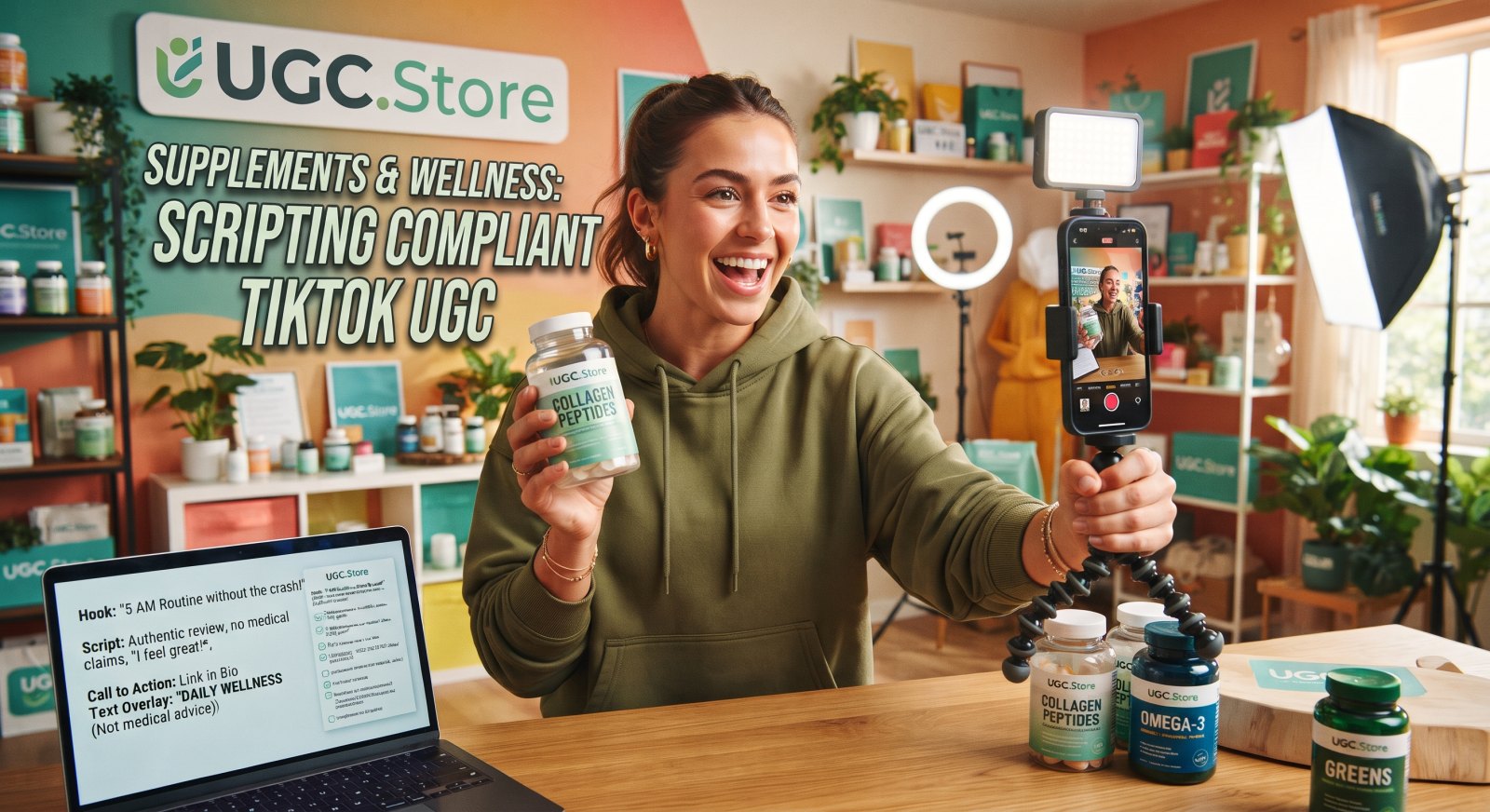
Executive Overview
Compliant supplement UGC is creative built on a simple but widely violated principle: the script persuades through routine, ritual, and personal journey framing — never through treatment, cure, or transformation claims. The compliance stakes are no longer theoretical. TikTok Shop's US policy now explicitly bars weight-loss and muscle-gain products and GLP-1 promotions , the FTC issued its first six-figure fines against individual creators for disclosure failures in social commerce contexts in 2026 , and — the liability point brands most often miss — a seller is responsible for prohibited claims made by creators promoting its products, with violations attributed to the seller's compliance score regardless of who wrote the offending line . The brands winning this category have stopped treating compliance as legal review at the end of the pipeline and started treating it as script architecture at the beginning — building every asset inside the permitted claims framework so that persuasion and policy safety are the same design, not competing constraints.
Theoretical Basis and Psychology of Mechanics
Supplement marketing operates under the most complex rule environment in the entire UGC economy, and understanding why requires mapping the three-layer structure that governs every asset. The first layer is federal law: the FDA permits structure/function claims — statements that a nutrient supports a normal body function, such as "supports immune health" or "promotes healthy digestion" — while any claim referencing a disease, condition, or treatment converts the product into an unapproved drug in the regulator's eyes . The second layer is the FTC's substantiation standard, which requires competent and reliable scientific evidence behind every health benefit claim and explicitly holds that the DSHEA disclaimer does not cure an otherwise deceptive ad — the disclaimer is a label requirement, not an advertising shield . The third layer is platform policy, which is stricter than both: TikTok bans before-and-after imagery outright for supplements, prohibits GLP-1 mentions in any supplement context, runs automated audio and text moderation that scans for flagged language, and requires the FDA disclaimer statement on screen in every US supplement ad .
The psychology of compliant persuasion begins with the mechanism the compliant script cannot use: transformation proof. Every other beauty vertical leans on before-and-after evidence, and supplements are categorically denied it — side-by-side physical comparisons are flagged as therapeutic claims in visual form . The replacement mechanism is ritual identity. When a creator documents a supplement woven into a credible daily routine — morning light, real kitchen, the actual moment of the day the product occupies — the viewer does not evaluate a health claim; she observes a lifestyle she can imagine inhabiting. The persuasion happens through behavioral modeling rather than outcome promising: the viewer buys not a result but a practice, and practices are exempt from the claims framework because no promise was ever made.
The second psychological mechanic is credibility through restraint. In a category saturated with miracle language, the creator who says "this is one part of my routine — it supports my energy on busy days, and honestly the biggest change was fixing my sleep schedule first" triggers a restraint premium: the audience's skepticism, calibrated by years of overclaiming, interprets voluntary limitation as evidence of truthfulness. This is the same flaw-first principle that powers wear-test cosmetics and empathy-driven skincare, applied to a category where the platform mandates the restraint rather than merely rewarding it. The third mechanic is journey suspense without outcome claims. A compliant supplement arc tracks inputs, not outcomes: the consistency streak, the routine evolution, the honest plateau ("month two — honestly nothing dramatic, I'm still here because I like how the routine feels"). Inputs are narrative; outcomes are claims. The algorithm rewards the narrative, and the conversion rate rewards the trust the narrative builds.
Step-by-Step Algorithm & Methodology
The compliant scripting pipeline below sequences every asset from brief to upload, with compliance embedded at each phase rather than appended at the end.
Phase 1 — The Category Qualification Gate (pre-production). Before any script is written, the product must clear the platform's category qualification process and the brand must have uploaded required documentation. TikTok supplements require the qualification pathway; listing or advertising without approval violates policy . Simultaneously, the creative team receives the approved claims document — the structure/function language vetted against FDA and FTC standards — because every script line will be built from this lexicon.
Phase 2 — The Routine Hook (0–3 seconds). The compliant hook opens on the ritual, not the result: creator in morning kitchen light, opening the cabinet, pouring coffee. Dialogue pattern: "The first thing I do every morning — before email, before anything — is this." No symptom confession, no body anxiety, no "if you feel tired…" — the personal-attributes framing ("Do your joints ache?") is a rejected-claim shape on every major platform . Target hook rate: above 68% on cold audiences.
Phase 3 — The Context Layer (3–12 seconds). The creator establishes the lifestyle context the supplement serves — a demanding schedule, a training block, a season of travel — describing circumstances, never conditions. The framing rule: the routine exists within a life, and the supplement is one element of that routine, which mirrors TikTok Shop's own guidance to show the product as one component of a healthy lifestyle rather than a guaranteed solution .
Phase 4 — The Product Placement Beat (12–25 seconds). The supplement enters with its structure/function language spoken in the creator's voice: "This is the omega-3 I take — it supports heart and brain health as part of my routine." Visual: label visible, dosage real, the DSHEA disclaimer displayed as clearly readable on-screen text — mandatory for US supplement ads and one of the fastest rejection triggers when missing .
Phase 5 — The Consistency Narrative (25–40 seconds). The compliance-safe suspense engine: the streak, the ritual's evolution, the honest check-in. "Ninety days of this routine — some weeks I'm perfect, some weeks I forget, and I just start again." This phase carries retention through narrative honesty rather than promised outcomes, and it generates the saves and re-watches the algorithm rewards.
Phase 6 — The Compliant CTA (final 5 seconds). The closing question is routine-framed, never health-framed: "What's the one thing you do every morning without fail? I'm always looking for better rituals." The link lives in the caption with proper disclosure; the Paid Partnership label is activated, since undisclosed gifted or paid content is ineligible for the For You feed and suppresses both creator and brand .
Ready-to-Use Working Templates & Scripts
Script One: "The Morning Cabinet" (Format: routine-ritual UGC, 45 seconds).
Opening frame: creator opening a kitchen cabinet, morning light, no makeup polish, coffee steam visible. Dialogue: "This cabinet tells you everything about my mornings." B-roll: hand reaching past coffee, landing on the supplement. SFX: cabinet hinge, coffee pour, room tone. Context layer: "I have ninety minutes between waking up and my first meeting, and I've learned the hard way that what happens in that window decides my whole day." Product beat: "Part of that window is this — it's a daily multivitamin that supports my energy metabolism. Not magic, just a baseline." On-screen text: the FDA disclaimer, clearly readable, held for the full product beat. Consistency narrative: "I've taken it for five months. Some mornings I forget, and I don't spiral — I just take it the next day. The routine matters more than the streak." Boundary statement: "This is one piece. Sleep, food, movement — those did the heavy lifting in my life. This just fills the gaps." CTA: "Tell me your non-negotiable morning step — I'm genuinely taking notes in the comments."
Script Two: "The Training Block Diary" (Format: lifestyle-context UGC for active wellness products, 50 seconds).
Dialogue: "Eight weeks into this training block, and my routine is the only thing holding together." B-roll: gym bag packed, supplement container dropped in, car keys. Context: "Four workouts a week, a job that doesn't care about my program, and a recovery routine I've actually stuck to for once." Product beat: "This protein and collagen blend supports muscle recovery — it's the post-workout anchor of the whole routine." Demo: real scoop into real shaker, on-screen disclaimer text during the beat. Consistency narrative: "Week three is where routines usually die for me. This one made it to week eight — mostly because it's simple enough not to negotiate with myself about." Boundary statement: "Nothing here replaced hard training or decent food. It supported the routine I was already committed to." CTA: "What week does your routine usually die? Drop it below — solidarity or solutions, either works."
Script Three: "The Seasonal Reset" (Format: travel/transition ritual UGC, 48 seconds).
Dialogue: "Every time I come back from a long trip, my whole routine needs a rebuild — so I made a checklist." B-roll: suitcase, then the checklist on a phone notes app, then the supplement on the counter. Context: "Three time zones in ten days, and my body keeps the score on my schedule — not on anything dramatic, just my rhythm's off." Product beat: "First thing back on the checklist: magnesium glycinate — it supports relaxation and restful sleep as part of my wind-down routine." Disclaimer text held on screen. Consistency narrative: "The checklist works because it's boring. Same order every night: phone down, this, ten minutes of reading. Night ten of the rebuild — my rhythm's back." Boundary statement: "The supplement supports the ritual. The ritual did the actual work." CTA: "What's on your reset checklist? I need one more item and the comments always deliver."
Comparative Analysis Matrix
| Core framing | Outcome promise ("fixes your gut") | Routine embedding ("part of my morning") |
| Visual evidence | Before-and-after body comparisons | Ritual documentation and consistency streaks |
| Claim language | Disease and treatment vocabulary | Structure/function claims from approved lexicon |
| Emotional register | Symptom anxiety and urgency | Lifestyle aspiration and identity |
| Hook mechanic | "If you suffer from…" | "The first thing I do every morning…" |
| Expected compliance exposure | Rejection, account review, enforcement | Qualification-gated, claims-documented stability |
| Problem statement | "Do you feel bloated and exhausted?" (personal attributes) | "Ninety minutes between waking and my first meeting" (circumstances) |
| Product introduction | "This cured my gut issues" (disease claim) | "Supports digestive health as part of my routine" (structure/function) |
| Trigger vocabulary | "Miracle, cure, hack, detox, secret" | "Experience, journey, routine, real life" |
| Disclaimer handling | Absent or buried in caption | Clearly readable on-screen text during product beats |
| Disclosure mechanics | Undisclosed gifting or affiliate posts | Paid Partnership label on every placement |
| Platform policy | Claims lexicon, disclaimer placement, qualification status | Automated moderation interpretation at submission time |
| Federal advertising law | Substantiation file for every claim used | FTC enforcement priorities shifting by quarter |
| Creator behavior | Pre-approval workflow, mandatory training | Creator improvisation in LIVE and comment replies |
| Seller compliance score | Documentation hygiene, claim audits | Violations attributed from creator content regardless of origin |
| Live shopping content | Pre-approved talking points, monitoring staff | Real-time verbal claims flagged mid-broadcast by automated systems |
Real-World Case Study Breakdown
A direct-to-consumer wellness brand selling a magnesium-based sleep support supplement entered TikTok Shop in mid-2026 after strong performance on Meta, bringing its proven creative playbook with it: symptom-led hooks ("still staring at the ceiling at 2 AM?"), transformation-adjacent sleep framing, and creator briefs that said "be authentic about how it changed your nights." The results were a compliance catastrophe that took three weeks to fully unfold. The first symptom-led assets were rejected by automated review within hours. A creator's gifted-post video — "this fixed my insomnia" — triggered a prohibited-claims violation that landed on the seller's compliance score, not the creator's, and the brand discovered the attribution rule only when its listing visibility began throttling . A second strike during a LIVE shopping session — a host improvising "it basically replaces sleeping pills" — was flagged by real-time moderation mid-broadcast, and the account entered review with the product launch indefinitely suspended .
The rebuild treated compliance as script architecture, not legal overlay. The brand completed category qualification, commissioned a claims substantiation file, and produced an approved claims lexicon: structure/function language for every SKU, a prohibited-words list, and mandatory script lines including the on-screen disclaimer and disclosure language. The new creative program commissioned ten creators across routine archetypes — the morning-optimizer, the training-block athlete, the seasonal-reset traveler — with briefs built entirely on context and ritual, explicitly banning symptom language, before-and-after framing, and any outcome claim. Every script passed pre-approval before filming; every delivered asset passed a claims audit against the lexicon before upload.
Final empirical telemetry after the twelve-week rebuild window: assets shipped with zero policy rejections across three waves, the compliance score recovered fully, and — the result that surprised the founding team — performance improved. CTR settled at 2.0% versus 0.8% on the pre-pivot library, CPA fell from $61 to $38, and the winning asset was a routine-ritual video whose top comment thread became viewers sharing their own morning checklists. The governing insight: the non-compliant playbook had been persuading the wrong people with the wrong promise, and the compliant playbook was persuading the right people with a frame they could act on without being promised the impossible. Compliance did not cost conversions; the violations had been camouflaging a weak creative strategy.
Real-World Engineering & Creative Feedback
"The lexicon is everything. We hand creators an approved-claims document and a prohibited-words list before they write a single line, and we require scripts back for review before anyone films. Creators love it — it removes the anxiety of guessing what's safe — and our rejection rate dropped to near zero. The mistake brands make is treating compliance as a filter at the end. It's the foundation at the beginning." — Nadia Ferreira, Compliance Director, TrueDose Brands
"Live shopping is where supplement brands die, and nobody budgets for it. Pre-recorded content can be pre-approved; a live host facing a chat of symptom questions will improvise into a disease claim in under ten minutes unless you have staff monitoring and a kill-switch protocol. We now run live shopping for supplements with a trained compliance moderator in the room, pre-approved answer cards for the top twenty questions, and an immediate stream-termination rule. Boring, expensive — and cheaper than the alternative." — Derek Osei, Paid Social Director, Meridian Performance Group
"The FTC creator fines in 2026 rewrote the negotiation table overnight. Creators who used to wave off disclosure language now ask for our disclosure templates. Smart brands turned this into an advantage: we run creator onboarding that includes a twenty-minute claims-and-disclosure certification, and we market that certification to creators as career capital. The creators who pass get rebooked first — we've essentially built a compliance-gated talent pool our competitors can't access." — Elif Kaya, Creator Partnerships Lead, Vantage Wellness Media
"Before-and-after was our entire creative strategy for two years, and losing it felt like losing the business. Then we discovered the replacement: routine documentation with visible consistency markers. A creator filming the same morning setup on day one, day thirty, and day ninety — same kitchen, same cabinet, same light — produces transformation rhythm without transformation claims. Viewers see the ritual's longevity and draw their own conclusions. The algorithm sees the series structure and compounds reach. We rebuilt three supplement accounts on this and every one outperformed its before-and-after era." — Sam Whitmore, Creative Strategist, Fieldcraft Studio
"The three-rulebook problem is the insight nobody wants to hear: your supplement can be legal under federal law, ineligible for TikTok Shop, and eligible for TikTok Ads simultaneously — three different rulebooks answering different questions about the same bottle . Brands keep getting burned because they brief one team on one rulebook. We now run a channel map for every SKU before a single script exists: where is this product allowed, under which rulebook, with which claims. That document has saved more launches than any creative test we've ever run." — Rosa Almeida, Head of Growth, Kettle & Compass Agency
Production Self-Check Checklist
Before final export and ad platform upload, every supplements and wellness UGC asset must clear the following quality gates:
- Claims lexicon audit passed — every spoken line and on-screen text checked against the approved structure/function document; zero disease, treatment, cure, or prevention language surviving the edit.
- Disclaimer placement confirmed — the FDA statement appears as clearly readable on-screen text during product beats, not buried in the caption; hold duration verified at mobile viewing speed.
- Before-and-after imagery categorically absent — no physical transformation comparisons, no body-change framing, no implied therapeutic outcomes in visual form.
- Disclosure mechanics functional — Paid Partnership label activated, material connection disclosed per FTC standards, gifted-product content treated identically to paid content.
- Creator pre-approval documented — the signed script, the delivered edit, and the claims audit stored together; evidence trail in place if attribution review occurs.
- LIVE protocol resourced — for live shopping, trained moderation staff, pre-approved answer cards, and stream-termination rules confirmed before broadcast, since verbal claims are monitored in real time.
- CTA mechanics compliant — routine-framed comment bait, no health questionnaires, no symptom harvesting in caption or comments.
- Accessibility layer complete — captions covering 100% of spoken dialogue including the disclaimer read-aloud, safe-zone compliant text, 9:16 vertical integrity confirmed.
- Landing-page parity checked — the destination substantiates only what the ad claims and adds no prohibited claims of its own.
Advanced FAQ
What is the exact difference between a structure/function claim and a disease claim in a UGC script?
The dividing line is the reference point. A structure/function claim describes a normal body function — "supports immune health," "promotes healthy digestion," "helps maintain cardiovascular function" — and is permitted with substantiation and the disclaimer . A disease claim references a medical condition — "reduces inflammation," "treats anxiety," "helps with arthritis" — and is prohibited regardless of how carefully it is worded, because it reclassifies the supplement as an unapproved drug . The practical test for every line: does this describe a normal function, or does it reference a condition? If it references a condition, rewrite it with a maintenance verb and a normal-function object.
Does including the FDA disclaimer make an otherwise aggressive claim acceptable?
No — this is the most expensive misconception in the category. The DSHEA disclaimer is a labeling requirement that accompanies structure/function claims; it does not immunize deceptive advertising. The FTC has stated explicitly that the disclaimer will not cure an otherwise deceptive ad, and dramatic testimonials cannot be rescued by "results not typical" language . The disclaimer belongs in every compliant asset — its absence is a fast rejection trigger — but it operates as a floor, not a ceiling. Claims must be substantiated on their own merits first; the disclaimer then formalizes them. An aggressive claim with a disclaimer is still an aggressive claim.
How should a brand handle creators who want to improvise personal health stories in their content?
Redirect, don't suppress. The creator's authentic health narrative is valuable material, but in the supplement category it must be reframed from outcomes to inputs: instead of "this supplement fixed my gut," the compliant version is "this is part of the routine I built while figuring out what worked for me — food, sleep, and consistency did most of it." Any anecdote that names a condition, promises a result, or implies treatment must be rewritten before filming, and the rewritten version must pass the same claims audit as scripted content because the seller owns the liability either way . Brands that build this reframing into creator onboarding — with certified templates for common story shapes — convert the compliance constraint into a distinctive, defensible creative voice.
Why do some supplement ads get rejected while identical-looking competitor ads keep running?
Because the three rulebooks are not synchronized and enforcement is not symmetric. A product can be legal to sell under federal law, blocked from TikTok Shop, and eligible for TikTok Ads simultaneously, with each rulebook answering a different question about the same product . Competitors running similar creative may be operating under a different qualification status, a different market scope, or simply haven't been caught yet — automated moderation flags supplements within hours, but enforcement arrives in waves, and surviving this month's review proves nothing about next month's. The correct response to asymmetric enforcement is not to copy the competitor but to build to the strictest applicable rulebook and maintain the claims documentation that makes every shipped asset defensible on demand.
What is the compliant replacement for before-and-after imagery in supplement UGC?
Routine documentation with visible consistency markers. The persuasive job of before-and-after is longevity proof — evidence that something persisted long enough to matter — and that job can be done without body transformation: the same kitchen cabinet on day one and day ninety, the same training bag across eight weeks, the checklist app showing a thirty-day streak, the creator naming the exact duration on camera. These frames prove commitment, and commitment is the attribute supplement buyers are actually purchasing, because the category's honest promise was never a transformed body — it was a routine the buyer could sustain. Frame the sustainment, name the timeline, hold the disclaimer, and let the viewer conclude what the platform forbids you to claim.
Custom Contextual Conclusion
Supplement UGC sits at the collision point of three rulebooks — federal law, platform policy, and the unwritten rules of audience trust — and the brands that thrive there have stopped experiencing that collision as a constraint. The compliant framework converts policy into creative doctrine: claim the function never the disease, document the routine never the transformation, name the timeline never the outcome, and hold the disclaimer as a design element rather than a legal fig leaf. Every mechanic that made the other verticals convert — confession, specificity, honesty, serialized evidence — survives the transition intact, because those mechanics were always about credibility, and credibility is the one asset no policy can prohibit. The non-compliant playbook promised results and rented the audience's skepticism; the compliant playbook offers a practice and earns the audience's belief. In a category where the FTC now fines creators personally , where live-stream moderation terminates sessions mid-broadcast, and where a creator's improvised sentence lands on the seller's compliance score, compliance is not the cost of doing business on TikTok. It is the business model — and the brands that internalize it first will own the category's trust dividend for years.