
Executive Overview
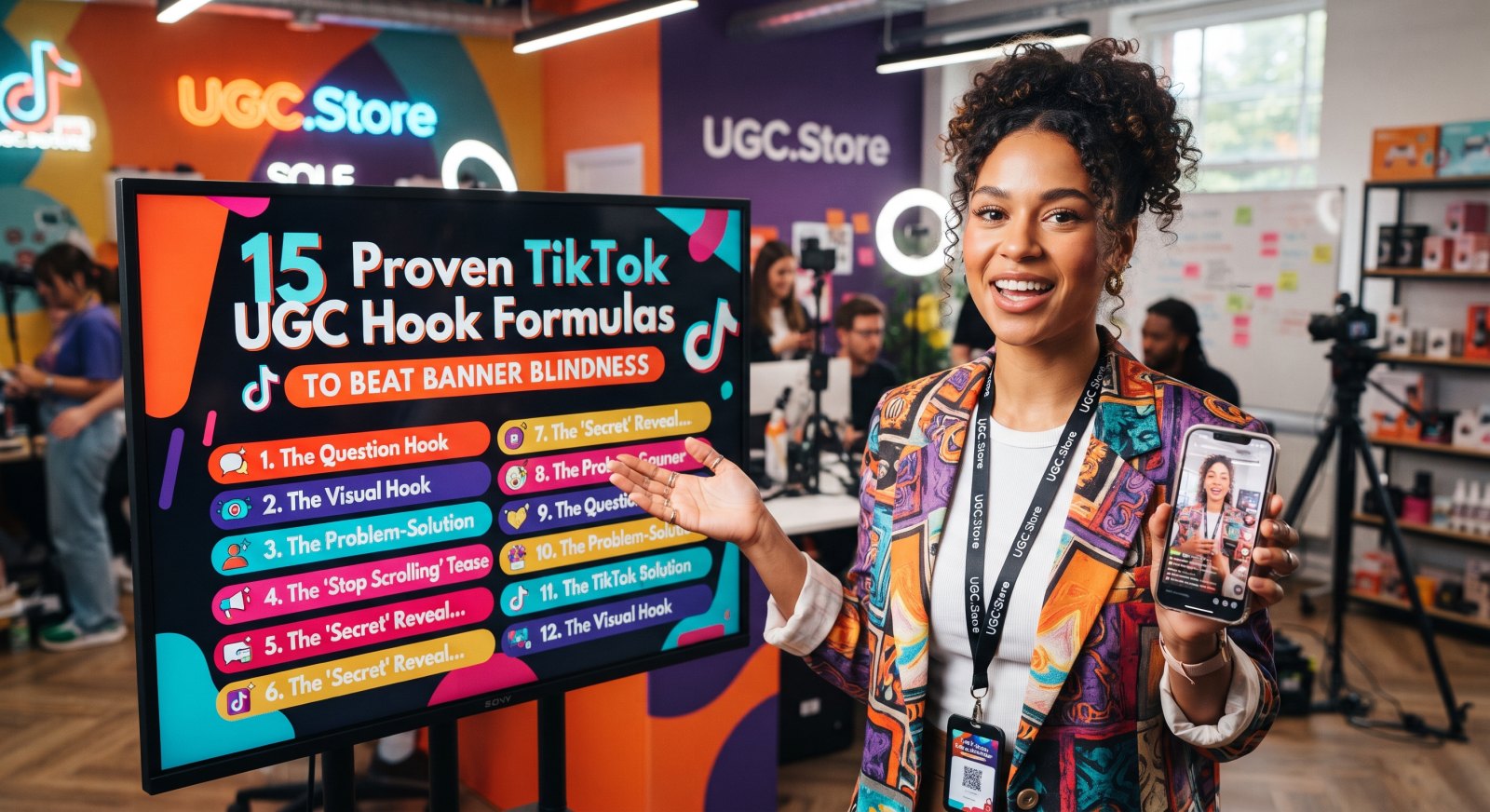
Banner blindness is not a visual problem. It is a pattern recognition problem, and the viewer’s brain is the judge. Users have been trained by years of advertising exposure to instantly categorize content as “ad-shaped” and scroll past it before conscious thought engages . The hook is the only element that can interrupt this pre-conscious filtering, and it has approximately 1.5 seconds to do so before the thumb decides . The 15 formulas below are not creative suggestions. They are pattern interrupts engineered to bypass the viewer’s ad-detection system by mimicking the grammar of organic content: specificity, confession, contrarian claims, and unresolved tension.-13
Theoretical Basis and Psychology of Mechanics
The psychology of banner blindness rests on a principle that most performance marketers misunderstand: the viewer does not evaluate ads. The viewer’s brain evaluates patterns, and anything that matches the stored template of “advertising” is filtered before attention is allocated . This filtering is automatic, pre-conscious, and ruthlessly efficient. The hook’s job is not to be persuasive. It is to be categorically ambiguous long enough for the viewer to engage with the content before the ad-detection system fires.
The first mechanism is the pattern interrupt as pre-conscious disruption. The scroll is a trance state, and the viewer is not consciously deciding to skip. The brain is pattern-matching at speed, and the hook that breaks the expected frame—an out-of-place object, an abrupt command, a visual that does not match the niche—stalls the pattern-matching long enough for the promise to land . This is why the imperative command (“Stop scrolling”) and the visual “wait, what” frame outperform polished introductions: they are not better arguments. They are harder to categorize.
The second mechanism is specificity as credibility signal. A hook that says “I lost weight” is invisible because it matches the ad template. A hook that says “I lost 23 pounds in 67 days without giving up pizza” is legible because the odd numbers read as real . The viewer’s brain does not have a stored template for “23 pounds in 67 days.” It has a template for “lose weight fast.” The specific number forces the brain to process the content as information rather than advertising, and the processing delay is the hook’s window.
The third mechanism is the open loop as cognitive itch. The human brain cannot leave a question unresolved, and the hook that asks the exact question the video will answer creates a cognitive debt the viewer must pay by watching . This is why the open loop question and the “I tested this for 30 days” experiment format outperform feature announcements: they are not claims. They are unfinished stories, and the viewer stays to see the ending.
The fourth mechanism is the native aesthetic as ad immunity. High production quality signals “advertising” and triggers banner blindness. Lower production quality—natural light, phone camera, authentic locations—signals “content” and bypasses the filter . This does not mean sloppy execution. It means strategic roughness: the visual language of a friend’s video, not a brand’s commercial. The hook must look like it was filmed on a phone because it probably was, and the viewer’s ad-detection system has not yet learned to flag it.
Step-by-Step Algorithm & Methodology
The framework below sequences a hook from concept to tested asset, with each phase engineered to bypass banner blindness before the viewer’s brain categorizes the content as advertising.
Phase 1 — Select the Formula by Goal (Pre-Production). The 15 formulas are not interchangeable. Each is engineered for a specific engagement outcome: completion, saves, comments, or shares. The cold-open result and pattern interrupt drive completion because they promise payoff. The specific-number reveal and listicle promise drive saves because they offer reference value. The open loop question and bold claim drive comments because they invite argument. The relatable call-out and trend-ride drive shares because they create social currency . The formula is selected by the metric the campaign is optimizing for, not by creative preference.
Phase 2 — The Three-Layer Hook Block (0–3 seconds). Every hook fires on three channels simultaneously: spoken line, on-screen text, and opening visual. The spoken line is what the creator says. The on-screen text is the muted-first promise in three to seven words. The opening visual is what is in frame before the viewer has parsed either. A hook that works only on one channel fails on the other two. The text must be legible at a glance. The visual must be recognizable at scroll speed. The spoken line must land within the first second .
Phase 3 — The Payoff Commitment (3–10 seconds). The hook is a promise, and the video must deliver it within the first ten seconds or the viewer’s trust collapses. A cold-open result must show the result. An open loop question must acknowledge the answer is coming. A bold claim must begin the argument. The hook does not need to resolve the tension, but it must prove the tension is real before the viewer’s patience expires .
Phase 4 — The Loop Close (final 3–5 seconds). The highest-performing hooks are designed for rewatch, and the final frame determines whether the loop feels intentional or jarring. The final frame should return to the opening visual or the opening tension, creating a narrative circle that rewards a second viewing. The viewer who watches twice is the algorithm’s strongest signal, and the loop is the mechanism .
Phase 5 — The Testing Protocol (Post-Launch). Hooks are tested in isolation: same body, same CTA, same audience, different opening line and visual. The metric is three-second view rate, not overall engagement. A hook that holds 70–80% of viewers past three seconds is a pass . A hook that holds fewer than 60% is rewritten, not scaled. The body can stay identical. The hook is where 80% of the performance difference lives .
Ready-to-Use Working Templates & Scripts
Formula 1: The Cold-Open Result (Goal: Completion).
Spoken: “This took me 47 tries and three weeks. Here is the one that worked.”
On-screen text: 47 tries. one worked.
Opening visual: The finished result on screen in the first frame, no introduction, no logo.
Payoff: The video shows the process that produced the result.
Why it works: Showing the payoff before the explanation makes the viewer stay to see how it happened. The odd number sets the value before the viewer can swipe .
Compliance: The result must be real and visible in frame. A promised result never shown on camera reads as bait and tanks completion.
Formula 2: The Pattern Interrupt (Goal: Completion).
Spoken: “Stop doing [common thing]. You are doing it backwards.”
On-screen text: you are doing it wrong
Opening visual: An unexpected motion or object that does not match the niche, then a snap to the creator.
Payoff: The video explains the correct method.
Why it works: The scroll is a trance. A visual or verbal interrupt breaks it long enough for the promise to land. The “backwards” frame opens a loop the viewer needs closed .-5
Compliance: The interrupt must pay off. A shock open with a boring middle trains viewers to swipe the next one faster.
Formula 3: The Specific-Number Reveal (Goal: Saves).
Spoken: “47 minutes. That is how much time I was losing every morning and I did not know it.”
On-screen text: 47 minutes. every morning.
Opening visual: The number large on screen, then a cut to the proof.
Payoff: The video shows where the 47 minutes were going and how they were reclaimed.
Why it works: A single hard number is the most save-worthy unit on TikTok. Odd figures (47, 2.4x, $873) read as real and get saved for later action .
Compliance: Never invent the number. A figure fact-checked in the comments costs more reach than the hook earned.
Formula 4: The Open Loop Question (Goal: Comments).
Spoken: “Why does [surprising thing] happen? I tested it so you do not have to.”
On-screen text: why does this happen?
Opening visual: The creator mid-gesture, caught at the moment of the question.
Payoff: The video answers the question before the end.
Why it works: A named question opens a loop and invites the viewer to guess in the comments before the reveal. Early comments pull more reach .
Compliance: Answer the question inside the video. A loop never closed reads as clickbait.
Formula 5: The Relatable Call-Out (Goal: Shares).
Spoken: “If you reopen the fridge for the third time hoping new food appeared, this video is calling you out.”
On-screen text: pov: you do this
Opening visual: A re-enactment of the exact moment, first frame.
Payoff: The video names the behavior and offers a solution or a laugh.
Why it works: Recognition is instant and shareable. “Send this to the friend who does this” is the most common share trigger on TikTok .
Compliance: Generic relatability disappears. “When you are tired” is nothing. The behavior must be hyper-specific.
Formula 6: The Bold Claim, No Hedge (Goal: Comments).
Spoken: “Credit card points are a scam. I do not care what the influencers say.”
On-screen text: points are a scam
Opening visual: Creator straight to camera, still, holding the frame.
Payoff: The video defends the claim with evidence.
Why it works: A confident claim with no hedge invites the comment section to argue, and the argument is the reach .
Compliance: Only ship a claim you would defend in person. A bold take you cannot support gets dragged.
Formula 7: The Listicle Promise (Goal: Saves).
Spoken: “Three apps that replaced my entire morning routine. The second one is the reason I cancelled my subscription.”
On-screen text: 3 apps. 1 routine.
Opening visual: The three app icons visible in frame, the second one circled.
Payoff: The video delivers all three, with the second one getting the most depth.
Why it works: A numbered promise creates a reference asset the viewer saves for later. The specific rank (“the second one”) forces the viewer to stay for the reveal .
Compliance: Deliver the number promised. A listicle that stops at two of three earns the angry comments.
Formula 8: The Story In Medias Res (Goal: Completion).
Spoken: “So I am standing in the parking lot and the app just told me the thing I had been dreading.”
On-screen text: the app told me something bad
Opening visual: Creator mid-story, visibly in the moment, no introduction.
Payoff: The video finishes the story and delivers the product context.
Why it works: Dropping the viewer into the peak of a real story creates immediate narrative investment. The brain wants the resolution .
Compliance: The story must be real or truthfully representative. Fabricated drama gets exposed in the comments.
Formula 9: The “I Tried This For 30 Days” (Goal: Completion).
Spoken: “I used this app for 30 days to see if it was a scam. Here is what actually happened.”
On-screen text: 30 days. not a scam?
Opening visual: The app screen visible, the creator’s skeptical face.
Payoff: The video shows the honest timeline and the real result, including limitations.
Why it works: The experiment framing promises evidence, not hype. The bounded timeframe makes the result feel earned .
Compliance: The timeline must be real. A “30-day test” filmed in one afternoon is detectable.
Formula 10: The Contrarian Open (Goal: Comments).
Spoken: “Everyone says you need a budget. They are wrong.”
On-screen text: budgets don’t work
Opening visual: Creator leaning back, arms crossed, confident.
Payoff: The video explains what to do instead.
Why it works: The brain cannot leave a contradiction unresolved. The viewer stays to see how the claim resolves .
Compliance: The contrarian claim must have a defensible argument. Contrarianism without substance is noise.
Formula 11: The Before-and-After Split (Goal: Completion).
Spoken: “This is the same task. One of these takes twenty minutes. One takes four seconds.”
On-screen text: same task. different time.
Opening visual: A split-screen frame, the old way on the left and the new way on the right, both in motion.
Payoff: The video holds the comparison and explains the difference.
Why it works: The split-screen makes the contrast visible and timed. The viewer stays for the bridge between the two sides .
Compliance: The old way must be shown honestly, not as a strawman. The comparison must be real.
Formula 12: The Leaked/Found Frame (Goal: Saves).
Spoken: “I found this in my old phone and I cannot believe I forgot about it.”
On-screen text: found this in my old phone
Opening visual: A phone screen with the app or content visible, the creator’s hand holding it.
Payoff: The video reveals what was found and why it matters.
Why it works: The audience treats “found” content as more authentic than performed content, even when the staging is obvious .
Compliance: The “found” framing must not be used to make a false claim about the product’s origin or history.
Formula 13: The Imperative Command (Goal: Completion).
Spoken: “Do not download another app until you see this.”
On-screen text: don’t download anything yet
Opening visual: Creator holding up a hand, stopping the viewer, direct eye contact.
Payoff: The video delivers high-stakes information that justifies the command.
Why it works: The most aggressive hook in the playbook, and the most divisive. When the payoff matches the urgency, it works brilliantly .
Compliance: Reserve for genuine high-stakes information. A weak payoff reads as desperate clickbait.
Formula 14: The Expert Credential Drop (Goal: Comments).
Spoken: “I have been a financial advisor for eleven years. Here is the thing nobody tells you about credit scores.”
On-screen text: 11 years. 1 thing nobody says.
Opening visual: Creator straight to camera, composed, credible.
Payoff: The video delivers the insider insight the credential promised.
Why it works: TikTok viewers trust short-form experts more than long-form ones, and they expect the credibility signal upfront .
Compliance: The credential must be real and verifiable. Fabricated expertise gets exposed and destroys trust.
Formula 15: The “Everyone Is Doing This Wrong” Reveal (Goal: Comments).
Spoken: “You are washing your face wrong. I was too, until I saw this.”
On-screen text: you’re doing it wrong
Opening visual: Creator mid-routine, then a cut to the correction.
Payoff: The video shows the correct method with visible proof.
Why it works: Adjacent to the contrarian open but positioned as a generous correction rather than a fight. The viewer stays to see if they are guilty .
Compliance: The “wrong” claim must be accurate and not fear-based. Health and beauty claims must be substantiated.
Comparative Analysis Matrix
| Formula | Primary Goal | Psychological Trigger | Best For |
|---|---|---|---|
| Cold-Open Result | Completion | Payoff before explanation | Apps, tools, transformations |
| Pattern Interrupt | Completion | Pre-conscious disruption | Saturated niches |
| Specific-Number Reveal | Saves | Specificity as credibility | Productivity, finance, time |
| Open Loop Question | Comments | Cognitive itch | Education, explanation |
| Relatable Call-Out | Shares | Identity recognition | Social, lifestyle, habits |
| Bold Claim, No Hedge | Comments | Argument invitation | Contrarian products |
| Listicle Promise | Saves | Reference value | Roundups, comparisons |
| Story In Medias Res | Completion | Narrative investment | Personal stories, testimonials |
| 30-Day Experiment | Completion | Bounded proof | Apps, routines, habits |
| Contrarian Open | Comments | Unresolved contradiction | Category disruption |
| Before-and-After Split | Completion | Visible contrast | Utility, productivity |
| Leaked/Found Frame | Saves | Voyeuristic authenticity | Discovery, nostalgia |
| Imperative Command | Completion | High-stakes urgency | Genuine warnings |
| Expert Credential Drop | Comments | Authority transfer | Regulated categories |
| Everyone Is Wrong Reveal | Comments | Correction instinct | Beauty, health, routines |
| Friction Point | Why Hooks Fail | Formula Solution |
|---|---|---|
| Banner blindness | Content matches ad template | Pattern interrupt and native aesthetic |
| Scroll speed | Hook requires conscious processing | Visual and verbal interrupt in first second |
| Trust deficit | Claim sounds like advertising | Specific numbers and honest limitations |
| Attention decay | Hook promises without proof | Payoff delivered within 3–10 seconds |
| Creative fatigue | Same format repeated | Formula rotation and format cycling |
| Testing Metric | Benchmark | Target |
|---|---|---|
| Three-second view rate | 55–65% average | 70–80% pass bar |
| Hook variation per body | 1–2 | 3–5 variations tested |
| Format rotation cycle | Ad hoc | 4–6 distinct formats rotating |
| Payoff delivery window | Variable | Within 3–10 seconds |
Real-World Case Study Breakdown
A productivity app launched a TikTok UA campaign in early 2026 with a creative library built on a single hook formula: the feature announcement. The opening line was consistently “This app just added [feature],” and the visual was the app’s home screen. Performance was diagnostic of the banner blindness mechanism: three-second view rate at 52%, well below the 70% pass bar, and CPI at $4.20** against a benchmark of **$2.80–$3.80. The hooks were legible and completely categorizable. The viewer’s brain processed “app feature announcement” and scrolled before the value proposition landed.
The strategic pivot kept the video bodies intact and rebuilt the hook layer using the 15-formula framework. The team produced five variations per body, each using a different formula, and tested them against the same audience with the same CTA. The formulas tested were: cold-open result, specific-number reveal, pattern interrupt, open loop question, and relatable call-out.
The winning hook came from the specific-number reveal formula: “47 minutes. That is how much time I was losing every morning and I did not know it.” The three-second view rate for this hook was 78%, compared to 52% for the feature announcement baseline. The same body that had previously opened with “This app just added a smart list” now opened with a number that the viewer’s brain could not categorize as advertising. The pattern interrupt hook (“Stop organizing your tasks. You are doing it backwards.”) came second at 74%.
The campaign ran for five weeks with the new hook layer, generated 1.2 million views, and drove 4,800 attributed installs at a blended CPI of $2.70—36% below the feature-announcement baseline. The governing insight: the body had been doing its job. The hook had been failing the three-second audition. The formulas did not change the product. They changed the first 1.5 seconds, and the first 1.5 seconds changed everything.
Real-World Engineering & Creative Feedback
“The hook is not a creative choice. It is a targeting mechanism. The first three seconds tell the viewer whether this video is for them. The formula is how you tell them without saying ‘this is for you,’ which is the most ad-shaped sentence in the language.” — Rocky Veen, UGC Strategist and Creator
“We stopped testing hooks against each other and started testing hooks against the three-second view rate. The body can stay identical. The hook is where 80% of the performance difference lives. The teams that understand this ship five hooks per body. The teams that do not ship one hook and wonder why the CPI never moves.” — Ben Achterberg, Head of User Acquisition, Cartwheel Apps
“Banner blindness is not about the banner. It is about the pattern. The viewer’s brain has a template for advertising, and anything that matches the template gets filtered before conscious thought. The hook’s job is to not match the template. The specific number, the contrarian claim, the pattern interrupt—these are not better arguments. They are harder to categorize.” — Priya Deshmukh, Creative Strategy Lead, Pixel & Pulse Agency
“The 72-hour half-life is real. A format that works on Monday is background noise by Thursday because every other brand saw it and copied it. The solution is not more testing. It is format rotation. Keep four to six distinct formulas in rotation. Cycle them before they decay. When you come back to a format three weeks later, it feels novel again.” — Marcus Lehto, Performance Marketing Director, Northline Interactive
“We almost cancelled the hook testing program because the first batch of variations all performed the same. Then we realized we were changing the hook and the body. The hook is a variable only if everything else is controlled. Same body, same CTA, same audience, different opening. That is how you find the formula that works. Everything else is noise.” — Elena Vasquez, Brand Director, Mosaic Apps
Production Self-Check Checklist
Formula selected by goal — the hook formula matches the campaign objective (completion, saves, comments, or shares), not creative preference.
Three-layer hook block complete — spoken line, on-screen text, and opening visual fire simultaneously within the first three seconds.
On-screen text is 3–7 words — legible at a glance, lowercase native register, no ad-speak surviving the review.
Opening visual is motion or tension — no static logo, no home screen, no greeting; the first frame contains either a result, an interrupt, or a face mid-expression.
Payoff committed within 10 seconds — the hook’s promise is visibly acknowledged or partially delivered before viewer patience expires.
Number is real and specific — any specific-number hook uses a verified, odd-precision figure; no invented statistics surviving the edit.
Claim is defensible — any bold or contrarian hook can be supported with evidence in the video body and would survive a comment-section argument.
Loop close designed — the final frame returns to the opening visual or tension, creating a rewatch trigger rather than a hard cut.
Native aesthetic confirmed — the hook does not look like a commercial; lighting, framing, and audio match organic content patterns.
Variations prepared — at least three hook variations per body are ready for testing, with the same body, CTA, and audience.
Advanced FAQ
How does a brand test hooks without confounding the results?
The hook must be the only variable. Same body, same CTA, same audience, same posting time, same creator. The opening line and the opening visual change; nothing else does. The metric is three-second view rate, not overall engagement, because the hook’s job is to earn the audition, not to close the sale . A hook that wins on three-second view rate but loses on completion is a hook that overpromised. A hook that wins on both is a hook worth scaling. The testing cadence should be weekly, with at least three variations per body, and the results logged by formula type to identify patterns across products .
What is the correct response when a hook formula stops working?
The formula has not stopped working. The format has decayed. TikTok creative effectiveness degrades exponentially, with some formats losing half their impact within 72 hours of launch as the audience pattern-matches the format as advertising . The solution is not to abandon the formula but to rotate it out and cycle back later. Maintain four to six distinct formulas in active rotation. When a formula shows declining three-second view rate, replace it with another formula from the rotation. Three weeks later, the original formula will feel novel again. The brands that scale are the ones that treat creative as a portfolio, not a single winning asset.
How does a brand use the imperative command without triggering ad-blindness or hostility?
The imperative command (“Stop scrolling,” “Don’t buy this yet”) is the most aggressive hook and the most divisive . It works only when the payoff is genuinely high-stakes for the specific viewer being targeted. A generic “stop scrolling” is invisible because it has been overused since 2022 . A targeted imperative that names the viewer’s specific situation (“If you are a freelancer with irregular income, stop scrolling”) earns the interruption because the specificity justifies the command. The rule is simple: the command must be earned by the specificity of the audience call-out. If the hook could apply to anyone, it applies to no one.
What is the right way to handle the on-screen text layer for muted viewing?
The on-screen text is the muted-first promise, and it must work without the spoken line. The text should be three to seven words, lowercase or native register, positioned in the upper-middle third of the frame away from TikTok’s action rail and caption stack. The text should not duplicate the spoken line verbatim; it should compress the promise into a scannable unit. The visual and the text should reinforce each other: the text names what the visual is showing, and the visual proves the text is not a lie. A viewer who watches muted should understand the hook’s promise in under two seconds.
What is the measurement stack beyond three-second view rate?
Three-second view rate is the hook’s primary metric, but it is not the only metric that matters. The secondary metric is completion rate: a hook that earns the audition but loses the viewer at the payoff is overpromising. The third metric is comment intent language: do the comments reference the hook’s claim or question, or are they generic (“what app”)? A hook that generates specific comments has landed. The fourth metric is save rate, particularly for the specific-number and listicle formulas: saves indicate reference value, which is the strongest signal that the content was worth the viewer’s time . The final metric is format-level decay: track the three-second view rate for each formula over time and rotate before the decay becomes a cliff.
Custom Contextual Conclusion
Banner blindness is not a creative problem to be solved with better visuals or louder claims. It is a categorization problem, and the viewer’s brain is the categorizer. The 15 formulas in this framework are not persuasion techniques. They are categorization delays—patterns that do not match the ad template long enough for the viewer to engage with the content before the filter fires. The specific number, the contrarian claim, the story dropped in medias res, the relatable call-out that names a behavior the viewer thought was private—these are not better arguments. They are harder to file. The hook has 1.5 seconds to earn the audition, and the formula is the mechanism that buys the time . The brands that scale TikTok UGC are not the ones with the best products or the biggest budgets. They are the ones that understood the first 1.5 seconds are not a creative choice. They are a targeting decision, and the formula is how the decision gets made.