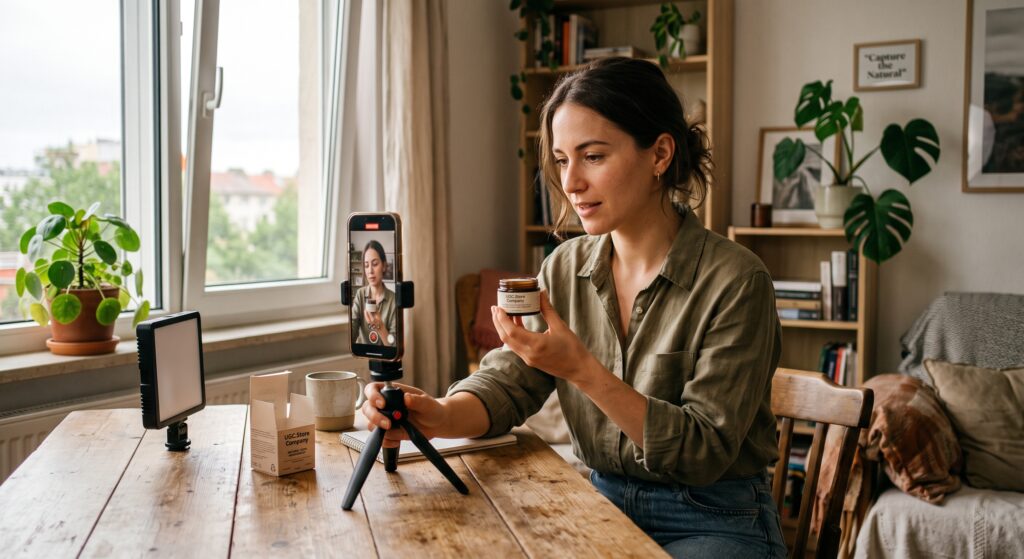
You can film professional, brand-ready UGC Content using nothing but a window and a wall. Position yourself at a 45-degree angle to the light source, use the opposite wall as natural fill, and shoot between 10 AM and 2 PM for the softest, most flattering skin tones — no ring light, no softbox, no budget required.
“I filmed my first 40 paid videos with a $0 lighting setup. Just a window in my studio apartment and a white bedsheet as a reflector. A brand later asked if I used a professional light kit because my skin looked ‘expensive.’ I told them it was just 11 AM and a north-facing window. They doubled my rate for the next campaign.”
— Sofia R., UGC Creator (Skincare & Wellness), $6.2K/month
Watch a UGC creator film an authentic skincare product review at home using just a smartphone and tripod. See how natural lighting and genuine storytelling create high-converting UGC content.
Why Natural Light Beats Artificial Light for UGC Beginners
Beginners obsess over buying a ring light. They browse Amazon, compare LED panels, and convince themselves that a $120 softbox is the barrier between amateur and professional footage. It is not. The barrier is understanding light, not owning equipment.
Natural window light offers three advantages that no artificial source can match at beginner price points. First, it is naturally diffused when it enters through glass, creating soft shadows that flatter skin and products without harsh edges. Second, it is free and already exists in your home. Third, it forces you to learn the fundamentals of light direction, fill, and exposure before you start throwing money at gear you do not yet understand how to use.
Artificial lights are tools for creators who already know what they need. Natural light is the teacher that gets you there. When you master window light, you can walk into any room, assess the available illumination in five seconds, and know exactly where to stand, where to place the product, and what time of day will give you the cleanest result. That skill travels. A ring light does not.
The Window Light Framework: Your 3-Point Setup Without Gear
Professional cinematographers use a three-point lighting system: key light, fill light, and backlight. You can replicate this exact structure using only your window, your walls, and one cheap household item. Call it the Window Light Framework — the system that turns any room with a window into a UGC studio.
The Key Light: Your Window at 45 Degrees
The key light is your main illumination source. Position yourself so the window sits at roughly a 45-degree angle to your face — not directly in front of you, and not directly to the side. The 45-degree placement creates gentle modeling on your features, defining your cheekbones and jawline without casting a harsh shadow across half your face.
If you face the window directly, you become flat and dimensionless. If you turn 90 degrees so the window is directly to your side, you get a split-face effect where one half of your face is bright and the other is in deep shadow. Neither looks professional. The 45-degree angle is the sweet spot that sculpts your face while keeping both sides visible.
Move closer to the window for brighter, more contrasty light. Move farther away for softer, more even illumination. A distance of 3 to 6 feet from the window is ideal for most UGC filming.
The Fill Light: Your Opposite Wall
In a professional studio, the fill light softens the shadows created by the key. In your apartment, the wall opposite your window acts as a giant bounce board. Light hits the wall, reflects back toward you, and gently lifts the shadow side of your face.
You can enhance this natural fill by placing a white object on the shadow side: a bedsheet draped over a chair, a poster board from the dollar store, or even a stack of white printer paper. The closer this white surface is to your face, the stronger the fill effect. You do not need to buy a reflector. You need to look around your room for the largest white surface and position it where the shadows fall.
The Background Separation: Depth and Distance
The third element of professional lighting is separation — the sense that you exist in a three-dimensional space rather than pressed against a flat wall. You create this by placing distance between yourself and your background.
If you stand with your back 12 inches from a wall, you cast a hard shadow on that wall and the shot looks cramped. If you move 4 to 6 feet away from the background, the window light falls off naturally, creating a soft gradient behind you that adds depth and visual interest. The product in your hands also catches light differently when the background is farther away, making it pop rather than blend into the scenery.
The Golden Window: Best Times to Film Natural Light UGC
Not all window light is equal. The quality changes dramatically throughout the day, and understanding these shifts allows you to schedule your filming sessions for maximum consistency.
Таблица
Time of Day
Light Quality
Skin Tone Result
Best Fix if You Must Film
7–9 AM
Soft, warm, low angle
Golden and flattering
Ideal for beauty and lifestyle
10 AM–2 PM
Bright, neutral, even
Clean and true-to-color
The optimal window for most UGC
3–5 PM
Warm, directional, long shadows
Dramatic but inconsistent
Use a white fill card to soften shadows
Overcast
Diffused, shadowless, cool
Flat but extremely even
Add slight contrast in post
Direct noon sun
Harsh, contrasty, blown highlights
Overexposed and unforgiving
Diffuse with a thin white curtain
The 10 AM to 2 PM window is your safest bet for consistent, repeatable results. If your schedule only allows evening filming, accept that your footage will be warmer and plan to cool your color temperature slightly in editing. Never fight the light. Understand it, schedule around it, or correct for it intentionally.
Common Natural Light Mistakes That Destroy UGC Quality
Even creators who understand the theory still sabotage their footage with these specific errors:
The Backlight Disaster. You stand with your back to the window because the view is pretty. Your face becomes a dark silhouette. The camera auto-exposes for the bright background and turns you into a shadow puppet. Always face toward the light source, not away from it.
The Direct Sunbeam Trap. A shaft of direct sunlight hits your face through an uncurtained window. Your skin turns into a patchwork of bright highlights and dark shadows. The fix is simple: diffuse the window with a thin white curtain, a bedsheet, or even a large piece of parchment paper taped to the glass. You are not blocking the light. You are spreading it out.
The Color Temperature Confusion. You film at 8 AM on Monday and 4 PM on Wednesday, then wonder why your portfolio looks like it belongs to two different people. Morning light is warm and golden. Afternoon light is cooler and bluer. If you must film at different times, use your phone’s manual white balance lock or apply a consistent color preset in post to unify the look.
The Moving Sun Panic. You start filming at 11 AM and by 11:20 the sun has moved enough to change your exposure. Your first take is perfectly lit and your fifth take is half a stop darker. The solution is to film shorter batches and check your exposure between takes. Lock your exposure on your phone before you start, but visually confirm that the light has not shifted dramatically mid-session.
The Natural Light Setup Checklist
Before you press record on any window-lit UGC video, run through this checklist. Every box you check is a mistake you have already avoided.
[ ] I am positioned 3–6 feet from the window at a 45-degree angle
[ ] The window is my key light; I am not backlit
[ ] Direct sunbeams are diffused with a white curtain or sheet
[ ] My background is 4–6 feet behind me for depth and separation
[ ] A white wall or reflector is positioned on my shadow side for fill
[ ] My phone exposure is locked before filming begins
[ ] I am filming between 10 AM and 2 PM for color consistency
[ ] I have checked that the product label is legible in the available light
[ ] I filmed a 5-second test clip and verified skin tones look natural
FAQ: Natural Light for UGC
What is the best time of day to film UGC with natural light?
The optimal window is between 10 AM and 2 PM, when sunlight is bright, neutral, and evenly diffused through most windows. This produces true-to-color skin tones and soft shadows that require minimal post-production correction.
Can I film professional UGC without any artificial lights?
Yes. The Window Light Framework uses your window as the key light, your opposite wall as fill, and distance from the background for depth. With proper positioning and a simple white reflector, natural light rivals entry-level artificial kits.
How do I fix harsh shadows when filming near a window?
Move farther from the window to soften the light, or diffuse direct sunbeams with a thin white curtain. Place a white surface on your shadow side to bounce fill light back onto your face. These two adjustments eliminate 90% of harsh shadow problems.
Why does my UGC footage look different at different times of day?
Sunlight changes color temperature throughout the day. Morning light is warm and golden; afternoon light is cooler and bluer. Lock your phone’s white balance before filming, or apply a consistent color correction preset in editing to unify your portfolio.
Do I need to buy a reflector for window light filming?
No. A white wall, bedsheet, poster board, or even a stack of printer paper can function as an effective fill reflector. Professional reflectors are useful but not mandatory for beginner UGC production.
Let the Window Teach You
You do not need a lighting budget to look like a professional UGC Creator. You need a window, a wall, and the discipline to position yourself correctly every single time. The Window Light Framework is not a compromise. It is a foundation. When you understand how natural light behaves, you can walk into any room, assess the available illumination in seconds, and create footage that brands mistake for studio production.
The creators who earn consistent income on the UGC Marketplace are not the ones with the most expensive gear. They are the ones who know how to make any environment work in their favor. Master the window. Master the light. And let your portfolio speak for itself before you ever buy your first ring light.