
The Mock Video Method: Creating Portfolio Pieces With Products You Already Own
You have read the guides. You have watched the tutorials. You have joined the UGC Creator Marketplace and built your profile. Then you hit the wall that stops every beginner: the portfolio section stares back at you, empty and silent, demanding proof that you can do the job before anyone will pay you to do it. Brands want to see your work. But you cannot show paid work because no brand has hired you yet. It is the classic experience trap, and it has killed more aspiring UGC Creator careers than bad lighting, poor audio, and shaky footage combined.
Here is the truth that experienced creators know but rarely say out loud: every professional UGC Creator on UGC.Store started with mock videos. Not fake videos. Not deceptive videos. Mock videos — portfolio pieces filmed with products you already own, treated with the same professionalism as a paid brief, uploaded as proof of your creative and technical abilities. The mock video is not a placeholder. It is a strategic asset. It is the bridge between I want to be a creator and I am a creator, here is my proof. When you master the Mock Video Method, you stop waiting for permission and start building the portfolio that lands your first paid UGC gig.
This guide is the complete blueprint. You will learn exactly which products in your home right now can become portfolio gold, which five formats brands evaluate first, how to write your own creative brief so your mock videos feel indistinguishable from paid work, and how to present them on your UGC.Store profile so brands see a professional, not a beginner begging for a chance.
“My first five ‘clients’ were imaginary. I filmed a review of my own face moisturizer, an unboxing of the protein powder I already drank, and a tutorial with the phone case on my desk. A skincare brand later told me they hired me because my mock video looked exactly like the content they wanted to buy. They could not tell it was unpaid. That is the point.”
— Elena V., UGC Creator (Beauty & Wellness), $5.8K/month
What Is the Mock Video Method?
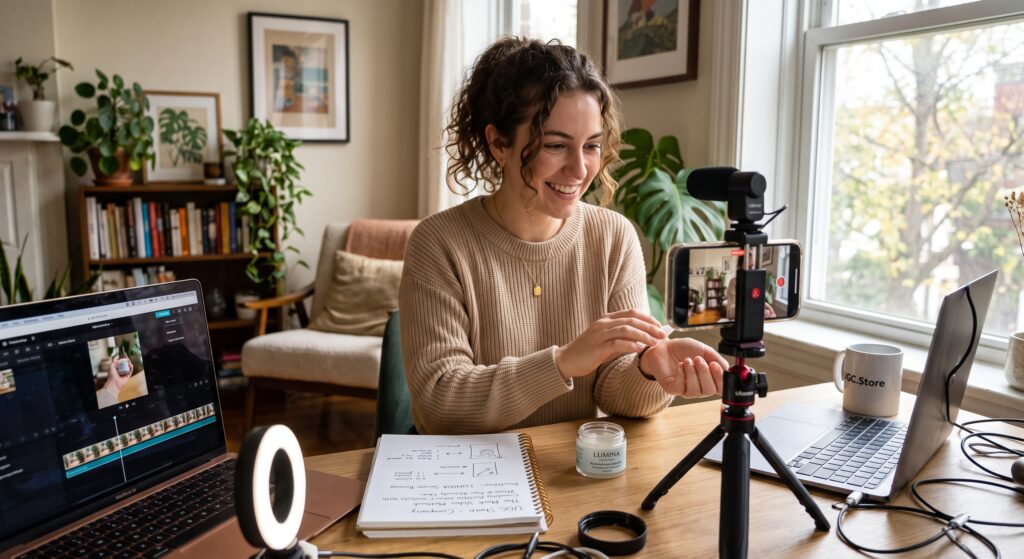
A mock video is a UGC Content piece created exactly as if a brand had hired you, but without the brand. You select a product from your own home — your shampoo, your laptop stand, your yoga mat, your coffee maker — and you film a complete, polished video following the structure, tone, and technical standards of a real paid brief. You write your own hook. You identify your own talking points. You film, edit, add captions, color-correct, and export exactly as you would for a $150 client deliverable.
The only difference is the client is you, and the product is already yours.
Mock videos solve the fundamental paradox of the beginner UGC Creator: brands need to see what you can do before they pay you, but you need money to buy products to show what you can do. The Mock Video Method removes that barrier entirely. Your bathroom is a product showroom. Your kitchen is a demo stage. Your desk is a tech review studio. The products you use every day are the raw material for a portfolio that proves your competence before you ever invoice a single dollar.
The Product Audit: Finding Your First Five Portfolio Pieces
Before you film anything, you need to identify which products in your immediate environment are worth filming. Not every item in your home makes a strong mock video. The best mock portfolio products share three qualities: you genuinely use them, they belong to a category with active brand demand on UGC.Store, and you can film them in a way that looks visually interesting.
Walk through your space with a creator’s eye. In your bathroom, you have skincare, haircare, dental care, grooming tools, and supplements. In your kitchen, you have appliances, gadgets, containers, specialty foods, and cleaning products. On your desk, you have tech accessories, productivity tools, apps and software you subscribe to, and organizational items. In your living space, you have home decor, fitness equipment, pet supplies, and lifestyle accessories. Each of these categories represents a niche where brands on the UGC Marketplace are actively hiring creators.
For your first five mock videos, select products from categories where you have the most natural authority. If you are a skincare obsessive, film your serum. If you are a remote worker, film your ergonomic mouse pad. If you are a fitness enthusiast, film your resistance bands. Authentic enthusiasm is the currency of UGC, and it is impossible to fake. Choose products you would genuinely recommend to a friend, because that genuine energy is what brands are buying.
Таблица
| Location | Product Categories | Example Mock Video |
|---|---|---|
| Bathroom | Skincare, haircare, oral care, grooming | “How I cleared my skin in 3 weeks with this $12 cleanser” |
| Kitchen | Appliances, gadgets, containers, specialty food | “The blender that actually crushes ice without waking my neighbors” |
| Desk / Office | Tech accessories, productivity tools, apps | “This $25 stand fixed my neck pain after one workday” |
| Living Space | Home decor, fitness, pet supplies, lifestyle | “My cat finally drinks enough water because of this fountain” |
| Closet / Wardrobe | Clothing care, accessories, organization | “How I fit 40 pieces of clothing into a carry-on” |
The Five Mock Formats That Build a Converting Portfolio
Brands do not hire generalists who film random content. They hire specialists who demonstrate mastery of the formats that convert in paid advertising. Your mock portfolio should contain at least one example of each of these five core UGC formats. When a brand visits your UGC.Store profile and sees all five, they see a creator who can handle any brief they throw at you.
The Unboxing. Film yourself opening a product for the first time — or simulate the first-time experience if you have owned it for a while. The unboxing format builds anticipation and trust. It shows the brand that you can create excitement around packaging, first impressions, and the unwrapping ritual that makes viewers feel like they are receiving the product themselves. For your mock video, set the product on a clean surface, film your hands opening it, and narrate your genuine reaction to the texture, smell, weight, and design.
The Testimonial. Look directly into the camera and share your honest experience with the product. This is the backbone of most paid UGC campaigns because it mimics a friend giving advice. For your mock testimonial, structure it around a specific transformation: “I used to struggle with X until I found this product, and now Y is completely different.” Keep it under 30 seconds. Make your face the focal point. Let your personality carry the frame.
The Tutorial. Show the viewer exactly how to use the product, step by step. This format is especially powerful for tech, software, kitchen gadgets, and beauty tools. For your mock tutorial, break the process into three clear steps. Film each step from a close angle where the product is the hero. Add captions that reinforce the sequence. End with a clear result that proves the product works.
The Problem / Solution. Open with the pain point: “My back hurts after eight hours at my desk.” Introduce the product as the unexpected fix: “Then I tried this lumbar support, and everything changed.” Show the before state, demonstrate the product in action, and reveal the after state. This format is conversion gold because it mirrors the viewer’s own internal monologue. For your mock version, be specific about your real problem. Generic complaints sound like ads. Specific complaints sound like truth.
The Lifestyle Integration. Film the product in the context of your daily routine. You are not reviewing it directly. You are simply using it. This format works beautifully for home goods, apparel, food, and fitness gear. For your mock lifestyle video, set up a scene that looks natural: making breakfast with your new pan, doing morning yoga on your mat, organizing your desk with your new tray. Let the product speak through context rather than explicit narration.
How to Write Your Own Mock Brief
The difference between an amateur mock video and a professional one is the brief. Amateurs pick up a product and wing it. Professionals write a brief first, even when the client is themselves. Writing a mock brief forces you to think like a brand, structure your content strategically, and practice the exact discipline you will need when a real brief arrives.
Before filming each mock video, open a notes app and answer these questions:
- Product name: What is the exact product you are filming?
- Target audience: Who is the ideal buyer? Be specific. “Women aged 25–35 with sensitive skin” is better than “everyone.”
- The hook: What is the first sentence that will stop the scroll?
- Key talking points: What are the three most important things the viewer needs to know?
- The problem it solves: What pain point does this product address?
- The transformation: What changes after using it?
- Call to action: What should the viewer do next? “Check the link,”“Try it yourself,” or “Comment if you relate.”
- Format and length: 15 seconds? 30 seconds? 60 seconds? Vertical 9:16?
- Visual requirements: Close-ups? Hands-only? Face-to-camera? Lifestyle context?
- Tone: Enthusiastic? Skeptical-turned-convinced? Calm and authoritative?
When you film from a brief rather than from impulse, your mock videos look intentional. They look like they were created by a creator who understands marketing, not just someone who likes their shampoo. That intentionality is what brands recognize and pay for.
The Step-by-Step Mock Filming Process
Once you have your product and your brief, it is time to execute. Follow this exact workflow for every mock video to ensure your portfolio maintains professional consistency.
Step 1: Study real briefs. Before filming, spend ten minutes on UGC.Store browsing active briefs in your product’s niche. Read the language brands use. Note the required talking points, the tone, and the deliverable specifications. Your mock video should feel like it could slot directly into one of those campaigns.
Step 2: Script your hook and talking points. Do not memorize a word-for-word script. Instead, write a loose outline with your hook at the top and three bullet points below it. Practice saying it out loud three times. The goal is conversational authenticity, not robotic recitation.
Step 3: Set your scene. Clear the background. Remove clutter. Position yourself near a window for natural light, or set up your ring light at eye level. Place the product where it will be visible in every frame. Lock your phone’s exposure and focus so the image stays consistent.
Step 4: Film multiple takes. Record your hook five times with slightly different energy levels. Record the full video three times. Capture B-roll: close-ups of the product, your hands using it, the texture, the result. Having options makes editing faster and the final product stronger.
Step 5: Edit to brief standards. Trim to your target length. Add burned-in captions. Apply your signature color preset. Add subtle background music if it fits the tone, or keep it clean if the brief style demands voice-only. Export in 1080p vertical.
Step 6: Label it professionally. Name your file descriptively: Mock_Beauty_Cleanser_Testimonial_30sec.mp4. When you upload it to your UGC.Store portfolio, title it clearly: “Skincare Testimonial Mock — Sensitive Skin Cleanser.” Transparency builds trust. Brands know it is a mock video. What impresses them is that it looks like a paid deliverable.
Presenting Mock Videos in Your Portfolio
Honesty is non-negotiable, but so is professionalism. When you upload mock videos to your UGC.Store profile, label them as Portfolio Sample or Mock Project in the title. Do not pretend they were paid gigs. Brands respect creators who are transparent about their experience level but obsessive about their output quality.
Organize your mock videos by niche and format. If you have three beauty mocks, group them together. If you have two tech mocks, place them adjacent. When a brand visits your profile, they should see a curated gallery that demonstrates range within your specialty, not a random collection of whatever was on your desk that day.
Replace your weakest mock video every time you complete a paid gig. The goal is to gradually shift your portfolio from 100% mock content to a mix that includes real client work. Eventually, your mocks become the minority, serving only to fill format gaps that your paid work has not yet covered.
- [ ] I selected 5 products I genuinely use from high-demand niches
- [ ] I wrote a mock brief for each product before filming
- [ ] My portfolio includes all 5 core formats: unboxing, testimonial, tutorial, problem/solution, lifestyle
- [ ] Each video is vertical 9:16, 1080p, with burned-in captions
- [ ] I filmed multiple takes and B-roll for editing flexibility
- [ ] Files are named descriptively and uploaded with transparent mock labels
- [ ] My background is clean, lighting is consistent, and audio is clear
- [ ] I review active brand briefs on UGC.Store before filming to match real market standards
Common Mock Video Mistakes That Make Beginners Look Amateur
Even with the best intentions, beginners sabotage their mock portfolios with avoidable errors:
The “Review” Label Trap. Titling your video “Honest Review of [Product]” positions you as a consumer, not a creator for hire. Brands do not hire reviewers. They hire content producers. Frame your mock as a testimonial, demonstration, or integration, not a review.
The Generic Product Problem. Filming a mock video about “shampoo” is too broad. Filming about “the sulfate-free shampoo that stopped my scalp irritation” is specific, story-driven, and brand-friendly. Specificity sells. Generality bores.
The Missing Call to Action. Every piece of UGC Content should guide the viewer toward a next step, even in a mock video. Without a call to action, your video looks like content for content’s sake. With one, it looks like a strategic asset.
The No-Captions Oversight. You know by now that captions are mandatory. A mock video without subtitles signals that you do not understand platform basics. A mock video with clean, proofread captions signals that you are ready for professional deliverables.
The One-and-Done Portfolio. Five mock videos is the minimum to start applying. Ten is better. Twenty gives you genuine range. Do not film one mock video, upload it, and wait. Film five in a single weekend. Batch creation is the habit that separates aspiring creators from working professionals.
From Mock to Money: The Snowball Effect
The Mock Video Method is not a permanent state. It is a launch strategy. Your mocks exist solely to get you over the experience gap so real brands can evaluate your skills. Once you land your first paid UGC gig, the dynamic shifts. You now have a real deliverable to add to your portfolio. Then a second. Then a fifth. Within three months, your mock videos become the foundation that supports a growing body of paid work.
But the mocks never truly lose their value. Even advanced creators film mock videos when they want to pivot into a new niche, demonstrate a new format, or rebuild their portfolio after a seasonal campaign ends. The method scales with your career. It is not just for beginners. It is for any creator who needs to prove capability before a client writes the first check.
The products on your bathroom counter are not clutter. They are your first clients. The phone in your hand is not just a phone. It is your production studio. The empty portfolio staring back at you is not a wall. It is a blank canvas. Fill it with mock videos that look so professional, so intentional, so strategically crafted that brands forget to ask whether you have experience and simply hire you for the quality they can see.
Start building your mock portfolio on UGC.Store today and turn the products you already own into your first paying clients tomorrow.
